
PMP-121 · Lesson 4 of 12 · 29 min
Engaging stakeholders through the life cycle
A stakeholder engagement plan is a forecast. Engagement itself happens day by day, in meetings, emails, workshops, hallway conversations and the occasional difficult phone call. This lesson follows stakeholders through the project life cycle, from initiation to closure, and covers the work of the manage stakeholder expectations task: keeping expectations realistic, tracking sentiment, dealing with issues and decisions, and handling the resistance that almost every significant change provokes. Change management theory is covered in BUS-130; here the focus is on what a project manager does with stakeholders at each stage.
Engagement changes across the life cycle
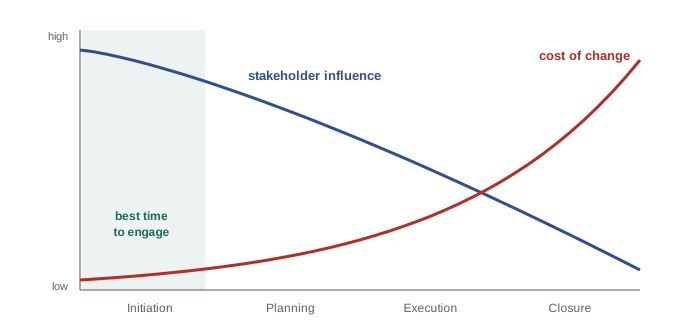
Different stakeholders matter most at different times, and the same stakeholder needs different things as the project moves on. Early on, influence is high and the cost of change is low; this is when stakeholders can shape objectives and scope most cheaply. Late in the project, influence is lower and changes are expensive, so the emphasis shifts to acceptance, readiness and adoption.
| Stage | Main engagement goals | Typical activities |
|---|---|---|
| Initiation | Find key stakeholders; agree purpose and success criteria; secure sponsorship | Interviews, charter workshop, kickoff |
| Planning | Gather requirements; agree scope, priorities and constraints; build the engagement and communication plans | Requirements workshops, prioritization sessions, plan reviews |
| Execution | Keep stakeholders informed and involved; manage expectations; resolve issues; prepare users for change | Reviews and demos, status reports, issue resolution, training |
| Monitoring and control | Track engagement and sentiment; manage changes and escalations | Engagement reviews, change control board, steering meetings |
| Transition and closure | Secure acceptance; hand over to operations; confirm benefits ownership; capture lessons | Acceptance testing, handover sessions, lessons learned, celebration |
Managing expectations
Expectations drift. A sponsor who agreed in March that a feature was out of scope may assume by July that it is coming. A user who saw an early prototype may expect the final product to look exactly the same. Managing expectations is mostly about preventing surprises: telling stakeholders early when something is changing, confirming agreements in writing, repeating key messages about scope and dates, and using demos and reviews to keep the shared picture current.
A useful habit is to separate three things in every conversation about a request: what the stakeholder is asking for, what the project has agreed to deliver, and what it would take to close the gap. When a stakeholder asks for something new, the right response is rarely an immediate yes or no. It is to understand the request, explain its effect on scope, schedule, cost and risk, and route it through the agreed change process. That keeps the relationship positive while protecting the baseline.
Worked problem
Handling a request without damaging the relationship
Two weeks before user acceptance testing, a regional director asks the project manager to add a custom report she says is essential. It is not in scope. How should the project manager respond?
Show solution
- Thank her and ask what decision the report would support and what happens if it is not available at launch.
- Explain honestly that the report is not in the current scope and that adding it now would affect testing and possibly the launch date.
- Offer options: submit a change request for impact assessment; deliver the report in the first post-launch release; or provide an interim extract the analysts can run manually.
- Agree the next step, record the request in the change log and confirm by email.
- Inform the sponsor and product owner so the decision is made by the right people, not by whoever asks last.
Answer: The project manager neither refuses nor quietly accepts. She clarifies the need, explains the impact, offers options and uses the change process, keeping the director engaged and the baseline protected.
Tracking engagement and sentiment
Engagement needs monitoring like any other part of the plan. Signs of engagement include attendance at reviews, timeliness of approvals and decisions, the tone and content of feedback, the number and nature of escalations, and informal comments. Some teams keep a simple sentiment score for key stakeholders, updated after each significant interaction, and review trends at the regular engagement review. A falling score is an early warning to act before resistance becomes opposition.
| Stakeholder | Month 1 | Month 2 | Month 3 | Month 4 | Trend and action |
|---|---|---|---|---|---|
| Chief nursing officer | −1 | 0 | +1 | +1 | Improving after acceptance criteria workshop; maintain |
| Unit managers | 0 | +1 | +1 | −1 | Fell after roster import errors in testing; fix and brief them |
| Nurses' union | −2 | −1 | −1 | −1 | Stable but negative; consult on overtime rule configuration |
| Night-shift nurses | n/a | 0 | +1 | +2 | Rising after mobile pilot; recruit as champions |
Sentiment scoring is subjective, so be careful not to treat it as data in the scientific sense. It works best when the same people score consistently, when scores are linked to specific observations ("approved the test plan a week early", "cancelled two reviews"), and when the main output is an action, not a chart.
Issues, decisions and the logs that support them
Stakeholder engagement generates issues and decisions. An issue is a current problem that needs resolving, such as a department refusing access to data or a disagreement about acceptance criteria. A decision is a choice that commits the project, such as approving a design or accepting a risk. Recording both matters. An issue log gives each issue an owner and a due date, so stakeholders see that concerns are being handled. A decision log records what was decided, by whom, when and on what basis, which prevents later disputes about whether something was agreed.
| Log | Typical fields | Stakeholder benefit |
|---|---|---|
| Issue log | Description, raised by, owner, priority, due date, status, resolution | Concerns are visibly owned and tracked |
| Decision log | Decision, options considered, decided by, date, rationale, affected parties | Prevents "we never agreed to that" |
| Change log | Request, requester, impact assessment, decision, date | Shows requests are assessed fairly |
| Assumption log | Assumption, owner, validation date, result | Makes hidden expectations visible |
Understanding resistance
Resistance is a normal response to change, not a character flaw. People resist for rational reasons (the change really will make their work harder, or the design has a flaw), emotional reasons (fear of losing competence, status or control, or simple fatigue from previous changes) and political reasons (a change shifts budget, authority or headcount). A project manager who treats all resistance as obstruction misses useful information: resisters often see risks the project team has overlooked.
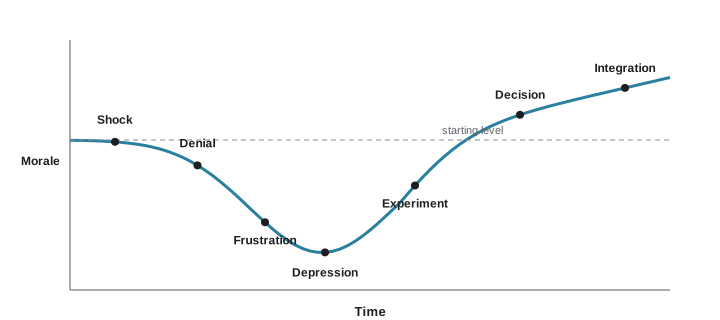
The change curve, adapted from Elisabeth Kubler-Ross's work on grief, describes a common emotional path: shock and denial, then frustration and a dip in morale and performance, then experimentation, acceptance and integration. Its practical lesson is that the dip is predictable. Communication should match where people are: facts and reasons early, listening and support in the dip, and practice, quick wins and recognition during recovery. Prosci's ADKAR model makes a similar point at the individual level: people need awareness of why, desire to take part, knowledge of how, ability to do it and reinforcement to sustain it. Resistance often signals that one of these elements is missing.
| Signal | Possible cause | Response |
|---|---|---|
| "Why are we doing this at all?" | Missing awareness of the reason | Explain the business reason honestly, including what happens if nothing changes |
| "This will never work here." | Low desire; past failures; real design concerns | Listen for specifics; involve the person in testing or design |
| "I don't know how to use it." | Missing knowledge or ability | Training, practice environments, floor support at launch |
| Quiet non-use after launch | Missing reinforcement; old habits; workarounds still available | Remove old routes carefully; recognize adopters; fix friction |
| Escalations over budget or authority | Political loss | Involve the sponsor; negotiate interests (lesson 9) |
Worked problem
Using resistance as information
Warehouse supervisors are resisting a new handheld scanning process. They say it is slower than paper. The project team believes they simply dislike change. What should the project manager do?
Show solution
- Treat the claim as a hypothesis to test, not an excuse: time both processes for the same picks.
- Observe the floor: the scanners lose signal in two aisles, forcing re-scans, which makes the new process slower there.
- Fix the coverage problem and involve two supervisors in retesting.
- Share the results, thank the supervisors for spotting the problem and ask them to help train their teams.
Answer: Part of the resistance was rational and pointed to a real defect. Fixing it and recognizing the supervisors turned resisters into contributors.
Engagement at transition and closure
As a project ends, attention often shifts to the next project, and stakeholder engagement suffers. But this is when acceptance, handover and benefits ownership are settled. Operations staff need training and support; the business owner needs to confirm who will measure benefits after the project team leaves; and stakeholders who contributed deserve thanks. A short closure conversation with key stakeholders, asking what went well and what to improve, produces valuable lessons and leaves relationships in good shape for the next project.
The sponsor relationship
Of all stakeholder relationships, the one with the sponsor deserves the most deliberate attention. The sponsor champions the project, secures funding, resolves issues beyond the project manager's authority and represents the project to executives. A project with a disengaged sponsor is far more likely to fail. Good practice is to agree early how often you will meet and what decisions the sponsor will make, to bring problems early with options rather than surprises, to help the sponsor prepare for executive meetings with concise briefings, and to ask directly for help when you need it. If the sponsor becomes disengaged, find out why: competing priorities, loss of confidence or a change in strategy each need a different response.
Worked problem
Re-engaging a distracted sponsor
The sponsor has cancelled three consecutive monthly meetings, and two decisions are now overdue. What should the project manager do?
Show solution
- Ask for 15 minutes rather than an hour, and send a one-page brief listing the two decisions, their deadlines and the impact of delay.
- In the meeting, ask how the sponsor would prefer to stay involved given current pressures; perhaps a short fortnightly call works better.
- Agree a delegate for routine decisions if the sponsor is overloaded, recorded in the decision log.
- If disengagement continues and decisions remain blocked, raise the governance gap with the steering committee or portfolio office.
Answer: Make engagement easy, adapt the format to the sponsor's situation, and escalate the governance gap only if decisions remain blocked.
Common mistakes
MistakeEngaging stakeholders heavily at the start and then only sending status reports.
InsteadPlan engagement for every stage, including execution, transition and closure.
MistakeSaying yes to stakeholder requests on the spot to keep them happy.
InsteadClarify the need, explain the impact, offer options and use the change process.
MistakeTreating all resistance as obstruction.
InsteadLook for rational, emotional and political causes; resistance often reveals real problems.
MistakeRelying on memory for what stakeholders agreed.
InsteadRecord decisions, issues and changes in logs and confirm key agreements in writing.
MistakeTreating sentiment scores as objective data.
InsteadLink scores to observations and use them to trigger actions.
Summary and key terms
- Stakeholder influence is highest and the cost of change lowest early in a project.
- Engagement goals shift from shaping objectives to acceptance and adoption as a project proceeds.
- Managing expectations means preventing surprises, confirming agreements and routing new requests through change control.
- Simple sentiment tracking, linked to observations, gives early warning of falling engagement.
- Issue, decision, change and assumption logs make concerns and agreements visible.
- Resistance has rational, emotional and political causes; the change curve and ADKAR help diagnose it.
- Transition and closure need deliberate engagement for acceptance, handover, benefits ownership and thanks.
- Expectation management
- Keeping stakeholders' expectations realistic and aligned with what the project has agreed to deliver.
- Sentiment log
- A record of key stakeholders' attitudes over time, linked to observations.
- Issue log
- A record of current problems, their owners, priorities and status.
- Decision log
- A record of project decisions, who made them, when and why.
- Resistance
- Opposition or reluctance toward a change, arising from rational, emotional or political causes.
- Change curve
- A model of the emotional stages people often pass through during change.
- ADKAR
- A model of individual change: awareness, desire, knowledge, ability and reinforcement.
- Handover
- The transfer of project deliverables and responsibilities to operations or the business owner.
- Benefits owner
- The person accountable for realizing and measuring benefits after the project ends.
- Change control
- The process for assessing and deciding on requested changes to the project baseline.
Practice problems
Work each problem on paper first, then reveal the answer to check.
When is stakeholder influence on a project typically highest?
Show answer
Early, during initiation and planning.
What three things should be separated when a stakeholder makes a new request?
Show answer
What is requested, what has been agreed, and what it would take to close the gap.
Give two signs that a stakeholder's engagement is falling.
Show answer
For example, missed reviews and slower approvals.
What is the difference between an issue log and a decision log?
Show answer
An issue log tracks current problems; a decision log records choices made, by whom and why.
Name three causes of resistance.
Show answer
Rational, emotional and political.
What does the "R" in ADKAR stand for?
Show answer
Reinforcement.
What communication suits people in the dip of the change curve?
Show answer
Listening, support and practical help rather than more promotion.
In the warehouse example, what did the resistance reveal?
Show answer
Poor scanner coverage in two aisles that made the new process slower.
Why is closure an important engagement stage?
Show answer
Acceptance, handover, benefits ownership and lessons learned are settled then.
Why should agreements be confirmed in writing?
Show answer
To prevent later disputes about what was agreed.
Lesson quiz · 5 questions
Score 60% or more to complete this lesson.
Create a free account to save your progress, take quizzes and earn a certificate.