
ROB-420 · Lesson 9 of 12 · 27 min
Regulation of automated vehicles in Canada and the United States
Engineers who build automated vehicles work inside a regulatory system that was designed for human drivers. Vehicle safety standards assume a steering wheel and pedals; traffic laws assume a licensed person at the controls; insurance and liability assume a driver who can be at fault. This lesson explains how Canada and the United States are adapting these systems. Both countries divide authority between levels of government in a similar way: the national government regulates the design and equipment of vehicles, while provinces, territories and states regulate drivers, traffic rules, registration and insurance. The details, and the pace of change, differ. All facts here are stated at the time of writing (October 2026); this is an area of rapid change, so verify current rules before relying on them.
The division of powers
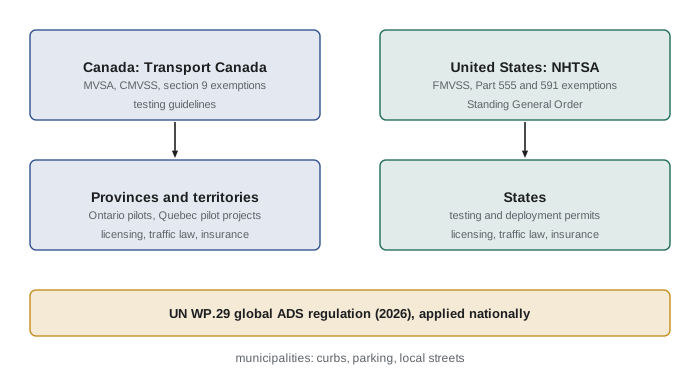
In Canada, Transport Canada administers the Motor Vehicle Safety Act, MVSA, and the Canada Motor Vehicle Safety Standards, CMVSS, which apply to vehicles manufactured in or imported into Canada. Manufacturers self-certify that their vehicles comply. Provinces and territories control who may drive, the rules of the road, vehicle registration, insurance and permission to test on public roads. An automated vehicle therefore needs to satisfy federal equipment standards, or obtain an exemption from them, and provincial rules for operation. Municipalities control curbs, parking and some local streets, which matters for robotaxi pick-up and delivery robots.
| Topic | Canada | United States |
|---|---|---|
| Vehicle design and equipment | Transport Canada: MVSA and CMVSS | NHTSA: Vehicle Safety Act and FMVSS |
| Certification | Manufacturer self-certification | Manufacturer self-certification |
| Exemptions from standards | Section 9 MVSA exemptions for new technology | Part 555 exemptions and Part 591 import exemptions |
| Crash reporting for ADS | Through testing guidelines and provincial pilot conditions | Standing General Order crash reporting |
| Driving, testing and deployment | Provinces and territories | States |
| Commercial trucks | Provincial carrier rules; federal hours-of-service for extra-provincial carriers | FMCSA federal rules plus state rules |
Canada: federal guidance and standards
Transport Canada has relied mainly on guidance rather than new binding rules for automated driving. Canada's Safety Framework for Connected and Automated Vehicles sets out the federal approach, and the Guidelines for Testing Automated Driving Systems in Canada, version 2.0, published in August 2021, describe good practice for trials on public roads: safety management, the role and training of safety drivers, operational design domain definition, data recording, cybersecurity, public communication and incident reporting to authorities. These guidelines are voluntary but are referenced by provinces and expected by Transport Canada. Canada also has guidance on safety assessment for automated driving systems that asks developers to document their approach across topics similar to the ones in Lesson 8.
Vehicles that cannot meet a CMVSS requirement, for example a shuttle without a steering wheel, can be imported or operated under a section 9 exemption of the MVSA for new technology or for vehicles intended for testing, subject to conditions. Transport Canada has granted such exemptions for low-speed automated shuttle trials in several cities. Internationally, Canada participates in the United Nations World Forum for Harmonization of Vehicle Regulations, WP.29. In June 2026 the forum adopted the first global regulatory framework for automated driving systems, a Global Technical Regulation and a corresponding UN Regulation. It requires a safety case showing the system is at least as safe as a competent and careful human driver, a safety management system, and in-service monitoring and reporting. Canada co-sponsored the regulation. Because Canada applies such regulations through its own CMVSS, Transport Canada must decide how to bring the framework into Canadian law, which, at the time of writing, has not yet happened.
Canada: provincial rules
Ontario launched Canada's first automated vehicle pilot program in January 2016 under Ontario Regulation 306/15, allowing approved organizations to test automated vehicles on public roads with conditions such as insurance, a safety driver for most tests and reporting. The province later permitted driverless testing under stricter conditions and allowed Level 3 vehicles to be sold and used by the public provided the driver remains ready to take over. A separate pilot for automated commercial motor vehicles, running from August 2025 for ten years, sets conditions for testing automated heavy trucks, including the presence of a qualified driver. Pilot terms are periodically renewed and amended, so check the current regulation.
Quebec amended its Highway Safety Code in 2018 to allow Level 3 vehicles that are approved for sale in Canada to be driven on its roads, and to let the transport minister authorize pilot projects for more highly automated vehicles, such as driverless shuttles, with conditions on insurance, routes and reporting. Quebec's public auto insurance system, which compensates bodily injury regardless of fault, simplifies some liability questions for crashes involving automated vehicles. Other provinces have run shuttle pilots under special permits or existing exemption powers. At the time of writing, to our knowledge, no driverless robotaxi service carries paying members of the public in Canada.
United States: federal policy
NHTSA has issued a sequence of non-binding policy documents since 2016 and has modernized its standards incrementally. In April 2025 the Department of Transportation announced an automated vehicle framework with three themes: prioritize safety, remove unnecessary barriers to innovation, and enable commercial deployment. It amended the Standing General Order, SGO, which since 2021 has required manufacturers and operators to report crashes involving automated driving systems and Level 2 driver assistance. Under the amended order, effective June 2025, the most serious crashes must be reported within a short deadline, while less serious ones are reported monthly, and the reporting criteria were streamlined. NHTSA publishes the reports, with some information redacted, and they are a key public data source on automated vehicle crashes, although they need careful interpretation because of differences in exposure and reporting.
Two exemption routes matter. Part 555 allows NHTSA to exempt a manufacturer from specific FMVSS for up to 2,500 vehicles per year under current law, for example to develop a vehicle without manual controls whose safety is at least equal to a compliant one. In 2025 NHTSA streamlined the review of these petitions, and in July 2026 it granted a Part 555 exemption to Zoox for a purpose-built robotaxi without a steering wheel or pedals, the first for a passenger-carrying automated vehicle, allowing commercial ride-hailing. Part 591 permits importing non-compliant vehicles for research, demonstration and testing; the 2025 framework extended a similar route to domestically built vehicles for non-commercial use. In parallel, NHTSA has issued proposed rules to update standards that assume a human driver, such as those for controls and displays, lighting, windshield systems and brakes, so that vehicles without manual controls can comply without exemption. In mid-2026 NHTSA withdrew a proposed voluntary program, AV STEP, that had been proposed in January 2025. Congress has considered federal automated vehicle legislation several times without enacting a comprehensive law.
Worked problem
Fleet size under an exemption cap
A robotaxi company holding a Part 555 exemption builds the maximum 2,500 vehicles per year. Each completes 25 paid trips per day, 330 days a year. How many trips per year does the exempted fleet provide after two years of production, and what does this suggest about the cap?
Show solution
- Fleet after two years: 5,000 vehicles.
- Trips: \( 5000 \times 25 \times 330 = 41.25 \) million per year.
- For comparison, a fleet doing more than 400,000 trips a week makes about 21 million a year.
Answer: About 41 million trips per year, so the cap allows large services but limits mass-market scale; this is one reason NHTSA is updating the underlying standards.
United States: state laws and deployments
Most states have enacted laws or executive orders on automated vehicles, and they vary widely. California requires separate Department of Motor Vehicles permits for testing with a safety driver, driverless testing and deployment, plus California Public Utilities Commission permits to carry passengers for pay; it also requires annual disengagement reports and collision reports. Arizona, Texas, Florida, Georgia, Nevada and others have more permissive frameworks that allow driverless operation if the vehicle meets general conditions such as complying with traffic laws, carrying insurance and being able to reach a minimal risk condition. Texas passed a law in 2025 requiring state authorization for commercial driverless operations. Some states regulate automated trucks separately, and some cities have sought more local control over robotaxi operations, generally without success, since state law usually preempts them.
Deployments have grown rapidly. At the time of writing, Waymo operates fully driverless paid robotaxi service in several US metropolitan areas, including Phoenix, San Francisco, Los Angeles, Austin and Atlanta, and has announced further cities; it reports hundreds of thousands of paid trips per week. Tesla began a small robotaxi service in Austin in 2025 that has since operated some vehicles without a safety monitor on board, and Zoox offers rides in its purpose-built vehicle in Las Vegas. Automated trucking companies, such as Aurora, operate driverless trucks on Texas highways. Each of these depends on state permission and federal reporting, and each remains subject to investigation and recall if problems arise: NHTSA has opened investigations and overseen software recalls involving several automated driving companies.
Liability and insurance
When an automated vehicle crashes, who is responsible? With a human driver, fault usually lies with a driver and is covered by their insurance. With a driverless vehicle, responsibility shifts toward the manufacturer or operator, through product liability and operator insurance. Some jurisdictions have clarified this explicitly; the United Kingdom's Automated Vehicles Act 2024, for example, makes the authorized self-driving entity responsible when the system is engaged. In North America, liability is largely handled by existing tort and product liability law, with insurance requirements in testing and deployment permits. Provinces with no-fault insurance schemes, such as Quebec and Manitoba, compensate injury regardless of fault, which shifts the question to how insurers recover costs from manufacturers. Level 3 systems raise the hardest questions, because responsibility depends on whether the system or the human was in control at the moment of the crash, which is why event data recorders and clear handover logs are important.
What regulation means for engineers
For a development team, regulation shapes requirements directly. The ODD must match the permit; data must be recorded to satisfy reporting rules; the system must handle interactions with police and first responders, an area of growing regulatory attention, including how a driverless vehicle responds to a traffic officer's hand signals or yields to emergency vehicles; software updates must be controlled because they can change behaviour after approval; and the safety case must be ready to share with regulators. Teams that design for transparency from the start, with logs, clear ODD definitions and documented safety arguments, move through approvals more easily in both countries.
Worked problem
Matching a test plan to jurisdictional rules
A company wants to test a driverless delivery van in Toronto and later in Montreal. List the main approvals or conditions it must consider at each level of government.
Show solution
- Federal: compliance with CMVSS, or a section 9 exemption if the van lacks manual controls; follow Transport Canada testing guidelines.
- Ontario: approval under the automated vehicle pilot regulation, with its insurance, reporting and driverless testing conditions.
- Quebec: a ministerial pilot project authorization with conditions on route, insurance and reporting.
- Municipal: curb access, loading zones and coordination with police and fire services.
Answer: Federal vehicle standards or exemptions, provincial or state testing approval with insurance and reporting, and municipal arrangements; each layer must be satisfied, and rules should be rechecked before every phase.
Common mistakes
MistakeAssuming one national agency approves automated vehicles end to end.
InsteadFederal agencies regulate vehicle design; provinces, territories and states regulate operation.
MistakeTreating voluntary guidelines as irrelevant.
InsteadProvinces, states and regulators expect them, and they shape permit conditions.
MistakeQuoting rules from memory.
InsteadThis area changes quickly; check current regulations and date your sources.
MistakeComparing SGO crash counts directly between companies.
InsteadExposure, ODD and reporting practices differ; normalize carefully.
MistakeIgnoring first-responder interaction.
InsteadRegulators increasingly require clear procedures for police, fire and ambulance encounters.
Summary and key terms
- National governments regulate vehicle design; provinces, territories and states regulate driving, testing and deployment.
- Canada relies on the MVSA, CMVSS, section 9 exemptions and voluntary testing guidelines, with provincial pilots in Ontario and Quebec.
- The US uses FMVSS, Part 555 and 591 exemptions, the Standing General Order and an evolving federal framework.
- A global UN framework for automated driving systems was adopted in June 2026; each country must implement it.
- US state laws range from permit-heavy California to more permissive regimes, with robotaxi services operating in several cities.
- Liability shifts toward manufacturers and operators as automation increases.
- MVSA
- Canada's Motor Vehicle Safety Act.
- CMVSS
- Canada Motor Vehicle Safety Standards.
- FMVSS
- US Federal Motor Vehicle Safety Standards.
- Self-certification
- Manufacturers certify their own compliance rather than obtaining prior approval.
- Section 9 exemption
- A Canadian MVSA exemption for new technology or testing.
- Part 555
- US regulation for temporary exemptions from FMVSS.
- Part 591
- US regulation for importing non-compliant vehicles for limited purposes.
- Standing General Order
- NHTSA order requiring crash reporting for automated systems.
- WP.29
- The UN World Forum for Harmonization of Vehicle Regulations.
- Product liability
- Legal responsibility of manufacturers for harm caused by defective products.
Practice problems
Work each problem on paper first, then reveal the answer to check.
Which level of government regulates vehicle equipment in Canada?
Show answer
Federal, through Transport Canada.
Which level controls permission to test on public roads?
Show answer
Provinces and territories in Canada; states in the US.
What is the annual vehicle limit for a Part 555 exemption under current law?
Show answer
2,500 vehicles.
What does the SGO require?
Show answer
Reporting of crashes involving automated driving systems and Level 2 systems.
When did Ontario start its automated vehicle pilot?
Show answer
January 2016.
What did Quebec permit in 2018?
Show answer
Level 3 vehicles on its roads and pilot projects for higher automation.
What did WP.29 adopt in June 2026?
Show answer
A global framework for automated driving systems.
Name a permissive US state for driverless operation.
Show answer
Arizona, Texas, Florida, Georgia or Nevada.
Why does Level 3 complicate liability?
Show answer
Responsibility depends on who was in control at the moment of the crash.
Why should engineers design for transparency?
Show answer
Logs, ODD definitions and safety cases ease approvals.
Lesson quiz · 5 questions
Score 60% or more to complete this lesson.
Create a free account to save your progress, take quizzes and earn a certificate.