
ROB-450 · Lesson 10 of 12 · 25 min
Cybersecurity, safety and the law
A connected robot that can be reprogrammed over a network can also be misused over a network. An attacker who changes a speed limit, a safety zone, a calibration value or a mobile robot's map can turn a safe machine into a dangerous one without touching it. Cybersecurity is therefore part of robot safety, and lawmakers have started to treat it that way, with security requirements appearing in machinery law, medical device law, product law and critical infrastructure law. ROB-360 lesson 10 covered the technical practices of securing robot software, such as threat modelling, secure communication, signed updates and least privilege, and the CISSP courses cover security governance in depth. This lesson focuses on the meeting point of security, safety and law: how attacks can defeat safety functions, how standards connect security to functional safety, what the law now requires of manufacturers and operators, and who is liable when a security failure leads to harm.
How attacks become safety problems
Safety engineering traditionally assumes that failures are random or result from honest mistakes. An attacker is different: intelligent, adaptive and able to choose the worst moment. Several kinds of attack can create physical hazards in robots.
| Attack | Example in a robot system | Possible physical consequence |
|---|---|---|
| Tampering with programs | Modified robot program moves through a zone where people work | Collision with workers |
| Tampering with safety configuration | Changed speed limit or safety zone in the robot controller | Safety function no longer protects as designed |
| Spoofing sensors or maps | False localization data or altered map sends a mobile robot into a restricted area | Collision, falls from docks |
| Denial of service | Flooding the network so that a fleet manager loses contact | Robots stop in exits or continue with stale instructions |
| Malicious update | Compromised update server delivers altered firmware | Fleet-wide hazardous behaviour |
| Ransomware | Production systems encrypted, operators improvise manual workarounds | Unsafe manual operation, bypassed safeguards |
Researchers demonstrated the risk in 2017, when a study by Politecnico di Milano and Trend Micro showed that industrial robot controllers exposed on networks could be manipulated to alter calibration and control parameters, subtly changing robot motion and the products made. Since then, government agencies such as the US Cybersecurity and Infrastructure Security Agency have published many advisories about vulnerabilities in robot controllers, programmable logic controllers and safety components. Well-designed safety architectures limit the damage: a hardwired emergency stop, safety functions in a separate safety controller with its configuration protected by passwords and checksums, and independent safety-rated sensors that do not depend on the network all reduce what an attacker can do. Lessons 3 and 4 showed that independence of channels protects against common cause failures; the same idea protects against common cause attacks.
Worked problem
Protecting a robot's safety configuration
A robot controller allows its safety configuration, including speed limits and zones, to be edited from the programming software over the plant network. Propose measures to prevent and detect unauthorized changes.
Show solution
- Prevent: restrict network access to the controller to an engineering workstation in a separate zone; require a dedicated safety password distinct from the programming password; where available, require a physical key switch or local confirmation for safety changes.
- Detect: record the safety configuration checksum in the validation report, display it on the pendant and check it at every shift start or automatically against a stored value.
- Respond: treat an unexpected checksum change as a safety incident, stop the cell and revalidate.
- Govern: put safety configuration changes under management of change, with named approvers and logs kept outside the controller.
Answer: Layered measures prevent remote changes, detect any change through the checksum and route changes through management of change and revalidation.
Standards that connect security and safety
The IEC 62443 series is the main framework for security of industrial automation and control systems, including robot cells. It divides a system into zones of assets with similar security needs, connected by conduits through which communication is controlled, and assigns each zone a target security level based on the threats it must resist. IEC 62443-3-2 describes the security risk assessment for zones and conduits, IEC 62443-3-3 the system security requirements, and IEC 62443-4-1 and 4-2 the product development life cycle and component requirements that robot and controller makers follow.
| Security level | Protection against |
|---|---|
| SL 1 | Casual or coincidental violation, such as an operator mistake |
| SL 2 | Intentional violation using simple means with low resources, generic skills and low motivation |
| SL 3 | Intentional violation using sophisticated means with moderate resources and system-specific skills |
| SL 4 | Intentional violation using sophisticated means with extended resources, such as state-sponsored attackers |
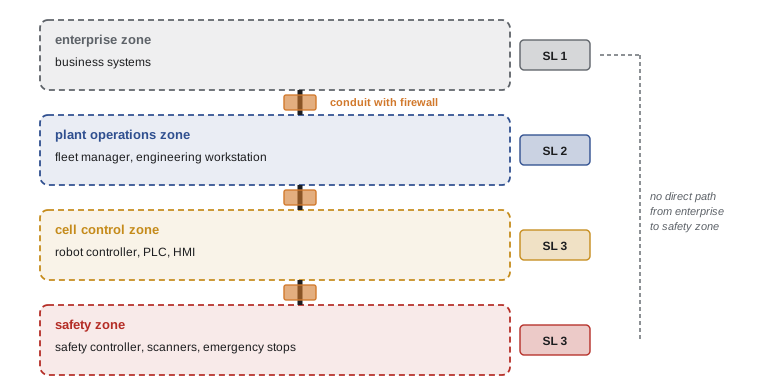
Security and safety can conflict. A security patch may change a safety-related controller and require revalidation; locking doors against intruders may conflict with emergency egress; account lockouts after failed passwords may prevent a technician from stopping a dangerous process. IEC TS 63074:2023 addresses security aspects related to the functional safety of safety-related control systems, explaining how threats to safety functions should be considered in the IEC 62061 and ISO 13849-1 processes, and ISO/IEC TR 5469 notes similar issues for AI. The practical rule is to run safety and security risk assessments together, so that each team knows what the other's measures do. The EU Machinery Regulation, discussed in lesson 5, makes protection against corruption a legal essential requirement for machinery placed on the EU market from January 2027, and machinery makers are expected to use IEC 62443 and related standards to show compliance.
# Choosing security measures for a robot cell under a budget, by risk reduction per dollar (illustrative)
threats = {   # name: (likelihood per year, consequence score 1-100)
    "remote change of safety config": (0.05, 95),
    "ransomware on cell HMI":         (0.20, 40),
    "spoofed AMR map update":         (0.08, 70),
    "USB malware via technician":     (0.15, 35),
}
measures = [  # (name, cost, {threat: fraction of likelihood removed})
    ("safety password + checksum audit", 4000, {"remote change of safety config": 0.85}),
    ("cell firewall and zone design",   18000, {"remote change of safety config": 0.6, "ransomware on cell HMI": 0.6, "spoofed AMR map update": 0.4}),
    ("signed map and update pipeline",  12000, {"spoofed AMR map update": 0.9}),
    ("USB port control and policy",      2500, {"USB malware via technician": 0.7, "ransomware on cell HMI": 0.2}),
    ("offline backups and recovery",     6000, {"ransomware on cell HMI": 0.3}),
]
def risk(t):
    return sum(l * c for l, c in t.values())
budget, chosen, current = 30000, [], dict(threats)
print(f"initial annual risk score: {risk(current):.2f}")
while True:
    best = None
    for name, cost, eff in measures:
        if name in chosen or cost > budget:
            continue
        trial = {k: (l * (1 - eff.get(k, 0)), c) for k, (l, c) in current.items()}
        gain = (risk(current) - risk(trial)) / cost
        if best is None or gain > best[0]:
            best = (gain, name, cost, trial)
    if best is None:
        break
    _, name, cost, current = best
    chosen.append(name); budget -= cost
print(f"add {name:34s} cost {cost:6d} risk now {risk(current):.2f} budget left {budget}")initial annual risk score: 23.60 add USB port control and policy cost 2500 risk now 18.33 budget left 27500 add safety password + checksum audit cost 4000 risk now 14.29 budget left 23500 add signed map and update pipeline cost 12000 risk now 9.25 budget left 11500 add offline backups and recovery cost 6000 risk now 7.33 budget left 5500
Quantitative scores like these are rough, but they force teams to state assumptions and compare options on the same basis. Note that the cheapest measures against the most severe threat, protecting the safety configuration, come first, which mirrors the safety principle of addressing severe consequences early.
What the law requires
Security duties come from several directions: product law for manufacturers, critical infrastructure law for operators in essential sectors, privacy and breach notification law for anyone holding personal information, sector regulators for medical devices and vehicles, and securities law for public companies. The European Union's Cyber Resilience Act, Regulation (EU) 2024/2847, is the most comprehensive product security law and affects any company selling connected robots in Europe.
| EU Cyber Resilience Act feature | What it means for connected robots |
|---|---|
| Scope | Products with digital elements, including robots, controllers and software, placed on the EU market |
| Essential requirements | Secure by default configuration, protection against unauthorized access, data protection, minimized attack surface, security updates |
| Vulnerability handling | Coordinated disclosure policy, software bill of materials, free security updates for a defined support period |
| Reporting | From 11 September 2026: early warning within 24 hours and notification within 72 hours of actively exploited vulnerabilities and severe incidents, through ENISA's single reporting platform |
| Full application | 11 December 2027, with conformity assessment and CE marking for cybersecurity |
In Canada, Bill C-8, which received royal assent in June 2026, enacts the Critical Cyber Systems Protection Act for federally regulated critical sectors such as telecommunications, energy, finance and transportation, with obligations for cyber security programs, supply chain risk management and incident reporting that come into force in phases; robots and automation used by operators in those sectors will fall within their compliance programmes. PIPEDA requires organizations to report breaches of security safeguards involving personal information to the Privacy Commissioner and to notify affected individuals where there is a real risk of significant harm, and Quebec's Law 25 has similar rules for confidentiality incidents. Health Canada expects pre-market cybersecurity information for connected medical devices. The Canadian Centre for Cyber Security publishes guidance and receives incident reports, and provincial securities regulators expect public companies to disclose material cyber risks and incidents.
Worked problem
Calculating CRA reporting deadlines
A robot maker selling in the EU confirms at 16:00 on a Thursday that a vulnerability in its fleet manager is being actively exploited against customers. A patch becomes available 9 days later. Under the CRA reporting rules, what are the deadlines?
Show solution
- Early warning: within 24 hours of becoming aware, so by 16:00 on Friday.
- Vulnerability notification with more detail: within 72 hours, so by 16:00 on Sunday; weekends do not extend the clock.
- Final report: no later than 14 days after a corrective or mitigating measure is available, so within 14 days of day 9, by day 23.
- In parallel: inform affected users of the vulnerability and corrective measures, and check obligations under other laws, such as personal data breach rules.
Answer: Early warning by Friday 16:00, notification by Sunday 16:00 and a final report within 14 days of the patch becoming available.
Liability for security failures
When an attack on a robot causes injury or loss, the questions of product liability and negligence from lesson 8 return in a new form. Was it reasonable to ship the robot with a default password, an unpatched known vulnerability or an exposed remote service? Did the operator follow the manufacturer's security guidance and apply updates? Was the attack foreseeable? Courts generally expect security measures in line with the state of the art and the known threat environment, so the publication of a vulnerability advisory or a patch can change what is reasonable overnight. Contracts increasingly allocate security responsibilities explicitly, such as who patches, who monitors and who responds, and specify support periods for security updates. Insurance for cyber events is usually separate from general liability insurance, and policies may exclude bodily injury or acts of war, which can leave gaps when a cyber attack causes physical harm. Companies should check how their policies would respond to a cyber attack that injures someone, because the answer is often unclear.
The bottom line for robot engineers is that security is a design input with legal consequences. Building in secure defaults, unique credentials, signed updates, network segmentation, protected safety configurations, logging and a coordinated vulnerability disclosure process is no longer just good practice; it is increasingly what the law requires and what courts will expect.
Common mistakes
MistakeTreating cybersecurity as an IT matter separate from robot safety.
InsteadAssess threats to safety functions alongside safety risks and coordinate measures.
MistakeLeaving safety configuration editable with the same password as programs.
InsteadUse separate credentials, checksums, local confirmation and management of change for safety settings.
MistakeApplying security patches to safety controllers without revalidation.
InsteadAssess the impact of patches on safety functions and revalidate as needed.
MistakeAssuming the CRA applies only from 2027.
InsteadIts reporting obligations apply from 11 September 2026.
MistakeAssuming general liability insurance covers injuries caused by cyber attacks.
InsteadCheck policy wording; cyber and bodily injury cover often have exclusions and gaps.
Summary and key terms
- Attacks can defeat safety functions by changing programs, configurations, sensors, maps or updates.
- Independent, hardwired and protected safety functions limit what attackers can do.
- IEC 62443 defines zones, conduits and security levels SL 1 to SL 4; IEC TS 63074 links security to functional safety.
- The EU Machinery Regulation requires protection against corruption, and the Cyber Resilience Act requires secure products, vulnerability handling and reporting from 11 September 2026, with full application on 11 December 2027.
- In Canada, Bill C-8 sets duties for critical sectors, PIPEDA and Law 25 require breach reporting, and Health Canada expects device cybersecurity information.
- Courts judge security against the state of the art, and contracts and insurance must address cyber-physical harm explicitly.
- Zone and conduit
- IEC 62443 groupings of assets and the controlled communication paths between them.
- Security level
- IEC 62443 measure of protection against attackers of increasing capability.
- IEC TS 63074
- Technical specification on security aspects of functional safety for machinery control systems.
- Cyber Resilience Act
- EU regulation setting cybersecurity requirements for products with digital elements.
- Software bill of materials
- A list of software components in a product, used to track vulnerabilities.
- Coordinated vulnerability disclosure
- A process for receiving, fixing and publishing security vulnerabilities.
- Actively exploited vulnerability
- A vulnerability that attackers are known to be using.
- Checksum
- A value computed from a configuration that changes if the configuration changes.
Practice problems
Work each problem on paper first, then reveal the answer to check.
Give two attacks that could defeat a robot safety function.
Show answer
Changing the safety configuration remotely; spoofing a mobile robot's map or localization.
What does SL 3 protect against?
Show answer
Intentional attacks with sophisticated means, moderate resources and system-specific skills.
Name a conflict between safety and security.
Show answer
Door locking for security versus emergency egress, or patches that require safety revalidation.
When do CRA reporting obligations begin?
Show answer
11 September 2026.
Within what times must the CRA early warning and notification be sent?
Show answer
24 hours and 72 hours after becoming aware.
Which federal bill for critical cyber systems received royal assent in June 2026?
Show answer
Bill C-8, enacting the Critical Cyber Systems Protection Act.
How does a checksum help protect a safety configuration?
Show answer
Any change alters the checksum, so comparing with the validated value detects unauthorized changes.
Why might insurance not cover injury from a cyber attack?
Show answer
General liability may exclude cyber events and cyber policies may exclude bodily injury or acts of war.
Lesson quiz · 5 questions
Score 60% or more to complete this lesson.
Create a free account to save your progress, take quizzes and earn a certificate.