
ROB-450 · Lesson 9 of 12 · 25 min
AI regulation and governance for robots
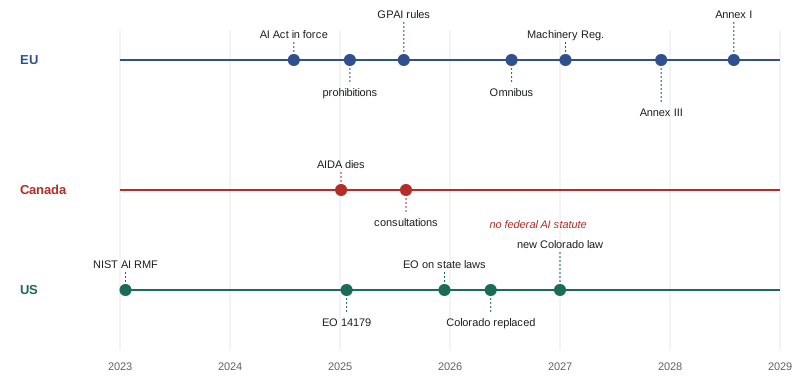
Robots increasingly rely on artificial intelligence for perception, planning, grasping, speech and decisions about people, such as which worker gets which task. Governments have responded with laws aimed at AI systems in general, alongside the sector rules covered in lessons 5 to 7. The result is a fast-moving and uneven landscape: the European Union has a comprehensive AI Act whose timetable changed in 2026, Canada has no general federal AI statute after its proposed law died in 2025, and the United States has a federal policy that favours light regulation and challenges state laws, while some states legislate anyway. This lesson explains what these frameworks require of robot makers and deployers, and how companies build AI governance that works across jurisdictions. Facts here are stated as of October 2026, and this area changes quickly enough that readers should check the current position before relying on any detail.
The EU AI Act
The EU's Artificial Intelligence Act, Regulation (EU) 2024/1689, entered into force on 1 August 2024. It classifies AI systems by risk. A short list of practices is prohibited outright, including manipulative techniques that cause significant harm, social scoring, untargeted scraping of facial images and emotion recognition in workplaces and schools except for medical or safety reasons; these prohibitions have applied since 2 February 2025. High-risk systems face detailed requirements. Systems that interact with people or generate content face transparency duties, such as telling people they are dealing with an AI system. Obligations for general-purpose AI models have applied since 2 August 2025. Most other systems face no specific obligations.
High-risk AI systems come in two groups. Annex I covers AI that is, or is a safety component of, a product already regulated by EU harmonization law, such as medical devices, toys, lifts and vehicles. Annex III lists stand-alone uses, including AI used in employment for recruitment, task allocation, monitoring and evaluation of workers, in education, in access to essential services such as credit, in critical infrastructure and in law enforcement. High-risk systems need a risk management system, data governance, technical documentation, automatic logging, transparency to deployers, human oversight measures, appropriate accuracy, robustness and cybersecurity, a quality management system, conformity assessment, registration, post-market monitoring and reporting of serious incidents. Deployers also have duties, such as using systems according to instructions, assigning human oversight to competent people and, for some deployers, assessing impacts on fundamental rights.
The timetable for high-risk obligations was changed by the Digital Omnibus on AI, which was published in the Official Journal on 24 July 2026 and entered into force on 27 July 2026. It moved the date for Annex III stand-alone high-risk systems from 2 August 2026 to 2 December 2027 and the date for Annex I product-embedded systems to 2 August 2028. Importantly for robotics, it took AI embedded in machinery covered by the Machinery Regulation out of the AI Act's direct high-risk rules, providing instead that the Commission may adopt AI-specific health and safety requirements under the Machinery Regulation itself. A machine's AI safety functions are therefore assessed through machinery law, discussed in lesson 5, while AI used by the same company to manage workers remains under the AI Act's employment rules.
| Robot-related AI use | Likely treatment under EU law after the 2026 Omnibus | Main obligations |
|---|---|---|
| Learned person detection used as a safety function in an industrial robot | Machinery Regulation (self-evolving ML safety functions need notified body assessment) | Essential requirements, technical file, CE marking |
| AI that allocates tasks and monitors warehouse workers' performance | High-risk under Annex III (employment), from 2 December 2027 | Risk management, logging, human oversight, deployer duties |
| Emotion recognition of workers by a factory robot camera | Prohibited since 2 February 2025, unless for medical or safety reasons | Do not deploy |
| Conversational reception robot in a hotel | Transparency obligations | Tell people they are interacting with an AI system |
| AI component of a surgical robot | High-risk under Annex I via medical device law, from 2 August 2028 | AI Act requirements integrated into medical device conformity assessment |
Penalties under the AI Act reach 35 million euros or 7 per cent of worldwide annual turnover for prohibited practices, with lower ceilings for other breaches. Like the GDPR, the Act applies to providers outside the EU who place systems on the EU market and, in some cases, to systems whose outputs are used in the EU, so Canadian and American robot makers selling into Europe must comply.
Canada
Canada has no comprehensive federal AI law in force. The Artificial Intelligence and Data Act (AIDA), Part 3 of Bill C-27, would have regulated high-impact AI systems, but the bill died on the Order Paper when Parliament was prorogued on 6 January 2025. After the April 2025 election, the government appointed a Minister of Artificial Intelligence and Digital Innovation, who indicated that AIDA would not return in its old form and that future rules would aim to be light and targeted; the government consulted on an AI strategy and possible regulatory approaches in 2025 and 2026, but no general AI bill had passed at the time of writing. In the meantime, AI used in robots is governed by existing laws: OHS laws for workplace hazards, product liability and consumer protection, human rights codes prohibiting discrimination in employment and services, the Competition Act for misleading claims about AI capabilities, PIPEDA and provincial privacy laws for personal information, and sector regulators such as Health Canada for machine-learning-enabled medical devices. Quebec's Law 25 has, since September 2023, required organizations that make decisions based exclusively on automated processing of personal information to inform the person, explain on request the personal information and principal factors used, and allow the person to have the decision reviewed by a human. Ontario's Strengthening Cyber Security and Building Trust in the Public Sector Act, 2024 enables rules on AI use by public sector bodies. Federal institutions follow the Treasury Board Directive on Automated Decision-Making, and a voluntary code of conduct for generative AI systems was published in 2023.
The United States
The United States has no comprehensive federal AI statute, and federal policy since January 2025 has emphasized removing barriers to AI development, including a December 2025 executive order directing the Justice Department to challenge state AI laws seen as inconsistent with federal policy. Existing federal laws still apply: the Federal Trade Commission acts against deceptive AI claims, anti-discrimination law applies to automated decisions, and the FDA and NHTSA regulate AI in devices and vehicles. The voluntary NIST AI Risk Management Framework is widely used. Canadian robot makers selling in the United States should expect these federal laws and an evolving set of state laws to apply.
States have legislated despite federal pressure, mostly on automated decisions about people rather than on robots' physical safety. Colorado passed the first broad state AI law in 2024, covering high-risk systems used in consequential decisions such as employment, but delayed its start to 30 June 2026, and in May 2026 repealed and replaced it with a narrower law, effective 1 January 2027, focused on transparency and consumer rights for covered automated decision-making technologies: developers must document intended uses and limitations for deployers, deployers must give notice before use in consequential decisions and explain adverse outcomes, consumers may seek correction and human review, and the attorney general enforces it with no private right of action. Other states have passed laws on specific topics, such as California's 2025 transparency law for developers of frontier AI models, laws on AI in hiring such as New York City's bias audit rule for automated employment decision tools, and Illinois's amendment to its human rights law on AI in employment. A robot company that uses AI to schedule, evaluate or monitor workers in several states must track these.
Worked problem
Mapping a warehouse AI deployment across jurisdictions
A logistics company operating in Ontario, Quebec, Colorado and Germany plans to deploy a system in which robots pick items while an AI scheduler assigns human workers to stations and scores their productivity. Identify the main AI-specific rules in each place.
Show solution
- Germany: the scheduler is high-risk under Annex III (task allocation and monitoring of workers) from 2 December 2027, with provider and deployer duties; works council consultation under German labour law also applies.
- Quebec: if decisions about workers are made exclusively by automated processing of personal information, Law 25 requires notice, explanation on request and human review.
- Ontario: no AI-specific private sector statute, but privacy expectations, human rights law and Ontario's requirement for employers with 25 or more employees to have a written electronic monitoring policy apply.
- Colorado: if the scheduler counts as a covered automated decision-making technology used in consequential employment decisions, the replacement law's notice, explanation and review duties apply from 1 January 2027.
Answer: The same system faces EU high-risk obligations, Quebec's automated decision rules, Ontario's monitoring policy requirement and Colorado's transparency law, so a single governance programme designed to the strictest common requirements is efficient.
Building AI governance in a robot company
Because laws differ and change, robot companies increasingly build an internal AI governance programme that meets the most demanding requirements they face and adapts as laws evolve. International standards provide structure: ISO/IEC 42001:2023 specifies requirements for an AI management system, in the way ISO 9001 does for quality, and can be certified; ISO/IEC 23894:2023 gives guidance on AI risk management; and the NIST AI Risk Management Framework offers a flexible process. For safety-relevant AI, these complement the functional safety standards of lessons 3 and 4 and ISO/IEC TR 5469 on AI in safety functions.
| Governance element | What it looks like for a robot maker |
|---|---|
| Inventory and classification | List every AI model in products and operations, its purpose, data and risk tier in each market |
| Accountability | Named owners for each system and an executive responsible for AI risk |
| Data governance | Records of training data sources, consent and licensing, representativeness and known gaps |
| Validation and testing | Performance on held-out and edge-case data, including subgroups such as children or wheelchair users for person detection |
| Human oversight design | Clear roles, the ability to override or stop, and interfaces that avoid automation bias |
| Change control | Rules for retraining and updates, with revalidation and documentation, similar to a PCCP |
| Monitoring and incidents | Field performance monitoring, logging, incident reporting to regulators where required |
| Transparency | Plain-language disclosure to users, documentation for deployers, honest marketing claims |
# A simple triage of AI uses in a robot product line against common regulatory triggers
uses = [
    dict(name="grasp planner", affects_people=False, safety_function=False, decisions_about_people=False, emotion=False, medical=False),
    dict(name="AMR person detection (safety)", affects_people=True, safety_function=True, decisions_about_people=False, emotion=False, medical=False),
    dict(name="worker scheduling and scoring", affects_people=True, safety_function=False, decisions_about_people=True, emotion=False, medical=False),
    dict(name="camera mood detection of staff", affects_people=True, safety_function=False, decisions_about_people=False, emotion=True, medical=False),
    dict(name="rehab exoskeleton gait model", affects_people=True, safety_function=True, decisions_about_people=False, emotion=False, medical=True),
]
def triage(u):
    flags = []
    if u["emotion"]:
        flags.append("EU: prohibited in workplaces unless medical/safety")
    if u["medical"]:
        flags.append("medical device rules (Health Canada / FDA / EU Annex I)")
    elif u["safety_function"]:
        flags.append("machinery functional safety; EU Machinery Regulation for ML safety functions")
    if u["decisions_about_people"]:
        flags.append("EU Annex III employment; Quebec Law 25; Colorado ADMT law; human rights law")
    if not flags:
        flags.append("internal governance only")
    return flags
for u in uses:
print(f"{u['name']:32s} -> " + "; ".join(triage(u)))grasp planner -> internal governance only AMR person detection (safety) -> machinery functional safety; EU Machinery Regulation for ML safety functions worker scheduling and scoring -> EU Annex III employment; Quebec Law 25; Colorado ADMT law; human rights law camera mood detection of staff -> EU: prohibited in workplaces unless medical/safety rehab exoskeleton gait model -> medical device rules (Health Canada / FDA / EU Annex I)
A triage like this does not decide legal questions, but it routes each use to the right experts and standards and makes sure nothing is missed. The highest-risk use in the list, emotion recognition of staff, is one a company might adopt casually as an add-on feature of a camera system without realizing it is prohibited in the EU and raises privacy and human rights concerns in Canada and the United States.
Honest claims are part of governance. Regulators in both countries have acted against exaggerated AI marketing: the US Federal Trade Commission has brought cases against companies making unsupported claims about AI capabilities, and Canada's Competition Act prohibits false or misleading representations and, since 2024 amendments, has given the Competition Bureau stronger tools against misleading claims. Describing a level 2 driver assistance system as self-driving, or a robot's person detection as guaranteeing safety, creates legal risk and, worse, encourages unsafe reliance.
Common mistakes
MistakeAssuming the EU AI Act applies only to European companies.
InsteadIt applies to providers placing AI systems on the EU market and in some cases to outputs used in the EU.
MistakeTreating all AI in a robot as one category.
InsteadClassify each AI use separately: safety functions, decisions about people and interactions have different rules.
MistakeBelieving Canada has no rules for AI because AIDA died.
InsteadPrivacy, human rights, consumer, OHS and sector laws apply, and Quebec's Law 25 regulates automated decisions.
MistakeRelying on 2024 information about Colorado's AI Act.
InsteadColorado repealed and replaced its law in May 2026; always check the current version.
MistakeAdding emotion recognition as a camera feature without review.
InsteadIt is prohibited in EU workplaces and raises privacy and human rights issues elsewhere.
Summary and key terms
- The EU AI Act classifies AI by risk; prohibitions apply from February 2025 and general-purpose AI obligations from August 2025.
- The July 2026 Digital Omnibus moved Annex III high-risk obligations to 2 December 2027 and Annex I to 2 August 2028, and routed AI in machinery through the Machinery Regulation.
- Canada has no federal AI statute after AIDA died in January 2025; existing laws and Quebec's Law 25 govern AI in robots.
- The United States has no federal AI statute; federal policy favours deregulation and challenges state laws, while sector regulators and the FTC enforce existing law.
- Colorado replaced its 2024 AI Act with a narrower transparency law effective 1 January 2027; other states regulate specific uses.
- Companies build AI governance using ISO/IEC 42001, ISO/IEC 23894 and the NIST AI RMF, with inventories, validation, oversight, change control and honest claims.
- High-risk AI system
- Under the EU AI Act, an AI system listed in Annex I or III that faces detailed requirements.
- Digital Omnibus on AI
- The 2026 EU amendment that postponed high-risk deadlines and adjusted scope.
- Provider and deployer
- EU AI Act roles: the party placing the system on the market and the party using it.
- AIDA
- Canada's proposed Artificial Intelligence and Data Act, which died in January 2025.
- Automated decision
- A decision based exclusively on automated processing, regulated in Quebec by Law 25.
- NIST AI RMF
- A voluntary US framework for managing AI risk with govern, map, measure and manage functions.
- ISO/IEC 42001
- A certifiable standard for AI management systems.
- Automation bias
- The tendency of people to over-trust automated outputs.
Practice problems
Work each problem on paper first, then reveal the answer to check.
When did the EU AI Act's prohibitions start to apply?
Show answer
2 February 2025.
What are the new dates for Annex III and Annex I high-risk obligations?
Show answer
2 December 2027 for Annex III and 2 August 2028 for Annex I.
How are AI safety functions in machinery treated after the Omnibus?
Show answer
Through the Machinery Regulation, with possible AI-specific delegated acts, rather than directly under the AI Act high-risk rules.
Why did AIDA not become law?
Show answer
Bill C-27 died when Parliament was prorogued in January 2025.
What does Quebec's Law 25 require for exclusively automated decisions?
Show answer
Advance notice, explanation of personal information and principal factors on request, and the opportunity for human review.
What happened to the Colorado AI Act in 2026?
Show answer
It was repealed and replaced in May 2026 by a narrower transparency law effective 1 January 2027.
Name two standards for AI governance.
Show answer
ISO/IEC 42001 and ISO/IEC 23894; also the NIST AI RMF.
Give an example of a misleading AI claim for a robot.
Show answer
Saying a robot's person detection guarantees safety, or calling a level 2 system self-driving.
Lesson quiz · 5 questions
Score 60% or more to complete this lesson.
Create a free account to save your progress, take quizzes and earn a certificate.