
ROB-450 · Lesson 7 of 12 · 26 min
Medical robots, autonomous vehicles and other regulated robots
Some robots work in sectors that already had strong regulators long before robots arrived. Surgical and rehabilitation robots are medical devices, automated vehicles are motor vehicles, and drones are aircraft. In these sectors, a robot cannot simply be designed to a voluntary standard and sold; it needs authorization from a government regulator, or must meet mandatory federal standards, before it reaches users, and the manufacturer has continuing duties to report problems. These regimes are a preview of how other robots may be regulated as they become more autonomous. This lesson explains the medical device and motor vehicle frameworks in Canada and the United States, the emerging global framework for automated driving, and briefly how drones fit, with pointers to the courses that treat drones in depth.
Medical robots
Medical robots range from surgical systems, in which a surgeon at a console controls instruments inside a patient, to rehabilitation robots and exoskeletons used in therapy, pharmacy automation, radiotherapy positioning systems and hospital disinfection robots. Whether a robot is a medical device depends on its intended use: a device intended for diagnosing, treating, mitigating or preventing disease or injury, or for restoring or modifying body function, is a medical device, while a delivery robot that carries supplies in a hospital is not, even if it works next to patients.
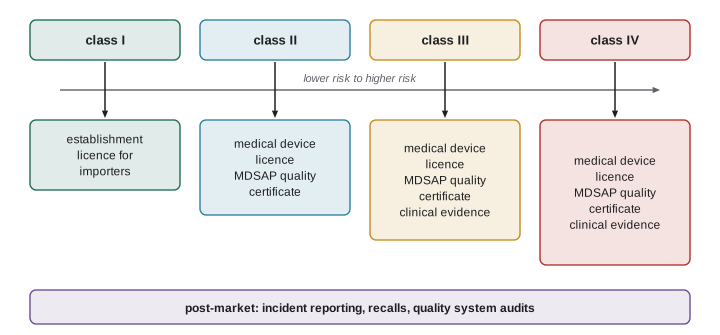
In Canada, medical devices are regulated by Health Canada under the Food and Drugs Act and the Medical Devices Regulations. Devices are classified by risk into classes I to IV using rules in the regulations, with invasive and active devices that deliver energy or support life in the higher classes. Class I devices do not need a device licence, but importers and distributors need a medical device establishment licence. Class II, III and IV devices need a medical device licence before they can be sold, supported by evidence of safety and effectiveness that grows with the class, and manufacturers must hold a quality management system certificate issued under the Medical Device Single Audit Program (MDSAP), based on ISO 13485. After sale, manufacturers and importers must report incidents involving death or serious deterioration in health within set deadlines, keep distribution records and handle recalls. In February 2025 Health Canada finalized pre-market guidance for machine-learning-enabled medical devices, which allows a predetermined change control plan describing anticipated changes to a model so that approved changes can be made without a new licence amendment each time.
Medical robots also follow medical device standards that complement general machinery safety. IEC 60601-1 sets general requirements for basic safety and essential performance of medical electrical equipment, and its particular standards include IEC 80601-2-77 for robotically assisted surgical equipment and IEC 80601-2-78 for medical robots for rehabilitation, assessment, compensation or alleviation. ISO 14971 sets the risk management process for medical devices, playing the role ISO 12100 plays for machinery; IEC 62304 covers medical device software life cycles; and IEC 62366-1 covers usability engineering, which matters greatly for surgical consoles where a confusing interface can lead to harm.
| Question | Machinery approach | Medical device approach |
|---|---|---|
| Risk management standard | ISO 12100 | ISO 14971 |
| Who approves the product? | Usually no one before sale in Canada and the US; conformity is self-declared | Government regulator before sale for most devices |
| Software | ISO 13849-1 and IEC 62061 software clauses | IEC 62304 software life cycle |
| Clinical evidence | Not applicable | Required for higher-risk devices |
| Post-market duties | Recalls under consumer law for consumer products; general liability | Mandatory incident reporting, recalls, licence conditions |
| Benefit-risk | Risk reduced to acceptable without counting benefit to the injured person | Residual risk weighed against clinical benefit to the patient |
The last row reflects a real difference in philosophy. A surgical robot carries risks to the patient that would be unacceptable for a factory machine, but they are judged against the benefit of surgery to that same patient. Researchers describe levels of autonomy for surgical robots, from no autonomy, where the surgeon controls every motion, through robot assistance and task autonomy, such as automated suturing, to conditional and high autonomy. Commercial systems are mostly at the lower levels at the time of writing, and regulators expect evidence that increases with autonomy.
Worked problem
Classifying a rehabilitation exoskeleton
A company makes a lower-limb exoskeleton. Version A is sold to logistics companies to reduce worker fatigue. Version B, mechanically identical, is sold to rehabilitation clinics to help patients relearn walking after spinal cord injury. How are they regulated?
Show solution
- Version A has no medical intended use, so it is a workplace product subject to OHS law, product liability and standards such as ISO 13482 for physical assistant robots.
- Version B has a medical intended use (restoring body function), so it is a medical device.
- In Canada, Version B would be classified under the Medical Devices Regulations, likely needing a medical device licence; in the US, FDA has classified powered exoskeletons as class II devices with special controls.
- Marketing material for Version A must avoid medical claims, or it could be treated as an unapproved medical device.
Answer: The same hardware is regulated differently depending on intended use: Version A as a workplace product, Version B as a medical device needing authorization.
Automated vehicles
An automated vehicle is a robot that carries people or goods on public roads. SAE J3016 defines six levels of driving automation, from level 0 (no automation) through level 2 (partial automation, where the driver must supervise continuously, as with most driver assistance systems) to level 3 (conditional automation, where the system drives in limited conditions but a human must take over when asked), level 4 (high automation within an operational design domain, with no takeover needed) and level 5 (full automation everywhere). The operational design domain describes the conditions, such as roads, speeds, weather and times of day, for which the system is designed, and defining it precisely is one of the most important safety decisions.
In Canada, responsibility is split. Transport Canada regulates vehicle design and equipment under the Motor Vehicle Safety Act through the Canada Motor Vehicle Safety Standards, with manufacturers self-certifying compliance, and has published voluntary guidance including a safety assessment tool for automated driving systems and guidelines for testing. Provinces and territories regulate drivers, licensing, insurance, traffic rules and road testing. Ontario has run a pilot program since 2016 under O. Reg. 306/15 that allows approved organizations to test automated vehicles on public roads under conditions, and Quebec's Highway Safety Code allows pilot projects for automated vehicles. Internationally, the UNECE World Forum for Harmonization of Vehicle Regulations adopted Global Technical Regulation No. 26 on automated driving systems in June 2026, which Canada co-sponsored; it uses a safety-case approach with requirements for safety management systems, post-deployment incident reporting and cybersecurity. Transport Canada consulted on the draft in spring 2026, and implementation in Canadian standards was expected to follow, so readers should check the current position.
Liability for automated vehicles is shifting from drivers toward manufacturers and operators. For level 2 systems, the driver remains responsible for supervising, but courts have also examined whether manufacturers' designs and marketing encouraged over-reliance; in 2025 a US federal jury in Florida found a carmaker partly liable for a fatal crash involving its driver assistance system, a verdict the company said it would appeal. For level 4 robotaxis with no driver, the operator is the natural defendant, and some jurisdictions have adopted rules making the automated system's owner responsible for traffic violations. Regulators have also used reporting duties: in 2024 one robotaxi operator paid a federal penalty for failing to fully report a 2023 crash in which its vehicle dragged a pedestrian.
# How many driverless miles are needed to show a fatality rate below a human benchmark?
import math
human_rate = 1.25e-8          # fatalities per vehicle mile (about 1.25 per 100 million, illustrative)
for confidence in (0.80, 0.95, 0.99):
    miles = -math.log(1 - confidence) / human_rate      # zero fatalities observed (Poisson)
    print(f"{confidence:.0%} confidence, zero fatalities: {miles / 1e6:,.0f} million miles")
# with some fatalities observed, use the chi-square upper bound
def upper_rate(k, miles, conf=0.95):
    # exact Poisson upper bound by bisection
    lo, hi = 0.0, 50.0 + 10 * k
    target = 1 - conf
    for _ in range(100):
        mid = (lo + hi) / 2
        cdf = sum(math.exp(-mid) * mid ** i / math.factorial(i) for i in range(k + 1))
        lo, hi = (mid, hi) if cdf > target else (lo, mid)
    return hi / miles
for k, m in ((1, 300e6), (3, 500e6)):
print(f"{k} fatalities in {m / 1e6:.0f} M miles: 95% upper bound = {upper_rate(k, m) * 1e8:.2f} per 100 M miles")80% confidence, zero fatalities: 129 million miles 95% confidence, zero fatalities: 240 million miles 99% confidence, zero fatalities: 368 million miles 1 fatalities in 300 M miles: 95% upper bound = 1.58 per 100 M miles 3 fatalities in 500 M miles: 95% upper bound = 1.55 per 100 M miles
The calculation, similar to a widely cited 2016 RAND Corporation analysis, shows that hundreds of millions of miles without a fatality are needed to show statistically that an automated fleet is safer than human drivers, and that even a few fatalities widen the uncertainty considerably. This is why regulators and developers rely on safety cases combining simulation, closed-course testing, scenario-based assessment, analysis of disengagements and crashes, and safety management systems rather than mileage alone. Lesson 12 develops the safety case idea. UL 4600, a standard for the safety evaluation of autonomous products, sets out what such a safety case should contain.
Drones and other regulated robots
Drones are aircraft and are regulated by aviation authorities. In Canada, Part IX of the Canadian Aviation Regulations governs remotely piloted aircraft systems, with pilot certificates, registration, operating categories and rules on airspace and distances from people; amendments taking effect in November 2025 expanded the routes to lower-risk operations beyond visual line of sight. In the United States, the FAA's 14 CFR Part 107 governs small unmanned aircraft, with waivers for operations beyond visual line of sight, and a new rule for routine beyond-visual-line-of-sight operations was proposed in 2025. PHOT-350 and CON-250 cover drone operations in more detail. Other robots in regulated sectors include robots in nuclear facilities, regulated by the Canadian Nuclear Safety Commission or the US Nuclear Regulatory Commission; mining robots, under provincial mining regulations or the Mine Safety and Health Administration; and agricultural robots, which fall under farm safety rules and, for pesticide-spraying robots, pesticide regulation.
| Sector | Canadian regulator | US regulator | Approval before use? |
|---|---|---|---|
| Medical devices | Health Canada | FDA | Yes for most devices |
| Road vehicles | Transport Canada, provinces | NHTSA, states | Self-certification to federal standards; state or provincial permits for testing and deployment |
| Drones | Transport Canada (CARs Part IX) | FAA (Part 107) | Registration, pilot certification, permits for some operations |
| Nuclear facilities | Canadian Nuclear Safety Commission | Nuclear Regulatory Commission | Within facility licences |
| Mines | Provincial mining regulators | MSHA | Equipment approvals for some hazardous atmospheres |
Worked problem
Assigning an SAE level and a regulatory route
A company deploys driverless shuttles on a fixed 3 km route in a business park, at up to 25 km/h, in daylight and dry weather only, with remote monitoring but no onboard operator. Assign the SAE level and list the main regulatory questions in either country.
Show solution
- The system drives without a human fallback within a limited operational design domain, so it is SAE level 4.
- Vehicle standards: the shuttle may lack manual controls, so it needs an exemption or a regulatory route from the federal vehicle regulator.
- Roads: if the business park roads are public, provincial or state permits for testing or deployment are needed; if private, occupiers' or premises liability and workplace law apply.
- Reporting and insurance: crash reporting duties, insurance requirements and the safety case for remote monitoring must be settled before service.
Answer: Level 4 with a narrow operational design domain; it needs a federal route for non-standard vehicle design, provincial or state permission for public roads, insurance and a safety case.
Common mistakes
MistakeAssuming any robot used in a hospital is a medical device.
InsteadIntended use decides; a supply delivery robot is not a medical device, a surgical robot is.
MistakeApplying machinery risk acceptance to surgical robots.
InsteadMedical devices weigh residual risk against clinical benefit under ISO 14971.
MistakeCalling a driver assistance system self-driving.
InsteadLevel 2 systems require continuous driver supervision; marketing that suggests otherwise creates safety and liability problems.
MistakeRelying on test mileage alone to prove automated vehicle safety.
InsteadCombine simulation, scenario testing, safety cases and safety management with field data.
MistakeIgnoring the operational design domain.
InsteadDefine and enforce the conditions for which the automated system is designed.
Summary and key terms
- Medical robots are regulated by intended use; Health Canada and the FDA classify devices by risk and require authorization for most.
- Canadian class II to IV devices need a medical device licence and an MDSAP quality certificate; MLMD guidance from February 2025 allows change control plans.
- Medical robot standards include IEC 60601-1, IEC 80601-2-77 and -78, ISO 14971, IEC 62304 and IEC 62366-1.
- SAE J3016 defines driving automation levels 0 to 5, and the operational design domain sets the conditions for safe automated driving.
- Transport Canada regulates vehicle design and provinces regulate roads and testing, with Ontario's pilot since 2016; GTR No. 26 was adopted in June 2026.
- Drones fall under aviation law, and nuclear, mining and agricultural robots under their sector regulators.
- Intended use
- The purpose for which a manufacturer makes and markets a device, which decides its regulatory status.
- Medical device licence
- Health Canada authorization to sell a class II, III or IV device.
- 510(k)
- US premarket notification showing substantial equivalence to a predicate device.
- De Novo
- US pathway for novel low- to moderate-risk devices without a predicate.
- PCCP
- Predetermined change control plan describing anticipated changes to a device's software.
- ISO 14971
- Risk management standard for medical devices.
- SAE J3016
- Standard defining six levels of driving automation.
- Operational design domain
- The conditions under which an automated driving system is designed to operate.
Practice problems
Work each problem on paper first, then reveal the answer to check.
What decides whether a robot is a medical device?
Show answer
Its intended use as stated and marketed by the manufacturer.
Which class of device does not need a Health Canada device licence?
Show answer
Class I, although importers and distributors need an establishment licence.
Name the medical device risk management standard.
Show answer
ISO 14971.
At which SAE level must the driver supervise continuously?
Show answer
Level 2 (and below).
What is the main difference between level 3 and level 4?
Show answer
Level 3 needs a human to take over when requested; level 4 needs no human fallback within its operational design domain.
Using zero failures and a rate of 1e-8 per mile, how many miles are needed for 95 per cent confidence?
Show answer
\( -\ln(0.05)/10^{-8} \approx 300 \) million miles.
Which standard sets out what a safety case for an autonomous product should contain?
Show answer
UL 4600.
Which regulators cover drones in Canada and the United States?
Show answer
Transport Canada under CARs Part IX and the FAA under 14 CFR Part 107.
Lesson quiz · 5 questions
Score 60% or more to complete this lesson.
Create a free account to save your progress, take quizzes and earn a certificate.