
ROB-460 · Lesson 5 of 12 · 30 min
Mining, construction and energy robots
Heavy industry has strong reasons to automate: dangerous work, remote sites, round-the-clock operation and very expensive machines whose utilization matters. Mining has deployed some of the largest autonomous fleets anywhere, and energy companies use robots to inspect pipelines, power lines, wind turbines and nuclear plants where sending people is slow, costly or hazardous. This lesson surveys autonomous haulage and drilling, underground automation, inspection robots in the energy sector, construction robotics and the safety and workforce issues these systems raise. Construction machine control and digital tools were covered in CON-250 and CON-260; here the focus is on autonomous and remotely operated machines.
Autonomous haulage in open-pit mines
Large open-pit mines move hundreds of thousands of tonnes of material a day in haul trucks carrying 200 to 400 tonnes each. Autonomous haulage systems (AHS) replace drivers with onboard computers, high-precision GNSS, radar and lidar, linked by a private wireless network to a central control system that assigns routes, manages traffic and enforces safety zones. Komatsu's FrontRunner and Caterpillar's MineStar Command are the best-known systems. Autonomous trucks began commercial operation in the Pilbara iron ore region of Western Australia in the late 2000s; Rio Tinto, BHP and Fortescue now run large autonomous fleets there, and Rio Tinto's AutoHaul system has run autonomous heavy-haul trains since 2019.
In Canada's oil sands, Suncor deployed the first commercial autonomous haul trucks in the region in 2018 and announced plans to expand its fleet over several years, and Imperial Oil reported in 2023 that all 81 haul trucks at its Kearl mine had been converted to autonomous operation. Oil sands operations add extreme cold, long winter darkness, soft ground in spring and frequent interactions with staffed light vehicles and support equipment.
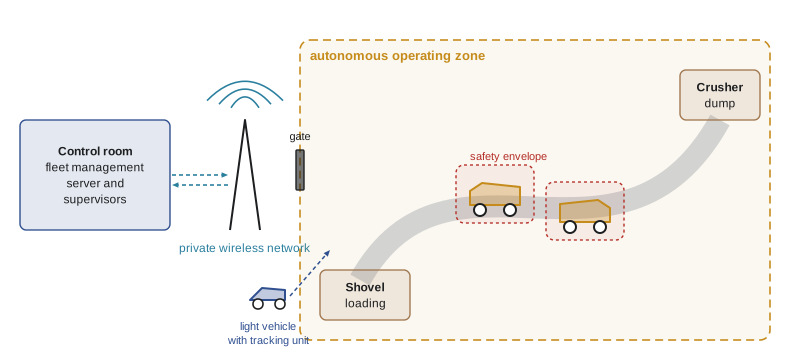
The safety concept relies on separation and positive control. The mine is divided into autonomous operating zones; staffed vehicles entering them carry tracking units that report position to the control system, and access is controlled by permits and gates. Each autonomous truck has a planned path and a safety envelope that the system keeps clear; onboard obstacle detection provides a further layer. If communication is lost, trucks stop. ISO 17757 sets safety requirements for autonomous and semi-autonomous machine systems in earth-moving and mining, and regulators expect mines to document risk assessments and change management for automation projects.
In Canada, mining is regulated provincially, under laws such as Ontario's mining regulation under the Occupational Health and Safety Act and Alberta's OHS Code, and oil sands operations also answer to the Alberta Energy Regulator for many aspects of operation. Mines introducing autonomous equipment typically work with the regulator and the joint health and safety committee on the risk assessment, training and procedures.
| Benefit reported by operators | Mechanism | Caveat |
|---|---|---|
| Higher utilization | No shift changes, breaks or driver shortages; trucks run more hours a year | Gains depend on maintenance and dispatch keeping pace |
| Consistent driving | Smoother speed control and braking reduce tyre and component wear | Road maintenance quality becomes more important |
| Safety | Fewer people exposed to haul road hazards and fatigue | New hazards at interfaces with staffed equipment |
| Lower cost per tonne | Productivity and wear gains, fewer drivers | Large investment in network, systems and training |
# Haul fleet productivity: staffed versus autonomous operation (illustrative assumptions)
hours_year = 8760
def tonnes_per_year(trucks, payload_t, cycle_min, availability, utilization):
    cycles_per_hour = 60 / cycle_min
    operating_hours = hours_year * availability * utilization
    return trucks * payload_t * cycles_per_hour * operating_hours
staffed = dict(trucks=40, payload_t=360, cycle_min=32, availability=0.88, utilization=0.75)
auto    = dict(trucks=40, payload_t=360, cycle_min=31, availability=0.88, utilization=0.86)
t_s, t_a = tonnes_per_year(**staffed), tonnes_per_year(**auto)
print(f"staffed fleet:    {t_s/1e6:6.1f} Mt per year")
print(f"autonomous fleet: {t_a/1e6:6.1f} Mt per year  (+{t_a/t_s - 1:.0%})")
trucks_needed = staffed["trucks"] * t_s / t_a
print(f"trucks needed to move the staffed tonnage autonomously: {trucks_needed:.1f}")staffed fleet: 156.1 Mt per year autonomous fleet: 184.8 Mt per year (+18%) trucks needed to move the staffed tonnage autonomously: 33.8
Modest gains in utilization and cycle time compound into a large difference in annual tonnage, or allow the same tonnage with fewer trucks. Published operator figures vary by site and are often commercially sensitive, so the numbers here are illustrative; the method is what matters when building a business case.
Drilling, loading and underground automation
Autonomous blast-hole drills position themselves from GNSS and a drill plan, level, drill to depth and move to the next hole, with one supervisor monitoring several rigs. Shovels and wheel loaders have been harder to automate fully because digging requires judging material and fragmentation, but assisted and remote-controlled loading is common. Underground, GNSS is unavailable and dust, water and darkness challenge sensors. Load-haul-dump machines (LHDs) in underground mines use lidar-based localization against surveyed tunnel profiles to drive autonomously between draw points and ore passes, with operators remotely controlling the loading step from a surface control room. Such teleremote and autonomous operation removes people from areas with fall-of-ground, blasting fumes and heat, and allows work to continue during shift changes and post-blast re-entry periods.
Underground automation depends on communication: leaky feeder cables, Wi-Fi and private LTE or 5G networks are installed in drifts so that machines and supervisors stay connected. Electrification of underground fleets with battery-electric LHDs and trucks reduces diesel exhaust and ventilation demand, and many Canadian mines have adopted battery-electric equipment; autonomy and electrification are often planned together.
Worked problem
Ventilation benefit of battery-electric machines
An underground mine plans ventilation of about 0.06 m³/s per kW of diesel engine power in a zone. Replacing four 250 kW diesel LHDs with battery-electric units removes the exhaust that this airflow was meant to dilute. How much airflow requirement is removed, assuming heat and other contaminants are handled separately?
Show solution
- Diesel power removed: \( 4 \times 250 = 1000 \) kW.
- Airflow requirement removed: \( 1000 \times 0.06 = 60 \) m³/s.
- Fan power scales roughly with the cube of flow in a fixed system, so large airflow reductions give much larger energy savings.
Answer: About 60 m³/s of diesel dilution airflow, a substantial saving; the actual ventilation design must still handle heat, dust and blasting fumes. The airflow factor here is illustrative.
Inspection robots in the energy sector
Pipelines are inspected internally by in-line inspection tools, often called smart pigs, which travel with the product flow and use magnetic flux leakage, ultrasonic or electromagnetic acoustic sensors to measure wall loss, cracks and dents along hundreds of kilometres. Pipelines that cannot accept conventional tools because of tight bends, valves or low flow can be inspected by self-propelled robotic crawlers. Above ground, drones and ground robots inspect rights-of-way, compressor stations and tank farms. Inspection robots carrying gas detectors and thermal cameras patrol plants on schedules, and quadruped robots are used on offshore platforms and in process plants to read gauges, listen for leaks and detect hot spots.
Federally regulated pipelines in Canada are overseen by the Canada Energy Regulator (CER), whose onshore pipeline regulations require integrity management programmes that commonly include in-line inspection; provincially regulated pipelines answer to provincial regulators such as the Alberta Energy Regulator.
Electricity utilities use robots on live transmission lines, where de-energizing a line is costly or impossible. Hydro-Québec's research institute developed LineScout, a robot that travels along energized conductors, crossing obstacles, to inspect and repair them, and later LineRanger and related tools; such robots have been used on high-voltage lines in Canada and abroad. Drones now carry out much routine line and tower inspection, and ground robots with insulated arms perform some live-line tasks at distribution voltages. Wind turbine blades are inspected by drones and by crawling robots that move along the blade, and solar farms use rail-mounted or autonomous cleaning robots, especially in dusty climates.
Worked problem
In-line inspection run planning
A smart pig must travel 180 km of pipeline. Its sensors record valid data between 0.5 and 4.0 m/s. The product flow gives a pig speed of about 2.2 m/s. How long will the run take, and how much data will it collect at 1,000 samples per metre from each of 400 sensors, with 2 bytes per sample?
Show solution
- Run time: \( 180000 / 2.2 \approx 81800 \) s, about 22.7 h.
- Samples: \( 180000 \times 1000 \times 400 = 7.2 \times 10^{10} \).
- Data: \( 7.2 \times 10^{10} \times 2 = 1.44 \times 10^{11} \) bytes, about 144 GB.
Answer: About 23 hours and roughly 144 GB of raw data, which must be stored onboard and analysed after the run; speed must stay inside the 0.5 to 4.0 m/s band for valid data.
Robots in nuclear facilities
Radiation drives automation in the nuclear industry. Robots and remote tools are used for reactor inspection, refurbishment and decommissioning, and in emergencies. In Ontario, the refurbishment of CANDU reactors at Darlington and Bruce has relied on purpose-built robotic tooling to remove and replace fuel channels and feeder tubes, reducing radiation exposure and schedule. At Fukushima Daiichi, a series of robots has been sent into the damaged reactor buildings since 2011, many failing because of radiation, debris and water; in 2024 the operator retrieved a first small sample of fuel debris with a remotely operated telescopic device.
Ionizing radiation damages electronics in two ways. Total ionizing dose gradually shifts transistor behaviour until circuits fail, and single-event effects are sudden upsets or latch-ups caused by individual particles. Many commercial electronics tolerate total doses only in the range of tens to a few hundred gray before failing, while radiation-hardened parts tolerate far more at much greater cost. Designers therefore shield sensitive electronics, keep them away from the source using long tethers or manipulators, use radiation-tolerant components, and plan the robot's time in high fields.
# Mission time limited by total ionizing dose (illustrative tolerances and dose rates)
budgets_gy = {"commercial camera": 50, "commercial computer board": 150, "radiation-tolerant controller": 5000}
dose_rates_gy_h = {"general area": 0.01, "near shielded vessel": 1.0, "inside damaged containment": 10.0}
shield_factor = 4.0     # local shielding reduces dose to electronics by this factor (illustrative)
for part, budget in budgets_gy.items():
    times = ", ".join(f"{loc}: {budget / (rate / shield_factor):,.0f} h" for loc, rate in dose_rates_gy_h.items())
print(f"{part:30s} {times}")commercial camera general area: 20,000 h, near shielded vessel: 200 h, inside damaged containment: 20 h commercial computer board general area: 60,000 h, near shielded vessel: 600 h, inside damaged containment: 60 h radiation-tolerant controller general area: 2,000,000 h, near shielded vessel: 20,000 h, inside damaged containment: 2,000 h
The table shows why robots entering a damaged containment last only a day or two with commercial electronics, while radiation-tolerant designs can last for months. Sensors such as cameras are often the weakest link, because image sensors cannot be shielded from the scene they are imaging.
The Canadian Nuclear Safety Commission (CNSC) licenses nuclear facilities in Canada, and licensees must keep worker doses as low as reasonably achievable (ALARA); remote and robotic tooling is a common way to meet that requirement during maintenance and refurbishment.
Construction robotics
Construction sites are semi-structured: plans exist, but the site changes daily, workers and machines are everywhere, and conditions vary with weather. Robots on site include autonomous compaction rollers and dozers using machine control, layout robots that print floor plans from the building model onto slabs, drilling robots for ceiling anchors, rebar-tying machines on bridge decks, bricklaying and block-laying systems, and quadruped or wheeled robots that capture progress scans. Much automation has moved off site into factories for prefabricated and modular construction, where the environment is controlled. CON-260 lesson 10 discussed these technologies as part of a digital construction toolkit; from a robotics standpoint, the hard problems are perception in clutter, working safely near people who are not trained robot operators, and connecting robots to building information models and schedules.
| Domain | Typical robots | Main drivers | Main obstacles |
|---|---|---|---|
| Open-pit mining | Autonomous haul trucks, drills, trains | Utilization, safety, remote sites | Interfaces with staffed equipment, network coverage |
| Underground mining | Autonomous and teleremote LHDs, drills | Removing people from hazards, electrification | No GNSS, dust, communication infrastructure |
| Pipelines and plants | Smart pigs, crawlers, quadrupeds, drones | Integrity management, regulation, cost | Access, data analysis, hazardous-area certification |
| Power lines and renewables | Line robots, drones, blade crawlers, cleaners | Avoiding outages, worker safety | Live-line hazards, wind, scale of assets |
| Nuclear | Remote tooling, inspection and decommissioning robots | Radiation exposure limits | Radiation damage to electronics, qualification |
| Construction | Layout, drilling, compaction and scanning robots | Labour shortages, quality, schedule | Changing sites, people nearby, integration |
Equipment used where flammable gas or dust may be present must be certified for hazardous locations, using the IECEx and ATEX schemes internationally, the Canadian Electrical Code's hazardous location rules with CSA certification, or the National Electrical Code's classified locations with listings by nationally recognized testing laboratories in the United States. Explosion-proof or intrinsically safe robots for oil and gas plants and underground coal mines are heavier and more expensive, which limits the choice of platforms.
Workforce and community effects
Automation in mining and energy changes jobs as well as machines. Haul truck driving has historically been a well-paid entry point into mining jobs, including for Indigenous community members near mine sites in Canada and Australia, and impact-benefit agreements often include employment commitments. Autonomous fleets reduce driver positions while creating jobs in control rooms, maintenance, network support and data analysis that require different training. Companies and unions have negotiated transition programmes, and communities have asked for early consultation and training access. ROB-450 lesson 11 discussed automation and work more broadly; engineers in this field should expect to explain such trade-offs to workers, communities and regulators.
Common mistakes
MistakeAssuming autonomous haul trucks are safe because they have obstacle detection.
InsteadSafety rests on zoning, access control, tracking of staffed vehicles, fail-safe stopping on communication loss and change management, with onboard detection as a further layer.
MistakeEstimating automation benefits from cycle time alone.
InsteadInclude utilization, availability, maintenance capacity and network reliability; most gains come from more operating hours.
MistakeUsing commercial electronics in high radiation fields without a dose budget.
InsteadEstimate total dose for the mission, shield and distance sensitive parts, and use radiation-tolerant components where needed.
MistakeSending a standard robot into a plant with flammable atmospheres.
InsteadCheck the hazardous-area classification and use equipment certified for it.
MistakeIgnoring workforce and community commitments in automation plans.
InsteadPlan retraining and new roles, consult early, and respect agreements with nearby communities.
Summary and key terms
- Autonomous haulage systems combine GNSS, perception, wireless networks and central fleet control, with safety based on zoning and positive control.
- Large autonomous fleets run in Australian iron ore mines and Canadian oil sands; ISO 17757 addresses their safety.
- Most productivity gains come from higher utilization, which compounds into large annual differences.
- Underground automation uses lidar localization, teleremote operation and private networks, often together with electrification.
- Energy inspection uses smart pigs, crawlers, line robots, drones and quadrupeds under pipeline and utility regulation.
- Radiation limits robot life through total dose and single-event effects; dose budgets and shielding guide design.
- Construction robotics, hazardous-area certification and workforce effects shape adoption in heavy industry.
- Autonomous haulage system
- A system of driverless haul trucks managed by central fleet control over a private network.
- Safety envelope
- A zone around a planned vehicle path that the control system keeps clear of other vehicles and people.
- Load-haul-dump machine
- An underground loader that carries ore from draw points to ore passes or trucks.
- Teleremote operation
- Remote control of a machine for some steps, often combined with autonomous travel.
- In-line inspection tool
- A device, often called a smart pig, that travels inside a pipeline measuring wall condition.
- Magnetic flux leakage
- An inspection method that detects metal loss from disturbances in a magnetic field in the pipe wall.
- Total ionizing dose
- The accumulated radiation dose that gradually degrades electronic components.
- Single-event effect
- A sudden malfunction caused by a single energetic particle striking a circuit.
- ALARA
- As low as reasonably achievable, the principle for limiting radiation exposure.
- Hazardous location
- An area where flammable gases, vapours or dusts may be present, requiring certified equipment.
Practice problems
Work each problem on paper first, then reveal the answer to check.
List three layers of protection in an autonomous haulage safety concept.
Show answer
Zoning and access control; tracking of staffed vehicles with safety envelopes kept clear by the controller; onboard obstacle detection; stopping on communication loss.
A truck fleet goes from 75 to 85 per cent utilization. Estimate the tonnage increase, all else equal.
Show answer
\( 85/75 - 1 \approx 13 \) per cent.
Why is GNSS-based autonomy not directly usable underground?
Show answer
Satellite signals do not reach underground; machines use lidar matching against tunnel profiles and other local references.
Why are autonomy and electrification often planned together in underground mines?
Show answer
Both reduce people's exposure and ventilation demand, and new equipment and infrastructure can be designed for both at once.
A pig travels at 1.8 m/s through 90 km. How long does the run take?
Show answer
\( 90000 / 1.8 = 50000 \) s, about 13.9 h.
What advantage do live-line robots give a utility?
Show answer
They inspect and repair energized lines without outages and reduce worker exposure to high-voltage hazards.
A camera tolerates 40 Gy and the dose rate at its location is 2 Gy/h. How long will it last?
Show answer
20 hours.
Why are cameras often the weakest component of a nuclear inspection robot?
Show answer
Image sensors are sensitive to radiation and cannot be shielded from the scene they must view.
Name two certification schemes for equipment in hazardous locations.
Show answer
IECEx and ATEX; CSA certification under the Canadian Electrical Code; NRTL listing under the National Electrical Code.
Why have Indigenous communities raised concerns about autonomous haul trucks?
Show answer
Driving jobs have been an important employment route under impact-benefit agreements, and automation reduces them unless new roles and training are provided.
Lesson quiz · 5 questions
Score 60% or more to complete this lesson.
Create a free account to save your progress, take quizzes and earn a certificate.