
SLS-120 · Lesson 1 of 12 · 20 min
Communication in selling
▶ Video coming soon A video version of this lesson is on the way.
Maya Chen sold appliances on the floor at Juniper & Pine Home in Regina for three years before she joined Ridgeline Workplace Solutions as an account executive in August 2026. On her second day, her new manager, Darnell Brooks, asked her what she thought had made her good on the sales floor. She said product knowledge. Darnell asked her to think about her best sale of the last year instead, and to tell him what she had actually done. After a minute she described a retired couple who came in to look at a dishwasher and left with a dishwasher, a range and a promise to come back for a refrigerator. 'I asked them what was wrong with the old one,' she said, 'and then I mostly listened. He cooks. She does the dishes. They argue about the noise.' Darnell nodded. 'That was not product knowledge,' he said. 'That was a conversation.'
This course is about that conversation. It teaches the skills that sit underneath every sale, in a store or across a boardroom table: listening, asking good questions, building rapport, reading and sending nonverbal signals, adapting to different people, using the phone, video and written messages well, telling stories and handling strong emotions. Darnell runs a weekly conversation clinic for Ridgeline's newer sellers on Tuesday mornings, and Maya's former manager at Juniper & Pine, Bev Halvorsen, is coaching a new sales associate, Aiden Laroque, on the store floor. The course follows both of them through the fall of 2026.
Why conversation is the core sales skill
Selling is often pictured as talking: the persuasive pitch, the smooth answer to every objection, the confident close. In practice, the sellers who do best usually talk less than average and ask and listen more. Buyers today can find specifications, prices and reviews on their own before they ever speak to a salesperson. What they cannot easily get on their own is help working out what they actually need, which options fit their situation and what could go wrong. A salesperson adds value by helping the buyer think, and that happens in conversation.
Conversation also builds the trust that makes a buyer willing to share information. A customer who feels heard will tell you the real budget, the real deadline and the real worry behind the request. A customer who feels pushed will tell you as little as possible and make the decision somewhere else. In both business-to-business and retail selling, the quality of the information a salesperson gathers depends on the quality of the conversation.
Finally, conversation is where most sales go wrong. Ask Darnell why deals are lost and he will name things like these: the seller assumed the problem instead of asking about it, talked over the buyer, missed a sign that the buyer was uncomfortable, followed up with a vague email, or got defensive when the buyer pushed back. None of these are product problems. All of them are conversation problems, and all of them can be trained.
How a sales conversation differs from other business communication
Many of the basic skills of clear communication, such as knowing your audience, being concise and confirming understanding, are covered in BUS-120 Business Communication. A sales conversation uses those skills, but it has features of its own.
| Feature | What it means | What it asks of the seller |
|---|---|---|
| Two goals at once | The buyer wants to solve a problem; the seller also wants to make a sale. | Be open about your role and keep the buyer's problem at the centre. |
| Uneven information | The seller knows the products; the buyer knows the situation. | Ask before you tell, so you know which product facts matter. |
| Real stakes for the buyer | Money, time and sometimes reputation ride on the decision. | Expect caution and treat it as reasonable, not as resistance. |
| Several conversations | Most sales take more than one contact, and many involve several people. | Summarize, confirm and agree on a next step every time. |
| A record that matters | Notes and follow-up messages become part of the deal. | Write things down accurately and promptly. |
The first feature deserves a moment. Buyers know that salespeople are paid to sell, and pretending otherwise damages trust. Good sellers do not hide their goal. They make it clear that they want the business, and equally clear that they want it only if the product genuinely fits. That combination of honesty about the goal and real interest in the buyer's problem is the foundation of everything else in this course.
A simple model of communication
Communication researchers have long described communication as a loop. A sender turns an idea into a message, sends it through a channel, and a receiver interprets it. The receiver's response, called feedback, tells the sender whether the message landed as intended. Noise is anything that interferes: a bad phone line, a distracted buyer, a word that means one thing to the seller and another to the buyer, or the buyer's suspicion that the seller is exaggerating.
For a salesperson, the most useful part of this model is the reminder that meaning is made by the receiver. When Maya tells a clinic manager that a printer is 'fast', the manager decides what fast means. If the clinic prints a few pages at a time, fast might mean the first page comes out quickly. The spec sheet might mean pages per minute on long jobs. Unless Maya asks, she will not know which meaning the manager heard. Much of this course is about shortening that loop: checking, confirming and adjusting so that the two people in the conversation are talking about the same thing.
The arc of a sales conversation
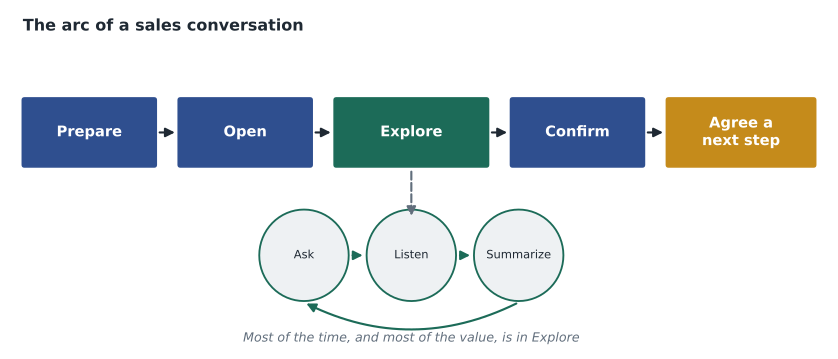
Sales conversations vary enormously, from a two-minute exchange beside a mattress display to a ninety-minute meeting with a school division's facilities team. Most of them, though, follow the same broad arc. Darnell draws it on the whiteboard at the first clinic as five stages.
Prepare. Before the conversation, the seller learns what can reasonably be known: who the buyer is, what they have bought before, what prompted the contact and what the seller hopes to learn. In a store, preparation is shorter but still real: knowing the stock, the current promotions and the delivery schedule before the first customer walks in.
Open. The first moments set the tone. The seller greets the buyer, makes a little personal connection if the setting allows it, and states the purpose of the conversation. In business selling, Darnell teaches a short opening that names the purpose, proposes how the time will be used and checks that the buyer agrees, such as: 'I thought we could spend a few minutes on how printing works for you today, then I can show you a couple of options if it makes sense. Does that work?'
Explore. This is the heart of the conversation. The seller asks questions, listens closely and summarizes what was heard, then asks again. Most of the skills in this course live here. In later courses, SLS-211 Consultative Selling and Discovery goes much deeper into planning and running discovery in business sales, and SLS-250 Retail Selling and Clienteling does the same for the sales floor.
Confirm. Before proposing anything, the seller checks understanding: 'So the main issue is that the front desk printer jams during the morning rush, and the doctors want scanned documents to go straight to patient files. Is that right?' Confirmation catches misunderstandings early and shows the buyer that they were heard.
Agree on a next step. Every conversation should end with something definite: a purchase, a demonstration, a quote by Thursday, a meeting with the person who signs the cheques, or even an agreement that the timing is wrong and a date to talk again. A conversation that ends with 'let me know' usually ends there.
Talking less and listening more
A popular figure among sales trainers is the talk-to-listen ratio, the share of a conversation in which the seller is speaking. Conversation analytics companies that record and analyze large numbers of sales calls have reported that sellers on successful calls tend to speak for well under half of the time, often somewhere around four tenths, while sellers on unsuccessful calls tend to talk more. These figures come from vendors analyzing their own customers' calls rather than from independent research, and the exact numbers vary from study to study, so they should be treated as a rough guide. The direction, though, matches what experienced sales managers report and what research on listening suggests: buyers respond well to sellers who let them speak.
Worked problem
Working out a talk ratio
Darnell listens to a recording of a 30-minute discovery call Maya made to Northfield Family Clinic. Maya spoke for a total of 19 minutes and the office manager for 11 minutes. What was Maya's talk ratio, and what does it suggest?
Show solution
- The talk ratio is the seller's talking time divided by the total talking time.
- \[19 \div (19 + 11) = 19 \div 30 \approx 0.63\]
- Maya spoke for about 63 minutes in every 100 of talking time, or roughly two thirds of the call.
- For a discovery call, where the goal is to learn about the buyer, that is high.
Answer: Maya talked for roughly 63 in every 100 minutes of the conversation. Darnell suggests she aim to bring that below half on her next discovery call by asking more open questions and pausing after each answer.
When they replayed the call, Maya could hear the problem. Each time the office manager mentioned a frustration, Maya jumped in to explain how a Ridgeline product would fix it. By the twentieth minute, the office manager was giving one-word answers. 'You were right about the products,' Darnell told her. 'You were just right too early.'
Honesty as a working rule
Every technique in this course can be used well or badly. Questions can uncover a real need or trap a buyer into agreeing to something. Rapport can be genuine or manufactured. Stories can illustrate truthfully or mislead. The course takes a clear position: the skills are meant to help buyers make good decisions, and they work best when they are used honestly. This is partly a matter of ethics, which SLS-150 Sales Law and Ethics treats in depth. It is also a practical point. Most sales depend on repeat business and referrals. A seller who wins one sale with a misleading conversation often loses the next five.
Honest conversation also has legal edges. In both countries, what a salesperson says about a product can become a representation the business is held to. A seller who tells a customer that a mattress 'will fix your back pain' or that a printer 'never jams' may be making a claim that consumer protection or competition law treats as misleading. The course flags these edges as they come up, and SLS-150 covers the law itself.
Two settings, one set of skills
Maya now sells to organizations, where a sale can take months, involve several people and be worth tens of thousands of dollars. Aiden sells to individuals and families, where most sales happen in a single visit and the buyer is usually standing in front of him. The settings differ, but the conversation skills are the same. Both of them have to open well, ask questions that help the buyer think, listen to the answers, check their understanding and agree on what happens next. In each lesson, you will see the skill in both settings.
| Skill | At Ridgeline (business selling) | At Juniper & Pine (retail selling) |
|---|---|---|
| Opening | A short purpose statement at the start of a scheduled call | A friendly greeting that does not pressure a browsing customer |
| Questioning | Questions about the organization's process, people and goals | Questions about the home, the household and how the product will be used |
| Listening | Taking notes and summarizing for the whole buying team | Picking up on what each family member cares about |
| Confirming | A written summary after the meeting | A quick spoken recap before showing products |
| Next step | A booked demonstration or a quote by a set date | A purchase today, a hold on an item or a follow-up call |
Bev puts it to Aiden on his first Saturday in a way Darnell would recognize. 'People don't come in to buy a sofa,' she says. 'They come in because something in their life changed. They moved, or the kids got bigger, or the old one finally gave out. Find out what changed, and the sofa part is easy.'
Common mistakes
MistakeProduct knowledge is the main thing that makes a good salesperson.
InsteadProduct knowledge matters, but it only helps once the seller understands what the buyer needs, which comes from conversation.
MistakeA good salesperson is a good talker.
InsteadSuccessful sellers usually spend more of the conversation asking and listening than talking.
MistakeBuyers should not know that the seller wants to make a sale.
InsteadBe open about the goal and equally clear that you want the sale only if the product fits.
MistakeA conversation that goes well will lead to the next step on its own.
InsteadAgree on a definite next step before the conversation ends.
Summary and key terms
- Conversation is the core sales skill because buyers can research products alone but need help working out what they need.
- Sales conversations combine two goals, uneven information, real stakes, several contacts and a record that matters.
- Meaning is made by the receiver, so sellers check and confirm rather than assume.
- Most sales conversations follow an arc: prepare, open, explore, confirm and agree on a next step.
- Successful sellers tend to talk for less than half of a discovery conversation, although published talk-ratio figures are rough.
- The skills in this course work best, and last longest, when used honestly.
- Feedback
- The receiver's response, which shows whether a message landed as intended.
- Noise
- Anything that interferes with a message, from a bad line to a buyer's suspicion.
- Talk-to-listen ratio
- The share of a conversation in which the seller is speaking.
- Next step
- A definite action both sides agree to at the end of a conversation.
Practice problems
Work each problem on paper first, then reveal the answer to check.
Name the five stages of the sales conversation arc.
Show answer
Prepare, open, explore, confirm and agree on a next step.
On a 40-minute call, a seller speaks for 14 minutes and the buyer for 26. What is the seller's talk ratio?
Show answer
14 divided by 40 is 0.35, or 35 minutes in every 100.
Why does Darnell say Maya was "right too early" on the clinic call?
Show answer
She proposed solutions before she understood the problem, so the office manager stopped sharing information.
What did Bev say customers are really coming in for?
Show answer
Something in their life changed; finding out what changed makes the product choice easy.
Lesson quiz · 5 questions
Score 60% or more to complete this lesson.
Create a free account to save your progress, take quizzes and earn a certificate.