
SLS-120 · Lesson 6 of 12 · 19 min
Social styles and adapting to the buyer
▶ Video coming soon A video version of this lesson is on the way.
Two buyers at Keystone Grain Equipment could hardly have been more different. Dale Petrie, the operations director, answered Maya's questions in short sentences, interrupted when she gave background he already knew, and asked twice how long the installation would take. Linda Sorensen, the human resources manager who would oversee the meeting rooms, wanted to know how other companies had introduced the booking software, whether staff had found it easy, and whether Ridgeline would train people in person. After the meeting, Maya told Darnell she felt she had been in two different conversations. 'You were,' he said. 'The question is whether you noticed in time to change how you talked to each of them.'
People differ in how they like to communicate and make decisions. Some want the bottom line; others want the full story. Some decide quickly; others want time, data or the views of colleagues. Adapting to these differences, without changing what is true, is a core sales skill. This lesson introduces one widely used model of communication styles, explains what the evidence does and does not say about such models, and shows how to adapt in practice.
The social styles model
In the 1960s and 1970s, industrial psychologists David Merrill and Roger Reid developed a model of social styles, later described in their 1981 book Personal Styles and Effective Performance. The model describes behaviour along two dimensions. Assertiveness is how much a person tends to tell rather than ask: how forcefully and quickly they state views and push for decisions. Responsiveness is how much a person tends to show emotion rather than control it: how openly they express feelings and how much weight they give to relationships compared with tasks. Combining the two gives four styles.
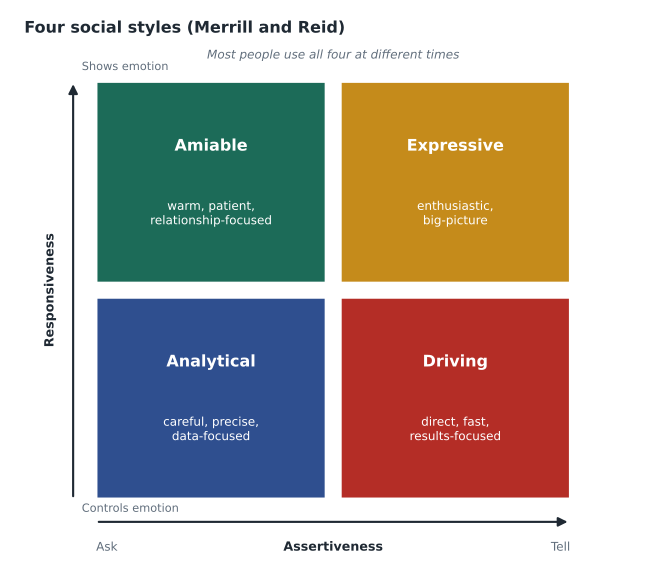
| Style | Typical behaviour | What they tend to value | How to adapt |
|---|---|---|---|
| Driving | Direct, fast, focused on results; may interrupt | Efficiency, results, control | Be brief and organized; lead with outcomes and options; let them decide |
| Expressive | Enthusiastic, talkative, big-picture, persuasive | Recognition, ideas, energy | Show interest in their vision; use stories; confirm details in writing |
| Amiable | Warm, patient, cooperative; avoids conflict | Relationships, security, consensus | Build personal trust; slow down; explain who else is affected; reduce risk |
| Analytical | Careful, precise, reserved, asks many questions | Accuracy, logic, evidence | Bring data and detail; allow time; avoid exaggeration; answer exactly |
Applied to Keystone, Dale Petrie showed many signs of a driving style: short sentences, impatience with background and a focus on the installation timeline. Linda Sorensen showed signs of an amiable style: interest in how people would experience the change and a wish for personal support. Adapting does not mean telling each one something different. It means delivering the same honest information in the way each one can use. For Dale, Maya prepared a one-page summary with the timeline, the cost and two options. For Linda, she arranged a call with the office manager at a school division that had introduced RoomFlow the year before.
Other popular models
Social styles is one of several models sellers meet. DISC, based on ideas from the psychologist William Moulton Marston in 1928 and turned into a questionnaire by later authors, uses four similar categories: dominance, influence, steadiness and conscientiousness. The Myers-Briggs Type Indicator sorts people into sixteen types based on Carl Jung's theory of psychological types. Many sales training programs use one of these, often through a paid questionnaire.
What the evidence says
These models are popular because they give sellers a simple language for an important truth: people communicate differently, and adapting helps. But the research evidence behind personality typing is limited, and sellers should use the models with care.
Sorting people into types loses information. Research on personality generally finds that traits vary continuously, with most people somewhere in the middle, rather than falling into distinct boxes. When the Myers-Briggs indicator has been studied, a substantial share of people get a different type when they retake it a few weeks later, which is a sign that the categories are not stable. The questionnaires behind commercial DISC and social styles tools have been studied mostly by their publishers, and independent evidence that typing sellers or buyers improves sales results is thin.
The best-supported model of personality among researchers is the five-factor model, often called the Big Five: openness, conscientiousness, extraversion, agreeableness and neuroticism. It measures traits on continuous scales rather than types, and it predicts some work outcomes modestly. It is not designed as a sales tool, and sellers cannot measure a buyer's personality during a conversation anyway.
People also behave differently in different situations. A buyer who is direct and impatient on a Monday morning with a deadline looming may be relaxed and chatty at a trade show dinner. The same person may act one way with their boss and another with a supplier.
For all these reasons, this course uses social styles as a description of the behaviour a seller can see in the moment, not as a label for who someone is. 'Dale is acting in a driving style in this meeting' is useful. 'Dale is a Driver' is a stereotype that can lead a seller to stop listening.
| Using a style model well | Using a style model badly |
|---|---|
| Noticing how this buyer communicates today | Labelling the buyer permanently |
| Adjusting pace, detail and format | Changing the facts or promises to suit the buyer |
| Checking a guess with a question: "Would a one-page summary help?" | Acting on a guess without checking |
| Remembering everyone uses several styles | Assuming a style predicts the decision |
| Adapting your own habits to the buyer | Expecting the buyer to adapt to you |
Adapting in practice
Whatever model a seller uses, adapting comes down to a few practical choices. Sellers can adjust them during a conversation as they learn more about the buyer.
| What to adjust | Options at one end | Options at the other end |
|---|---|---|
| Pace | Brisk; get to the point | Unhurried; leave space |
| Detail | Headline and options | Full specifications and evidence |
| Focus | Results, cost and timeline | People, process and experience |
| Format | Short spoken summary or one-page brief | Detailed document, references or a trial |
| Decision support | Clear recommendation and options | Time, consultation with colleagues, low-risk first step |
| Small talk | Very little | More, as the buyer invites |
The signals that guide these choices are mostly visible in the conversation itself. How quickly does the buyer speak? Do they ask for numbers or for examples? Do they talk about 'I' or 'we'? Do they want to decide in the meeting or consult others? The simplest signal of all is to ask: 'How would you like to see the options: a short summary or the full detail?'
Worked problem
Adapting one message for two buyers
Maya needs to tell both Keystone buyers that installation of the meeting room screens and the booking software will take three weeks, with one week during which two rooms are out of use. Write how she might say it to each.
Show solution
- To Dale, who wants results and speed: "Installation is three weeks. Two rooms are out for one of those weeks; we'd schedule that week around your dealer visits. You'd be fully running by the 22nd."
- To Linda, who cares about people and process: "Installation takes three weeks. In one of those weeks, two rooms will be unavailable, so we'd work with you on a schedule that avoids disrupting staff, and we'd run two short training sessions before go-live so everyone feels comfortable."
- Check that both versions contain the same facts: three weeks, two rooms, one week out of use.
Answer: The facts are identical. Dale's version leads with the outcome and the date; Linda's leads with how people will be affected and supported. Neither version hides the week of disruption.
Adapting on the sales floor
Retail conversations are shorter, so Aiden has less time to read a customer's style, but the same choices apply. Bev teaches him to start in the middle, at a moderate pace with a moderate amount of detail, and adjust quickly. A customer who says 'Just tell me which one's best for under a thousand' wants a recommendation and a reason. A customer who reads every tag and asks about the warranty terms wants detail. A couple where one partner asks about specifications and the other asks how it will feel may need both, and Aiden can address each in turn.
One trap in retail is adapting to the person with the strongest style and ignoring the other. In the sectional sofa story from lesson 5, the partner who asked more questions got most of Aiden's attention, while the quieter partner's concerns about cost went unheard. Bev's rule is to make sure each person in the group gets at least one question directed to them.
Adapting without losing yourself
Some new sellers worry that adapting means being fake. It does not have to. Adapting is what considerate people do in everyday life: speaking more slowly to someone who seems confused, getting to the point with someone who is busy, giving more reassurance to someone who seems nervous. The seller stays the same person with the same values and the same facts. What changes is pace, detail, format and focus. A seller who changes the substance, telling a driving buyer that installation is quick and an amiable buyer that it is gentle when neither is true, has stopped adapting and started misleading.
Adapting to buyers who are stressed, rushed or new to the topic
Style is not the only difference that matters. A buyer's situation on the day can change how they need information far more than any stable preference. A facilities manager dealing with a broken boiler will want a short, practical conversation, whatever their usual style. A first-time buyer who has never bought office equipment before needs more explanation than an experienced purchasing manager. A retail customer who has just come from a hospital appointment may want space and patience.
Sellers adapt to these situations with the same tools: pace, detail, format and focus. They also adapt their language. Industry jargon that an experienced buyer expects can confuse a newcomer, while over-explaining basics to an expert sounds patronizing. A useful check is to ask early how familiar the buyer is with the topic: 'Have you been through a printer lease before, or would it help if I explained how they usually work?' Most buyers appreciate the question, and the answer saves time for both sides.
Accessibility is part of adapting too. Some buyers will need larger print, captions on a video call, a quieter space, more time or information in another format. Asking 'Is there anything that would make this easier for you?' and acting on the answer is good service, and in both countries accessibility laws expect businesses to remove barriers for customers with disabilities.
Language is another difference to adapt to. In Canada and the United States, many buyers speak English as an additional language or prefer another language for important decisions. Speaking clearly, avoiding idioms and slang, checking understanding with open questions and offering written summaries all help. Ridgeline keeps a list of staff who can hold conversations in other languages, and Juniper & Pine lets associates hand a customer to a colleague who shares their language when the customer prefers it.
Finally, remember that buyers are adapting to sellers too. A buyer who seems curt may simply be matching a seller who came in fast and formal. If a conversation feels stiff, the first thing to check is your own pace and tone.
Common mistakes
MistakeSocial styles describe fixed personality types.
InsteadThey describe behaviour a seller can see in the moment, and most people show more than one style.
MistakePersonality typing tools are well supported by research.
InsteadEvidence is limited; types lose information, retest results can change and independent evidence for sales benefits is thin.
MistakeAdapting means telling each buyer what they want to hear.
InsteadAdapt pace, detail, format and focus; keep the facts the same.
MistakeSellers should guess a buyer's style and act on it.
InsteadCheck a guess with a simple question about how the buyer wants information.
MistakeIn a group, adapt to the most vocal person.
InsteadMake sure each person in the group is asked and heard.
Summary and key terms
- People differ in how they communicate and decide, and adapting to those differences is a core sales skill.
- Merrill and Reid's social styles model combines assertiveness and responsiveness into driving, expressive, amiable and analytical styles.
- DISC and the Myers-Briggs indicator are similar popular models; the research evidence behind personality typing is limited.
- Use style models to describe what you see today, not to label people permanently.
- Adapt pace, detail, focus, format, decision support and small talk, and check your guesses with questions.
- Adapting changes how information is delivered, never what is true.
- Social styles
- Merrill and Reid's model of four communication styles based on assertiveness and responsiveness.
- Assertiveness
- How much a person tends to tell rather than ask.
- Responsiveness
- How much a person tends to show emotion rather than control it.
- Big Five
- The research-based model of personality traits: openness, conscientiousness, extraversion, agreeableness and neuroticism.
Practice problems
Work each problem on paper first, then reveal the answer to check.
Name the two dimensions of the social styles model.
Show answer
Assertiveness and responsiveness.
Why does the course say "Dale is acting in a driving style" rather than "Dale is a Driver"?
Show answer
Because styles describe behaviour in a situation, and labels can become stereotypes that stop the seller listening.
Give two reasons sellers should be cautious about personality typing.
Show answer
For example: types lose information because traits vary continuously; retest results can change; independent evidence for sales benefits is thin.
What simple question can a seller ask to check a buyer's preferred style?
Show answer
For example: "Would you like a short summary or the full detail?"
Lesson quiz · 5 questions
Score 60% or more to complete this lesson.
Create a free account to save your progress, take quizzes and earn a certificate.