
SLS-130 · Lesson 1 of 12 · 21 min
Why service sells
▶ Video coming soon A video version of this lesson is on the way.
On a cold Monday in early October 2026, Aiden Laroque started his sixth week as a sales associate at Juniper & Pine Home, the furniture and appliance store on the east side of Regina. He had expected to spend his days selling sofas and refrigerators. Instead, his first two customers that morning wanted something else. One had bought a dishwasher in August and could not get the delivery crew to come back and level it. The other wanted to know whether the mattress she had bought in the spring was still inside its comfort trial. Neither was buying anything. Both, Aiden noticed, had come to the store rather than phoning.
Bev Halvorsen, the store manager, watched him handle both conversations and then took him aside. "Those two people are worth more to us than most of the shoppers who walked in today," she said. "The dishwasher customer has a kitchen renovation planned for next year. The mattress customer has two teenagers who will need beds. If we look after them now, they come back. If we brush them off, they tell everyone at work."
Across town, the same lesson was being learned in a different setting. Maya Chen, a new account executive at Ridgeline Workplace Solutions, was reviewing her accounts with her manager, Darnell Brooks. Ridgeline sells office furniture, printers with managed print contracts, meeting-room technology and a room-booking software subscription called RoomFlow to schools, clinics, law firms and other businesses. One of Maya's accounts, Riverbend Dental Group, had a printer contract coming up for renewal in February 2027. "The renewal isn't decided in February," Darnell told her. "It's decided every time their printer jams and somebody calls us. By the time you sit down to renew, they already know whether they want to."
This course is about that idea: that the way an organization treats customers after the first sale decides much of what it sells next. It runs through year 1 of both the Professional Sales and the Retail Sales programs, and it follows Aiden at Juniper & Pine and Maya at Ridgeline as they learn to serve customers well, recover when things go wrong, and measure whether their efforts are working.
What customer service and customer experience mean
The two terms in this course's title are related but not the same. Customer service is the help an organization gives customers before, during and after a purchase: answering questions, fixing problems, handling returns, booking deliveries and repairs. It is usually delivered by people, sometimes with the help of technology, and it happens in specific interactions that can be observed and improved.
Customer experience is wider. It is the sum of everything a customer goes through with an organization and how they feel about it: seeing an advertisement, browsing the website, walking into the store, talking to a salesperson, paying, waiting for delivery, using the product, getting help when it breaks, and receiving the bill. Service is one part of experience. A store can have friendly, skilled service staff and still give a poor experience if its website is confusing, its delivery windows are unreliable and its invoices are hard to read.
A useful way to separate them is to ask who controls each part. Service interactions are mostly controlled by front-line staff and their managers. Experience is shaped by almost every department: marketing writes the promises, operations sets delivery times, finance designs the invoices, and the website team decides how easy it is to book a repair. Improving experience therefore needs people across the organization to work together, which is why lesson 12 treats redesigning an experience as a team project.
| Customer service | Customer experience | |
|---|---|---|
| Scope | Specific interactions where a customer gets help | Everything the customer goes through, from first awareness to the end of the relationship |
| Who shapes it | Front-line staff, supervisors, service policies | Every department, plus the product itself |
| How it is measured | Satisfaction after an interaction, resolution, handling time | Loyalty, retention, overall satisfaction, effort across the journey |
| Juniper & Pine example | How Aiden handles the dishwasher complaint | Whether buying, delivering and installing a dishwasher felt easy from start to finish |
| Ridgeline example | How quickly a jammed printer gets fixed | Whether owning a managed print contract feels like a good decision a year later |
Why service sells
Salespeople sometimes think of service as a cost: time spent on people who have already paid, time that could be spent finding new customers. The evidence points the other way. Good service sells in at least four ways.
First, service keeps customers. Most businesses earn a large share of their revenue from people who have bought before. A customer who stays for years buys replacement products, adds new ones and costs less to serve than a stranger, because they already know how to buy and need less persuading. Frederick Reichheld and W. Earl Sasser, writing in the Harvard Business Review in 1990, reported that in the service companies they studied, cutting customer defections by 5 in 100 raised profits by between 25 and 85 in 100, depending on the industry. The figure is often repeated as if it applied everywhere, which it does not; it came from particular industries in a particular period. The direction of the finding, though, has held up well: keeping good customers is usually far cheaper than replacing them.
Second, service creates referrals and reputation. People ask friends and colleagues where to buy, and they read online reviews. A customer whose problem was handled well becomes evidence that the business can be trusted. A customer whose problem was ignored becomes evidence of the opposite, and online that evidence stays visible for years.
Third, service creates sales opportunities. A service conversation is often the moment a customer mentions what they need next. The dishwasher customer's kitchen renovation and the clinic's plan to open a second site are examples. A service person who listens can pass that information to sales, and a salesperson who handles service well earns the right to ask about it.
Fourth, service protects price. Customers who trust an organization are less likely to switch for a small discount. In business-to-business selling, a strong service record is one of the main reasons a customer renews without putting the contract out to tender. In retail, a store known for reliable delivery and easy returns can charge more than an online seller that offers neither.
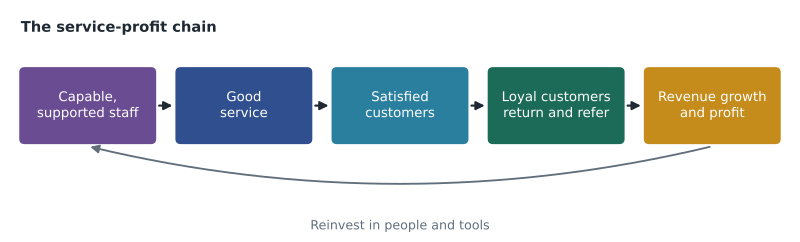
The service-profit chain
In 1994 a group of Harvard researchers, James Heskett and colleagues, described what they called the service-profit chain. Their idea was that profit and growth come mainly from customer loyalty; loyalty comes from satisfaction; satisfaction comes from the value customers receive; and that value is created largely by employees who are capable, supported and satisfied in their own work. The chain starts inside the organization, not with the customer.
The practical message for a sales or service team is that front-line staff cannot give good service with poor tools, unclear policies or no authority to fix anything. When Aiden could not answer the mattress customer's question because the comfort-trial dates were stored only in the delivery system, which sales associates could not see, the problem was not his attitude. It was a link in the chain that the store had not built. Bev asked the operations lead, Marcus Dube, to give associates read-only access to delivery records the following week.
The service-profit chain is a model, not a law. Later research found that the links are real but weaker and more variable than the original articles suggested, and that satisfaction does not always turn into loyalty, especially where switching is easy or prices dominate. It remains a useful checklist: if service is poor, look at the tools, training and authority staff have before blaming the staff themselves.
Service in retail and in business-to-business selling
Service looks different in a store and in a business account, and this course uses both settings because most sellers will work in one or the other.
In retail, a customer usually deals with whoever is available, and many interactions are short. The customer is spending their own money, often on something they will live with for years: a sofa, a mattress, a refrigerator. Emotions run high when a delivery is late or a product fails, because the problem is in their home. Service has to be consistent across many staff and many shifts, so standards and training matter a great deal. The relationship may be long, but it is made of separate visits and calls.
In business-to-business selling, the customer is an organization, and several people inside it are affected by the service: the office manager who books the printer repair, the staff who use the printer, the finance clerk who checks the invoice, and the director who signs the renewal. Each has different needs. Service is often governed by a written contract with response times, called a service level agreement, and failures can cost the customer money. The relationship is continuous: an account executive like Maya may serve the same clinic for years.
| Retail (Juniper & Pine) | Business-to-business (Ridgeline) | |
|---|---|---|
| Who the customer is | An individual or household | An organization with several stakeholders |
| Typical interaction | Short, face to face or by phone, with whoever is on shift | Repeated, by phone, email, portal or visit, often with a named contact |
| What is at stake | Personal money and comfort at home | Productivity, budgets and someone's reputation at work |
| How promises are set | Store policies, advertising, what the associate says | Contracts and service level agreements, plus what the account executive says |
| What loyalty looks like | Returning for the next purchase and recommending the store | Renewing, expanding the contract and giving references |
Everyone in sales is in service
In small and mid-sized businesses there is rarely a clean line between sales and service. At Juniper & Pine, the associate who sold a refrigerator is the person the customer phones when it arrives with a dent. At Ridgeline, Maya is the person Riverbend Dental Group emails when the RoomFlow booking screen stops working, even though a support team actually fixes it. Customers do not care about internal departments. They care that the person they trust takes responsibility for getting the problem solved.
That does not mean salespeople must fix everything themselves. It means they must own the problem until it is handed to someone who will fix it, tell the customer what will happen next, and check that it did happen. Lesson 4 calls this keeping the loop closed. A salesperson who passes a problem along and forgets it teaches the customer that the relationship ends when the money is paid.
The cost of poor service
Poor service costs more than the lost customer. It also creates repeat contacts, because a problem not solved the first time comes back, often angrier. It creates refunds, discounts and free delivery given to calm people down. It takes managers' time. It produces negative reviews that turn away customers the business never meets. And it wears out staff, who spend their shifts absorbing frustration that better processes would have prevented.
A simple way to see the size of the problem is to estimate what a lost customer is worth. Lesson 11 does this properly, using the idea of customer lifetime value. For now, a rough estimate is enough to show why Bev cared so much about two customers who were not buying anything.
Worked problem
What one lost customer costs Juniper & Pine
Bev estimates that a typical Juniper & Pine household buys from the store about once every two years, spending about 1,800 dollars per purchase, and that the store's gross margin, the share of each sale left after paying for the goods, is 40 in 100. She expects a satisfied household to keep buying for about ten years. Estimate the gross margin lost when such a household leaves for good after a badly handled complaint, ignoring the time value of money.
Show solution
- Count the purchases over ten years at one purchase every two years: 10 ÷ 2 = 5 purchases.
- Total spending: 5 × 1,800 = 9,000 dollars.
- Gross margin on that spending: 9,000 × 0.40 = 3,600 dollars.
- Remember what this leaves out: referrals the household would have made, and the negative reviews it may now write.
Answer: About 3,600 dollars of gross margin, before counting lost referrals or the effect of bad reviews. Spending twenty minutes and a modest goodwill gesture to keep that household is usually a good trade.
Maya's numbers at Ridgeline are larger. Riverbend Dental Group's managed print contract brings in about 14,000 dollars a year, and Ridgeline has sold the clinic furniture and RoomFlow as well. Losing the account would not only cost the renewal; it would remove the clinic from the list of references Maya hopes to use with other clinics. Business customers talk to each other too, at association meetings and in procurement networks.
What customers actually want from service
Research and experience point to a short list of things most customers want when they contact a business for help. They want the problem solved, ideally the first time. They want to be treated with respect and not made to feel foolish. They want honest information about what will happen and when. They want not to repeat themselves. And they want the process to be easy: few steps, few transfers, no hunting for the right phone number. Later lessons return to each of these. Lesson 10 shows how to measure them, and lesson 11 shows how they connect to whether customers stay.
What is not on the list matters too: lavish gestures. Customers appreciate a pleasant surprise, but surveys of service contacts consistently find that removing hassle matters more than adding delight. An associate who fixes a delivery problem in one call, and confirms the new date in writing, usually does more for loyalty than one who apologizes warmly, gives a gift card and leaves the problem unsolved.
How this course is organized
The twelve lessons move from the customer's point of view to the organization's. Lessons 2 and 3 cover the customer journey and the standards and promises a business makes. Lessons 4 to 7 cover individual interactions: running a service conversation, handling complaints, recovering from failures, and dealing with difficult or upset customers. Lessons 8 and 9 cover channels: phone, chat and email, then self-service and AI tools. Lessons 10 and 11 cover measurement, loyalty and retention. Lesson 12 brings everything together in a case study, redesigning a service experience at Juniper & Pine and at Ridgeline.
Throughout, the examples use real laws where they matter, such as the consumer protection and accessibility rules that apply in Saskatchewan and across Canada. The companies and people are fictional. The methods are the ones used in real stores and sales teams.
Common mistakes
MistakeTreating service as a cost that takes time away from selling.
InsteadService keeps customers, creates referrals, uncovers new needs and protects price; it is part of selling.
MistakeBlaming front-line staff for every service failure.
InsteadCheck the tools, information, policies and authority staff have; the service-profit chain starts with supporting employees.
MistakeThinking customer service and customer experience mean the same thing.
InsteadService is the help given in specific interactions; experience is everything the customer goes through, shaped by every department.
MistakeQuoting retention statistics as universal laws.
InsteadFigures such as Reichheld and Sasser's came from particular industries; use them to show direction, and estimate your own business's numbers.
MistakePassing a problem to another department and forgetting it.
InsteadOwn the problem until it is solved: hand it over, tell the customer what will happen, and check that it did.
Summary and key terms
- Customer service is the help an organization gives customers in specific interactions; customer experience is everything a customer goes through and how they feel about it.
- Good service sells by keeping customers, generating referrals and reviews, uncovering new needs and protecting price.
- The service-profit chain links capable, supported staff to good service, satisfaction, loyalty and profit, although later research found the links weaker than first claimed.
- Retail service is consistent help across many short interactions with individuals; business-to-business service is continuous, often contractual and involves several stakeholders.
- Salespeople own customer problems until they are solved, even when someone else fixes them.
- A rough lifetime estimate shows how much margin one lost customer represents.
- Customer service
- The help given to customers before, during and after a purchase, in specific interactions.
- Customer experience
- Everything a customer goes through with an organization and how they feel about it.
- Service-profit chain
- A model linking employee capability and satisfaction to service quality, customer loyalty and profit.
- Customer defection
- A customer leaving for a competitor or stopping buying.
- Service level agreement
- A contract term setting response and resolution times for service.
- Gross margin
- The part of a sale left after paying for the goods sold.
Practice problems
Work each problem on paper first, then reveal the answer to check.
Give two reasons a salesperson should care about a customer who is not buying anything today.
Show answer
Any two of: the customer may buy again; they may refer others or write reviews; the conversation may reveal a new need; trust protects future prices and renewals.
Name one link in the service-profit chain and explain how a store could weaken it without meaning to.
Show answer
For example, employee capability: if associates cannot see delivery records, they cannot answer customers' questions, so service suffers.
A household spends 2,400 dollars every three years for twelve years at a 35 in 100 gross margin. Roughly what margin is lost if it leaves at the start?
Show answer
12 ÷ 3 = 4 purchases; 4 × 2,400 = 9,600 dollars; 9,600 × 0.35 = 3,360 dollars.
Lesson quiz · 5 questions
Score 60% or more to complete this lesson.
Create a free account to save your progress, take quizzes and earn a certificate.