
SLS-130 · Lesson 8 of 12 · 18 min
Service by phone, chat and email
▶ Video coming soon A video version of this lesson is on the way.
Juniper & Pine's service team handled about 2,300 customer contacts in October 2026: roughly 1,100 phone calls, 650 emails, 420 website chats and 130 text-message conversations, plus the customers who walked up to the service desk. Two years earlier, almost all contacts had been phone calls and visits. Customers now chose the channel that suited them, and they expected the same quality of answer whichever they chose. A customer who started a chat at lunch and phoned that evening did not want to explain the whole problem again.
This lesson covers the main remote service channels: phone, email, chat and text. It explains what each is good for, the skills each one needs, how to write clearly for customers, how to measure each channel, and how to keep service consistent when customers move between them. Lesson 9 covers self-service and AI tools.
Choosing the right channel
Each channel has strengths and weaknesses. Phone calls carry tone of voice and allow quick back-and-forth, which suits complicated or emotional problems. Email suits detailed information, attachments and anything that needs a record, but it is slow for back-and-forth. Chat is quick for simple questions and lets customers multitask, but long explanations are tiring to type. Text messages suit short updates and confirmations, and most people read them within minutes. In person is best when the customer needs to see or touch something, such as fabric samples or a damaged product.
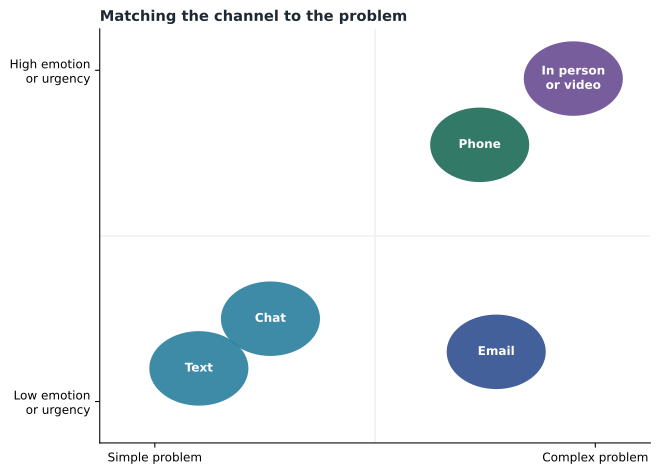
Good service teams sometimes move a conversation to a better channel. A chat about a damaged sofa that becomes long and upset is often better finished on the phone: "This sounds frustrating. Would it be easier if I called you now? I have the details here." A phone call that agrees on a complicated set of actions is better followed by an email confirming them. Moving channels should always be offered, not forced, and it should never mean the customer has to start again.
Telephone service
On the phone the customer cannot see the service person, so voice carries everything. Speed, tone, warmth and clarity matter more than in person. Some practical habits help.
- Answer with a clear greeting, the business name and your name.
- Smile while speaking; it changes the sound of the voice in a way callers can hear.
- Ask permission before putting someone on hold, say how long it will be, and check back if it takes longer.
- Before transferring a call, explain why and to whom, and pass on the details so the customer does not repeat themselves. This is called a warm transfer.
- Take notes during the call and summarize at the end.
- If you promise a call back, give a time and keep it.
Long hold times are one of the most common complaints about phone service. A queue message that gives an honest estimate of the wait, and offers a call-back instead of holding, removes much of the frustration. Juniper & Pine introduced call-backs in September 2026; customers who chose a call-back rated their experience much higher than those who waited on hold for the same time, even though the problem was solved at about the same moment.
Email is slower than phone or chat, but it lets the service person think, check facts and give a complete answer. Customers who choose email often want detail and a written record. The biggest risk in email service is the back-and-forth: a vague reply that leads to another question, then another reply, so a problem that could be solved in one message takes four, spread over a week.
A good service email answers every question the customer asked, in the order they asked it. It uses plain language and short paragraphs. It states clearly what will happen next and when. It anticipates the obvious follow-up questions and answers them too. And it is written to the person, not as a form letter.
| Weak reply | Stronger reply |
|---|---|
| "Thank you for contacting us. Your request has been forwarded to the appropriate department." | "Thanks for letting us know the dresser drawer is sticking. I've booked a technician for Thursday, November 19, between 1 and 3 p.m. If that time doesn't suit, reply with a better day and I'll change it." |
| "Please refer to our return policy on the website." | "Yes, you can return the lamp until November 28, because it's within 30 days of purchase and unused. Bring it and your receipt to the service desk, and we'll refund your card the same day; the refund usually appears within five business days." |
| A single long paragraph mixing three answers | Three short paragraphs, one per question, each starting with the answer |
Response time matters in email too. Many businesses set a standard, as Juniper & Pine did in lesson 3, of replying within one business day. An automatic acknowledgement that says when a full reply will come is better than silence, but it is not a substitute for the reply.
Writing clearly for customers
Most customer contact is now written: emails, chats, texts, help articles. Clear writing is therefore a core service skill. A few principles cover most situations.
- Lead with the answer. Put the most important information first: what you have done, or what will happen.
- Use plain words. Write "we will refund you" rather than "a refund will be processed to the original tender".
- Keep sentences short, around 15 to 20 words on average.
- Be specific about dates, times, amounts and names.
- Use the customer's name, and sign with your own.
- Read it once from the customer's point of view before sending.
Tone is harder in writing because the reader cannot hear the writer's voice. Short replies can seem curt; jokes can be misread; exclamation marks can seem insincere if overused. A warm but simple style works best: polite, direct and human. Writing "I'm sorry the delivery was late" reads as sincere; "We apologize for any inconvenience this may have caused" reads as a template.
Chat and messaging
Live chat on a website, and messaging through text or apps, have grown quickly because customers like getting help without a phone call. Chat sits between phone and email: it is written, but customers expect quick replies, usually within a minute or two. Service staff often handle two or three chats at once, which is efficient but risky; customers notice long pauses and generic answers.
Good chat service starts with a quick, personal greeting, asks for the order number early, keeps messages short, and avoids long blocks of text. It uses saved replies, sometimes called canned responses, for common information such as store hours, but personalizes them. It tells the customer if a check will take a few minutes, so they are not left wondering. And it ends with a summary of what was agreed, which the customer can save.
Text messaging works particularly well for updates. Juniper & Pine's delivery texts, introduced after the journey-mapping session in lesson 2, give a two-hour window the evening before and a thirty-minute warning on the day, and let customers reply to reschedule. In the first two weeks of November 2026 the number of "where is my truck?" calls fell from about 14 per 100 deliveries to about 4.
Texts and other electronic messages also bring legal duties. Canada's Anti-Spam Legislation (CASL) governs commercial electronic messages, which generally need the recipient's consent and must identify the sender and offer a way to unsubscribe. Messages that only confirm or update an existing transaction, such as a delivery notice, are treated differently from promotional ones. Service teams should keep transactional updates separate from marketing, and SLS-150 covers the rules in detail.
Measuring channel performance
Each channel has its own common measures. Some focus on speed, some on effort and some on outcome.
| Measure | What it means | Main channels |
|---|---|---|
| Average speed of answer | How long customers wait before reaching a person | Phone, chat |
| Abandonment rate | Share of customers who give up before reaching a person | Phone, chat |
| First response time | Time from the customer's message to the first human reply | Email, chat, text |
| Average handling time | Time spent on each contact, including follow-up work | All |
| First contact resolution | Share of problems solved in the first contact, with no need to contact again | All |
| Satisfaction after the contact | The customer's rating of the interaction, covered in lesson 10 | All |
Speed measures are useful but can be misleading on their own. If staff are pushed to cut average handling time, they may rush customers and fail to solve the problem, which leads to repeat contacts. First contact resolution is often the best single operational measure, because a problem solved first time is good for the customer and cheap for the business. It is usually estimated by checking whether the same customer contacts again about the same issue within a set period, such as seven days.
Worked problem
Comparing first contact resolution by channel
In October 2026 Juniper & Pine's service team recorded the following. Phone: 1,100 contacts, of which 286 were followed by another contact about the same issue within seven days. Email: 650 contacts, 221 followed by another. Chat: 420 contacts, 76 followed by another. Estimate first contact resolution for each channel and suggest what to look at.
Show solution
- Phone: 1,100 − 286 = 814 resolved first time; 814 ÷ 1,100 × 100 = 74 in 100.
- Email: 650 − 221 = 429; 429 ÷ 650 × 100 = 66 in 100.
- Chat: 420 − 76 = 344; 344 ÷ 420 × 100 = 81.9, about 82 in 100.
- Email is lowest. A likely cause is vague replies that lead to more questions; reviewing a sample of emails that caused repeat contacts would show whether this is true.
- Chat is highest, but chat may receive simpler questions, so the channels are not handling identical work.
Answer: First contact resolution was about 74 in 100 for phone, 66 for email and 82 for chat. Email is the clearest target for improvement, starting with a review of replies that led to repeat contacts. Comparisons should allow for the different kinds of problems each channel receives.
Keeping channels consistent
Customers move between channels, and they expect the business to remember them. A customer who explained a problem by chat should not have to explain it again by phone. This requires a shared record: every contact, in every channel, logged against the customer and the order. Most service teams use a CRM or a dedicated ticket system for this. SLS-140 covers these tools.
Consistency also means giving the same answer in every channel. If the website says returns are accepted within 30 days, the phone team, the chat team and the store must say the same. Juniper & Pine keeps a short internal knowledge base of current policies and answers to common questions, which all service staff use, so the answer does not depend on who the customer happens to reach. Lesson 9 shows how the same knowledge base feeds self-service and AI tools.
Remote service for business customers
Business customers use the same channels, often with additions such as a customer portal where they can log tickets, see the status of repairs and download invoices. Ridgeline's customers can report a printer fault by phone, email or portal; the portal is used most, because office managers like seeing a record of every ticket. Many business customers also expect a named contact. Helen Park at Riverbend Dental Group emails Maya directly about most things, even though support tickets are handled by another team. Maya's job is to make that work: she answers quickly, logs the issue in the right system, and copies Janet on updates, so Janet gets the personal contact she wants and the support team gets the record it needs.
Common mistakes
MistakeForcing customers into one channel.
InsteadLet customers choose, and offer to move channels when another would serve them better.
MistakeTransferring a caller without explanation.
InsteadUse a warm transfer: explain why, and pass on the details so the customer does not repeat themselves.
MistakeSending vague emails that lead to more questions.
InsteadAnswer every question, lead with the answer, give specific next steps and anticipate follow-ups.
MistakePushing staff only to cut handling time.
InsteadBalance speed with first contact resolution, which shows whether problems are actually solved.
MistakeGiving different answers in different channels.
InsteadUse a shared customer record and a common knowledge base of current policies.
Summary and key terms
- Each service channel has strengths: phone for complex or emotional problems, email for detail and records, chat for quick questions, text for updates, and in person for things customers must see.
- Staff can offer to move conversations to a better channel without making customers start again.
- Phone service relies on voice, honest hold times, call-backs and warm transfers.
- Email and chat need clear, specific writing that leads with the answer.
- Electronic messages carry legal duties, especially for marketing.
- Channel measures include speed of answer, abandonment, first response time, handling time and first contact resolution, which is often the most useful.
- Consistency across channels needs a shared customer record and a common knowledge base.
- Channel
- The medium through which a customer and business interact, such as phone, email, chat or in person.
- Warm transfer
- Passing a caller to another person after explaining why and sharing the details, so the caller need not repeat them.
- Call-back
- An offer to phone the customer back instead of keeping them on hold.
- First contact resolution
- The share of problems solved in the first contact, without the customer needing to contact again.
- Abandonment rate
- The share of customers who give up before reaching a person.
- Knowledge base
- A shared collection of current policies and answers used by staff and self-service tools.
Practice problems
Work each problem on paper first, then reveal the answer to check.
Which channel suits a long, upset conversation about a damaged sofa, and why?
Show answer
Phone or in person, because tone of voice and quick back-and-forth help with complex and emotional problems.
Rewrite "Your request has been forwarded to the appropriate department" as a better email.
Show answer
For example: "I've asked our delivery team to rebook your sofa. They will call you by 4 p.m. tomorrow with a new date."
Of 500 chats, 60 led to another contact about the same issue within seven days. What is first contact resolution, in 100?
Show answer
(500 − 60) ÷ 500 × 100 = 88 in 100.
Lesson quiz · 5 questions
Score 60% or more to complete this lesson.
Create a free account to save your progress, take quizzes and earn a certificate.