
SLS-150 · Lesson 7 of 12 · 18 min
Calls, texts and email: CASL and the do-not-call list
▶ Video coming soon A video version of this lesson is on the way.
Owen Pelletier, who leads Ridgeline's inside sales team, had a plan for November. A list vendor offered 400 names and email addresses of office managers at small businesses in the region, with mobile numbers for about half. Owen wanted to load the list into the CRM and start a six-touch sequence: three emails, two calls and a text message. He brought the plan to the weekly sales meeting. Leah Marchand, who had been invited to talk about something else, asked three questions. Where did the vendor get the addresses? What consent do we have to message these people? And what happens when someone asks us to stop? Nobody in the room could answer the first two.
Electronic messages and phone calls are the main tools of modern prospecting, and both are tightly regulated. The rules differ more between Canada and the United States here than almost anywhere else in sales law, and the penalties can be counted per message, which means a single careless campaign can create enormous liability. This lesson explains the rules for email, text and other electronic messages, and for sales calls, in your country.
Canada's Anti-Spam Legislation
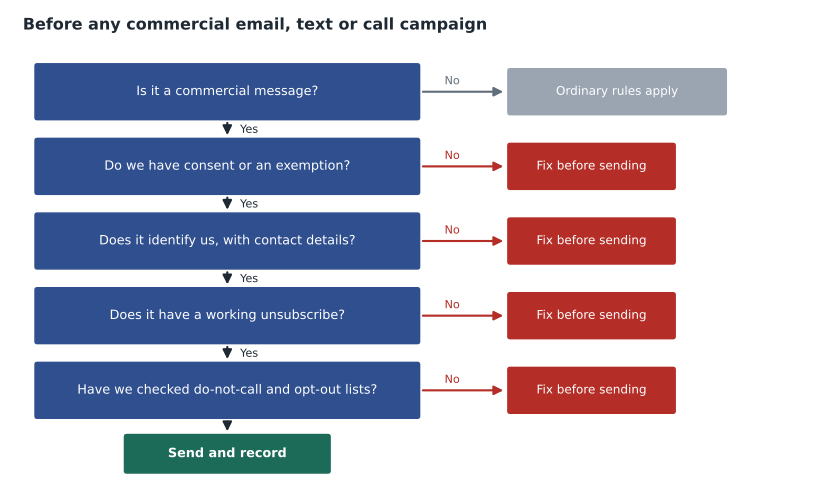
Canada's Anti-Spam Legislation, usually called CASL, governs commercial electronic messages: emails, text messages, social media direct messages and similar messages whose purpose includes encouraging participation in a commercial activity. CASL is a consent-based law. In general, you may not send a commercial electronic message to an electronic address unless the recipient has consented, the message identifies the sender, and it contains a working unsubscribe mechanism. The rules apply to business recipients as well as consumers, with some exemptions explained below. The CRTC enforces the core rules, and the Competition Bureau and the Privacy Commissioner enforce related provisions on misleading electronic messages and address harvesting.
Consent under CASL
Consent can be express or implied. Express consent is a clear, positive agreement to receive messages, such as ticking an unticked box or replying yes, and it lasts until the person withdraws it. A request for express consent must explain its purpose, identify who is seeking consent and say that the person can unsubscribe at any time. Implied consent arises only in specific situations, and most of them expire. The most important is an existing business relationship: a purchase, lease or written contract within the past two years, or an inquiry or application within the past six months. Implied consent also exists when a person has conspicuously published their business email address, for example on their employer's website, without a statement that they do not want commercial messages, and the message is relevant to their business role. Bought lists almost never come with valid consent, because consent given to the list vendor does not carry over to Ridgeline unless the person agreed to receive messages from third parties identified when consent was obtained.
Exemptions, identification and unsubscribing
Some messages are exempt from the consent requirement. Messages between employees of the same organization, and messages between organizations that have a relationship where the message concerns the recipient organization's activities, are exempt. A single message sent on a referral from someone with a relationship to both parties is exempt from consent, but it must still identify the sender and the referrer and contain an unsubscribe mechanism. Messages that only answer a request, give a quote the recipient asked for or deliver a product the person bought have fewer requirements. Every message that needs consent must identify the sender, give a mailing address and either a phone number, email address or web address that remains valid for at least 60 days, and offer an unsubscribe mechanism that is easy to use and free. Unsubscribe requests must be honoured within 10 business days. Penalties under CASL can reach 1 million dollars per violation for individuals and 10 million dollars for organizations, and directors and officers can be personally liable. A private right to sue was written into the law but has never been brought into force.
Worked problem
Counting an unsubscribe deadline
A prospect replies "unsubscribe" to one of Owen's sequence emails on Monday, November 2, 2026. By what date must Ridgeline have stopped sending her commercial messages?
Show solution
- Both countries require unsubscribe requests to be honoured within 10 business days.
- Business days exclude weekends and statutory holidays. Remembrance Day, Wednesday, November 11, is a statutory holiday in Saskatchewan.
- Count from Tuesday, November 3: November 3, 4, 5 and 6 are days 1 to 4; November 9 and 10 are days 5 and 6; November 11 is skipped; November 12 and 13 are days 7 and 8; November 16 and 17 are days 9 and 10.
- The deadline is Tuesday, November 17, 2026.
Answer: The legal deadline is November 17, but Ridgeline's CRM processes unsubscribes automatically within minutes. The deadline is a maximum, not a target.
Telemarketing rules
Sales calls are governed by the CRTC's Unsolicited Telecommunications Rules. Calls to consumers for telemarketing are allowed only between 9 a.m. and 9:30 p.m. on weekdays and between 10 a.m. and 6 p.m. on weekends, local time. Callers must identify themselves and the organization they represent at the start of the call and give contact information on request. Telemarketers must register with the National Do Not Call List operator, check their calling lists against a version of the list no more than 31 days old, and not call numbers on it unless an exemption applies. Every telemarketer, including one making exempt calls, must keep an internal do-not-call list, add a number within 14 days of a request and keep it there for three years and 14 days. The rules also restrict automatic dialing-announcing devices, which cannot be used to sell without the person's express consent.
Do-not-call exemptions
The National Do Not Call List rules have exemptions that matter for sellers. Calls to businesses are exempt from the List, though identification, calling hours and internal list obligations for telemarketing still apply. Calls to consumers with an existing business relationship are exempt for 18 months after a purchase, lease or rental, or after a written contract ends, and for 6 months after an inquiry or application. Registered charities, political parties and candidates, survey and market research calls, and newspapers seeking subscriptions are also exempt. An exemption from the List never removes the obligation to honour a person's request not to be called again.
What Ridgeline did with the list
Leah asked the list vendor how it collected the addresses. The answer was that it gathered them from public websites and trade directories. Under CASL, that could support implied consent only for addresses that were conspicuously published, without a no-solicitation statement, where Ridgeline's message would be relevant to the person's role; it did not support consent for the mobile numbers, which were not published, and text messages to them were dropped entirely. Grace filtered the list to the 140 addresses that could be traced to a published source and kept a record of the source for each one. Owen rewrote the first email as a short, relevant introduction that asked for express consent to keep in touch. Calls to the businesses' main lines went ahead, because business calls are exempt from the National Do Not Call List, with identification at the start of every call and an internal do-not-call list kept in the CRM.
The campaign reached fewer people than Owen wanted, but its reply rate was higher than any sequence the team had run that year. Relevance does more for response than volume, and it is also what the law rewards.
Writing a compliant first email
Owen's rewritten first email shows how the rules translate into a message. It was short, specific to the recipient's business, honest in its subject line and complete in its required elements. Its structure is a useful model for any first outreach.
| Part | What Owen wrote | Why |
|---|---|---|
| Subject line | "Meeting rooms at Westgate & Rowe" | Accurate and specific; no false urgency or fake reply prefix |
| Opening | Why he was writing to this firm in particular | Relevance is what earns a reply |
| Value | One sentence on a result other firms had seen, from the substantiation file | Claims must be supported |
| Request | Permission to send occasional updates, with a yes/no reply | |
| Identification | Owen's name, Ridgeline's name, mailing address, phone and website | Required in both countries |
| Unsubscribe | A one-click link and an offer to reply "stop" | Must work and be honoured quickly |
Other channels: social messages, voicemail and recordings
CASL applies to any electronic message sent to an electronic address, which includes direct messages on social media platforms and messaging apps. A connection request on a professional network is usually not a commercial message in itself, but a direct message that promotes Ridgeline's products is, and needs consent or an exemption, identification and an unsubscribe option. Prerecorded voicemail messages and automated calls fall under the CRTC's telemarketing rules, which generally require express consent for automatic dialing-announcing devices used to sell. And if a sales call is recorded, the caller must say so at the start of the call; the rules for recording consent were covered in SLS-120.
Across every channel, the practical test is the same as the legal one: would the person reasonably expect to hear from you, does the message say clearly who you are, and can they easily make it stop? A campaign that passes those three questions is usually on the right side of the law and also performs better.
Building compliance into the CRM
Most compliance with these rules happens through systems rather than memory. Grace configured Ridgeline's CRM so that every contact record carries a consent field showing the type of consent or exemption, its source and its date, and the system blocks sequence emails to contacts without a valid entry. Implied consent based on an inquiry or purchase is given an expiry date, and the CRM alerts the owner a month before it lapses so the seller can ask for express consent. Unsubscribe links update the record automatically, and any "please don't call" note logged by a rep adds the number to the internal do-not-call list.
| Field | Example entry |
|---|---|
| Consent type | Implied: inquiry |
| Source | RoomFlow webinar registration form |
| Date obtained | April 20, 2026 |
| Expiry | October 20, 2026, unless express consent is obtained |
| Do-not-call | No |
| Last unsubscribe or opt-out | None |
Systems do not remove judgment. A seller still has to decide whether a message is relevant, whether a call at that moment is welcome and whether a contact who seemed annoyed should be left alone. But systems catch the routine errors that create most legal exposure, such as emailing someone who unsubscribed last month or calling a number on the internal list. Owen now checks the consent report every Monday before his team starts a new sequence, and the team treats a blocked message as a prompt to ask for consent, not as an obstacle to work around.
The rules can feel restrictive to a new inside sales rep, but Owen frames them as a description of good prospecting. Messages go to people with a real reason to hear from Ridgeline, say clearly who is writing, and stop when asked. Teams that prospect that way get fewer complaints, better deliverability and more replies, so following the rules and hitting targets rarely pull in different directions for long.
One last habit helps when rules change, as the telemarketing rules in particular often do: the team checks with Leah before launching any new channel, tool or kind of campaign, rather than assuming last year's answer still holds.
Common mistakes
MistakeIf an address is on a bought list, we can email it.
InsteadUnder CASL, consent rarely transfers with a bought list; check how each address was obtained.
MistakeBusiness recipients are not covered by anti-spam law.
InsteadBoth countries' email rules apply to business recipients, with only specific exemptions.
MistakeTen business days to unsubscribe is a target.
InsteadIt is a legal maximum; good systems process requests immediately.
MistakeAn exemption from the do-not-call list means we can ignore requests not to call.
InsteadInternal do-not-call lists must be kept and honoured in every case.
MistakeA text is just a short email.
InsteadTexts are commercial electronic messages under CASL and need consent, identification and an unsubscribe option.
Summary and key terms
- CASL requires consent, identification and an unsubscribe mechanism for commercial electronic messages, including email, texts and direct messages.
- Implied consent from an existing business relationship lasts two years after a purchase or contract and six months after an inquiry.
- Unsubscribe or opt-out requests must be honoured within 10 business days.
- Telemarketing to consumers is limited to 9 a.m. to 9:30 p.m. on weekdays and 10 a.m. to 6 p.m. on weekends; numbers on the National Do Not Call List cannot be called without an exemption.
- Every telemarketer must keep an internal do-not-call list and honour requests not to be called.
- Commercial electronic message
- Under CASL, an electronic message that encourages participation in a commercial activity.
- Express consent
- A clear, positive agreement to receive messages, which lasts until withdrawn.
- Implied consent
- Consent the law infers in specific, usually time-limited situations, such as a recent purchase.
- Internal do-not-call list
- A telemarketer's own list of people who have asked not to be called.
Practice problems
Work each problem on paper first, then reveal the answer to check.
A contact made an inquiry on April 20, 2026, and has not bought anything. Does Ridgeline have implied consent to email her on November 13, 2026?
Show answer
No. Implied consent from an inquiry lasts six months, which ended on October 20, 2026.
An unsubscribe request arrives on Monday, November 2, 2026. When is the legal deadline to stop sending?
Show answer
Tuesday, November 17, 2026, counting 10 business days and skipping the November 11 holiday.
Are calls to a business's main line covered by the National Do Not Call List?
Show answer
No, business calls are exempt from the List, but identification and internal do-not-call requests still apply.
Lesson quiz · 5 questions
Score 60% or more to complete this lesson.
Create a free account to save your progress, take quizzes and earn a certificate.