
SLS-221 · Lesson 1 of 12 · 23 min
The rise of inside sales
▶ Video coming soon A video version of this lesson is on the way.
On Monday, September 14, 2026, Owen Pelletier pulled two chairs up to a pair of desks near the window on the second floor of Ridgeline Workplace Solutions in Regina. The four desks in that corner belonged to Ridgeline's inside sales team: Owen, who led it, and three colleagues, Jordan Reyes, Amira Nassar and Tyler Greyeyes. Each desk had two screens, a headset hanging from a hook and a small ring light clipped to the top of one monitor. Maya Chen, two weeks into her job as a field account executive, sat down beside Owen with a notebook. Darnell Brooks, her manager, had asked Owen to give her a standing Monday-afternoon session through the fall: an hour each week on how the inside team worked, so that Maya would know what to expect from it and how to sell well herself when she could not be in the room with a customer.
"Most people think inside sales means cold calling from a cubicle," Owen said. "That was true twenty years ago. Today it just means selling without travelling to the customer. We use the phone, video, email, chat and social media. Some of our deals close without anyone from Ridgeline ever walking into the customer's building. And a lot of what your field deals depend on, the first meeting, the follow-up when you are on the road, the renewal reminder, happens at these four desks."
This course follows Owen's Monday sessions with Maya from September to November 2026. It covers how inside sales teams are organized, how they respond to inbound leads and work outbound cadences, how they use the phone, video, social media and chat, how they are measured and how a remote or hybrid sales team works together. It ends with a lab in which Maya spends a full day working alongside the inside team. SLS-210 introduced prospecting and qualification; this course goes deeper into the people, motions and tools that do that work at scale.
What inside sales is
Inside sales is selling done remotely, by phone, video and online channels, rather than face to face at the customer's site. The term began as the opposite of field sales (also called outside sales), in which sellers travel to meet customers in person. In the twentieth century, inside sales usually meant telephone order-taking or high-volume calling for simple products, while anything complex or expensive was sold in the field. That division has largely broken down. Inside sellers now handle complex, multi-meeting sales, and field sellers do much of their own work by video and email.
It helps to separate three ideas that are often blurred together. The first is the channel: how the seller and buyer meet, whether in person, by phone, by video or in writing. The second is the role: what part of the sales process a person is responsible for, such as finding new prospects or closing deals. The third is the motion: the repeatable pattern a team follows for a type of deal, such as responding to inbound quote requests or running outbound campaigns into a list of target accounts. A Ridgeline field account executive like Maya uses several channels in one week; Owen's team plays several roles; and the company runs several motions at once.
| Idea | Question it answers | Examples at Ridgeline |
|---|---|---|
| Channel | How do seller and buyer communicate? | In person, phone, video meeting, email, LinkedIn message, website chat |
| Role | Who is responsible for which part of the sale? | SDR, BDR, account executive, account manager |
| Motion | What repeatable pattern does the team follow for a kind of deal? | Inbound quote response; outbound campaign to clinics; renewal outreach 180 days before a lease ends |
Why inside sales grew
Several forces pushed selling indoors over the past two decades. The first was cost. A field visit takes travel time, fuel or mileage, parking and sometimes a hotel night. An inside seller can hold several conversations in the time it takes a field seller to drive to one meeting. For smaller deals, a field visit can cost more than the deal is worth.
The second force was technology. Reliable video meetings, cloud CRMs, sales engagement platforms that schedule and track sequences of emails and calls, and electronic signatures made it possible to run a whole sale remotely. Ten years ago, sending a proposal and getting it signed without a meeting was unusual; today, as SLS-140 showed, it is routine.
The third force was the buyer. Research firms that survey business buyers, such as Gartner, have reported for years that buyers spend most of their buying journey researching on their own, and only a small share of their time with any supplier's salespeople. A 2025 Gartner survey reported that a majority of B2B buyers said they would prefer a buying experience without a sales representative, at least for some purchases. Buyers who do want to talk to a seller often prefer a short video call to an in-person meeting, because it fits more easily into their day.
The fourth force was the pandemic of 2020 and 2021. When offices closed, almost all selling became remote for a time. Many teams discovered that remote selling worked better than they had expected, and many buyers discovered they liked it. When offices reopened, selling did not go fully back. Most B2B teams now run a hybrid model, in which the channel is chosen to fit the customer and the stage of the deal rather than the job title of the seller.
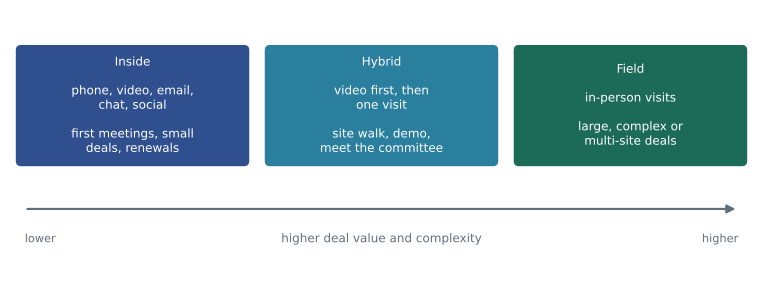
Where the line falls at Ridgeline
Ridgeline sells furniture, managed print, workplace technology and RoomFlow, its room-booking software, to organizations across southern Saskatchewan. Owen explained how the company decided which deals were worked mainly from inside and which needed a field seller. The rule was not written down as a single number, but the pattern was clear. Small single-product deals, such as one printer for a ten-person office, were sold entirely by the inside team. Renewals of existing printer contracts usually were too. Larger deals, multi-product deals and anything involving a site survey, an installation plan or a committee of decision-makers went to a field account executive, with the inside team booking the first meeting.
"The line moves," Owen said. "Three years ago we sent a field rep to every RoomFlow demo. Now Amira does most of them by video, and the field rep only goes out if the customer wants to see the room panels installed somewhere. Video demos turned out to be better, because the customer can share their own calendar and we can show RoomFlow working with it."
Worked problem
Comparing the cost of a field visit and a video meeting
Maya has a first meeting with a clinic 70 km from Regina. The drive takes about 50 minutes each way. Ridgeline reimburses driving at 0.70 dollars per km (an illustrative company rate). The meeting itself lasts 45 minutes. Ridgeline estimates the cost of a field account executive's time, including salary, benefits and overhead, at about 60 dollars an hour. A video meeting would take 45 minutes plus about 15 minutes of preparation and set-up. What does each option cost, and how many video meetings could Maya hold in the time of one visit?
Show solution
- Time for the field visit: 50 minutes each way plus 45 minutes in the meeting, plus about 15 minutes to park, sign in and set up.
- \[50 + 50 + 45 + 15 = 160 \text{ minutes} \approx 2.67 \text{ hours}\]
- Cost of Maya's time for the visit.
- \[2.67 \times 60 = 160 \text{ dollars}\]
- Driving cost for the round trip of 140 km.
- \[140 \times 0.70 = 98 \text{ dollars}\]
- Total for the visit: about 160 + 98 = 258 dollars.
- The video meeting takes 60 minutes, or 1 hour, so it costs about 60 dollars of Maya's time and nothing for travel.
- Number of one-hour video meetings in the 160 minutes of the visit.
- \[\frac{160}{60} \approx 2.7\]
Answer: The visit costs about 258 dollars and the video meeting about 60, so the visit costs a little over four times as much. In the time of one visit, Maya could hold about two and a half video meetings. The visit is still worth it when seeing the site changes the sale, for example to measure a room or meet several decision-makers at once.
The arithmetic does not mean field visits are wasteful. It means each visit should earn its cost. Owen's advice to Maya was to ask, before every visit, "What will I learn or achieve in person that I could not by video?" If the answer was "measure the space," "see the old printers jam," or "meet the three partners who never join calls," the visit was worth it. If the answer was "it feels more professional," a video call would usually do.
What changes when you sell remotely
Remote selling is not the same conversation with a screen in between. Some things get harder. The seller sees less: on the phone, nothing at all; on video, only a face and a slice of background. Small signals of confusion or doubt are easier to miss, so the seller has to ask more checking questions. Attention is harder to hold, because the buyer's email and phone are within reach. Building trust can take longer when the buyer has never shaken the seller's hand.
Other things get easier. A remote seller can bring a specialist into a call at short notice, share a screen to show a live quote or a product demonstration, and send a summary within minutes of hanging up. Meetings can be shorter and more frequent, so a deal can move in small steps rather than waiting weeks for the next visit. And the seller can talk to buyers spread over a wide area, which matters for a company like Ridgeline whose customers are scattered across a large rural region.
| Harder remotely | Easier remotely |
|---|---|
| Reading the buyer's reactions | Bringing a specialist in at short notice |
| Holding attention for a long meeting | Sharing a screen with a live quote or demo |
| Building trust with someone you have never met | Following up within minutes with a written summary |
| Seeing the customer's site and problem | Reaching customers spread over a large area |
| Meeting several decision-makers at once, if some will not join calls | Holding short, frequent meetings that keep a deal moving |
The inside team at Ridgeline
Owen described the inside team's work as four kinds of job. First, inbound response: answering quote requests, website chats and calls from people who come to Ridgeline. Second, outbound prospecting: reaching people who have not asked to hear from Ridgeline, in target accounts the field team wants to win. Third, small-deal selling: closing simple, low-value deals from start to finish without a field seller. Fourth, account support: renewal reminders, small add-on orders and check-in calls for existing customers, so the account managers can focus on the largest accounts.
The team was small, four people serving six field account executives and two account managers, so each person specialized a little. Amira handled most inbound leads and RoomFlow demos. Tyler and Jordan ran outbound cadences into target accounts, Tyler mainly for clinics and schools and Jordan for professional firms and manufacturers. Owen did a share of each, coached the others and ran the team's weekly numbers with Grace Liu, the sales operations analyst. Lesson 2 looks at these roles in detail.
Worked problem
How much of the pipeline starts at the inside team?
In the third quarter of Ridgeline's fiscal year (June to August 2026), the field team created 84 new opportunities. The CRM shows their sources: 31 came from meetings booked by the inside team's outbound work, 18 from inbound leads the inside team qualified and passed on, 21 from the field sellers' own prospecting, 9 from referrals and 5 from existing customers expanding. What share of new opportunities started with the inside team?
Show solution
- Add the opportunities that came through the inside team, outbound and inbound.
- \[31 + 18 = 49\]
- Divide by all new opportunities.
- \[\frac{49}{84} = 0.583 \approx 58 \text{ in } 100\]
Answer: About 58 in 100 of the field team's new opportunities began with the inside team. That is why Darnell wanted Maya to understand how Owen's team worked: more than half of her future pipeline would probably pass through those four desks first.
Careers in inside sales
For many people, inside sales is the first job in a sales career. A typical path at a company like Ridgeline starts as a sales development representative, booking meetings, then moves to an inside account executive role closing smaller deals, and then to a field or senior account executive role, account management or sales leadership. Owen had followed that path himself, starting as an SDR in 2021. Some people stay in inside roles for their whole career, because the variety and pace suit them and because senior inside sellers at many companies earn as much as field sellers.
The skills transfer in both directions. Inside sellers become very good at short, focused conversations, at writing clearly and at managing a high volume of activity. Field sellers become very good at reading a room and managing complex deals. The strongest sellers have both sets of skills, which is why many companies now move people between the two kinds of role, and why this course is part of the program for every B2B student, not just those who plan to work at an inside desk.
What the rest of the course covers
Lesson 2 describes the main inside-sales roles and how work passes between them. Lesson 3 covers responding to inbound leads, and lesson 4 designing outbound cadences. Lessons 5 and 6 turn to the phone and to video prospecting. Lessons 7 and 8 cover a seller's online presence and social selling. Lesson 9 covers selling through chat and messaging. Lesson 10 covers how inside teams are measured, and lesson 11 how remote and hybrid teams work together. Lesson 12 is a lab: a full day with the inside team, from the morning huddle to the end-of-day review.
Common mistakes
MistakeThinking inside sales is only cold calling.
InsteadInside sales covers inbound response, outbound prospecting, small-deal selling and account support, using phone, video, email, chat and social channels.
MistakeTreating every deal as needing a field visit.
InsteadAsk what a visit would achieve that video could not, and visit when the answer justifies the cost.
MistakeConfusing channel, role and motion.
InsteadSeparate how you communicate (channel), who does which part (role) and the repeatable pattern for a kind of deal (motion).
MistakeAssuming remote selling is the same conversation on a screen.
InsteadAsk more checking questions, keep meetings shorter and follow up quickly in writing.
MistakeSeeing the inside team as separate from field sales.
InsteadMuch of the field pipeline begins with the inside team, so the two need to work as one system.
Summary and key terms
- Inside sales is selling done remotely, by phone, video, email, chat and social channels, rather than at the customer's site.
- It grew because of cost, technology, changing buyer preferences and the shift to remote work in 2020 and 2021, and most B2B teams now run a hybrid model.
- Channel, role and motion are separate ideas.
- A field visit can cost several times as much as a video meeting, so each visit should earn its cost.
- Remote selling makes reading reactions and building trust harder, but makes bringing in specialists and following up faster easier.
- At Ridgeline, about 58 in 100 of the field team's new opportunities began with the inside team.
- Inside sales
- Selling done remotely, by phone, video, email, chat and other online channels.
- Field sales
- Selling in which the seller travels to meet customers in person; also called outside sales.
- Hybrid sales model
- An approach in which the channel is chosen to fit the customer and the stage of the deal.
- Channel
- The way a seller and buyer communicate, such as in person, phone or video.
- Sales motion
- A repeatable pattern a team follows for a type of deal, such as inbound quote response.
- Inbound response
- Answering prospects who contact the company first, through forms, chats or calls.
Practice problems
Work each problem on paper first, then reveal the answer to check.
A field visit takes 3 hours of a seller's time at 60 dollars an hour plus 110 dollars of travel. A video meeting takes 1 hour. How much more does the visit cost?
Show answer
Visit: 3 × 60 + 110 = 290 dollars. Video: 60 dollars. The visit costs 230 dollars more, almost five times as much.
Name the four kinds of work Ridgeline's inside team does.
Show answer
Inbound response, outbound prospecting, small-deal selling and account support.
Give one reason a seller might still choose a field visit.
Show answer
To see the site, measure a room, watch an old printer fail or meet several decision-makers who will not join a call.
Lesson quiz · 5 questions
Score 60% or more to complete this lesson.
Create a free account to save your progress, take quizzes and earn a certificate.