
SLS-221 · Lesson 11 of 12 · 20 min
Working in a remote sales team
▶ Video coming soon A video version of this lesson is on the way.
On Monday, October 26, Maya noticed that the inside team's corner was only half full. Jordan and Tyler were at their desks, but Amira's chair was empty and her face was on the wall screen, joining the team's morning huddle from her home in Moose Jaw. "Amira's in the office Mondays and Wednesdays," Owen said, "but today she had a plumber coming. Nobody can tell the difference on the phone." Ridgeline's inside team, like many sales teams since 2020, worked in a hybrid arrangement: some days in the office, some at home, with a few people mostly remote. This lesson covers how a remote or hybrid sales team stays organized, connected and productive, and how it protects customers' information and its own people.
Why remote selling teams need more structure
In an office, much of a sales team's coordination happens without anyone planning it. A rep overhears a colleague's call and learns a phrase. A manager notices someone looking discouraged after a bad call. Two reps realize at the coffee machine that they are both emailing the same clinic. Remote teams lose most of that. They have to replace it with deliberate habits: regular meetings with clear purposes, shared records, agreed ways of communicating and time set aside for coaching and for simply talking.
Research on remote work has found both benefits and costs. Studies of remote and hybrid workers have often reported fewer interruptions, less commuting and higher satisfaction for many people, alongside weaker informal communication, slower learning for newer staff and a greater risk of isolation. Results vary by job and by how well the arrangement is managed, so the evidence is best read as a list of things to watch rather than a verdict for or against remote work.
The team rhythm
Owen ran the inside team on a fixed weekly rhythm, the same whether people were in the office or at home.
| When | What | Purpose |
|---|---|---|
| Daily, 8:15 to 8:30 a.m. | Huddle (on video for anyone at home) | Each rep says their main target for the day and any blocker; no problem-solving in the huddle |
| Monday, 3:00 to 4:00 p.m. | Session with a field AE (this fall, Maya) | Teach and coordinate with the field team |
| Tuesday, 11:00 to 11:30 a.m. | Call review | Listen to two recorded calls together and discuss one thing each did well and one to change |
| Wednesday | One-to-one coaching, 30 minutes each | Each rep's numbers, deals and development |
| Thursday, 4:30 to 5:00 p.m. | Pod check-ins with paired AEs (from December) | Choose target accounts for the next week |
| Friday, 3:30 to 4:00 p.m. | Wins and lessons | Share one win and one lesson; informal, cameras on if people are comfortable |
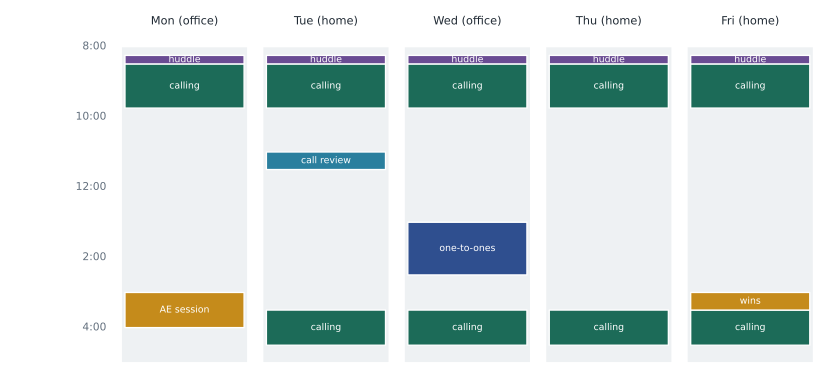
Two principles shaped this rhythm. First, meetings were short and fixed, so they did not eat into calling blocks, which Owen protected as carefully as customer meetings. Second, each meeting had one purpose. The huddle was for focus and blockers, not discussion; any problem raised in the huddle was taken to a separate conversation afterward with only the people who needed to be there.
Synchronous and asynchronous communication
Remote teams communicate in two ways. Synchronous communication happens in real time: calls, video meetings, live chat. Asynchronous communication does not require everyone to be present at once: CRM notes, shared documents, recorded videos and messages answered when the person is ready. Good remote teams use asynchronous communication for most information and reserve synchronous time for decisions, coaching and relationships.
| Use asynchronous for | Use synchronous for |
|---|---|
| Hand-off notes and deal updates (in the CRM) | A hand-off conversation on a complex deal |
| Sharing a useful email template or post | Coaching on a difficult call |
| Questions that can wait a few hours | Anything urgent for a customer |
| Announcements and policy changes | Disagreements, which escalate in writing |
| Weekly numbers | Celebrating wins and checking how people are doing |
Ridgeline's team chat channel had three simple norms. Customer information went in the CRM, not the chat, so it was recorded where everyone could find it. Urgent customer issues were phoned, not typed, because a message could sit unread. And anyone could set a "focus" status during a calling block, which meant colleagues waited for a reply unless it was urgent.
Time zones
Time zones matter for any team that sells across a wide area. Saskatchewan is unusual: it stays on Central Standard Time all year and does not move its clocks in spring and autumn. That means Regina has the same clock time as Winnipeg from November to March, but in summer it matches Calgary and Edmonton, which are on Mountain Daylight Time, and is an hour behind Winnipeg. Ridgeline's customers were almost all in Saskatchewan, so this rarely mattered for selling, but it mattered for the team's suppliers and partners elsewhere in Canada, and for booking meetings with head offices in Alberta, Manitoba or Ontario.
Worked problem
Booking a meeting across time zones
Maya wants to book a 30-minute video call with a facilities manager at a clinic group's head office in Calgary, and a colleague in Toronto who handles purchasing. Calgary is on Mountain Time and Toronto on Eastern Time; both change their clocks, while Regina does not. In November, after clocks change, Calgary is one hour behind Regina and Toronto one hour ahead. Maya proposes 10:30 a.m. Regina time. What time is that in Calgary and Toronto? What would the same Regina time be in July?
Show solution
- In November, Calgary is one hour behind Regina: 10:30 − 1 = 9:30 a.m. in Calgary.
- Toronto is one hour ahead: 10:30 + 1 = 11:30 a.m. in Toronto.
- In July, Calgary moves its clocks forward an hour and Regina does not, so they match: 10:30 a.m. in both. Toronto is then two hours ahead of Regina: 12:30 p.m.
Answer: In November the call is at 9:30 a.m. in Calgary and 11:30 a.m. in Toronto. In July, the same Regina time would be 10:30 a.m. in Calgary and 12:30 p.m. in Toronto, a lunch hour, so Maya would choose an earlier time in summer. Calendar software handles the arithmetic, but sellers still need to check that the proposed time is sensible for everyone.
Coaching and learning remotely
New reps learn fastest by watching and listening to experienced colleagues, which is harder when people are not in the same room. Ridgeline used three remote substitutes. Call shadowing let a new rep listen live to an experienced colleague's calls through the phone system, as Maya did with Jordan in lesson 5. Recorded call reviews let the team listen to good and bad calls together each Tuesday. And side-by-side sessions on video, where an experienced rep shared their screen while working a calling block and talked through their choices, gave new reps a view of the small decisions that never show up in a recording.
Owen's one-to-ones followed a consistent structure: five minutes on how the rep was doing as a person, ten minutes on their numbers using Grace's dashboard, ten minutes on one or two specific deals or calls, and five minutes on one skill to work on before the next week. He wrote short notes in a shared document so that both he and the rep could see progress over time, an asynchronous record that made each synchronous meeting more useful.
Protecting customer information at home
Working from home creates information-security risks: family members overhearing calls, screens visible to visitors, printed notes left on a kitchen table and home networks less protected than the office's. Under PIPEDA, Ridgeline is responsible for protecting the personal information it holds wherever its employees work. Its remote-work policy required reps to work on company laptops with full-disk encryption, use the company's secure connection when away from the office, lock their screens when stepping away, take calls where they could not be overheard, keep paper notes to a minimum and shred them rather than throwing them away, and never use personal email or messaging for customer information.
Wellbeing and rejection
Inside sales involves a lot of rejection: most calls go unanswered, many conversations end in a no and some people are rude. In an office, colleagues notice when someone has had a hard morning. At home, a rep can spend a whole day hearing no without anyone noticing. Owen built small habits to counter that. The Friday wins-and-lessons meeting made sure good news was shared. He checked in briefly with anyone who had had a difficult call, and he encouraged reps to take a short break away from the screen after a hard conversation rather than dialling straight on.
He also watched for overwork. Remote reps sometimes keep working into the evening because their laptop is always within reach, and sales targets make it tempting. Owen asked the team not to send emails or messages to each other after 6:00 p.m. except in emergencies, and to schedule any late emails to customers for the next morning. Rested reps sounded better on the phone, and the team's numbers did not suffer.
Worked problem
How much of the week goes to meetings?
Using the rhythm in the table, a rep attends the daily huddle (15 minutes, 5 days), the Tuesday call review (30 minutes), a Wednesday one-to-one (30 minutes) and the Friday wins and lessons (30 minutes). Tyler also attends the Monday AE session (60 minutes). How many hours of internal meetings does Tyler have in a week, and what share is that of a 40-hour week?
Show solution
- Huddles.
- \[15 \times 5 = 75 \text{ minutes}\]
- Other meetings.
- \[30 + 30 + 30 + 60 = 150 \text{ minutes}\]
- Total.
- \[75 + 150 = 225 \text{ minutes} = 3.75 \text{ hours}\]
- Share of a 40-hour week.
- \[\frac{3.75}{40} = 0.094 \approx 9 \text{ in } 100\]
Answer: Tyler spends about 3.75 hours a week, about 9 in 100 of his time, in internal meetings. Owen's rule of thumb was to keep internal meetings below about 10 in 100 of a rep's week, so that most time went to customers and prospects.
Onboarding a new remote rep
When Ridgeline hires a new inside rep, the first weeks decide how quickly they ramp up, a cost lesson 10 measured at roughly 40,000 dollars of expected revenue in the first quarter. Owen's onboarding plan for a hybrid rep asked them to spend more of their first month in the office than experienced reps did, because learning by overhearing is hard to replace. It then moved to the normal hybrid pattern.
| Period | Where | Focus | Measures |
|---|---|---|---|
| Weeks 1 and 2 | Office every day | Products, CRM, policies, call shadowing with each experienced rep | Completed training; shadowed at least ten hours of calls |
| Weeks 3 and 4 | Office four days | First calling blocks with a colleague listening; first inbound leads | First meetings booked; feedback on every call block |
| Month 2 | Normal hybrid pattern | Full cadences on a small list; one-to-ones weekly | About 6 accepted meetings |
| Month 3 | Normal hybrid pattern | Full list; first video and social selling routine | About 9 accepted meetings |
Each new rep also had a buddy, an experienced colleague other than their manager, who answered small questions and checked in daily for the first month. On remote days, the buddy and the new rep kept a video call open during part of the calling block, with microphones muted, so the new rep could ask a question the moment it came up. Owen found that this simple habit cut the number of small mistakes in the first month, such as wrong dispositions and missed hand-off notes, more than any amount of written guidance.
The plan ended with a review at ninety days. Owen and the new rep compared their numbers with the ramp expectations, listened together to three recorded calls from the first week and three from the last, and agreed the next quarter's development points. Hearing how much their own calls had improved was, Owen said, the single most motivating moment of a new rep's first quarter, and it was easy to miss in a remote team unless someone planned for it.
Common mistakes
MistakeAssuming a remote team coordinates itself.
InsteadSet a fixed rhythm of short meetings, each with one purpose, around protected calling blocks.
MistakePutting customer information in team chat.
InsteadRecord it in the CRM, and phone rather than type when something is urgent.
MistakeBooking meetings without checking time zones.
InsteadCheck each contact's time zone, including places that do not change their clocks.
MistakeLeaving new remote reps to learn alone.
InsteadUse call shadowing, recorded call reviews and side-by-side sessions.
MistakeIgnoring rejection and overwork in remote reps.
InsteadShare wins, check in after hard calls and set clear limits on after-hours messages.
Summary and key terms
- Remote and hybrid sales teams lose the informal coordination of an office and must replace it with deliberate habits.
- Ridgeline's inside team runs on a fixed weekly rhythm of short meetings, each with one purpose, around protected calling blocks, using asynchronous tools such as the CRM for most information and synchronous time for decisions and coaching.
- Time zones need care.
- New reps learn remotely through call shadowing, recorded reviews and side-by-side sessions.
- Working from home requires the same protection of customer information as the office.
- Managers should watch for the effects of rejection and overwork.
- Tyler's internal meetings take about 9 in 100 of his week.
- Hybrid work
- An arrangement in which people work some days in the office and some elsewhere, often at home.
- Huddle
- A short daily team meeting for focus and blockers.
- Synchronous communication
- Communication in real time, such as calls and video meetings.
- Asynchronous communication
- Communication that does not need everyone present at once, such as CRM notes and shared documents.
- Call shadowing
- Listening live to a colleague's calls to learn from them.
- Side-by-side session
- A session in which an experienced rep works while sharing their screen and explaining their choices.
Practice problems
Work each problem on paper first, then reveal the answer to check.
A rep has a 15-minute huddle each day, two 30-minute meetings and one 45-minute meeting a week. How many hours of internal meetings is that?
Show answer
75 + 60 + 45 = 180 minutes, or 3 hours.
Give two examples of information that should be shared asynchronously.
Show answer
Any two of: hand-off notes, deal updates, templates, announcements, weekly numbers.
Name three rules for protecting customer information when working from home.
Show answer
Any three of: use encrypted company laptops, use the secure connection, lock screens, take calls privately, shred paper notes, never use personal email.
Lesson quiz · 5 questions
Score 60% or more to complete this lesson.
Create a free account to save your progress, take quizzes and earn a certificate.