
SLS-222 · Lesson 6 of 12 · 22 min
Pricing models
▶ Video coming soon A video version of this lesson is on the way.
At the value desk on October 20, Grace Liu put three of Ridgeline's price lists side by side on the screen: furniture, managed print and RoomFlow. "Same company," she said, "three completely different ways of charging. If you don't understand why, you'll end up negotiating the wrong thing."
A pricing model is the way a price is structured: what the customer pays for, in what units, and how the amount changes as the customer buys more or uses more. Two offers with the same total cost can feel very different to a buyer depending on the model, and the right model can make a deal easier to approve without lowering the price at all.
How sellers set the level of a price
Before the structure comes the level. There are three broad ways businesses decide how much to charge, and most use a mix of them.
| Approach | How the price is set | Strength | Weakness |
|---|---|---|---|
| Cost-plus | Cost of the product plus a set margin | Simple, covers costs | Ignores what the customer would pay and what competitors charge |
| Competition-based | Close to competitors' prices, above or below | Keeps the seller in the market | Ignores differences in value; invites price wars |
| Value-based | Based on what the offer is worth to the customer compared with its alternatives | Captures more of the value created | Requires knowing the customer's value; harder to do |
Pricing writers such as Thomas Nagle, author of *The Strategy and Tactics of Pricing*, argue that cost should set the floor below which a seller will not go, competitors' prices show the customer's alternatives, and value should set the price. Lesson 8 covers value-based pricing in detail. This lesson is about the structures that carry the price.
Per-unit pricing
The simplest model charges a set price per unit: per chair, per printer, per licence, per room. It is easy to understand and to compare, which is both its strength and its weakness. Per-unit prices invite buyers to compare unit prices with competitors' and to ignore differences in what each unit includes. Westgate & Rowe's chair question in lesson 5 was a per-unit comparison that hid most of the cost.
Volume and tiered pricing
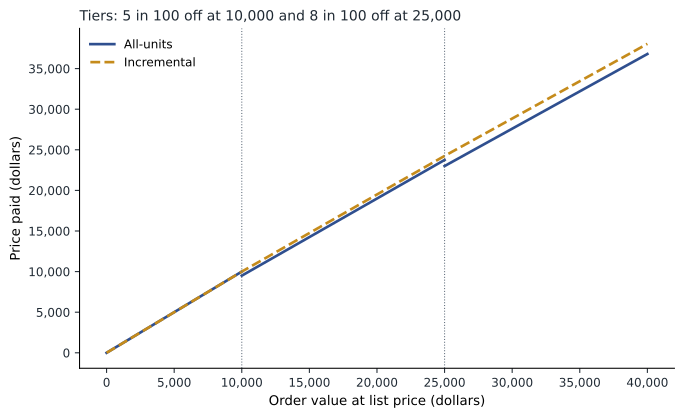
Many sellers lower the unit price as the customer buys more. There are two common ways to do it, and they can produce surprisingly different totals. With all-units pricing, once the order reaches a tier, every unit gets that tier's price. With incremental (or graduated) pricing, each tier's price applies only to the units within that tier, as with income tax brackets.
Ridgeline's furniture list used all-units volume discounts: orders under 10,000 dollars at list price, 5 in 100 off orders from 10,000 to 24,999 dollars, and 8 in 100 off orders of 25,000 dollars or more.
Worked problem
All-units and incremental tiers on a 26,000-dollar order
A customer orders 26,000 dollars of furniture at list. Calculate the price under Ridgeline's all-units tiers, and under an incremental scheme with the same breakpoints and rates.
Show solution
- All-units: the order is at least 25,000 dollars, so all of it gets 8 in 100 off.
- \[26{,}000 \times 0.92 = 23{,}920\]
- Incremental: the first 10,000 dollars at list; the next 15,000 at 5 in 100 off; the last 1,000 at 8 in 100 off.
- \[10{,}000 + 15{,}000(0.95) + 1{,}000(0.92) = 10{,}000 + 14{,}250 + 920 = 25{,}170\]
Answer: All-units pricing gives 23,920 dollars and incremental pricing gives 25,170 dollars. The same breakpoints and rates produce a difference of 1,250 dollars.
All-units tiers create a strange effect near each breakpoint: buying a little more can cost less in total. A customer ordering 24,800 dollars of furniture pays 24,800 × 0.95 = 23,560 dollars, but one ordering 25,000 dollars pays 25,000 × 0.92 = 23,000 dollars, 560 dollars less for 200 dollars more furniture. Experienced buyers know this and will add something small to cross a breakpoint. A seller should know it too, both to help a customer and to avoid being surprised in a negotiation.
Bundles
A bundle combines several products or services at one price, usually lower than the sum of their separate prices. Bundles simplify buying, encourage customers to take more, and make direct price comparison harder. RoomFlow's Essentials plans for small offices were bundles: 65 dollars a month for up to two rooms, or 109 dollars a month for up to four, with booking, panels and basic reports. Larger sites with video integration used the Business plan at 45 dollars per room per month.
Bundles can also be unbundled when a customer wants a lower price. Removing a component, rather than discounting the whole, keeps the price of what remains intact. Lesson 11 returns to this as a way of competing with a cheaper offer.
Subscriptions
A subscription charges a regular fee, usually monthly or yearly, for continuing access to a product or service. Software is the best-known example, but subscriptions now cover equipment, maintenance and supplies. For the seller, subscriptions produce predictable recurring revenue and a reason to keep the customer happy. For the customer, they turn a large purchase into an operating expense, spread the cost and usually include updates and support. Their drawback is that the payments never stop, which is why lesson 5 compared five-year totals.
Subscriptions also change the seller's incentives after the sale. Because the revenue arrives month by month, losing a customer early is expensive. Ridgeline's account managers, as SLS-220 showed, track renewal risk for exactly this reason.
Usage-based pricing
Usage-based pricing charges for what the customer actually uses: per page printed, per hour of service, per gigabyte stored, per booking. It matches cost to value closely and lets small customers start cheaply, but it makes the customer's costs harder to predict. Many offers combine a fixed base with usage charges above an allowance, a hybrid model. Ridgeline's managed print plans included both kinds.
Worked problem
Choosing between a bundled print plan and a usage plan
Plan A costs 400 dollars a month and includes up to 3,000 pages, with extra pages at 0.015 dollars each. Plan B costs 160 dollars a month plus 0.09 dollars a page. A clinic prints about 2,100 pages a month. Which plan is cheaper for the clinic, and at what monthly volume would the two cost the same?
Show solution
- At 2,100 pages, plan A costs 400 dollars (within the allowance).
- \[\text{Plan B} = 160 + 0.09(2{,}100) = 160 + 189 = 349\]
- Within the allowance, plan A stays at 400 dollars, so the plans cost the same when:
- \[160 + 0.09p = 400 \quad\Rightarrow\quad p = \frac{240}{0.09} \approx 2{,}667 \text{ pages}\]
- At 3,500 pages, plan A costs 400 + 500(0.015) = 407.50 dollars and plan B costs 160 + 315 = 475 dollars.
Answer: At 2,100 pages plan B is cheaper, 349 dollars against 400. Above about 2,667 pages a month, plan A is cheaper, and the gap widens as volume grows.
The right answer for the clinic depended on more than this month's volume. Eastgate's owners had told Maya that a fixed, predictable monthly cost mattered more to them than saving a little in a quiet month, and that the clinic planned to add two physiotherapists in 2027, which would raise printing. Maya recommended plan A for those reasons and showed plan B's figures as well, so that the owners could see she was not hiding a cheaper option.
Outcome-based pricing
At the far end of the range, some sellers charge for results rather than products: a share of energy saved, a fee per qualified lead, a payment linked to uptime. Outcome-based pricing aligns the seller's income with the customer's value, but it requires a clear way to measure the outcome, agreement on what would have happened without the seller, and trust on both sides. Ridgeline used it only in small ways, such as service credits when response times were missed, which SLS-130 described.
Price structure and the law
Charging different customers different prices is generally legal in Canada; the Competition Act's specific offence of price discrimination was repealed in 2009, although charging different prices can still raise concerns if it is part of an abuse of a dominant position. What sellers must not do is agree with competitors on prices, which is a criminal offence under section 45, or advertise a price that leaves out fixed mandatory charges, the drip pricing covered in SLS-150.
Ridgeline's practical rule was that list prices and discount bands applied equally to similar customers, that any special price was recorded in the CRM with its reason, and that nobody discussed prices with competitors, ever.
Matching the model to the customer
Grace's main point was that the pricing model is part of the offer, and that the best model depends on how the customer buys, budgets and measures value. She gave the team a short set of questions to ask before choosing which version of a price to put in a proposal.
| Question to ask | If the answer is… | A model that may fit |
|---|---|---|
| Is there a capital budget, an operating budget, or both? | Capital is scarce or needs board approval | Subscription, lease or hybrid that uses the operating budget |
| How predictable is the customer's usage? | Usage swings with the season | Usage-based or hybrid with a modest base |
| How much does the customer value predictable costs? | Very much, as at Eastgate | Fixed monthly fee with a generous allowance |
| How large and how certain is the value? | Large and measurable | Value-based or partly outcome-based pricing |
| How will the buyer compare offers? | By unit price on a spreadsheet | Show totals and what each unit includes, alongside unit prices |
| What do the customer's rules require? | A public tender with a price form | The structure the tender specifies, priced carefully |
The last question matters more than sellers expect. In a public tender like Prairie Valley's, the buyer sets the price structure on a form, and a seller who offers something different may be ruled non-compliant. Creativity about the model belongs before the tender is written, in the conversations SLS-212 described, not in the response.
Monthly or total: how a price is framed
The same price can be stated in several ways: per month, per year, per room, per user, or as a total over the contract. Research on price framing, such as John Gourville's 1998 study of "pennies-a-day" framing, found that expressing a cost as a small daily or monthly amount can make it seem more acceptable, especially for ongoing purchases. The effect is real but can be overused, and a finance director will always calculate the total.
Worked problem
Framing the Westgate & Rowe RoomFlow price
Westgate & Rowe is considering RoomFlow Essentials for four rooms at 109 dollars a month on a three-year term. The firm has about 30 staff. Express the price as a three-year total, a yearly amount, and a monthly amount per person.
Show solution
- \[109 \times 36 = 3{,}924 \text{ dollars over three years}\]
- \[109 \times 12 = 1{,}308 \text{ dollars a year}\]
- \[\frac{109}{30} \approx 3.63 \text{ dollars per person per month}\]
Answer: The same price is 3,924 dollars over three years, 1,308 dollars a year or about 3.63 dollars per person per month.
Maya's rule, which she took from Rob, was to show the monthly figure the customer would see on an invoice and the total the customer would commit to, side by side, and never to show only the small number. Priya Nandakumar needed the monthly figure for her operating budget and the total for the partners' approval. A seller who hides the total does not make the deal more likely; it makes the partners suspicious when they find it.
Framing also matters when comparing offers with different structures. A buyer comparing a subscription at 45 dollars a room per month with a perpetual licence at 900 dollars a room is comparing a monthly figure with a one-time figure. The honest way to help is to convert both to the same basis, a total over the same period, as lesson 5 did, and to let the buyer see every component.
Common mistakes
MistakePer-unit price is the best way to compare offers.
InsteadUnit prices hide differences in what each unit includes; compare total cost over the same period.
MistakeAll-units and incremental tiers with the same rates give the same price.
InsteadThey can differ by a lot, and all-units tiers can make a slightly larger order cheaper.
MistakeUsage-based pricing is always cheaper for small customers.
InsteadIt is cheaper only below the break-even volume, and it makes costs less predictable.
MistakeChanging the pricing model is the same as giving a discount.
InsteadA different structure, such as a subscription or hybrid plan, can make a deal easier to approve without lowering the price.
Summary and key terms
- A pricing model is the structure of a price: what the customer pays for, in what units, and how the amount changes with volume or use.
- Price levels can be set by cost-plus, competition or value; cost sets the floor and value should set the price.
- Per-unit pricing is simple but invites narrow comparisons.
- All-units tiers apply the tier price to every unit and create steps at breakpoints; incremental tiers apply each rate only within its tier.
- Bundles combine items at one price, subscriptions charge a regular fee, usage-based pricing charges for what is used, and hybrid models combine a base with usage charges.
- Outcome-based pricing ties payment to results.
- Pricing law differs by country, but agreeing prices with competitors is illegal in both.
- Pricing model
- The structure of a price: what is charged for, in what units, and how the amount changes.
- Cost-plus pricing
- Setting a price as cost plus a set margin.
- All-units pricing
- Volume pricing in which every unit gets the price of the tier the order reaches.
- Incremental pricing
- Volume pricing in which each tier's price applies only to the units within that tier.
- Bundle
- Several products or services sold together at one price.
- Subscription
- A regular fee for continuing access to a product or service.
- Usage-based pricing
- Charging for the amount the customer actually uses.
- Hybrid pricing
- A fixed base fee plus charges for use above an allowance.
Practice problems
Work each problem on paper first, then reveal the answer to check.
Plan X costs 300 dollars a month with no usage charge; plan Y costs 100 dollars plus 0.05 dollars a page. At what monthly volume do they cost the same?
Show answer
100 + 0.05p = 300, so p = 4,000 pages.
Under Ridgeline's all-units tiers, what does a 10,000-dollar order cost, and what does a 9,900-dollar order cost?
Show answer
10,000 × 0.95 = 9,500 dollars; 9,900 dollars at list. The larger order costs 400 dollars less.
Why might a finance director prefer a subscription to a purchase even if the five-year total is higher?
Show answer
It spreads the cost, avoids a large up-front payment, may be treated as an operating expense and usually includes updates and support.
Lesson quiz · 5 questions
Score 60% or more to complete this lesson.
Create a free account to save your progress, take quizzes and earn a certificate.