
SLS-222 · Lesson 8 of 12 · 24 min
Value-based pricing
▶ Video coming soon A video version of this lesson is on the way.
In early November, Keystone's IT contractor, Northgate IT, mentioned to Dale Petrie that a regional audiovisual integrator had quoted 41,500 dollars to equip the six training rooms with video and displays. The integrator did not offer room booking and its service contract promised a technician within eight business hours. Dale passed the number to Maya with the comment "Your price is 6,500 dollars higher. Why?"
At the value desk on November 3, Rob said it was the most useful question a customer could ask. "He's telling us the alternative and its price. Now we can work out exactly what our difference is worth to him, and whether 48,000 is fair."
What value-based pricing is
Value-based pricing sets a price according to the value an offer creates for the customer, compared with the customer's next best alternative, rather than according to the seller's costs or competitors' list prices alone. It does not mean charging the maximum a customer can bear. It means understanding what the offer is worth to this customer and setting a price that leaves the customer clearly better off while earning the seller a fair share of the value it creates.
The most widely taught framework comes from Thomas Nagle and colleagues in *The Strategy and Tactics of Pricing*, which describes the economic value to the customer (EVC), also called economic value estimation. EVC has two parts.
- The reference value: the price of the customer's next best alternative.
- The differentiation value: what the differences between the seller's offer and that alternative are worth to the customer. Positive differences add value; negative differences, where the seller's offer is worse or costs more to run, subtract it.
EVC is the most a fully informed, rational customer should be willing to pay. If the price is above it, the customer is better off with the alternative. If the price is below it, the customer gains the difference.
Finding the differences
Maya listed every difference between Ridgeline's offer and the integrator's, then checked each one with the person at Keystone who could put a number on it.
| Difference | Direction | How it was valued | Per year (dollars) |
|---|---|---|---|
| RoomFlow booking linked to calendars, so Linda's coordinator stops managing room clashes by email | Positive | About 3 hours a week × 50 weeks × 32 dollars an hour (Linda's estimate) | 4,800 |
| Four-business-hour service instead of eight, avoiding cancelled training sessions | Positive | About 2 sessions a year saved × 1,500 dollars each in dealer travel and rescheduling (Linda's 2025 records) | 3,000 |
| One supplier for rooms, panels, video and printing | Positive | Not valued: real but hard to measure | — |
| RoomFlow subscription, which the integrator's offer does not need | Negative | 6 rooms × 45 dollars × 12 months | − 3,240 |
| Net differentiation per year | 4,800 + 3,000 − 3,240 | 4,560 |
Two things about the list mattered. First, the benefits both offers shared, the hotel and travel savings from lesson 4, were not differentiation; the integrator's rooms would produce them too, so they belonged in the reference, not the difference. Second, the negative item was included honestly. A seller who leaves out the ways its offer costs more is not doing value-based pricing; it is doing marketing.
Calculating Keystone's EVC
Worked problem
Economic value to Keystone of Ridgeline's training centre
The integrator's price, the reference value, is 41,500 dollars. Ridgeline's offer has a net differentiation value of 4,560 dollars a year over the five-year life of the equipment. Using Keystone's discount rate of 8 in 100, what is the present value of the differentiation, and what is the EVC?
Show solution
- \[\text{Annuity factor} = \frac{1 - 1.08^{-5}}{0.08} \approx 3.9927\]
- \[\text{PV of differentiation} = 4{,}560 \times 3.9927 \approx 18{,}207\]
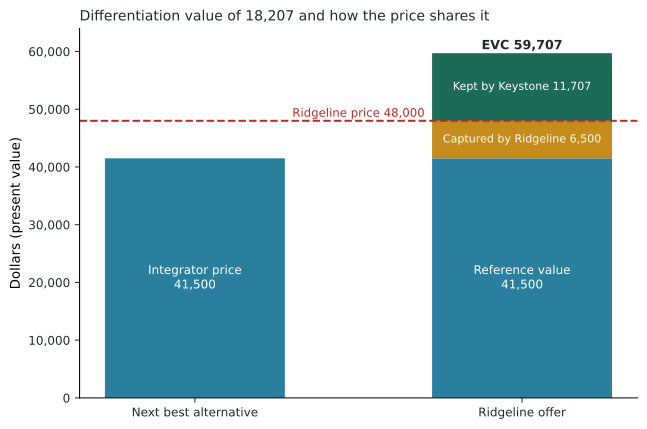
- \[\text{EVC} = 41{,}500 + 18{,}207 = 59{,}707\]
Answer: The differentiation is worth about 18,200 dollars to Keystone over five years, so the EVC is about 59,700 dollars. Ridgeline's price of 48,000 dollars is well below it.
Sharing the value
The gap between the reference value and the EVC is the value Ridgeline's differences create. The price decides how that value is shared. At 48,000 dollars, Ridgeline captures 48,000 − 41,500 = 6,500 dollars of it, and Keystone keeps 59,707 − 48,000 = 11,707 dollars.
Worked problem
How the differentiation value is shared
What share of the 18,207 dollars of differentiation value does Ridgeline capture at a price of 48,000 dollars, and what share does Keystone keep?
Show solution
- \[\frac{6{,}500}{18{,}207} \approx 0.357 \qquad \frac{11{,}707}{18{,}207} \approx 0.643\]
Answer: Ridgeline captures about 36 in 100 of the value its differences create, and Keystone keeps about 64 in 100. That is a price Maya can defend: Keystone is clearly better off choosing Ridgeline, and Ridgeline is paid for what it adds.
Nagle and other pricing writers stress that the customer must be left with a clear incentive to buy. A price set right at the EVC gives the customer no reason to switch and no margin for error in the estimates. Many practitioners aim to leave the customer more than half of the differentiation value, especially when some of it is soft or uncertain, as the coordinator's time was here. Rob's rule of thumb was simpler: "If the customer can't see that they're winning, we'll lose."
Using EVC in the conversation
Maya did not show Dale the EVC chart. She used its logic to answer his question in his terms. "The integrator's rooms would give you the same hotel and travel savings, and they're 6,500 dollars cheaper. What the extra buys you is the booking system, so Linda's team stops untangling room clashes, which she puts at about three hours a week, and four-hour service instead of eight, which would have saved two cancelled sessions last year. After the RoomFlow subscription, that's worth about 4,500 dollars a year to you, so the difference pays for itself in under eighteen months, and after that you're ahead."
Worked problem
Payback on the price difference
Ridgeline's price is 6,500 dollars higher than the integrator's, and the net differentiation is worth 4,560 dollars a year. How long does the higher price take to pay back?
Show solution
- \[\frac{6{,}500}{4{,}560} \approx 1.43 \text{ years} \approx 17 \text{ months}\]
Answer: About 17 months, which is how Maya could say "under eighteen months" to Dale.
Dale's reply was a test: "And if I don't believe the three hours?" Maya had prepared for it. Without the coordinator's time, the net differentiation fell to 3,000 − 3,240 = − 240 dollars a year, and on pure money the integrator would be the better choice. She said so. "Then it comes down to whether four-hour service and the booking system are worth 6,500 dollars to you over five years. Linda thinks the three hours is conservative, but it's your call." Dale said that was the first straight answer he had had from a vendor all year.
Value-based pricing across customers
Value-based pricing usually means different prices for different customers, because the same offer is worth more to some than to others. Sellers handle this in several ways. They design different offers for different segments, such as Essentials bundles for small offices and the Business plan for larger sites. They use good, better, best options, letting customers choose the level of value they want. And they set list prices by segment and then price individual deals within approved bands. What they should not do is guess at each customer's willingness to pay and charge whatever they can get; that damages trust when customers compare notes, and in some markets and situations it raises legal concerns, as lesson 6 noted.
| Approach | How it captures different values | Ridgeline example |
|---|---|---|
| Segmented offers | Different products for groups that value different things | RoomFlow Essentials for small offices; Business plan per room for larger sites |
| Good, better, best | The customer chooses how much value it wants and pays accordingly | Training centre with four rooms, six rooms, or six rooms with managed audiovisual support |
| Add-on services | Customers who value extra service pay for it separately | Same-day loaner printers; extended training |
| Deal pricing within bands | The seller adjusts within approved limits, recorded with reasons | Discount bands and CRM reasons, lesson 7 |
Limits of value-based pricing
Value-based pricing is harder than cost-plus. It requires real discovery, data from the customer and honest estimates, and every figure in the EVC can be argued. It works best when the seller's differences are real and measurable, when the customer has a clear alternative, and when the seller can explain the value simply. It works poorly in markets where offers are nearly identical, where buyers buy strictly on price through a tender, or when the seller cannot get the customer's numbers. In those cases, competition-based pricing, with cost as the floor, may be all there is.
Pricing a deal on value: the steps
Rob summarized the method as six steps that any account executive could follow for a significant deal, with or without Grace's help.
| Step | What to do | Keystone training centre |
|---|---|---|
| 1. Identify the alternative | Find out what the customer would do instead, and what it costs | Regional integrator, 41,500 dollars |
| 2. List the differences | Every way the offer is better or worse than the alternative | Booking, faster service, one supplier; subscription cost |
| 3. Value each difference | With the customer's figures, or a stated assumption the customer accepts | 4,800 and 3,000 dollars a year; minus 3,240 |
| 4. Calculate the EVC | Reference value plus the present value of net differences | About 59,700 dollars |
| 5. Set the price within the range | Above cost and the reference value where the differences justify it; below EVC with a clear customer share | 48,000 dollars, Keystone keeping about 64 in 100 |
| 6. Explain it in the customer's terms | Usually as payback on the difference or savings per year | The extra 6,500 dollars pays back in about 17 months |
Step five has a floor as well as a ceiling. A value-based price must still cover Ridgeline's costs and earn an acceptable margin. If the EVC were below Ridgeline's cost, the honest conclusion would be that the offer was wrong for this customer, not that the price should go lower.
A small example: when value is lower
Value-based pricing does not always justify a higher price. In mid-October, a three-person bookkeeping office in Regina asked Owen Pelletier's inside team about RoomFlow for its single meeting room. Its next best alternative was a free shared calendar, which already worked well enough for three people. The only real difference was the panel outside the door.
Worked problem
When the value does not support the price
The office's alternative is a free calendar. RoomFlow Essentials costs 65 dollars a month, the smallest plan, for up to two rooms. The office estimates it loses perhaps 15 minutes a month to booking confusion, worth about 10 dollars of staff time. What is the annual net differentiation value?
Show solution
- Positive differentiation: about 10 dollars a month, or 120 dollars a year.
- Negative differentiation: the subscription, 65 × 12 = 780 dollars a year.
- \[\text{Net} = 120 - 780 = -660 \text{ dollars a year}\]
Answer: The net differentiation is negative: RoomFlow would cost the office about 660 dollars a year more than the value it adds. The right answer was to tell them so.
Owen's team told the office that a shared calendar was the sensible choice for now, and added a note in the CRM to check back if the firm grew or moved. The office manager later referred a larger client firm to Ridgeline. Value-based thinking includes recognizing when there is not enough value, and saying so.
Value and the January price increase
Value-based pricing also helped Maya with a timing question. RoomFlow's panel manufacturer had announced a price increase of 4 in 100 from January 1, 2027, and Keystone's board would not meet until later in January. Rob's first instinct had been to push for a signature before Ridgeline's fiscal year-end on November 30. SLS-150 described how that became a written price hold to January 31 instead, which the manufacturer supported. The value case was the reason Maya could be confident about waiting: if the proposal was worth about 59,700 dollars to Keystone, a few weeks' delay would not lose the deal, while pressure to sign before the board met might.
Common mistakes
MistakeValue-based pricing means charging as much as the customer will pay.
InsteadIt means pricing according to the value created compared with the alternative, leaving the customer clearly better off.
MistakeShared benefits belong in the differentiation value.
InsteadBenefits the alternative would also deliver are part of the reference; only differences count.
MistakeNegative differences can be left out because they weaken the case.
InsteadInclude them; leaving them out is marketing, not value-based pricing.
MistakeThe best price is right at the EVC.
InsteadAt the EVC the customer gains nothing; leave the customer a clear share of the value, especially when estimates are uncertain.
Summary and key terms
- Value-based pricing sets a price according to the value an offer creates compared with the customer's next best alternative.
- Economic value to the customer is the reference value, the alternative's price, plus positive and minus negative differentiation value.
- Only differences count; shared benefits belong in the reference.
- The price divides the differentiation value between seller and customer, and the customer should keep a clear share.
- Payback on the price difference is often the simplest way to explain the result.
- Across customers, value-based pricing works through segmented offers, good-better-best options, add-ons and deal pricing within bands.
- It needs real data and honest estimates, and works poorly where offers are nearly identical or buying is purely on price.
- Value-based pricing
- Setting prices according to the value created for the customer compared with its next best alternative.
- Economic value to the customer (EVC)
- The reference value plus positive and minus negative differentiation value.
- Reference value
- The price of the customer's next best alternative.
- Differentiation value
- What the differences between an offer and the alternative are worth to the customer, positive or negative.
- Good, better, best
- A set of offers at increasing levels of value and price from which the customer chooses.
Practice problems
Work each problem on paper first, then reveal the answer to check.
An alternative costs 20,000 dollars. Your offer saves the customer 3,000 dollars a year more than the alternative but costs 1,000 dollars a year more to run. Over three years, ignoring discounting, what is the EVC?
Show answer
20,000 + 3 × (3,000 − 1,000) = 26,000 dollars.
At a price of 23,000 dollars, how is the differentiation value of 6,000 dollars shared?
Show answer
The seller captures 3,000 (23,000 − 20,000) and the customer keeps 3,000 (26,000 − 23,000).
Why does the hotel saving not belong in Keystone's differentiation value?
Show answer
Because the integrator's rooms would deliver it too; it is part of what both alternatives provide.
Lesson quiz · 5 questions
Score 60% or more to complete this lesson.
Create a free account to save your progress, take quizzes and earn a certificate.