
SLS-254 · Lesson 12 of 12 · 23 min
Case study: joining up a store and its website
▶ Video coming soon A video version of this lesson is on the way.
At two o'clock on Wednesday, November 11, 2026, a few hours after their last fall session, Tessa Yellowbird and Aiden Laroque stood at the end of the boardroom table in Juniper & Pine's back office with a printed plan and a laptop connected to the wall screen. Around the table sat Bev Halvorsen, Marcus Dube, Noura Saleh and the store's two owners. Six weeks earlier, at their first session on September 30, Tessa had shown Aiden the promise gap: the website promising things the store could not deliver. The plan in front of the owners, titled "One store, one promise", set out how to close that gap and join the store and the website together during 2027. Tessa would present the strategy and the numbers; Aiden, who had spent the fall moving between the sales floor, the pick-up counter and the chat console, would present the parts that touched customers directly.
This final lesson works through that plan as a case study. It brings together every earlier lesson: the channel review from lesson 1, the funnel from lesson 2, product pages, marketplaces, pick-up, shipping and returns, social and live selling, chat, reviews and the measures from lesson 11. Everything in the plan describes work for 2027 and was, on November 11, a proposal.
Step 1: the diagnosis
Tessa opened with the evidence, not the solutions. She had learned from Bev's numbers mornings that owners trust a plan more when they can see the problem in their own data. Her diagnosis had five findings, each traced to a lesson in the fall.
| Finding | Evidence | Lesson |
|---|---|---|
| The promise gap | 37 of 225 October web orders had a stock problem; 21 were cancelled | 1 |
| Surprise costs at checkout | About 73 in 100 carts abandoned; delivery costs shown only at the end | 2 |
| Thin product pages | The rebuilt Halden page converted about 40 in 100 better; 55 in 100 of photos lacked useful alt text | 3 |
| Slow replies | Pre-purchase chats answered within a minute converted about twice as often as slow ones | 9 |
| Incentives that split the channels | Associates earned nothing when customers they served bought online | 1 |
She then showed the opportunity. The website sold about 144,000 dollars a month and contributed about 166 dollars per order, as lesson 11 calculated, and it influenced roughly 650,000 dollars a month of store sales, as lesson 1 estimated. "The website is not a second store," she said. "It is the front door of this one."
Step 2: the plan
The plan grouped its actions under the five foundations of omnichannel retail from lesson 1: inventory visibility, consistent prices and promotions, a single customer view, flexible fulfilment and shared policies.
| Foundation | Action | When (planned) | Owner |
|---|---|---|---|
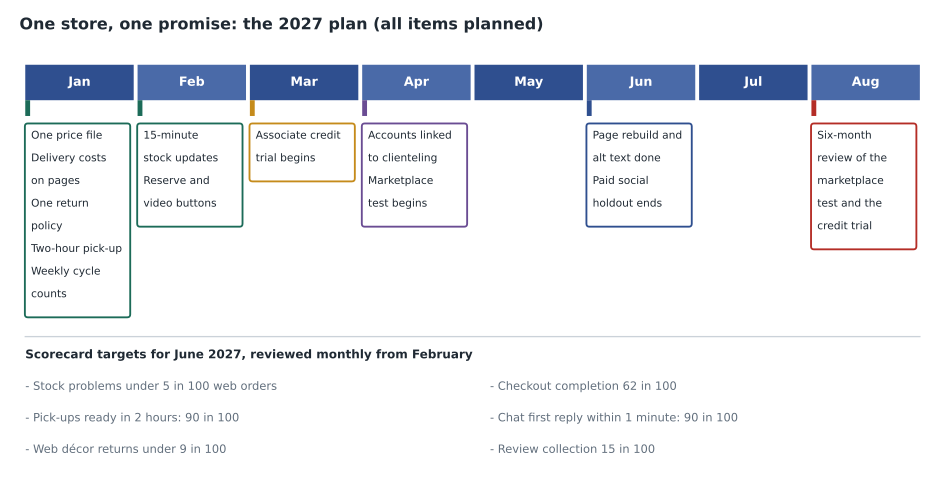
| Inventory visibility | Update website stock every 15 minutes instead of nightly; show "floor model only" and "on hold" clearly | Software live in February | Tessa and Marcus |
| Inventory visibility | Cycle counts of web-heavy décor every week | From January | Marcus |
| Consistent prices | One price file for store and website; delivery costs and dates on every product page | January | Tessa |
| Single customer view | Link website accounts to the clienteling app profile, with the customer's consent | April | Tessa |
| Flexible fulfilment | Reserve online, try in store button; video appointments from product pages | February | Aiden and floor team |
| Flexible fulfilment | Two-hour pick-up promise for in-stock décor, with a second picker on Saturdays | January | Marcus |
| Shared policies | One return policy for all channels, linked beside every "add to cart" button | January | Bev |
| Incentives | Credit associates for web orders by customers they served in the previous 14 days | Six-month trial from March | Bev |
| Selling channels | Rebuild the top 200 product pages; finish alt text; marketplace test of 40 décor items; holdout test of paid social | January to June; marketplace test from February | Tessa |
Step 3: the numbers
The owners' first question was the cost of the biggest item, the 15-minute inventory updates. The store's inventory software supplier had quoted 18,000 dollars to set up the link to the website and 450 dollars a month for the faster service. Tessa had estimated the benefit from October's numbers.
Worked problem
Payback on the inventory link
In October, 37 web orders had a stock problem and 21 were cancelled. Tessa expects the 15-minute updates to cut stock problems to about 8 a month and cancellations to about 5. Each order saved contributes about 166 dollars (lesson 11). Each stock problem also costs about 20 minutes of staff time at 24 dollars an hour to sort out. What is the monthly benefit, the net monthly benefit after the 450-dollar fee, and the payback period on the 18,000-dollar setup cost?
Show solution
- Orders saved from cancellation each month:
- \[21 - 5 = 16\]
- Contribution recovered:
- \[16 \times 166 = 2{,}656\]
- Stock problems avoided and staff time saved:
- \[(37 - 8) \times \tfrac{20}{60} \times 24 = 29 \times 8 = 232\]
- Net monthly benefit:
- \[2{,}656 + 232 - 450 = 2{,}438\]
- Payback period:
- \[18{,}000 \div 2{,}438 \approx 7.4 \text{ months}\]
Answer: The inventory link would pay back its setup cost in about seven and a half months, counting only cancelled web orders and staff time. It ignores the benefits that are harder to count, such as customers who stopped trusting the website after a cancellation, and pick-up promises the store can now keep. The owners asked for a check of the actual numbers after six months.
The second question was about the associate credit. Bev's concern was cost; the owners' concern was fairness to associates who had always been paid only for store sales. Aiden presented this part, because he had heard customers on the floor say "I'll go home and order it" many times that fall.
Worked problem
What would associate credit cost?
From the clienteling app and the order system, Tessa found that in October about 34 web furniture orders came from customers an associate had served in the store in the previous 14 days. These orders averaged 1,300 dollars with a gross margin of 44 in 100. Floor associates earn commission of 8 in 100 of the margin on furniture. What would crediting those orders cost per month?
Show solution
- Margin per order:
- \[1{,}300 \times 0.44 = 572\]
- Commission per order:
- \[572 \times 0.08 = 45.76\]
- Monthly cost:
- \[34 \times 45.76 \approx 1{,}555.84\]
Answer: Crediting those orders would cost about 1,556 dollars a month. If it led associates to help even three more customers a month complete a furniture purchase they would otherwise have abandoned, the extra margin, about 3 times 572 or 1,716 dollars, would cover it. The owners approved a six-month trial from March, with the 14-day window and a review in August.
Step 4: the scorecard
A plan without measures cannot be reviewed. Tessa proposed a small scorecard of measures that the owners would see every month, each with its fall 2026 baseline and a target for June 2027. She chose measures that the store could collect reliably from its own systems and that each tie to a part of the plan.
| Measure | Fall 2026 baseline | Target for June 2027 |
|---|---|---|
| Web orders with a stock problem | about 16 in 100 | under 5 in 100 |
| Checkout completion (orders divided by checkouts started) | about 55 in 100 (September) | 62 in 100 |
| In-stock décor pick-ups ready within 2 hours | about 77 in 100 | 90 in 100 |
| Pre-purchase chats with a first reply within 1 minute | about 67 in 100 | 90 in 100 |
| Web décor return rate | about 12 in 100 (July to September) | under 9 in 100 |
| Review collection rate | about 12 in 100 | 15 in 100 |
| Contribution per web order | about 166 dollars | at least 175 dollars |
Worked problem
Checking a baseline
In October, 64 of 96 pre-purchase chats had a first reply within one minute (lesson 9). What share is that, and how many of 100 such chats would need a first reply within a minute to meet the target?
Show solution
- October share:
- \[64 \div 96 \approx 0.667\]
- At the target, chats answered within one minute out of 100:
- \[100 \times 0.90 = 90\]
Answer: About 67 in 100 chats had a fast first reply in October; the target requires 90 in 100. The plan's second chat person on Saturday afternoons and the AI assistant's routine answers are meant to close that gap.
Step 5: risks and what could go wrong
Tessa ended with risks, because Bev had taught her that owners trust a plan more when it admits what might fail. The inventory link depends on accurate store stock; if counts are wrong, faster updates only spread wrong numbers faster, which is why weekly cycle counts start first. The associate credit could be gamed by associates logging brief conversations with customers who were going to buy online anyway, so the trial counts only customers with a recorded consultation note. The marketplace test could take staff time from the store's own website, so it has a time budget and a stop rule. And customers linking their website accounts to the clienteling app must give clear consent, with the privacy notice updated first.
Linking website accounts to store profiles is a new use of personal information. Under PIPEDA the store must explain the purpose clearly, obtain meaningful consent, let customers decline without losing the ability to shop, and protect the combined data. Follow-up messages made possible by the link must meet CASL's consent rules.
The decision
The owners approved the plan with three changes. They asked for the inventory link and the one price file to go first, before any new selling channel, because "there is no point bringing more people to a promise we cannot keep". They asked Bev to present the associate credit trial to the floor team herself, with the rules in writing. And they moved the marketplace test from February to April, so that it would not compete with the inventory work for Tessa's time. Bev added one change of her own: a monthly fifteen-minute review of the scorecard at the first numbers morning of each month, starting in February 2027.
For Aiden, the case study was the end of a fall that had changed how he thought about his job. In September he had seen the website as something separate from the floor, even a rival. By November he saw a single kind of customer, Priya at the chat console, the couple at the pick-up counter, the viewers asking questions during Noura's live table, moving through one store by whatever door suited them. His job, and the store's, was to keep the same promise at every door.
Presenting a plan to decision makers
Tessa had prepared the presentation as carefully as the plan itself, and Aiden noticed several habits worth copying. She started with the question the owners cared about, whether the website was helping the store, and answered it in the first two minutes. She used the store's own numbers, not industry averages, wherever she could, and she said where a number was an estimate. She gave each major action a clear owner and a date, so that the plan could be followed up. She kept the slides simple, one idea per slide, and handed out the detailed tables on paper for anyone who wanted them.
She also practised the hardest questions in advance. The night before, she asked Aiden to play the owners and challenge every number. He asked why the store should spend 18,000 dollars when the website was already making money, and whether the associate credit would simply pay commission on sales that would have happened anyway. Her answers in the meeting were short because she had already worked them out: the cancellations were losing money and trust every month, and the trial would count only customers with a recorded consultation, with a review in August. Preparing for objections, a skill from SLS-250, works in a boardroom just as it does on the sales floor.
Common mistakes
MistakeStart with the most exciting new channel.
InsteadFix the foundations, such as inventory accuracy and one price file, before adding channels that depend on them.
MistakePresent the plan without the problem.
InsteadShow the evidence from the store's own data first, so decision makers see why each action matters.
MistakeCount only the benefits that are easy to measure.
InsteadCount them carefully, name the harder-to-measure ones, and plan a check of actual results.
MistakeChange pay plans without guarding against gaming.
InsteadWrite clear rules, such as requiring a recorded consultation, and review the trial.
MistakeA plan is finished once it is approved.
InsteadReview it against a scorecard of measures with baselines and targets, on a set schedule.
Summary and key terms
- A joined-up plan starts with a diagnosis from the store's own data and the opportunity the website creates for the whole store.
- Actions can be grouped under the omnichannel foundations: inventory visibility, consistent prices, a single customer view, flexible fulfilment and shared policies, plus incentives.
- Each major action needs its own numbers, such as payback on systems and the cost of pay plan changes, with stated assumptions.
- A small scorecard with baselines and targets lets the owners review progress every month.
- Naming risks, such as inaccurate stock, gaming and privacy, makes a plan more credible and more likely to work.
- Foundations come before new channels, because every channel depends on keeping the same promise.
- Diagnosis
- The evidence-based statement of the problems a plan sets out to solve.
- Payback period
- The time it takes for the net benefits of an investment to equal its upfront cost.
- Scorecard
- A short set of measures with baselines and targets, reviewed regularly.
- Baseline
- The value of a measure before a change, used to judge progress.
- Stop rule
- A condition, set in advance, under which a test or project will be ended.
- Associate credit
- Commission or recognition given to an associate for an online purchase by a customer they served.
Practice problems
Work each problem on paper first, then reveal the answer to check.
A system costs 12,000 dollars to set up and brings a net benefit of 1,500 dollars a month. What is the payback period?
Show answer
12,000 divided by 1,500 is 8 months.
Why did the owners put the inventory link before new selling channels?
Show answer
New channels bring more customers to the same promise; if stock information is wrong, they make the promise gap bigger.
Give one way to stop associates gaming a credit for online orders.
Show answer
Count only customers with a recorded consultation note in the clienteling app within the set window.
Why should each scorecard measure have a baseline?
Show answer
Without the starting value, there is no way to tell whether the plan made a difference.
Lesson quiz · 5 questions
Score 60% or more to complete this lesson.
Create a free account to save your progress, take quizzes and earn a certificate.