
BAR-140 · Lesson 1 of 12 · 23 min
How the MPRE works
▶ Video coming soon A video version of this lesson is on the way.
On Thursday evening, October 1, 2026, Hollis Marchetti opens a second video call for the week. The Tuesday group is still meeting as usual, but two members have an exam coming before everyone else's. Ngozi Adeyemi needs the Multistate Professional Responsibility Examination for her New York application, and Eddie Boudreaux needs it for Louisiana. Both are booked for the November administration, Ngozi on Thursday, November 12 and Eddie on Friday, November 13. Marchetti calls the new series the Thursday ethics workshop and invites anyone who wants a refresher. Sofia Reyes, who passed the MPRE in 2025, joins because California's exam has ethics essays. Dana Whitfield, who scored 93 in the spring, joins 'for the company and the coffee.'
Marchetti starts by asking the newcomers what they think the exam is. Ngozi, who practiced in Lagos before her LLM, guesses that it tests New York's ethics rules. Eddie thinks it is a test of Louisiana's rules. 'Neither,' Marchetti says. 'It is a national exam built on the American Bar Association's model rules, plus the law that controls lawyers everywhere in the country. That is good news and bad news. Good, because you learn one set of rules. Bad, because your own state's rules may differ, and on this exam you answer by the national standard.'
This course prepares you for that exam. It works through the subjects NCBE tests, rule by rule, with original practice questions and explanations, and ends with a full-length practice set. Lessons 2 through 11 follow the order of the professional responsibility subjects as most courses teach them, and each one is organized around how questions on that topic are actually built. This first lesson explains what the exam is, who requires it, how it is scored and delivered, and how to plan for it.
What the MPRE is
The Multistate Professional Responsibility Examination is written and scored by the National Conference of Bar Examiners, the nonprofit that also writes the Multistate Bar Examination and the NextGen bar exam. Its stated purpose is to measure what candidates know and understand about the established standards that govern lawyers' professional conduct. It is not a test of personal character, and passing it says nothing about an applicant's fitness; that is the separate character and fitness review discussed in BAR-101.
The exam has 60 multiple-choice questions, each with four answer choices. Fifty are scored. The other ten are pretest questions that NCBE is trying out for future exams. They look exactly like the scored questions and are mixed in among them, so there is no way to tell which ten do not count. Treat every question as if it matters. The exam lasts two hours, which works out to two minutes per question with no time left over for review unless you move faster on the easy ones.
The MPRE is given on computers at Pearson VUE testing centers, the same kind of center used for many licensing exams. NCBE's site lists centers across the United States and in the territories. As of November 2026 there is no at-home or remote version; the remote option that existed during the pandemic has ended. Plan for about two and a half to three hours at the center from arrival to finish, because check-in includes identification checks, photographs and the security procedures every test center uses.
Who requires it
Almost every US jurisdiction requires a passing MPRE score for admission. The exceptions are Wisconsin and Puerto Rico, which do not require it at all. Connecticut and New Jersey require it but also accept, as an alternative, a passing grade in a law school professional responsibility course that meets their standards. Each jurisdiction that requires the MPRE sets its own passing score and its own rules about how old a score may be.
Minimum passing scores range from 75 to 86 on NCBE's scale. Many jurisdictions require 80, and many others require 85; Utah and California sit at the top at 86, and a handful, including the District of Columbia, New Jersey and Pennsylvania, accept 75. New York requires 85 and accepts a score for four years from the date the exam was taken, whether before or after the bar exam. A score is a single number reported by NCBE, so an applicant who wants to be admitted in two jurisdictions with different requirements needs to clear the higher of the two.
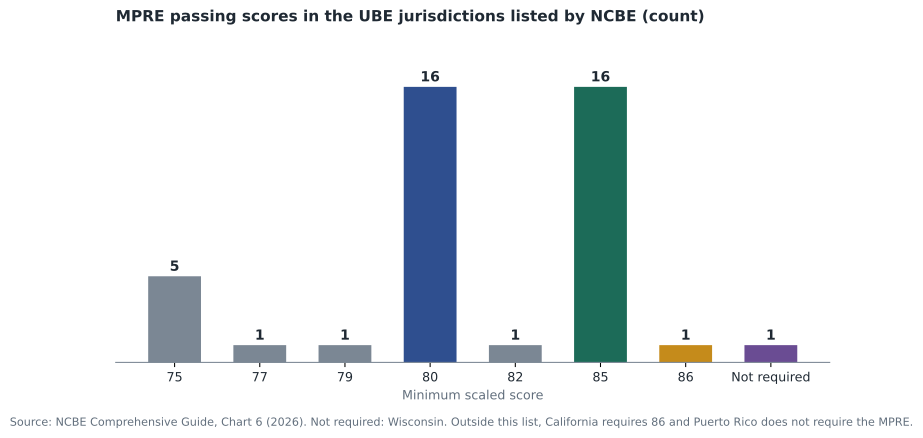
Timing rules matter as much as the score. Some jurisdictions require the MPRE to be passed within a window before or after the bar exam, such as 24 months before to 12 months after in North Carolina, or three years before the application in South Carolina. Others, such as Oklahoma, accept a passing score indefinitely. Tennessee treats a score as valid for two years. Kansas requires the score to be reported by a deadline before an applicant may sit. Marchetti's rule for the group is simple: find your jurisdiction's rule in NCBE's Comprehensive Guide and on the board's own website, write the dates on your calendar, and do not assume that a score you earned three years ago still counts.
| Jurisdiction | Minimum score | Score age rule (summary) |
|---|---|---|
| New York | 85 | Valid for four years from the date taken; before or after the bar exam |
| Texas | 85 | Generally any time before, or within two years after, passing the Texas exam |
| Missouri | 80 | Proof due within one year after notice of passing |
| North Carolina | 80 | Within 24 months before or 12 months after the written exam |
| Utah | 86 | No time limit stated in NCBE's chart |
| Wisconsin | Not required | Diploma privilege and exam applicants both exempt |
How the score works
Your MPRE result is a scaled score from 50 to 150. NCBE converts the number of scored questions you answered correctly into a scaled score through equating, a statistical process that adjusts for small differences in difficulty between versions of the exam. Equating means a scaled 85 on a harder form represents the same level of knowledge as an 85 on an easier form. You will not see a raw score or a percentage, and there is no penalty for wrong answers, so never leave a question blank.
For context, NCBE reported 60,954 MPRE examinees in 2025, split almost evenly across the March, August and November administrations, with a national mean scaled score of 95.6 for the year. The mean was lower in March (93.9) than in August (96.3) or November (96.7). A mean in the mid-90s, against passing scores of 75 to 86, tells you that most well-prepared candidates pass. It also tells you that people who walk in without studying, assuming common sense will carry them, are the ones who fail. Many MPRE questions are built so that the answer that feels fair is not the answer the rules give.
NCBE sends scores to the jurisdiction you named when you registered and releases them to you through your NCBE account several weeks after the exam. Additional score reports to other jurisdictions are ordered later through NCBE's score services for a fee. Some jurisdictions also ask applicants to request a separate transcript when they apply for admission by transfer or on motion.
Registration, fees and test dates
The MPRE is offered three times a year, in March, August and November, each over two consecutive days so that test centers can schedule everyone. In 2026 the administrations were March 24 and 25, August 11 and 12, and November 12 and 13, with registration closing on January 22, June 11 and September 17. NCBE has published the 2027 dates as March 23 and 24, August 18 and 19, and November 4 and 5, with registration deadlines of January 21, June 17 and September 21, 2027.
Registration has two parts. You first register with NCBE through your NCBE account, which creates your NCBE Number, and then schedule an appointment with Pearson VUE. Both steps, and payment, must be finished by 11:59 p.m. Central time on the deadline. NCBE is strict on this point: there is no late registration, and no new registrations are accepted after the deadline. The fee for the 2026 and 2027 administrations is 185 dollars, paid by debit or credit card. It includes one score report to the jurisdiction you designate and one release of the score to you.
You may change your appointment time or test center within the same administration for a 25 dollar fee, at least 48 hours before the first day of that administration. You cannot move a registration to a later administration. If you cancel at least 48 hours ahead, you get a partial refund; after that, you get nothing back and must register again for a later date.
Candidates who need testing accommodations must apply to NCBE and receive a decision before registering and scheduling, because accommodations cannot be added to an existing appointment. NCBE publishes a recommended submission date for each administration, weeks before the registration deadline. Ngozi, whose eyesight requires larger on-screen text, applied in July for the November exam and had her approval before she scheduled. Marchetti tells the group that this is the single most common way candidates lose an administration: they register first and ask for accommodations second.
Where the answers come from
The MPRE tests the law governing lawyers as it stands nationally. In practice that means four sources. The first and largest is the ABA Model Rules of Professional Conduct, which most states have adopted with local changes. The second is the ABA Model Code of Judicial Conduct, for the small set of questions about judges. The third is controlling constitutional decisions, such as the Supreme Court's cases on lawyer advertising and judicial elections. The fourth is generally accepted principles of the law of lawyering, the kind collected in the Restatement (Third) of the Law Governing Lawyers, which covers topics the rules do not fully address, such as malpractice liability and the attorney-client privilege.
The exam does not test your state's version of the rules. If New York's rule differs from the Model Rule, the Model Rule controls your answer. NCBE also states that it updates the exam to reflect amendments to the Model Rules and the Code of Judicial Conduct after a lead time, so very recent amendments are not tested at once. In this course we flag recent changes, including the ABA's February 2026 rewrite of Model Rule 1.14 on clients with decision-making limitations and the comment amendments adopted in August 2026, and we teach the rules in force while noting that questions about the newest language may lag.
How questions are built
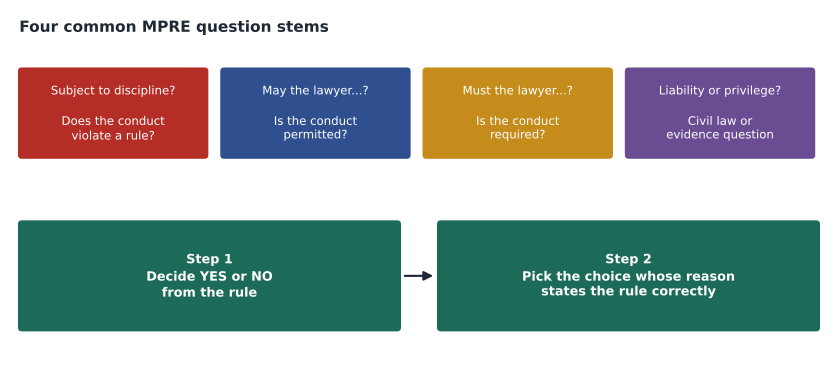
Most MPRE questions present a short scenario, usually four to eight sentences, about a lawyer, a client and a problem, and then ask a question in one of a few standard forms. 'Is the lawyer subject to discipline?' asks whether the conduct violates a disciplinary rule. 'May the lawyer...?' asks whether the conduct is permitted. 'Must the lawyer...?' asks whether it is required. Some questions ask whether a lawyer is subject to civil liability, or whether a communication is privileged, which bring in the Restatement and the law of evidence rather than the disciplinary rules alone.
The answer choices are usually built as pairs of yes and no, each with a reason. Two choices say yes, for different reasons, and two say no, for different reasons. A good method is to decide yes or no first, from the rule, and then choose the reason that correctly states why. Distractors often have a correct conclusion with the wrong reason, or a reason that would be correct in a different scenario. Watch the modal verbs: 'subject to discipline' is a stronger statement than 'may,' and 'must' is stronger still.
Worked problem
Reading the stem and the choices
A lawyer represents a buyer in a land purchase. The seller, who has no lawyer, calls the buyer's lawyer to ask whether the contract is fair to her. The lawyer replies that it is a standard contract and that she should sign it. Is the lawyer subject to discipline? (A) Yes, because the lawyer gave legal advice to an unrepresented person whose interests conflict with the client's. (B) Yes, because a lawyer may never speak with an unrepresented person about a matter. (C) No, because the lawyer did not state anything false. (D) No, because the seller initiated the call.
Show solution
- Decide yes or no first. Model Rule 4.3 forbids a lawyer from giving legal advice to an unrepresented person whose interests are, or reasonably may be, in conflict with the client's, other than the advice to get a lawyer.
- Telling the seller the contract is standard and she should sign it is legal advice, and her interests as seller conflict with the buyer's. So the answer is yes.
- Between the two yes choices, (B) overstates the rule: lawyers may speak with unrepresented people if they do not mislead them or give them advice. (A) states the rule correctly.
Answer: (A). The method: yes or no from the rule, then the reason that matches the rule.
A study plan for the MPRE
Most candidates need 25 to 40 hours of focused study for the MPRE, spread over three to six weeks, though it depends on how recently and how well they took professional responsibility in law school. Marchetti's plan for the Thursday group has four parts. First, read each lesson in this course and the Model Rules it discusses, with the comments, because many questions turn on a comment rather than the black-letter rule. Second, do practice questions after every lesson and review every explanation, including for questions you got right. Third, keep an error log listing each rule you missed and the specific point you got wrong. Fourth, take a full timed practice set at least twice, two weeks and one week before the exam.
She also warns against two habits. The first is answering by instinct: many MPRE questions are designed so that the morally comfortable answer is wrong, for example by tempting you to disclose confidential information to do good, when the rules forbid it. The second is relying on your own state's rules or your law firm's practices. Eddie admits that he would have answered several of the first practice questions by what his summer employer did. Marchetti tells him that is exactly why people who have worked in law offices sometimes score lower than those who have not.
| Week | Focus | Practice |
|---|---|---|
| 1 | Lessons 1 to 3: the exam, regulation of the profession, the client-lawyer relationship | 30 practice questions; start an error log |
| 2 | Lessons 4 to 6: confidentiality and conflicts (about a quarter of the exam) | 40 practice questions; review the conflict figures |
| 3 | Lessons 7 to 9: competence, fees, trust accounts, litigation, advertising | 40 practice questions |
| 4 | Lessons 10 and 11: other roles and judicial conduct; first full timed set | 60-question timed set; review every explanation |
| 5 | Error log review; second full timed set; rest the day before | 60-question timed set; light review only |
Test day
Arrive 30 minutes before your appointment with a current government-issued identification whose name matches your registration exactly. Pearson VUE may refuse to admit anyone more than 15 minutes late, and a missed appointment means paying again for a later administration. Personal items, including phones and watches, go in a locker. The center provides what you may use, and the exam runs on its computers with a timer on screen. There are no scheduled breaks within the two hours, and the clock keeps running if you leave the room.
Pace yourself at about 15 questions every half hour. If a question is taking more than three minutes, choose your best answer, flag it if the software allows, and move on; every question is worth the same. Because there is no penalty for guessing, answer everything. When Eddie asks whether to change answers on review, Marchetti tells him to change one only when he can name the rule that makes his first answer wrong.
Practice problems
Work each problem on paper first, then reveal the answer to check.
How many MPRE questions are scored?
Show answer
Fifty of the 60. The other ten are unscored pretest questions that you cannot identify.
Which jurisdictions do not require the MPRE?
Show answer
Wisconsin and Puerto Rico. Connecticut and New Jersey accept an approved law school ethics course as an alternative.
Can you register after the deadline if you pay a late fee?
Show answer
No. NCBE accepts no new registrations after the deadline.
If New York's rule and the ABA Model Rule differ, which controls your MPRE answer?
Show answer
The ABA Model Rule, because the MPRE tests national standards.
Common mistakes
MistakeThe MPRE tests my state's ethics rules.
InsteadIt tests the ABA Model Rules, the Model Code of Judicial Conduct, controlling constitutional law and generally accepted principles.
MistakeI can register late or add accommodations after I schedule.
InsteadThere is no late registration, and accommodations must be approved before you schedule.
MistakeAny passing MPRE score lasts forever.
InsteadMany jurisdictions limit how old a score may be. Check your board's rule.
Summary and key terms
- The MPRE has 60 four-choice questions, 50 scored and 10 pretest, in two hours at Pearson VUE centers; there is no remote version.
- Scores run from 50 to 150; passing scores range from 75 to 86, and many jurisdictions also limit the age of a score.
- Wisconsin and Puerto Rico do not require the MPRE; Connecticut and New Jersey accept an approved course instead.
- The fee is 185 dollars for 2026 and 2027; there is no late registration, and accommodations must be approved before scheduling.
- Answers follow the ABA Model Rules, the Model Code of Judicial Conduct, controlling constitutional decisions and generally accepted principles.
- MPRE
- The Multistate Professional Responsibility Examination, NCBE's 60-question test on the law governing lawyers and judges.
- Pretest question
- An unscored question NCBE is testing for future use; it is indistinguishable from scored questions.
- Scaled score
- A score converted from the number of correct answers by equating, so results on different forms are comparable.
- Model Rules
- The ABA Model Rules of Professional Conduct, adopted in some form in nearly every state.
- Subject to discipline
- The MPRE phrase asking whether conduct violates a rule of professional conduct.
Lesson quiz · 5 questions
Score 60% or more to complete this lesson.
Create a free account to save your progress, take quizzes and earn a certificate.