
BAR-140 · Lesson 4 of 12 · 21 min
Client confidentiality
▶ Video coming soon A video version of this lesson is on the way.
At the October 22 workshop, Marchetti puts a short scenario on the screen. A lawyer's client, during a meeting about a contract dispute, mentions that her brother has been stealing from his employer. Nobody asked; the client just said it. Later, the lawyer reads in the newspaper that the brother has been arrested. Marchetti asks two questions: is the client's remark privileged, and is it confidential? Dana answers that it is probably not privileged, because it was not about legal advice for the client. Eddie says that means it is not confidential either. Marchetti stops him there. 'That is the most expensive mistake on the MPRE,' she says. 'Privilege and confidentiality are different things.'
Client confidentiality makes up about 6 to 12 percent of the exam, and it touches many other topics, including conflicts, withdrawal, reporting misconduct and candor to the tribunal. This lesson covers the attorney-client privilege and the work-product doctrine, which are rules of evidence and procedure; the broader ethical duty of confidentiality under Model Rule 1.6; the client's consent and implied authorization; the exceptions that permit disclosure; and the duty to safeguard information, including when lawyers use technology and artificial intelligence.
Three different protections
The attorney-client privilege is a rule of evidence. It protects confidential communications between a client and lawyer, made for the purpose of obtaining or giving legal advice, from compelled disclosure in legal proceedings. If it applies, neither the lawyer nor the client can be forced to testify about the communication. The work-product doctrine, recognized in Hickman v. Taylor (1947) and codified for federal civil cases in Federal Rule of Civil Procedure 26(b)(3), protects documents and tangible things prepared in anticipation of litigation, with especially strong protection for a lawyer's mental impressions, opinions and legal theories.
The ethical duty of confidentiality is broader than both. Model Rule 1.6(a) says a lawyer shall not reveal information relating to the representation of a client unless the client gives informed consent, the disclosure is impliedly authorized to carry out the representation, or an exception in paragraph (b) applies. 'Information relating to the representation' includes everything the lawyer learns in the course of the representation, from any source, whether or not it is privileged, whether or not the client asked for secrecy, and even if it is in a public record. The client's remark about her brother is not privileged, because it was not made to get legal advice, but it is information relating to the representation, so the lawyer may not reveal it.
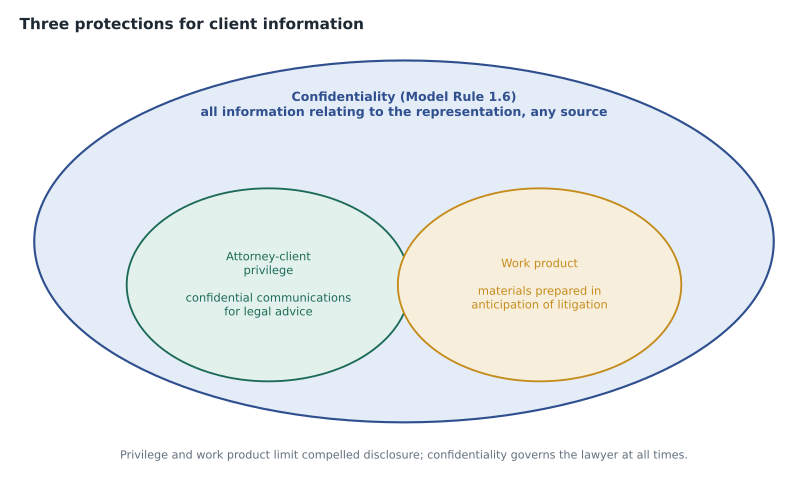
| Attorney-client privilege | Duty of confidentiality | |
|---|---|---|
| Source | Law of evidence (common law; state codes; Federal Rule of Evidence 501) | Rules of professional conduct (Model Rule 1.6) |
| Protects | Confidential communications for legal advice | All information relating to the representation, whatever its source |
| Applies when | Someone seeks to compel disclosure in a proceeding | At all times, in and out of court |
| Overcome by | Waiver, crime-fraud exception, other exceptions | Informed consent, implied authorization, Rule 1.6(b) exceptions, court order |
| After death | Survives the client's death (Swidler & Berlin v. United States, 1998) | Continues after the representation and the client's death |
The attorney-client privilege in more detail
The privilege requires a communication, between privileged persons (the client, the lawyer, and agents who assist them, such as interpreters and paralegals), made in confidence, for the purpose of obtaining or providing legal assistance. A communication made in the presence of an unnecessary third party, such as a friend sitting in on the meeting, is generally not privileged, because it was not made in confidence. Facts are not privileged: a client cannot refuse to testify about what she saw just because she also told her lawyer. Only the communication itself is protected.
For organizations, the Supreme Court in Upjohn Co. v. United States (1981) rejected a narrow test that protected only communications with top management, and held that communications between corporate counsel and lower-level employees, made at the direction of superiors to secure legal advice for the company and concerning matters within the employees' duties, are privileged. The privilege belongs to the company, not the employee. That is why lawyers who interview employees give a warning, often called an Upjohn warning, that the lawyer represents the company, and the company may choose to waive the privilege.
The privilege belongs to the client, who may waive it. Disclosure to third parties outside the privileged circle generally waives it. The crime-fraud exception removes protection from communications made to obtain help in committing or planning a crime or fraud; it does not apply to a client's confession of a past crime, which remains privileged. In Swidler & Berlin v. United States (1998), the Supreme Court held that the privilege survives the client's death, refusing to allow a grand jury to obtain a lawyer's notes of a conversation with a client who had died.
Consent and implied authorization
A lawyer may reveal information when the client gives informed consent, meaning agreement after the lawyer explains the material risks and reasonably available alternatives. A lawyer is also impliedly authorized to disclose information as needed to carry out the representation, such as admitting facts in a negotiation to reach a settlement, or sharing information with other lawyers in the same firm. Lawyers in a firm may discuss a client's matter with each other unless the client has instructed that particular information be confined to specified lawyers.
A lawyer may consult another lawyer outside the firm about compliance with the lawyer's own ethical duties; Rule 1.6(b)(4) permits disclosure to secure legal advice about compliance with the rules. Informal consultations with colleagues about a client's matter, using hypotheticals, are allowed if there is no reasonable likelihood that the listener will learn the client's identity or the situation. ABA Formal Opinion 511 (2024, revised) applied that limit to lawyer listservs: posting a question with enough detail to identify the client or matter requires the client's informed consent.
The exceptions in Rule 1.6(b)
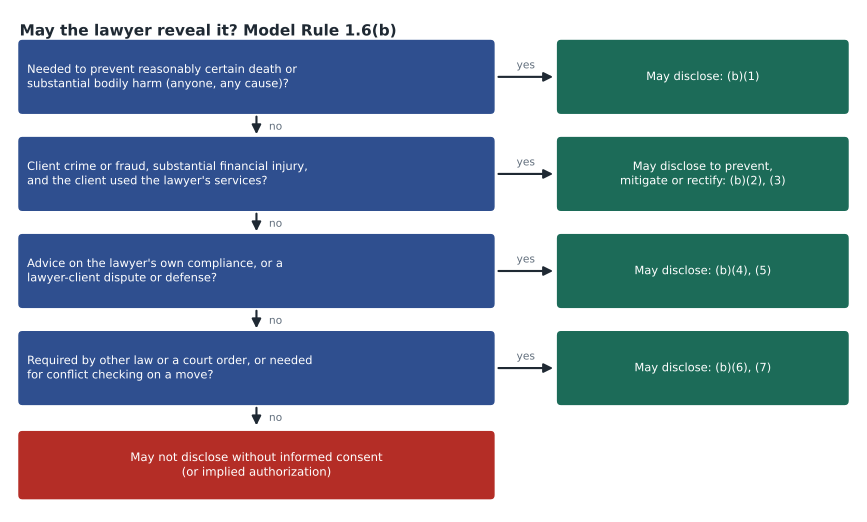
Rule 1.6(b) permits, but does not require, disclosure to the extent the lawyer reasonably believes necessary in seven situations. The word 'permits' matters: on the MPRE, an answer that says a lawyer must disclose under Rule 1.6(b) is usually wrong. Other rules can turn permission into a requirement, as Rule 3.3 does before a tribunal, and Lesson 8 covers that.
| Rule 1.6(b) | A lawyer may reveal information reasonably necessary to... |
|---|---|
| (1) | Prevent reasonably certain death or substantial bodily harm |
| (2) | Prevent the client from committing a crime or fraud reasonably certain to cause substantial financial injury, if the client used or is using the lawyer's services |
| (3) | Prevent, mitigate or rectify substantial financial injury from such a crime or fraud that resulted from the client's use of the lawyer's services |
| (4) | Secure legal advice about the lawyer's compliance with the rules |
| (5) | Establish a claim or defense in a controversy between lawyer and client; defend against charges about the lawyer's conduct; respond to allegations about the representation |
| (6) | Comply with other law or a court order |
| (7) | Detect and resolve conflicts arising from a change of employment or firm ownership, if not prejudicial to the client |
Look at the structure of the first three. The death or bodily harm exception in (b)(1) applies regardless of who will cause the harm and whether the lawyer's services were involved, and does not require that the harm be imminent, only reasonably certain. The financial exceptions in (b)(2) and (b)(3) are narrower: they require a crime or fraud by the client, substantial financial injury, and the client's use of the lawyer's services. A client who confides that he is defrauding investors through a scheme the lawyer had nothing to do with does not trigger (b)(2), though the lawyer must not assist and may need to withdraw.
The self-defense exception in (b)(5) lets a lawyer reveal information to collect a fee or defend against a malpractice claim, a disciplinary complaint, or even a third party's claim that the lawyer participated in the client's wrongdoing. It does not let a lawyer respond to every criticism. ABA Formal Opinion 496 (2021) concluded that a client's negative online review, by itself, does not justify revealing confidential information in reply, and in August 2026 the ABA amended comment [10] to Rule 1.6 to say so expressly. A lawyer may respond to a bad review in general terms, for example that the lawyer disagrees with the review's description of events, but may not reveal what happened in the representation.
Worked problem
A confidence about future harm
A divorce client tells his lawyer that he intends to take the children out of the country next week in violation of a custody order and that he has bought tickets. The lawyer believes him. Separately, he tells the lawyer he has been hiding income from his ex-spouse through a business the lawyer has never advised. May the lawyer disclose either fact?
Show solution
- Parental abduction may involve risk of harm, but (b)(1) requires reasonably certain death or substantial bodily harm, which these facts do not clearly show. The intended conduct is a crime, but (b)(2) requires that the lawyer's services be used, and they are not.
- However, the lawyer must not assist and should counsel the client against the plan. A court order or statute may require disclosure under (b)(6) in some jurisdictions.
- The hidden income is a fraud, but the lawyer's services were not used, so (b)(2) and (b)(3) do not apply. If the hidden income must be disclosed in a filing the lawyer prepares, the lawyer may not file a false document and must withdraw if the client insists.
Answer: On the Model Rules as written, the lawyer generally may not reveal either fact without the client's consent, unless the facts show reasonably certain serious bodily harm or the lawyer's services are involved. The lawyer must not assist either plan.
Disclosures compelled by law or a court
Rule 1.6(b)(6) permits disclosure required by other law or a court order. When a lawyer is subpoenaed or asked to testify about a client's information, the lawyer should assert on the client's behalf every nonfrivolous claim that the information is protected, such as the privilege or work product. If the court orders disclosure after the claims are rejected, the lawyer may comply, though the lawyer should consult the client about an appeal where appropriate. Disclosure should be no broader than necessary, and lawyers can seek protective orders to limit who sees the information.
Safeguarding information and technology
Rule 1.6(c), added in 2012, requires a lawyer to make reasonable efforts to prevent the inadvertent or unauthorized disclosure of, or unauthorized access to, information relating to the representation. Reasonableness depends on the sensitivity of the information, the likelihood of disclosure without added safeguards, the cost and difficulty of safeguards, and how much safeguards would hurt the lawyer's ability to represent clients. A lawyer whose unencrypted laptop with client files is stolen from a car has not automatically violated the rule, but a lawyer who ignores basic protections may have. Clients may require greater protection, or give informed consent to less.
Rule 4.4(b) deals with the other side of the coin: a lawyer who receives a document or electronically stored information relating to the representation of the lawyer's client, and knows or reasonably should know that it was inadvertently sent, must promptly notify the sender. Whether the receiving lawyer may read or use it, and whether privilege is waived, are questions for other law, such as Federal Rule of Evidence 502(b) and court rules on clawback.
ABA Formal Opinion 512 (2024), the ABA's first opinion on generative artificial intelligence, applied Rule 1.6 to lawyers' use of these tools. Before entering information relating to a representation into a tool that may use the inputs to train or may disclose them to others, a lawyer must evaluate the risk, and for self-learning tools that can reveal inputs, the opinion concludes that the client's informed consent is generally required, and boilerplate consent in an engagement letter is not enough. The opinion also addresses competence, communication, candor, supervision and fees, which later lessons cover.
Duration and other confidentiality rules
The duty of confidentiality continues after the representation ends and after the client's death. Rule 1.9(c) forbids using a former client's information to the former client's disadvantage unless the rules permit it or the information has become generally known, and forbids revealing it except as the rules permit. In August 2026 the ABA amended comment [8] to Rule 1.9 to clarify when information is generally known: such information may be used adversely to the former client, but not disclosed. Rule 1.8(b) imposes a similar limit on current clients' information: a lawyer must not use it to the client's disadvantage without informed consent. Using client information for the lawyer's own benefit without harming the client, such as learning about a good investment, is not forbidden by 1.8(b), though other law such as insider trading rules may apply.
Rule 1.18 extends confidentiality to prospective clients, and Rule 1.6 applies to information from the client's agents, opposing parties and public sources alike. Marchetti summarizes the lesson in one line for the group's error log: 'If you learned it because you represent the client, assume it is confidential, and look for consent, implied authority or a 1.6(b) exception before you say a word.'
Practice problems
Work each problem on paper first, then reveal the answer to check.
Is information a lawyer finds in a public court file about the client confidential under Rule 1.6?
Show answer
Yes. Confidentiality covers all information relating to the representation, including public information.
Does the attorney-client privilege survive the client's death?
Show answer
Yes, under Swidler & Berlin v. United States (1998).
May a lawyer reveal a client's confidential information to respond to a negative online review?
Show answer
No. A review alone is not a controversy permitting disclosure; the lawyer may respond only in general terms.
Must a lawyer disclose to prevent a client's fraud that uses the lawyer's services?
Show answer
The Model Rule permits, but does not require, disclosure under Rule 1.6(b)(2); the lawyer must not assist and may have to withdraw.
Common mistakes
MistakeIf it is not privileged, it is not confidential.
InsteadConfidentiality under Rule 1.6 is far broader than the privilege.
MistakeThe 1.6(b) exceptions require disclosure.
InsteadThey permit disclosure of what is reasonably necessary; Rule 3.3 and other law can impose requirements.
MistakeA client's confession of a past crime is unprotected because of the crime-fraud exception.
InsteadThe exception covers communications to further a crime or fraud, not confessions of past crimes.
Summary and key terms
- The privilege protects confidential communications for legal advice from compelled disclosure; work product protects litigation preparation materials.
- Rule 1.6 confidentiality covers all information relating to the representation, from any source, at all times, even after death.
- Disclosure is allowed with informed consent, implied authorization or a Rule 1.6(b) exception, and only to the extent reasonably necessary.
- The financial exceptions require the client's crime or fraud and use of the lawyer's services; the bodily harm exception does not.
- Rule 1.6(c) requires reasonable safeguards, including for technology and generative AI (Formal Opinion 512); online reviews do not justify disclosure.
- Attorney-client privilege
- An evidence rule protecting confidential lawyer-client communications made for legal advice from compelled disclosure.
- Work product
- Materials prepared in anticipation of litigation, protected from discovery, with near-absolute protection for opinion work product.
- Crime-fraud exception
- Removes privilege from communications made to further a crime or fraud.
- Implied authorization
- A lawyer's authority to disclose information as needed to carry out the representation.
- Upjohn warning
- A notice to an employee that corporate counsel represents the company, which controls the privilege.
Lesson quiz · 5 questions
Score 60% or more to complete this lesson.
Create a free account to save your progress, take quizzes and earn a certificate.