
BAR-140 · Lesson 6 of 12 · 24 min
Conflicts: former clients and imputation
▶ Video coming soon A video version of this lesson is on the way.
The second conflicts session, on November 5, 2026, is the last full workshop before Ngozi and Eddie sit the exam. Marchetti builds it around a story about lawyers changing jobs, which is where most of these questions come from. 'Lawyers move,' she says. 'They leave firms, join government, become judges, come back to private practice and take the knowledge in their heads with them. The rules in this lesson decide what they can do next, and whether the people they now work with are tainted by what they know.'
This lesson covers duties to former clients under Model Rule 1.9, imputation of conflicts within a firm and screening under Rule 1.10, the special rules for former and current government lawyers under Rule 1.11, former judges, arbitrators, mediators and law clerks under Rule 1.12, and prospective clients under Rule 1.18. It also explains how these rules show up in motions to disqualify, which courts decide using the rules as guidance.
Duties to former clients: Model Rule 1.9
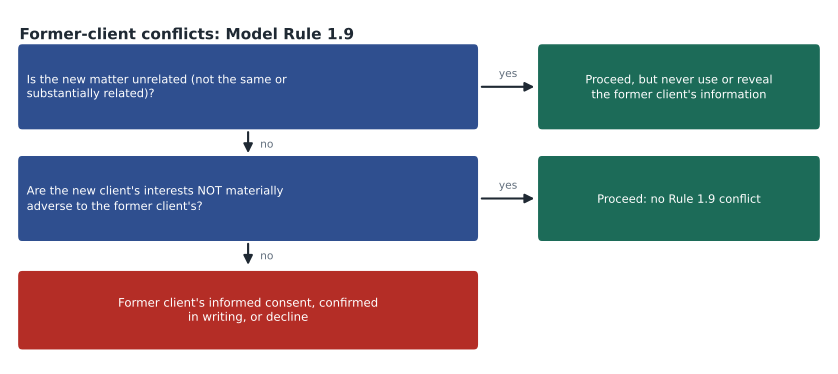
Rule 1.9(a) says a lawyer who has formerly represented a client in a matter shall not thereafter represent another person in the same or a substantially related matter in which that person's interests are materially adverse to the interests of the former client, unless the former client gives informed consent, confirmed in writing. Each element matters. If the new matter is not substantially related, the lawyer may act against a former client freely, though the lawyer still may not use or reveal the former client's confidential information. If the new client's interests are not materially adverse to the former client's, there is no Rule 1.9 conflict at all.
Matters are substantially related if they involve the same transaction or legal dispute, or if there is a substantial risk that confidential factual information that would normally have been obtained in the prior representation would materially advance the new client's position. The test is objective: the lawyer does not have to have actually learned the information; the question is what a lawyer in that role would ordinarily learn. A lawyer who handled a company's environmental permits for years cannot later sue the company for pollution at the same plant. A lawyer who once drafted a company's employee handbook may well be able to sue it years later in an unrelated patent case.
The comments clarify that general knowledge of a former client's policies and practices ordinarily does not by itself bar later adversity, but knowledge of specific facts gained in a prior representation that are relevant to the new matter does. Information that has become generally known can be used against a former client under Rule 1.9(c), and in August 2026 the ABA amended comment [8] to Rule 1.9 to describe when information is generally known, such as information widely available in the public domain or within the relevant industry, as opposed to information that is merely in a public record somewhere. Generally known information may be used, but it still may not be disclosed.
When a lawyer changes firms
Rule 1.9(b) addresses a lawyer whose former firm represented a client. The lawyer may not represent a person in the same or a substantially related matter materially adverse to that client if the lawyer personally acquired information protected by Rules 1.6 and 1.9(c) that is material to the matter, unless the former client gives informed consent, confirmed in writing. A lawyer who was at a large firm but never worked on or learned about a particular client's matter is not disqualified just because the old firm represented that client. What counts is what the lawyer personally knows.
Imputation within a firm: Model Rule 1.10
Rule 1.10(a) says that while lawyers are associated in a firm, none of them may knowingly represent a client when any one of them practicing alone would be prohibited from doing so by Rule 1.7 or 1.9. The conflict of one is the conflict of all, because lawyers in a firm share information and loyalty. A firm includes lawyers in a law partnership, professional corporation, sole proprietorship or other association authorized to practice law, and lawyers in a legal services organization or the legal department of a corporation.
Rule 1.10(a) has two exceptions. First, a conflict based on a personal interest of the prohibited lawyer is not imputed if it does not present a significant risk of materially limiting the representation by the others. If one lawyer's strong religious or political views would limit her, the others may proceed; if a lawyer's spouse is opposing counsel, the conflict is personal to that lawyer. Second, under Rule 1.10(a)(2), added to the Model Rules in 2009, a conflict that arises from a lawyer's association with a prior firm is not imputed to the new firm if the prohibited lawyer is timely screened from any participation in the matter and is apportioned no part of the fee from it, and written notice is promptly given to the affected former client describing the screening procedures, along with a statement of the firm's and the screened lawyer's compliance with the rules, a willingness to respond to inquiries, and certifications of compliance at reasonable intervals on request and at the end of the screening.
Not every state has adopted lateral screening for private lawyers; some allow it only in limited situations. The MPRE follows the Model Rule. Screening is also discussed in the comments to Rule 1.10 for nonlawyer staff: a paralegal or secretary who moves from one firm to another does not disqualify the new firm if the person is screened, because the imputation rule applies to lawyers.
Rule 1.10(b) addresses what happens when a lawyer leaves. After a lawyer has terminated association with a firm, the firm may represent a person with interests materially adverse to those of a client represented by the departed lawyer, unless the matter is the same or substantially related to the one in which the departed lawyer represented the client and any lawyer remaining in the firm has information protected by Rules 1.6 and 1.9(c) that is material to the matter. Rule 1.10(c) allows a disqualification imputed under 1.10 to be waived by the affected client under the conditions of Rule 1.7.
Worked problem
A lateral hire
Priya, an associate at Firm A, spent two years defending Coastal Foods against a wrongful termination claim and knows its litigation strategy. She joins Firm B, which represents the plaintiff in that same lawsuit. Can Firm B continue?
Show solution
- Priya personally is disqualified under 1.9: same matter, materially adverse, and she has the information.
- Under 1.10(a), her conflict is imputed to Firm B unless an exception applies.
- Under 1.10(a)(2), Firm B can avoid imputation if it timely screens Priya, gives her no part of the fee and promptly sends written notice to Coastal Foods with the required information.
Answer: Under the Model Rules, Firm B may continue if it screens Priya properly and gives the notice. A court deciding a motion to disqualify may still weigh the risk, and some states do not permit this screen.
Government lawyers: Model Rule 1.11
Rule 1.11 balances two concerns: that government lawyers should not use public office to benefit future private clients, and that the government should be able to attract good lawyers who will later return to private practice. Under Rule 1.11(a), a lawyer who has formerly served as a public officer or employee of the government is subject to Rule 1.9(c) and shall not otherwise represent a client in connection with a matter in which the lawyer participated personally and substantially as a public officer or employee, unless the appropriate government agency gives its informed consent, confirmed in writing.
The test is personal and substantial participation in a particular matter, not merely having worked at the agency. A former prosecutor who supervised the prosecution of a defendant may not later represent that defendant in the same case, but a former agency lawyer who drafted general regulations may later represent private clients affected by them, because rulemaking of general application is not a matter in this sense. When a former government lawyer is disqualified, Rule 1.11(b) lets the new firm proceed if the lawyer is timely screened and apportioned no part of the fee, and written notice is promptly given to the government agency. The notice goes to the agency, not to opposing parties.
Rule 1.11(c) adds a confidential government information rule: a lawyer who acquired information about a person while serving the government, which the government is prohibited by law from disclosing or has a legal privilege not to disclose, may not represent a private client whose interests are adverse to that person in a matter in which the information could be used to the person's material disadvantage. Screening is available here too. Rule 1.11(d) governs current government lawyers: they are subject to Rules 1.7 and 1.9 and may not participate in a matter in which they participated personally and substantially while in private practice, unless the agency consents in writing, or negotiate for private employment with any person involved as a party or lawyer in a matter in which the lawyer is participating personally and substantially, with a narrow allowance for law clerks under Rule 1.12(b).
| Lawyer | Rule | Who must consent | Can the new firm screen? |
|---|---|---|---|
| Former client lawyer moving to a new private firm | 1.9, 1.10(a)(2) | The former client | Yes, with notice to the former client (Model Rule) |
| Former government lawyer in private practice | 1.11(a), (b) | The government agency | Yes, with notice to the agency |
| Lawyer with confidential government information about a person | 1.11(c) | Not curable by consent | Yes |
| Former judge, arbitrator, mediator or law clerk | 1.12 | All parties to the proceeding | Yes, with notice to the parties and tribunal |
| Lawyer who consulted a prospective client | 1.18 | Affected client and prospective client | Yes, if the lawyer took reasonable measures to limit information |
Former judges, arbitrators, mediators and law clerks: Model Rule 1.12
Rule 1.12(a) says a lawyer shall not represent anyone in connection with a matter in which the lawyer participated personally and substantially as a judge or other adjudicative officer, as a law clerk to such a person, or as an arbitrator, mediator or other third-party neutral, unless all parties to the proceeding give informed consent, confirmed in writing. Consent must come from all parties, not one side. A former judge's firm may proceed if the former judge is timely screened and apportioned no part of the fee, and written notice is promptly given to the parties and any appropriate tribunal.
Two details are tested. First, a lawyer serving as a judge, adjudicative officer or neutral may not negotiate for employment with a party or lawyer involved in a matter in which the lawyer is participating personally and substantially. A law clerk may, but only after notifying the judge. Second, an arbitrator selected as a partisan by a party in a multimember arbitration panel is not prohibited from later representing that party.
Prospective clients: Model Rule 1.18
A prospective client is a person who consults a lawyer about the possibility of forming a client-lawyer relationship. Even if no relationship forms, the lawyer may not use or reveal information learned in the consultation, except as Rule 1.9 would permit for a former client. Under Rule 1.18(c), the lawyer may not represent a client with interests materially adverse to the prospective client in the same or a substantially related matter if the lawyer received information that could be significantly harmful to the prospective client.
Rule 1.18(d) gives two ways out. The representation is permitted if both the affected client and the prospective client give informed consent, confirmed in writing. Or the firm may proceed if the lawyer who received the information took reasonable measures to avoid exposure to more disqualifying information than was reasonably necessary to decide whether to take the matter, the lawyer is timely screened and apportioned no part of the fee, and written notice is promptly given to the prospective client. That is why careful lawyers limit initial interviews to the information needed to run a conflict check and decide whether to take the case. ABA Formal Opinion 510 (2024) explains how a firm can avoid imputation when it is adverse to one of its lawyer's prospective clients.
A person who sends unsolicited information to a lawyer, without any reasonable expectation that the lawyer is willing to discuss a possible relationship, is not a prospective client. Someone who emails a lawyer chosen at random from a directory, or who consults a lawyer only to disqualify the lawyer from representing the other side, does not gain the protection of Rule 1.18.
Worked problem
A short consultation
A woman meets with a family lawyer for 20 minutes about divorcing her husband and describes her finances and an affair. She does not hire the lawyer. A month later her husband asks the same firm to represent him in the divorce. May the firm represent him?
Show solution
- She was a prospective client, and the information about finances and the affair could be significantly harmful to her in the same matter.
- The lawyer who met her is disqualified unless both give informed consent, confirmed in writing.
- The firm can avoid imputation only if the lawyer took reasonable measures to limit the information, is screened, gets no part of the fee, and the wife receives prompt written notice. Discussing the affair and finances in detail may show the lawyer did not limit the information.
Answer: Probably not, unless both spouses consent in writing. If the lawyer limited the intake to conflict information, a screen with notice could allow the firm to proceed.
Disqualification in court
These rules are disciplinary rules, but courts use them when deciding motions to disqualify counsel in litigation. A court has inherent power to disqualify a lawyer to protect the integrity of the proceeding, and it weighs the client's right to counsel of choice and the risk that disqualification motions are filed for tactical delay. A court may disqualify a firm even where screening technically meets the Model Rule, or refuse to disqualify despite a technical violation. On the MPRE, read the stem carefully: 'Is the lawyer subject to discipline?' and 'Will the court grant the motion to disqualify?' can have different answers.
Practice problems
Work each problem on paper first, then reveal the answer to check.
Can a lawyer sue a former client in a matter unrelated to the prior work?
Show answer
Yes, if the matters are not substantially related, but the lawyer may not use or reveal the former client's confidential information unless it is generally known.
Who must receive notice when a firm screens a lateral lawyer under Rule 1.10(a)(2)?
Show answer
The affected former client.
A former agency lawyer drafted a general regulation. May she represent private clients challenging it?
Show answer
Generally yes. Rulemaking of general application is not a particular matter in which she participated personally and substantially.
Who must consent before a former mediator represents one side in the same matter?
Show answer
All parties to the proceeding, confirmed in writing.
Common mistakes
MistakeOnce a client leaves, the lawyer owes nothing more.
InsteadRule 1.9 bars substantially related adverse work and forbids using or revealing the former client's information.
MistakeA former government lawyer is barred from any matter involving the old agency.
InsteadOnly matters in which the lawyer participated personally and substantially, plus confidential government information.
MistakeScreening is available in every situation under the Model Rules.
InsteadIt is unavailable to cure the conflicted lawyer's own disqualification, and some states limit lateral screening.
Summary and key terms
- Rule 1.9 bars representing a new client against a former client in the same or a substantially related matter without informed consent, confirmed in writing.
- Rule 1.10 imputes 1.7 and 1.9 conflicts to the firm, except personal-interest conflicts and lateral conflicts cured by a timely screen with notice to the former client.
- Rule 1.11 limits former government lawyers to matters they did not handle personally and substantially; screening with notice to the agency protects the new firm.
- Rule 1.12 requires all parties' consent before a former judge, clerk or neutral takes a matter; screening with notice protects the firm.
- Rule 1.18 protects prospective clients; firms can proceed with consent or by screening a lawyer who limited the information received.
- Substantially related matter
- A matter involving the same transaction or dispute, or one where confidential information normally obtained before would materially advance the new client's position.
- Imputation
- Treating one lawyer's conflict as a conflict of every lawyer in the firm.
- Screen
- Procedures isolating a conflicted lawyer from a matter, with no share of the fee and required notice.
- Personally and substantially
- Direct, significant involvement in a particular matter, the test for government lawyers and former judges.
- Generally known
- Information widely available in the public domain or the relevant field, which may be used, but not disclosed, against a former client.
Lesson quiz · 5 questions
Score 60% or more to complete this lesson.
Create a free account to save your progress, take quizzes and earn a certificate.