
BAR-140 · Lesson 11 of 12 · 25 min
Judicial conduct
▶ Video coming soon A video version of this lesson is on the way.
On Wednesday, November 11, the night before her exam, Ngozi asks Marchetti for a short call about the one topic she has barely studied. 'Judges,' she says. 'I am not going to be a judge.' Marchetti tells her that is what most candidates think, and why the two to five judicial conduct questions on a typical MPRE are easy points for people who spend an hour on them. 'They test a small number of rules over and over. Learn the ex parte rule, disqualification, gifts and campaign rules, and you have most of it.'
Judicial conduct makes up about 2 to 8 percent of the MPRE. The source is the ABA Model Code of Judicial Conduct, adopted in its current structure in 2007 and amended several times since, plus the Supreme Court's decisions on judicial elections and due process. The Code is organized into four canons, each containing numbered rules. This lesson covers who the Code applies to, independence and impartiality, ex parte communications, disqualification, extrajudicial activities, gifts and financial activities, and political and campaign activity by judges and judicial candidates.
Structure and scope of the Code
Canon 1 requires a judge to uphold and promote the independence, integrity and impartiality of the judiciary, and to avoid impropriety and the appearance of impropriety. Canon 2 requires a judge to perform the duties of judicial office impartially, competently and diligently. Canon 3 requires a judge to conduct personal and extrajudicial activities so as to minimize the risk of conflict with the obligations of judicial office. Canon 4 forbids a judge or candidate for judicial office from engaging in political or campaign activity inconsistent with the independence, integrity or impartiality of the judiciary.
The Code applies to anyone authorized to perform judicial functions, including magistrates, court commissioners, special masters and referees, and, through the application section, in part to part-time and retired judges serving by assignment. Rules phrased with 'shall' or 'shall not' are binding, while 'should' or 'may' signal guidance. Lawyers are tested on the Code in part because Model Rule 8.4(f) makes it misconduct for a lawyer to knowingly assist a judge in conduct that violates the judicial conduct rules, and Rule 8.2(b) requires lawyer candidates for judicial office to comply with it. ABA Formal Opinion 521 (2026) addressed how the Code applies to judges acting in administrative and supervisory roles.
Impartiality and the duties of office
Rule 1.2 requires a judge to act at all times in a manner that promotes public confidence in the independence, integrity and impartiality of the judiciary, and to avoid impropriety and the appearance of impropriety. The test for an appearance of impropriety is whether the conduct would create in reasonable minds a perception that the judge violated the Code or engaged in other conduct that reflects adversely on the judge's honesty, impartiality, temperament or fitness. Rule 1.3 forbids a judge from abusing the prestige of judicial office to advance the personal or economic interests of the judge or others, such as using official letterhead to get out of a traffic ticket or to pressure a business in a personal dispute. A judge may, however, write a reference letter based on personal knowledge, and may use official letterhead for it if there is no likelihood the reader would see it as pressure.
Under Canon 2, a judge must uphold and apply the law and perform duties fairly and impartially (Rule 2.2); perform duties without bias or prejudice and require lawyers in proceedings to refrain from manifesting bias, while allowing legitimate advocacy when such factors are issues in the proceeding (Rule 2.3); not be swayed by public clamor or fear of criticism (Rule 2.4); perform duties competently and diligently (Rule 2.5); accord every person with a legal interest in a proceeding the right to be heard (Rule 2.6); and hear and decide matters assigned unless disqualification is required (Rule 2.7, the duty to sit). A judge may encourage settlement but must not act in a manner that coerces any party into settling.
Ex parte communications: Rule 2.9
Rule 2.9 says a judge shall not initiate, permit or consider ex parte communications, or other communications made to the judge outside the presence of the parties or their lawyers, concerning a pending or impending matter. The exceptions are tested heavily. A judge may engage in ex parte communication for scheduling, administrative or emergency purposes that does not address substantive matters, if the judge reasonably believes no party will gain an advantage and the judge promptly notifies all other parties and gives them an opportunity to respond. A judge may obtain the written advice of a disinterested expert on the law, if the judge gives advance notice to the parties of the person to be consulted and the subject, and gives the parties a reasonable opportunity to object and respond to the notice and the advice.
A judge may consult with court staff and officials whose functions are to aid the judge in carrying out adjudicative responsibilities, such as law clerks, and with other judges, if the judge makes reasonable efforts to avoid receiving factual information not part of the record and does not abrogate the responsibility to decide the matter personally. With the consent of the parties, a judge may confer separately with the parties and their lawyers in an effort to settle matters pending before the judge. And a judge may initiate, permit or consider any ex parte communication when expressly authorized by law, such as in specialized problem-solving courts like drug courts, where the judge may meet with participants and treatment providers.
Rule 2.9(c) adds a rule that matters more every year: a judge shall not investigate facts in a matter independently, and shall consider only the evidence presented and any facts that may properly be judicially noticed. The comments make clear that this prohibition extends to information available in all media, including electronic. A judge who searches the internet for information about a party, or looks at a litigant's social media profile, violates the rule. If a judge inadvertently receives an unauthorized ex parte communication bearing on the substance of a matter, the judge must make provision promptly to notify the parties of its substance and give them an opportunity to respond.
| Communication | Permitted under Rule 2.9? |
|---|---|
| A lawyer emails the judge to argue the merits of a pending motion | No |
| The judge's clerk calls one lawyer to reschedule a hearing, with prompt notice to the other side | Yes, scheduling without substantive content |
| The judge asks a law professor for written advice on the law, after notice and an opportunity to respond | Yes |
| The judge discusses the case with her law clerk | Yes |
| The judge looks up the defendant's social media posts | No, independent investigation of facts |
| With both parties' consent, the judge meets separately with each side to explore settlement | Yes |
Disqualification: Rule 2.11
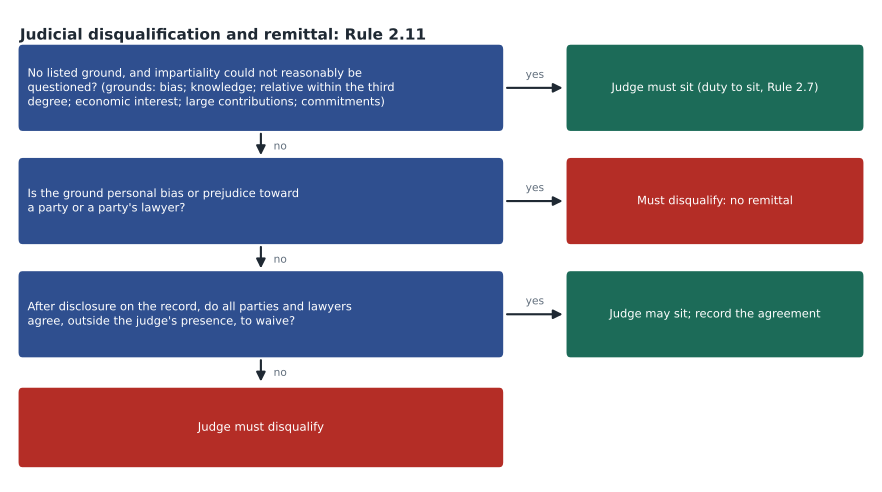
Rule 2.11(a) says a judge shall disqualify himself or herself in any proceeding in which the judge's impartiality might reasonably be questioned. The rule then lists specific situations, which apply in addition to the general standard. A judge must disqualify when the judge has a personal bias or prejudice concerning a party or a party's lawyer, or personal knowledge of facts in dispute. A judge must disqualify when the judge knows that the judge, the judge's spouse or domestic partner, or a person within the third degree of relationship to either of them, or the spouse or domestic partner of such a person, is a party, an officer, director, general partner or managing member of a party; is acting as a lawyer in the proceeding; has more than a de minimis interest that could be substantially affected by the proceeding; or is likely to be a material witness. The third degree of relationship covers great-grandparents, grandparents, parents, uncles, aunts, siblings, children, nieces, nephews, grandchildren and great-grandchildren.
A judge must also disqualify when the judge knows that the judge, individually or as a fiduciary, or the judge's spouse, domestic partner, parent or child, or any other member of the judge's family residing in the household, has an economic interest in the subject matter in controversy or in a party. 'Economic interest' means more than a de minimis legal or equitable interest; it does not include an interest in a mutual or common investment fund the judge does not manage, or deposits in a bank, or an office in a charitable organization. Under Rule 2.11(a)(4), a judge must disqualify when the judge knows or learns that a party, a party's lawyer or the law firm of a party's lawyer has within a period of years made aggregate contributions to the judge's campaign above an amount the jurisdiction sets. Other grounds include public statements by the judge, outside the course of judicial duties, that commit or appear to commit the judge to reach a particular result, and prior involvement in the matter as a lawyer, a judge in another court, or a government employee who participated personally and substantially.
Rule 2.11(c) allows remittal. A judge subject to disqualification, other than for personal bias or prejudice concerning a party or the party's lawyer, may disclose on the record the basis of the disqualification and ask the parties and their lawyers to consider, outside the presence of the judge and court personnel, whether to waive it. If, after disclosure, the parties and lawyers all agree that the judge should not be disqualified, the judge may participate, and the agreement must be incorporated into the record. The rule of necessity, noted in the comments, can also override disqualification when no other judge is available, such as when every judge would be affected by a case about judicial salaries.
The Constitution adds an outer limit. In Caperton v. A.T. Massey Coal Co. (2009), the Supreme Court held that due process required a state supreme court justice to recuse himself from a case involving a company whose chief executive had spent about three million dollars supporting the justice's election while the case was headed to the court, because the contributions created a serious, objective risk of actual bias. In Williams v. Pennsylvania (2016), the Court held that due process was violated when a state supreme court chief justice who, as district attorney, had personally approved seeking the death penalty against a defendant later participated in deciding the defendant's appeal.
Extrajudicial activities: Canon 3
Judges may participate in many outside activities, such as teaching, writing, and civic and charitable groups, but Rule 3.1 says a judge shall not participate in activities that will interfere with the proper performance of judicial duties, lead to frequent disqualification, appear to a reasonable person to undermine the judge's independence, integrity or impartiality, appear to a reasonable person to be coercive, or make use of court premises, staff or resources except for incidental use for activities concerning the law, the legal system or the administration of justice. Rule 3.6 forbids a judge from holding membership in any organization that practices invidious discrimination on the basis of race, sex, gender, religion, national origin, ethnicity or sexual orientation.
Rule 3.7 lets a judge participate in activities sponsored by organizations concerned with the law, the legal system or the administration of justice, and by educational, religious, charitable, fraternal or civic organizations not conducted for profit. A judge may assist such an organization in planning fundraising and managing its funds, and may solicit contributions only from members of the judge's family or from judges over whom the judge does not exercise supervisory or appellate authority. A judge may appear or speak at, receive an award at, be featured on the program of, and permit the judge's title to be used in connection with an event of such an organization, but if the event serves a fundraising purpose, only if the event concerns the law, the legal system or the administration of justice. A judge may not personally ask lawyers or the public for donations to a charity.
Rule 3.10 forbids a judge from practicing law, except that a judge may act pro se and may, without compensation, give legal advice to and draft or review documents for a member of the judge's family, but may not act as an advocate or negotiator for a family member in a legal matter. Rule 3.8 limits fiduciary roles, such as executor or trustee, to members of the judge's family, and Rule 3.9 forbids serving as an arbitrator or mediator or otherwise performing judicial functions apart from official duties unless authorized by law. Rule 3.11 allows a judge to hold and manage investments, including real estate, but forbids serving as an officer, director, manager, general partner, advisor or employee of any business entity, except a business closely held by the judge or family members or one primarily engaged in investing the financial resources of the judge or family.
Gifts and reporting: Rules 3.13 to 3.15
Rule 3.13 forbids a judge from accepting any gifts, loans, bequests, benefits or other things of value if acceptance is prohibited by law or would appear to a reasonable person to undermine the judge's independence, integrity or impartiality. Some items may be accepted without public reporting: items with little intrinsic value, such as plaques and greeting cards; gifts from friends, relatives or others whose appearance or interest in a proceeding pending or impending before the judge would in any event require disqualification; ordinary social hospitality; commercial or financial opportunities and benefits, including special pricing and discounts, and loans from lending institutions in their regular course of business, if the same terms are generally available to similarly situated persons who are not judges; and scholarships and fellowships awarded on the same terms as to other applicants. Other items, such as gifts incident to a public testimonial and invitations to attend bar-related or law-related events without charge, may be accepted only if publicly reported under Rule 3.15, along with certain other gifts the Code lists.
Rule 3.12 permits a judge to accept reasonable compensation for extrajudicial activities permitted by the Code, such as teaching, unless acceptance would appear to undermine the judge's independence, integrity or impartiality. Rule 2.15 mirrors Model Rule 8.3: a judge having knowledge that another judge or a lawyer has committed a violation raising a substantial question regarding honesty, trustworthiness or fitness must inform the appropriate authority, and a judge who receives information indicating a substantial likelihood of such a violation must take appropriate action.
Political and campaign activity: Canon 4
Rule 4.1 forbids judges and judicial candidates from acting as a leader or holding office in a political organization, making speeches on behalf of a political organization, publicly endorsing or opposing a candidate for any public office, soliciting funds for or paying an assessment to a political organization or candidate, personally soliciting or accepting campaign contributions other than through a campaign committee, knowingly or with reckless disregard making any false or misleading statement, and making pledges, promises or commitments inconsistent with the impartial performance of the adjudicative duties of office about cases, controversies or issues likely to come before the court.
Several of these limits have been tested in the Supreme Court. In Republican Party of Minnesota v. White (2002), the Court struck down Minnesota's 'announce clause,' which forbade judicial candidates from announcing their views on disputed legal or political issues, holding that it violated the First Amendment. The Model Code responded by forbidding pledges, promises and commitments rather than announcements of views. In Williams-Yulee v. Florida Bar (2015), the Court upheld Florida's rule forbidding judicial candidates from personally soliciting campaign contributions, holding that the state's interest in preserving public confidence in the integrity of the judiciary justified the narrowly tailored ban. Judicial candidates may establish campaign committees, which may solicit and accept reasonable contributions within limits and time periods set by law.
Rule 4.2 lets candidates in public elections attend political gatherings, seek endorsements from people and organizations other than partisan political organizations in nonpartisan elections, and, in partisan elections, identify as members of a party. Rule 4.5 requires a judge who becomes a candidate for a nonjudicial elective office to resign from judicial office upon becoming a candidate, unless permitted by law to continue to hold judicial office. Marchetti summarizes Canon 4 for Ngozi in two sentences: a judge may campaign but may not personally ask for money or promise outcomes, and a judge may not lead or endorse for anyone else.
Worked problem
A judge's week
During one week a trial judge (1) accepts a 25 dollar discount at a store that offers it to all government employees; (2) calls his niece's landlord, on chambers stationery, to complain about a repair on her behalf; (3) gives a keynote speech, without fundraising, at a bar association dinner; and (4) learns that his son's law firm represents the defendant in a case before him, and continues to hear it because his son is not working on the case. Which actions violate the Code?
Show solution
- (1) is a benefit available on the same terms to others who are not judges, so it is allowed.
- (2) is advocacy for a family member and uses the prestige of office for her interest, violating Rules 1.3 and 3.10.
- (3) is an extrajudicial activity concerning the law, permitted under Rule 3.7.
- (4) The son is within the third degree. If his firm's interest could be substantially affected, or the judge's impartiality might reasonably be questioned, the judge must disqualify unless the parties remit after disclosure.
Answer: (2) violates the Code, and (4) does unless the judge disqualifies or obtains remittal after disclosing the relationship on the record.
Practice problems
Work each problem on paper first, then reveal the answer to check.
May a judge look at a party's public social media page to learn more about the dispute?
Show answer
No. Rule 2.9(c) forbids independent factual investigation, including online.
Can parties waive a judge's disqualification based on personal bias toward a lawyer?
Show answer
No. Remittal is unavailable for personal bias or prejudice concerning a party or lawyer.
May a judicial candidate personally phone lawyers to ask for campaign contributions?
Show answer
No. Contributions must be solicited through a campaign committee; Williams-Yulee upheld the ban.
May a judge serve as executor of a close friend's estate?
Show answer
No. Fiduciary service is limited to members of the judge's family.
Common mistakes
MistakeAny ex parte contact is forbidden.
InsteadScheduling and administrative contacts, consultations with court staff, written expert advice with notice, settlement conferences with consent and legally authorized contacts are allowed.
MistakeA judge may never accept anything of value.
InsteadMany benefits are allowed, some without reporting and some only with public reporting.
MistakeJudicial candidates may not state their views on legal issues.
InsteadThey may announce views (White); they may not make pledges, promises or commitments about cases or issues.
Summary and key terms
- The Model Code has four canons: independence and integrity, duties of office, extrajudicial activities, and political activity; lawyers may not assist judicial misconduct.
- Rule 2.9 bars ex parte communications on substance and independent factual investigation, with narrow exceptions.
- Rule 2.11 requires disqualification when impartiality might reasonably be questioned or listed grounds apply; parties may remit except for personal bias; due process sets outer limits (Caperton, Williams).
- Judges may teach, write and support nonprofits but may not personally solicit funds from the public, practice law, or serve as fiduciaries outside the family.
- Gifts are limited and some must be reported; judges and candidates may not personally solicit contributions (Williams-Yulee) or make pledges or promises, though they may announce views (White).
- Model Code of Judicial Conduct
- The ABA's model rules for judges, organized into four canons, adopted in some form by most states.
- Ex parte communication
- A communication with the judge about a matter without all parties present or notified.
- Remittal
- The procedure by which parties and lawyers waive a judge's disqualification after disclosure on the record.
- Third degree of relationship
- Relatives as close as great-grandparents, uncles, aunts, nieces, nephews and great-grandchildren.
- De minimis
- An insignificant interest that could not raise a reasonable question about the judge's impartiality.
Lesson quiz · 5 questions
Score 60% or more to complete this lesson.
Create a free account to save your progress, take quizzes and earn a certificate.