
BAR-202 · Lesson 12 of 12 · 18 min
Capstone: Alaska practice questions and an exam-day plan
▶ Video coming soon A video version of this lesson is on the way.
On a Sunday afternoon in late November, Marchetti sends Owen a capstone set built for him: ten multiple-choice questions on Alaska admission and Alaska law, a short practice problem on Alaska civil litigation, and a worksheet for planning exam week. 'None of this is on the UBE,' she writes, 'but you will be living it in six months. Do the questions cold, then check the explanations. Then do the exam-week plan, which is the part that actually affects February.' This lesson reproduces the set. All questions and facts are original and fictional.
Part A: ten questions
Answer each question before reading the explanation that follows it.
Question 1. A candidate graduated from an ABA-approved law school in May 2026, earned an MPRE score of 79 in 2025, and plans to sit the February 2027 Alaska exam. Which statement is correct? (A) She cannot apply until she retakes the MPRE. (B) She may apply and sit, but must achieve an MPRE score of 80 before admission. (C) Her 79 satisfies Alaska because it is within eight years. (D) Alaska does not require the MPRE.
Answer: B. Alaska requires an MPRE score of 80, but the score may be submitted any time before admission. She can apply and sit now and retake the MPRE before admission. A 79 is below Alaska's minimum.
Question 2. A lawyer earned a UBE score of 268 in July 2025 in a jurisdiction with a 266 passing score. May she be admitted in Alaska on that score? (A) Yes, because she passed where she sat. (B) Yes, if she also has an MPRE score of 80. (C) No, because Alaska requires 270 for transferred scores. (D) No, because Alaska never accepts transferred scores.
Answer: C. Bar Rule 2, Section 4 requires a UBE score of 270 or higher. Alaska accepts transfers, but only at its own standard.
Question 3. Which person is NOT eligible to sit for the Alaska exam? (A) An ABA graduate with a pending JD to be awarded before the exam. (B) A lawyer licensed in Montana, with no ABA degree, who practiced there three of the last five years. (C) A person who completed one year at an ABA-approved school and a clerkship program under AS 08.08.207. (D) A person seeking only a score to transfer to another state, with no intention of seeking Alaska admission.
Answer: D. Alaska offers no courtesy seating; applicants must certify that their purpose is Alaska admission. The others fit Section 1, Section 3(a) and Section 3(b).
Question 4. An Alaska jury finds a plaintiff's damages are 400,000 dollars and allocates fault: Defendant A 50 percent, Defendant B 30 percent, plaintiff 20 percent. Defendant A is judgment-proof. How much can the plaintiff collect from Defendant B? (A) 400,000 dollars. (B) 320,000 dollars. (C) 120,000 dollars. (D) Nothing, because the plaintiff was at fault.
Answer: C. Under AS 09.17.080, judgment is entered against each defendant for its share of fault: 30 percent of 400,000 is 120,000 dollars. The plaintiff bears Defendant A's uncollectible share. Pure comparative fault means the plaintiff's 20 percent does not bar recovery.
Question 5. After a contested jury trial, a plaintiff wins a money judgment of 100,000 dollars. What is the scheduled Civil Rule 82 award? (A) 20,000 dollars. (B) 12,500 dollars. (C) 10,000 dollars. (D) 30,000 dollars.
Answer: B. Twenty percent of the first 25,000 dollars is 5,000 dollars; ten percent of the next 75,000 dollars is 7,500 dollars; the total is 12,500 dollars. The court may vary it under Rule 82(b)(3).
Question 6. A defendant serves an offer of judgment 70 days after both parties' initial disclosures and 150 days before trial. The plaintiff rejects it and obtains a judgment 20 percent less favorable than the offer. What share of the defendant's reasonable actual fees from the date of the offer must the plaintiff pay? (A) 75 percent. (B) 50 percent. (C) 30 percent. (D) None.
Answer: B. The offer was served more than 60 days after disclosures but more than 90 days before trial, so 50 percent applies under AS 09.30.065. The judgment was more than 5 percent less favorable, so the statute is triggered.
Question 7. A jury awards 1,000,000 dollars in noneconomic damages for an injury that is not a severe permanent impairment or disfigurement. The plaintiff's life expectancy is 40 years and the defendant is 30 percent at fault. What noneconomic damages does the defendant owe? (A) 400,000 dollars. (B) 300,000 dollars. (C) 120,000 dollars. (D) 320,000 dollars.
Answer: B. Allocate fault first (Kisling v. Grosz): 30 percent of 1,000,000 is 300,000 dollars. The general cap is the greater of 400,000 dollars or 40 times 8,000 dollars (320,000 dollars), so 400,000 dollars. The 300,000-dollar share is below the cap, so no reduction applies.
Question 8. Police equip an informant with a recording device and send her to buy drugs from a suspect in his home, without a warrant. In an Alaska prosecution, the recording is most likely: (A) Admissible, because the informant consented. (B) Inadmissible under State v. Glass; the informant may still testify. (C) Inadmissible, and the informant may not testify. (D) Admissible under United States v. White.
Answer: B. Glass requires a warrant for monitoring a conversation with only one participant's consent; it suppressed the recording but not the informant's own testimony.
Question 9. Two enrolled members of an Alaska tribe litigated custody of their member child in tribal court, with notice and a hearing. One parent now asks the superior court to ignore the tribal order. The superior court should: (A) Ignore it, because there is no Indian country. (B) Give it full faith and credit automatically. (C) Recognize it under comity unless there was no jurisdiction, a denial of due process or a public policy violation. (D) Transfer the case to federal court.
Answer: C. John v. Baker recognized inherent tribal jurisdiction over custody of member children and adopted comity for recognition.
Question 10. A father has committed two separate incidents of domestic violence against the mother, neither causing serious injury. In an Alaska custody case: (A) No presumption applies without a serious injury. (B) A rebuttable presumption bars him from sole or joint custody. (C) He automatically loses all contact with the child. (D) The court may consider the incidents only if he was convicted.
Answer: B. Under AS 25.24.150(h), more than one incident is a history of perpetrating domestic violence, triggering the presumption in subsection (g). Unless rebutted, visitation is supervised under subsection (j).
Part B: a short problem
Read the facts, write an answer of about 400 words, then compare it with the model answer.
Facts. Rosa Ilanik, a 35-year-old Bethel resident with a life expectancy of 44 more years, was injured when a delivery van owned by Tundra Freight LLC struck her snowmachine on a frozen river road. She suffered a broken leg that healed with a permanent limp but no severe permanent impairment. Her medical bills and lost wages total 90,000 dollars. A second snowmachine, driven by Pete Moses, also contributed to the crash; Pete has no insurance and few assets. Rosa was traveling slightly too fast. Her lawyer sues Tundra Freight in superior court; Tundra Freight files a third-party claim against Pete. Ninety-five days before trial, Tundra Freight serves an offer of judgment for 150,000 dollars. Rosa rejects it. The jury finds total damages of 90,000 dollars economic and 500,000 dollars noneconomic and allocates fault: Tundra Freight 40 percent, Pete 40 percent, Rosa 20 percent. Analyze Tundra Freight's liability, the offer of judgment and Rule 82.
Worked problem
Model answer outline
Rosa Ilanik v. Tundra Freight LLC (fictional).
Show solution
- Comparative fault and several liability: Alaska applies pure comparative fault (Kaatz), so Rosa's 20 percent does not bar recovery. Under AS 09.17.080, judgment against Tundra Freight is limited to its 40 percent share; Pete's 40 percent is entered against Pete and is likely uncollectible, a loss Rosa bears.
- Economic damages: 40 percent of 90,000 is 36,000 dollars, not capped.
- Noneconomic damages: allocate fault first (Kisling): 40 percent of 500,000 is 200,000 dollars. General cap: the greater of 400,000 dollars or 44 x 8,000 = 352,000 dollars, so 400,000 dollars. 200,000 is below the cap; no reduction.
- Judgment against Tundra Freight: 36,000 + 200,000 = 236,000 dollars, plus prejudgment interest and costs as allowed.
- Offer of judgment: Rosa's judgment against Tundra Freight (236,000 dollars) is more favorable than the 150,000-dollar offer, so AS 09.30.065 does not shift fees to her.
- Rule 82: Rosa is the prevailing party with a money judgment after a contested trial. Scheduled award on 236,000 dollars: 20 percent of 25,000 (5,000) + 10 percent of 75,000 (7,500) + 10 percent of 136,000 (13,600) = 26,100 dollars, subject to the 82(b)(3) factors. Prejudgment interest would be included in the base.
Answer: Tundra Freight owes about 236,000 dollars in damages plus a scheduled Rule 82 award of about 26,100 dollars (on that base), and the offer of judgment has no effect because Rosa beat it.
A strong answer also notes what it does not know: the amount of prejudgment interest, which would increase both the judgment and the Rule 82 base, and whether Tundra Freight could argue for a reduced Rule 82 award under the listed factors. On the UBE, the same facts would be analyzed under joint and several liability unless the question said otherwise, and no fee award would follow; the contrast is the point of the exercise.
Part C: an exam-week plan for February in Alaska
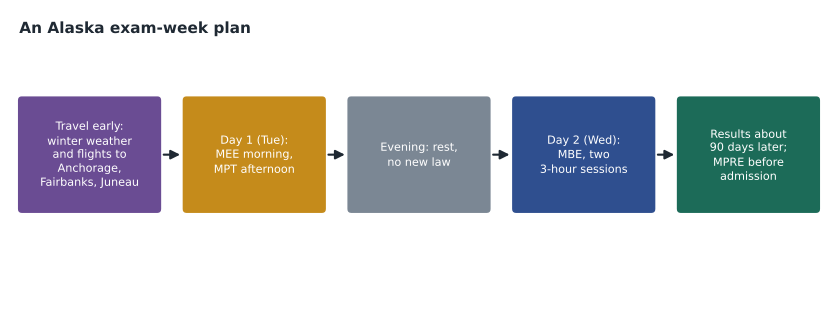
The last part of the capstone is practical, and Marchetti asks Owen to fill in each line with dates, times and names.
| When | Task | Owen's plan |
|---|---|---|
| December 1, 2026 | Application complete; laptop registered | Filed October 28; laptop fee paid; Fairbanks site chosen |
| Late January 2027 | Final full practice exam under time | Saturday, two days, at the courthouse library after hours with permission |
| February 3, 2027 | Last partial-refund withdrawal date | Decide by January 31 whether he is ready |
| Week before | Taper: short timed sets, sleep schedule shifted to exam hours | Stop new outlines by February 16 |
| February 22, 2027 | Travel and check-in logistics | Already in Fairbanks; walk to the site to time the route |
| February 23, 2027 | Day one: MEE (morning), MPT (afternoon) | Laptop charged, power cord, approved items in a clear bag, ID |
| February 23 evening | Rest | Light review of the MBE traps list only |
| February 24, 2027 | Day two: MBE | Pace: about 1.8 minutes per question; flag and move on |
| After the exam | Results about 90 days later | MPRE score already sent; keep application updated |
Three Alaska-specific points belong in every plan. Travel early if you are not already in your test city, because winter flights can be delayed or canceled. Know the site's rules for laptops and permitted items, including the Anchorage laptop form if you test there. And protect your sleep: by late February, Fairbanks and Anchorage have roughly ten hours of daylight, far more than in December, but early mornings are still dark and cold, so plan the commute.
Final advice
Marchetti's closing note to Owen fits every candidate. 'For February, the only law that counts is the national law the UBE tests. Know your Alaska traps so your clerkship does not lead you astray on the MBE. After February, the Alaska law in this course becomes your daily work: Rule 82 in every settlement, several liability in every multi-party case, Glass in every recorded conversation, ANCSA in every land question, the domestic violence presumption in every custody case. Learn it then, and learn it well.'
Common mistakes
MistakeUsing Alaska's several liability rule on the MBE.
InsteadOn the exam, use joint and several liability unless the question says otherwise; use AS 09.17.080 in Alaska practice.
MistakeApplying the cap before allocating fault.
InsteadAllocate fault first, then compare the defendant's share with the cap (Kisling).
MistakeIgnoring prejudgment interest when computing a Rule 82 award.
InsteadThe Rule 82(b)(1) base includes prejudgment interest.
MistakeLeaving travel to the day before a February exam.
InsteadPlan for winter weather and arrive early.
Scoring yourself
Marchetti asks Owen to score Part A by topic, not just in total. Questions 1 to 3 test admission rules; 4 to 7 test Alaska civil litigation; 8 tests criminal procedure; 9 tests Alaska Native law; and 10 tests family law. A miss in the first group matters now, because it could affect his application. A miss in the second group will matter in his first months of practice. Owen misses only Question 6, choosing 75 percent because he counted from the wrong date, and adds the offer-of-judgment timing rule to his list.
Summary and key terms
- Alaska admission questions turn on Bar Rule 2: eligibility routes, the 270 standard, the MPRE of 80 and no courtesy seating.
- Alaska civil practice combines pure comparative fault, several liability, noneconomic caps applied after fault, Rule 82 fees and offers of judgment.
- Glass, John v. Baker and the domestic violence presumption are recurring Alaska issues in criminal, family and tribal matters.
- On the UBE, apply national defaults; in Alaska practice, apply Alaska law.
- An exam-week plan should cover deadlines, travel, laptop rules, sleep and pacing.
- Capstone
- A final exercise combining the course's material.
- Prejudgment interest
- Interest on damages from the time of injury or claim until judgment, included in the Rule 82 base.
- Taper
- Reducing study volume in the final days before an exam to arrive rested.
- Traps list
- A personal list of points where familiar local law differs from what the exam tests.
- Pacing
- Planning time per question or task to finish each session.
Practice problems
Work each problem on paper first, then reveal the answer to check.
Recompute Rosa's Rule 82 award if prejudgment interest adds 14,000 dollars to the judgment.
Show answer
Base 250,000 dollars: 5,000 + 7,500 + 10 percent of 150,000 (15,000) = 27,500 dollars.
On the UBE, how much of Rosa's damages could she collect from Tundra Freight if Pete is insolvent and no special rule is stated?
Show answer
Under joint and several liability, all of her damages reduced by her own 20 percent of fault.
Which Alaska rule would change the answer to Question 8 if police had obtained a warrant first?
Show answer
None; with a warrant, Glass is satisfied and the recording is admissible, subject to other rules.
Lesson quiz · 5 questions
Score 60% or more to complete this lesson.
Create a free account to save your progress, take quizzes and earn a certificate.