
BAR-202 · Lesson 7 of 12 · 18 min
Alaska courts, civil procedure and attorney's fees
▶ Video coming soon A video version of this lesson is on the way.
The superior court judge Owen clerks for keeps a laminated card on her bench with a table of percentages. On Owen's first day she showed it to him. 'This,' she said, 'is the most important rule in Alaska civil practice, and most lawyers who move here have never heard of it.' The card was Civil Rule 82. This lesson explains Alaska's courts, the basics of its civil procedure, and the fee-shifting rules that make Alaska litigation different from almost anywhere else in the country.
The Alaska court system
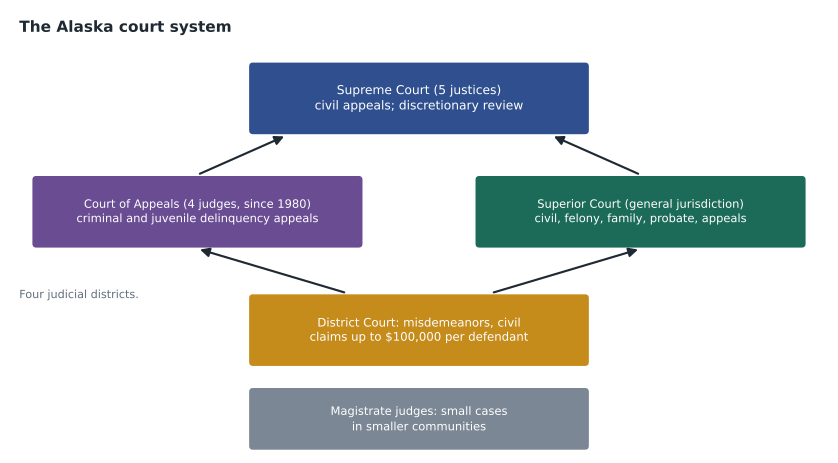
Alaska has a unified, state-funded court system with four levels.
The Supreme Court is the highest court. It has five justices, who choose one of their number as chief justice for a three-year term; a chief justice may not serve consecutive terms. The court hears appeals in civil cases from the superior court, may accept discretionary petitions for review, including in criminal cases decided by the Court of Appeals, and adopts the rules of practice and procedure, including the Bar Rules.
The Court of Appeals, created by the legislature in 1980, has four judges. It hears criminal matters: appeals from convictions and sentences, post-conviction relief, juvenile delinquency, extradition, habeas corpus, probation and parole, and bail. Alaska thus splits intermediate appellate review by subject: criminal cases go to the Court of Appeals, while civil appeals go directly to the Supreme Court.
The superior court is the trial court of general jurisdiction, with 45 judges. It hears felony and civil cases of any size, family law, child-in-need-of-aid and delinquency cases, probate, guardianships and conservatorships, and appeals from the district court and many administrative agencies.
The district court is a court of limited jurisdiction with 20 judges. It hears state misdemeanors and minor offenses and civil claims up to 100,000 dollars per defendant. Small claims are generally capped at 10,000 dollars. Magistrate judges, who need not be lawyers, serve the district court in communities that do not need a full-time judge; they hear traffic and ordinance violations, civil cases up to 10,000 dollars, and misdemeanors if the defendant agrees in writing.
The trial courts are divided into four judicial districts, with boundaries set by statute. Judges are chosen by merit selection: the Alaska Judicial Council screens applicants and nominates candidates, the governor appoints from the nominees, and judges then stand periodically for retention elections.
Alaska civil procedure in brief
The Alaska Rules of Civil Procedure are modeled on the Federal Rules, and much of what a law student learns in civil procedure carries over: notice pleading, liberal joinder, discovery, summary judgment, and the jury trial right. But Alaska has its own text, its own case law and some rules with no federal counterpart. A new lawyer should read the Alaska rules themselves, not assume the federal version applies.
Several Alaska features come up constantly. The general limitations period for personal injury, wrongful death, assault, battery, defamation and harm to property is two years from accrual under AS 09.10.070. Statutory and rule-based fee shifting, described below, affects every settlement discussion. And because Alaska uses several liability, discussed in Lesson 8, defendants routinely ask the court to allocate fault to other responsible persons, which shapes joinder and discovery strategy.
Civil Rule 82: the Alaska rule on attorney's fees
Most American jurisdictions follow the American rule: each side pays its own lawyer, win or lose, unless a statute or contract says otherwise. Alaska is different. Since territorial days Alaska has awarded the prevailing party in a civil case a partial contribution toward its attorney's fees. Today Civil Rule 82 governs.
For a prevailing party who recovers a money judgment, Rule 82(b)(1) sets a schedule based on the amount of the judgment, including prejudgment interest, and on how far the case went.
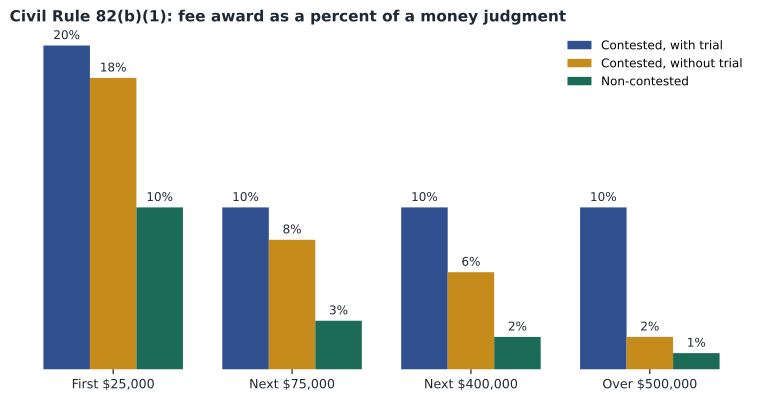
| Portion of judgment | Contested with trial | Contested without trial | Non-contested |
|---|---|---|---|
| First 25,000 dollars | 20 percent | 18 percent | 10 percent |
| Next 75,000 dollars | 10 percent | 8 percent | 3 percent |
| Next 400,000 dollars | 10 percent | 6 percent | 2 percent |
| Over 500,000 dollars | 10 percent | 2 percent | 1 percent |
When the prevailing party does not recover a money judgment, for example a defendant who wins or a party who obtains only an injunction, Rule 82(b)(2) awards a share of that party's reasonable actual attorney's fees that were necessarily incurred: 30 percent if the case went to trial and 20 percent if it was resolved without trial.
The schedule is a starting point, not a ceiling. Under Rule 82(b)(3), the court may vary an award after considering listed factors: the complexity of the litigation; the length of trial; the reasonableness of the hourly rates and hours expended; the reasonableness of the number of lawyers; efforts to minimize fees; the reasonableness of each side's claims and defenses; vexatious or bad faith conduct; the relationship between the work and the significance of what was at stake; whether the award would be so onerous that it would deter similarly situated litigants from going to court; whether the fees were influenced by considerations outside the case; and other equitable factors. A court that varies an award must explain why.
Worked problem
Computing a Rule 82 award
After a jury trial, Owen's judge enters a 160,000-dollar money judgment, including prejudgment interest, for a plaintiff. The plaintiff moves for Rule 82 fees under the schedule.
Show solution
- Contested with trial: use the first column.
- First 25,000 dollars at 20 percent: 5,000 dollars.
- Next 75,000 dollars at 10 percent: 7,500 dollars.
- Remaining 60,000 dollars (within the next 400,000) at 10 percent: 6,000 dollars.
- Total: 5,000 + 7,500 + 6,000 = 18,500 dollars.
Answer: The scheduled award is 18,500 dollars. The defendant may argue for a reduction, and the plaintiff for an increase, under the Rule 82(b)(3) factors.
Rule 82 changes behavior. A plaintiff with a weak claim risks paying part of the defendant's fees; a defendant who refuses a fair settlement risks adding the plaintiff's fees to the judgment. Clients from Outside are often surprised to learn that losing a lawsuit in Alaska costs more than their own lawyer's bill, and a new lawyer should explain the rule at the first meeting.
The constitutional claimant statute
The legislature has carved out important exceptions. Under AS 09.60.010, a claimant who prevails in asserting a right under the federal or Alaska constitution is entitled to full reasonable attorney's fees and costs devoted to those claims, and a claimant who loses may not be ordered to pay the other side's fees devoted to those claims, if the claim was not frivolous and the claimant did not have sufficient economic incentive to bring the case regardless of the constitutional claims. The statute protects people who litigate constitutional questions for reasons other than money, and a lawyer bringing such a case should plead and document it with the statute in mind.
Offers of judgment
Alaska adds a second layer of fee shifting through offers of judgment, governed by AS 09.30.065 and Civil Rule 68. Either party may serve an offer to allow judgment on specified terms at any time more than ten days before trial. The offeree has ten days to accept in writing; otherwise the offer is treated as withdrawn.
If the offeree rejects the offer and the final judgment is at least 5 percent less favorable to the offeree than the offer (10 percent where there are multiple defendants), the offeree must pay the offeror's costs and a share of the offeror's reasonable actual attorney's fees from the date of the offer. The share depends on timing: 75 percent if the offer was served within 60 days after both parties made their initial disclosures, 50 percent if it was served later but more than 90 days before trial, and 30 percent if it was served 90 days or less, but more than 10 days, before trial.
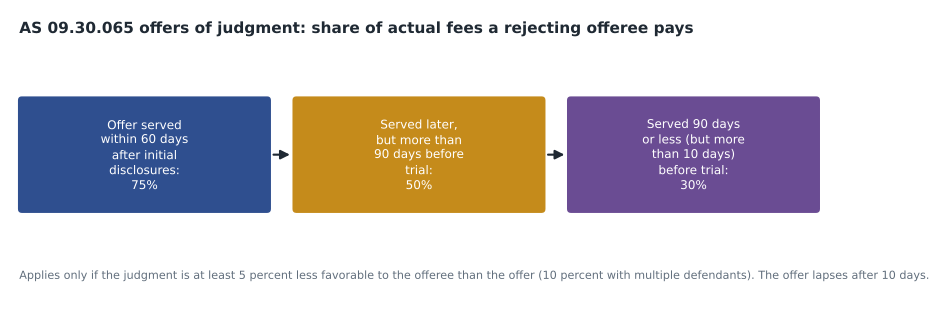
The timing rule rewards early offers. A defense lawyer who evaluates a case quickly and serves a realistic offer soon after initial disclosures puts heavy pressure on the plaintiff, and plaintiffs can use the same tool against defendants. Offers of judgment and Rule 82 interact, and Alaska case law addresses how to avoid double recovery; the details are for practice, not for this course.
Costs
Separately from attorney's fees, the prevailing party usually recovers allowable costs, such as filing fees, certain deposition expenses and witness fees, under the civil rules. Costs are usually modest compared with fees, but they add up in long cases.
Common mistakes
MistakeAssuming the American rule on fees applies in Alaska.
InsteadCivil Rule 82 awards the prevailing party a partial fee in most civil cases.
MistakeFiling a criminal appeal in the Supreme Court as of right.
InsteadCriminal appeals go to the Court of Appeals; the Supreme Court may grant discretionary review.
MistakeServing a settlement offer late and expecting full fee shifting.
InsteadUnder AS 09.30.065, the share falls from 75 to 50 to 30 percent as trial approaches.
MistakeIgnoring AS 09.60.010 in constitutional litigation.
InsteadA non-frivolous constitutional claimant without sufficient economic incentive is protected from adverse fees and may recover full fees.
Who is the prevailing party?
Rule 82 awards fees to the prevailing party, and deciding who prevailed is not always simple. Alaska courts generally look at which party succeeded on the main issues in the case, not merely who received some relief. When both sides win something, the court has discretion to decide who prevailed overall or that neither did. A defendant who defeats a claim entirely is a prevailing party without a money judgment, and its award is calculated as a percentage of its reasonable actual fees under Rule 82(b)(2). Lawyers argue about prevailing-party status often enough that a new lawyer should read the Alaska cases on it before the first fee motion.
Fee motions in practice
A party seeking Rule 82 fees files a motion after judgment, supported by an affidavit and billing records showing the fees incurred, within the time set by the rules. The opposing party can challenge the hours, the rates and the application of the Rule 82(b)(3) factors. Because fee awards are part of nearly every Alaska civil judgment, keeping accurate, contemporaneous time records matters even in contingent-fee cases, where the lawyer may not otherwise track hours closely. A plaintiff's lawyer who wins a large verdict but cannot document reasonable fees may receive only the schedule amount, or have to defend it on a thin record.
Counseling clients about Rule 82
Marchetti's former students who practice in Alaska tell her that Rule 82 changes the first client meeting. A plaintiff should hear, early and in plain terms, that losing could mean paying part of the other side's legal fees. A defendant should hear that refusing a reasonable settlement could add the plaintiff's fees to the judgment. Many lawyers put a short explanation of Rule 82 in their engagement letters. Insurers and businesses that litigate often in Alaska build Rule 82 exposure into their reserves and settlement authority.
District court and small claims
The district court's jurisdictional limit of 100,000 dollars per defendant makes it the forum for many contract, debt and minor injury cases, and small claims procedures handle disputes up to 10,000 dollars with simplified rules designed for people without lawyers. A new lawyer handling a modest claim should consider whether district court, with its faster docket, is the better forum, and should check how the fee rules apply there before advising the client.
Why Alaska fee shifting matters to new lawyers
New lawyers often meet Rule 82 for the first time in their first case. A senior lawyer asks for a quick estimate of fee exposure, or a client asks what happens if they lose. Owen has drafted enough bench memos on fee motions to give a simple answer: in a case resolved without trial on a money judgment, expect the schedule percentage of the judgment; in a case won by the defense, expect a percentage of the defense's reasonable actual fees; and expect the court to consider the listed factors whenever either side asks for a departure.
He also warns that fee awards can exceed the amount in controversy in small cases. A plaintiff who loses a modest claim after a long trial may owe a share of the defendant's fees that is larger than the claim itself, which is one reason Alaska lawyers think carefully before taking small cases to trial.
Summary and key terms
- Alaska's courts: a five-justice Supreme Court, a four-judge Court of Appeals for criminal matters, a superior court of general jurisdiction, a district court and magistrate judges, in four judicial districts.
- The Alaska Rules of Civil Procedure follow the federal model but have their own text; the personal injury limitations period is two years.
- Civil Rule 82 awards the prevailing party a scheduled share of fees: for money judgments 20, 18 or 10 percent of the first 25,000 dollars, falling by bracket; otherwise 30 or 20 percent of actual fees.
- AS 09.60.010 protects and rewards non-frivolous constitutional claimants without sufficient economic incentive.
- Offers of judgment under AS 09.30.065 shift 75, 50 or 30 percent of actual fees depending on timing.
- Civil Rule 82
- Alaska's rule awarding a prevailing civil party partial attorney's fees by schedule.
- American rule
- The general US rule that each party pays its own attorney's fees.
- Offer of judgment
- A formal offer to allow judgment on stated terms that shifts fees if rejected and not beaten.
- Merit selection
- Judicial appointment from candidates screened by a commission, followed by retention elections.
- Court of Appeals
- Alaska's intermediate appellate court for criminal and related matters, created in 1980.
Practice problems
Work each problem on paper first, then reveal the answer to check.
A defendant wins a contested case without trial and has reasonable actual fees of 40,000 dollars. What is the scheduled Rule 82 award?
Show answer
20 percent of 40,000 dollars, or 8,000 dollars.
A plaintiff's judgment after a contested trial is 25,000 dollars. What is the scheduled award?
Show answer
20 percent of 25,000 dollars, or 5,000 dollars.
An offer served 120 days before trial and 100 days after initial disclosures is rejected and not beaten by 5 percent. What share of fees shifts?
Show answer
50 percent (more than 60 days after disclosures but more than 90 days before trial).
Lesson quiz · 5 questions
Score 60% or more to complete this lesson.
Create a free account to save your progress, take quizzes and earn a certificate.