
BAR-202 · Lesson 4 of 12 · 18 min
The Alaska bar exam: format, scoring and passing score
▶ Video coming soon A video version of this lesson is on the way.
Owen has heard two rumors about the Alaska exam. One says Alaska has the hardest passing score in the country. The other says Alaska's exam has a special Alaska day. Both used to be closer to true than they are now, and Marchetti uses them to frame this lesson. Alaska once required a UBE score of 280, the highest of any UBE jurisdiction, and before it joined the UBE it wrote its own essays. Today the exam is the standard two-day UBE, and the passing score is 270.
The Uniform Bar Examination in Alaska
Alaska administers the Uniform Bar Examination, prepared by NCBE and given on the same days across UBE jurisdictions. The Alaska Bar Association describes the two days this way.
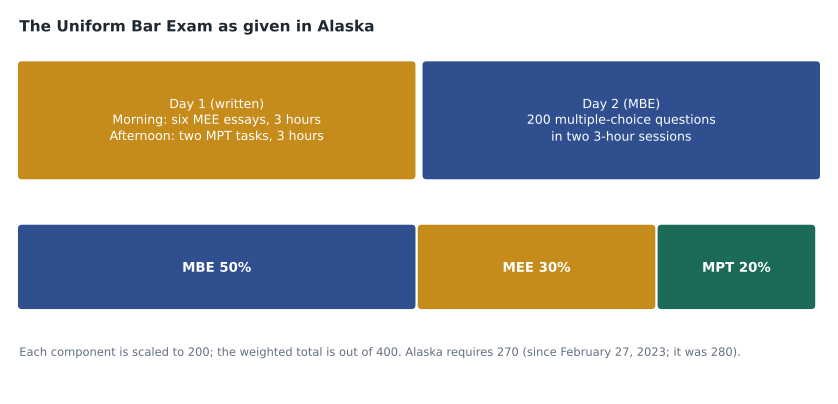
Day one is the written day. The morning session is the Multistate Essay Examination (MEE): six essays in three hours, about 30 minutes each. The afternoon session is the Multistate Performance Test (MPT): two 90-minute tasks in three hours, each asking the examinee to produce a lawyering document, such as a memo, brief or letter, from a file of facts and a library of law.
Day two is the Multistate Bar Examination (MBE): 200 multiple-choice questions in two three-hour sessions of 100 questions each. Of the 200, 175 are scored and 25 are unscored pretest questions that look exactly like the others. The MBE covers seven subjects: civil procedure, constitutional law, contracts, criminal law and procedure, evidence, real property and torts.
For the February 2027 exam, the dates are Tuesday, February 23, and Wednesday, February 24. The July 2027 exam is Tuesday and Wednesday, July 27 and 28. The exam is given in Anchorage, Fairbanks and Juneau; applicants choose a site when they apply.
The July 2026 changes to the MEE
Since the July 2026 exam, four subjects are no longer tested on the MEE: conflict of laws, family law, trusts and estates, and secured transactions. NCBE made the change across all UBE jurisdictions as part of the transition to the NextGen exam, and the Alaska Bar Association's exam page reflects it. From July 2026 through February 2028, family law and trusts and estates are tested regularly through the MPT instead, where the examinee receives the relevant law in the library and does not have to memorize it.
The practical result for Owen is a narrower memorization load for the written day. The MEE now draws on business associations (agency, partnerships, corporations and limited liability companies) plus the MBE subjects. His bar course, built before 2026, still contains outlines for the removed subjects; he can skip memorizing them but should keep reading MPT practice files that use family law and trusts and estates, because those libraries reward familiarity with the vocabulary.
How the UBE is scored
Each of the three components produces a scaled score on a 200-point scale. The MBE is scaled nationally by NCBE through a statistical process called equating, so that a score means the same thing from one administration to the next regardless of how hard a particular set of questions was. The written components are graded by the jurisdiction's graders, using NCBE's grading materials, and then scaled to the MBE, so that the written scores take on the same distribution as the MBE scores of the same group of examinees.
The three scaled scores are then weighted: MBE 50 percent, MEE 30 percent and MPT 20 percent. The result is a total UBE score out of 400. In practice, many people think of it as the MBE scaled score plus the scaled written score, each on a 200-point scale.
| Component | Questions | Time | Weight |
|---|---|---|---|
| MBE | 200 multiple-choice (175 scored) | Two 3-hour sessions | 50 percent |
| MEE | Six essays | Three hours | 30 percent |
| MPT | Two performance tasks | Three hours | 20 percent |
| Total | Two days | Scored out of 400 |
Alaska's passing score: 270
A total UBE score of 270 or higher passes in Alaska. That was not always true. Until February 2023, Alaska required 280, the highest passing score among UBE jurisdictions. Members of the bar and others argued that the high cut score kept qualified candidates out of a state that badly needed lawyers. On February 27, 2023, the Alaska Supreme Court signed Supreme Court Order 2002, which lowered the score to 270 in three places in the Bar Rules: the passing score for the Alaska exam, the score needed for admission based on a UBE earned elsewhere, and the score accepted for transfer. The order took effect the day it was signed.
In the national picture, UBE passing scores range from 260 to 270, and 270 is at the top of the current range. A score of 266, for example, passes in many UBE jurisdictions but not in Alaska. That matters for transfer: a candidate who earns a 266 in a state with a 266 cut score cannot transfer it to Alaska.
Marchetti translates the number into a goal. 'A 270 is roughly a 135 average on each half. If your MBE practice scores put you around 135 to 140 scaled, and your essays and performance tests are solid, you are in range. If you are well below that in January, change your plan in January, not in February.' She stresses that scaled scores depend on the whole group of examinees, so practice-test conversions are estimates, not promises.
No MBE carry-over and no partial passing
Some jurisdictions let a candidate who scored well on the MBE carry that score into a later exam. Alaska does not. The Bar states that it does not accept MBE scores from previous exams to waive the MBE: every Alaska sitting requires the full UBE. Alaska also does not let a candidate pass one component and retake only another. The total score decides.
Results and what happens if you fail
Results are generally announced about 90 days after the exam. A candidate who passes still needs character and fitness approval and an MPRE score on file before admission. A candidate who fails may reapply, paying the reapplicant fee of 618 dollars for 2027. The deadline depends on which exam they sat; for July 2027, February 2027 examinees have until May 31.
The Supreme Court's 2026 order preparing for the NextGen exam also gives the Board of Governors authority to set policy on the rights of applicants who take the exam and fail, such as access to their answers or score information. Failing candidates should read the Bar's current policy when results arrive and use whatever review it allows. Marchetti recommends looking first at the component scores: a candidate whose MBE was strong and written score weak needs a very different plan from one with the opposite pattern.
Exam-day logistics in Alaska
Most UBE logistics are national: exam software, a laptop meeting the vendor's requirements, approved items in a clear bag, no notes, and the jurisdiction's identification rules. A few points are particular to Alaska.
First, travel. Candidates from outside Anchorage, Fairbanks and Juneau often fly in, and February weather can delay flights. Booking a flight that arrives a day or more early, with lodging near the test site, removes one source of stress. Second, laptop registration: the Bar charges 129 dollars for laptop registration, and candidates testing in Anchorage with a laptop complete a specific form. Third, accommodations must be requested by the application deadline, December 1 or May 1.
Worked problem
Estimating Owen's total
In a January practice exam, Owen's MBE converts to an estimated scaled score of 141. Marchetti grades his essays and performance tests and estimates a scaled written score of 127.
Show solution
- Total estimate: 141 + 127 = 268.
- Compare to Alaska's cut score: 268 is two points short of 270.
- Identify the gap: the written score is pulling him down; the MBE is above the 135 average needed.
- Plan: in the next five weeks, do one timed MEE set and one MPT a week with feedback, and keep MBE practice at a maintenance level.
Answer: Owen is close but below the line. Shifting effort to the written components, worth half the score, is the most efficient fix.
Common mistakes
MistakeBelieving Alaska still requires 280.
InsteadAlaska lowered its UBE passing score to 270 on February 27, 2023 (SCO 2002).
MistakeMemorizing conflict of laws and secured transactions for the MEE.
InsteadThose subjects left the MEE in July 2026; family law and trusts and estates appear on the MPT with law supplied.
MistakePlanning to carry over a strong MBE score from a previous attempt.
InsteadAlaska does not accept prior MBE scores; each sitting requires the full UBE.
MistakeTreating practice conversions as guaranteed scores.
InsteadScaled scores depend on the examinee group; use estimates to guide effort, not to predict results.
Inside each component
The MBE's seven subjects carry equal numbers of scored questions: 25 each, for a total of 175 scored questions. Each question presents a short fact pattern and four answer choices, and examinees have an average of about 1.8 minutes per question. Because the scored questions are equated, an examinee's scaled score reflects performance relative to a fixed standard, not to the particular difficulty of that day's questions.
The MEE's six essays may draw on any of the remaining MEE subjects: business associations and the seven MBE subjects. A single essay often combines topics, such as an agency question that also involves contract formation. Graders look for identification of the issues, accurate statements of the rules, application of the rules to the facts and sound conclusions, written clearly in the time available. NCBE provides graders with analyses and grading materials, and jurisdictions grade on a relative basis, ranking answers against one another before the written scores are scaled.
The MPT's two tasks each come with a file, containing the facts in the form of documents such as interview transcripts, letters and pleadings, and a library, containing the law, such as cases, statutes and regulations, often from a fictional jurisdiction. The task memo tells the examinee what to write and for whom. The MPT rewards careful reading of the instructions, organization and the use of specific facts, not memorized law.
Writing on a laptop or by hand
Most candidates type the MEE and MPT using the exam software, which requires laptop registration and the 129-dollar laptop fee. Candidates who prefer to write by hand may do so. The choice affects preparation: a typist should practice under the exam software's constraints, while a writer should practice legible handwriting under time pressure. Either way, Marchetti tells candidates to practice the way they will test.
Why the cut score matters for study planning
Because Alaska's standard is at the top of the UBE range, an Alaska candidate cannot plan to squeak by on a score that would pass elsewhere. Marchetti encourages Owen to set a target a little above 270, roughly 275, in practice. That margin absorbs the normal variation between practice estimates and real scaled scores, and it protects him if he ever wants to transfer his score to another jurisdiction, all of which accept 270.
A note on the history of the Alaska exam
Alaska adopted the UBE in 2014. Before then, its written exam included essays drafted for Alaska. Joining the UBE made Alaska scores portable and Alaska open to scores from other UBE jurisdictions, which suits a state that depends heavily on lawyers who move in from elsewhere. The 2023 reduction of the cut score to 270 continued the same trend, making it easier for qualified candidates to be admitted while keeping Alaska's standard at the top of the national range.
Building a schedule around the weights
The 50, 30 and 20 weighting should shape how Owen spends his time. Half of his score comes from the MBE, so multiple-choice practice is the backbone of his schedule: timed sets several days a week, with careful review of every missed question. The MEE is worth 30 percent, so he writes at least two full essays a week under time limits and compares them with the released analyses NCBE publishes, without memorizing model answers. The MPT is worth 20 percent but rewards skills he uses every day in chambers, so he practices a full task every week or two to keep his timing sharp.
Marchetti adds one warning about averages. A candidate who scores well on the MBE can carry weaker written scores, and the reverse is also true, because the components are combined into one total. But no strategy works if one component collapses, so she tells every Alaska candidate to protect a floor on each part rather than gamble on a single strength.
Reading a score report
A candidate who does not pass receives a score report showing the scaled scores for each component and the total. Owen's study group has learned to read these reports calmly: the total tells you how far you were from 270, and the component scores tell you where the points are most cheaply found. A candidate who was 8 points short with a weak MPT, for example, may gain more from MPT practice than from another pass through the MBE outlines.
Summary and key terms
- Alaska gives the two-day UBE: MEE and MPT on day one, MBE on day two, in Anchorage, Fairbanks and Juneau.
- Components are scaled to 200 and weighted 50 (MBE), 30 (MEE) and 20 (MPT) percent; the total is out of 400.
- Alaska's passing score is 270, lowered from 280 by SCO 2002 on February 27, 2023.
- Since July 2026, four subjects left the MEE; family law and trusts and estates appear on the MPT with law supplied.
- Alaska accepts no MBE carry-over; results come about 90 days after the exam.
- UBE
- The Uniform Bar Examination: MBE, MEE and MPT, scored and weighted the same way in every UBE jurisdiction.
- Scaled score
- A score adjusted statistically so that results are comparable across administrations.
- Equating
- The statistical process NCBE uses to keep MBE scaled scores consistent over time.
- Cut score
- The minimum total score needed to pass; 270 in Alaska.
- MBE carry-over
- Using an MBE score from an earlier exam in place of retaking the MBE; Alaska does not allow it.
Practice problems
Work each problem on paper first, then reveal the answer to check.
A candidate earned a 268 UBE in July 2026 in a state with a 266 cut score. Can she transfer it to Alaska?
Show answer
No. Alaska requires 270 for transferred scores as well as for its own exam.
Which written subjects can still appear on the MPT through February 2028 even though they left the MEE?
Show answer
Family law and trusts and estates, with the law supplied in the library.
What are the weights of the three UBE components?
Show answer
MBE 50 percent, MEE 30 percent, MPT 20 percent.
Lesson quiz · 5 questions
Score 60% or more to complete this lesson.
Create a free account to save your progress, take quizzes and earn a certificate.