
BAR-202 · Lesson 9 of 12 · 18 min
Alaska Native law, land and subsistence
▶ Video coming soon A video version of this lesson is on the way.
One of the first files Owen's judge handed him involved a custody dispute between two parents, both enrolled members of the same Alaska Native village. A tribal court had already entered an order. The question was whether the superior court should honor it. Owen had taken federal Indian law in law school, and he expected to find reservations, Indian country and the familiar federal framework. Alaska's version turned out to be different in almost every respect. This lesson introduces the Alaska Native law every Alaska lawyer needs to recognize: the Alaska Native Claims Settlement Act, the status of tribes and Indian country, the recognition of tribal court judgments, and the law of subsistence.
A note on scope: this is an introduction for a new lawyer, not a treatise. Alaska Native law is a specialized field with its own practitioners, and matters involving tribal sovereignty, Native corporations, the Indian Child Welfare Act or subsistence regulation often call for consultation with lawyers who practice in it daily.
Before ANCSA
When the United States purchased Alaska from Russia in 1867, Alaska Natives had lived on and used the land for thousands of years, and the question of their land rights was left unresolved for a century. Statehood in 1959 sharpened the conflict: the Statehood Act let the new state select more than 100 million acres of federal land, while Native groups asserted aboriginal title to much of the same land. The discovery of oil at Prudhoe Bay in 1968 made a settlement urgent, because a pipeline across the state could not be built while title was clouded. Congress responded in 1971.
The Alaska Native Claims Settlement Act (1971)
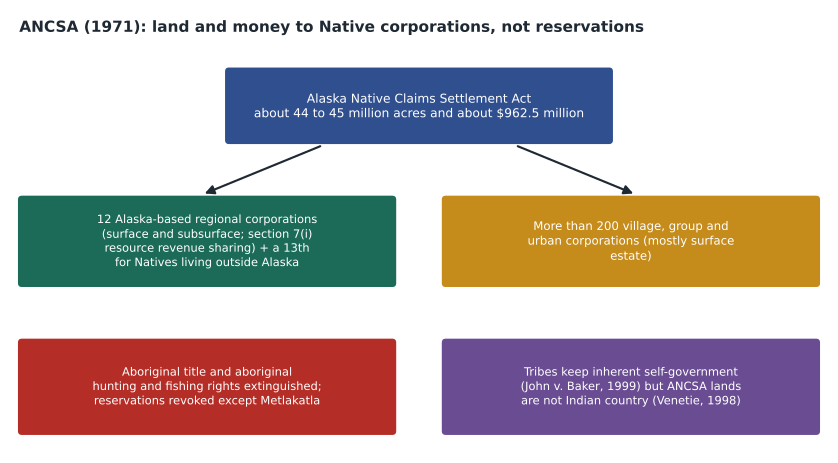
The Alaska Native Claims Settlement Act, known as ANCSA, took an approach unlike any earlier federal settlement with Native peoples. Instead of creating reservations held in trust by the United States, it extinguished aboriginal title and aboriginal hunting and fishing rights in exchange for land and money conveyed to corporations owned by Alaska Natives. The settlement is usually described as roughly 44 million acres and 962.5 million dollars.
ANCSA created twelve regional corporations, each tied to a region of the state, and a thirteenth regional corporation for Alaska Natives living outside Alaska, which received money but no land. It also created more than 200 village, group and urban corporations. In general, village corporations received the surface estate of lands around their villages, and regional corporations received the subsurface estate beneath village lands along with other lands. Alaska Natives alive in 1971 enrolled and received shares of stock.
Two features of the corporate structure have lasting legal significance. First, section 7(i) of ANCSA requires each regional corporation to share a portion of its revenue from timber and subsurface resources with the other regional corporations, to even out the uneven distribution of natural resources across the state. Section 7(j) then passes part of those shared revenues through to village corporations and certain shareholders. Disputes over 7(i) calculations produced major litigation and eventually a settlement agreement among the regions. Second, ANCSA originally restricted the sale of corporate stock for twenty years, until 1991. Congress's 1987 amendments, often called the 1991 amendments, kept the restrictions in place indefinitely unless a corporation's shareholders vote to lift them, and protected undeveloped land from certain taxes and creditor claims.
ANCSA also revoked the reserves that had been set aside for Native use, with one exception: the Annette Island Reserve of the Metlakatla Indian Community, which remains a federal Indian reservation. Some villages whose reserves were revoked chose to take title to their former reserve lands in fee instead of participating in the land and money settlement, which is why the Native Village of Venetie Tribal Government owned about 1.8 million acres of former reservation land in the case discussed below.
Tribes in Alaska
ANCSA dealt with land and money; it did not abolish Alaska Native tribes as governments. There are more than 200 federally recognized tribes in Alaska, and Congress and the federal government have repeatedly confirmed their status. What ANCSA changed was the land base: because ANCSA land is owned by state-chartered corporations, not held in trust for tribes, most tribes in Alaska have little or no territory over which they exercise governmental jurisdiction.
Venetie (1998): ANCSA lands are not Indian country
In federal Indian law, many questions of jurisdiction turn on whether conduct occurs in Indian country, a term defined in 18 U.S.C. section 1151 to include reservations, dependent Indian communities and allotments. In Alaska v. Native Village of Venetie Tribal Government, 522 U.S. 520 (1998), the tribe argued that its former reservation lands, which it owned in fee after ANCSA, were a dependent Indian community, so that the tribe could tax a contractor building a school there.
A unanimous Supreme Court disagreed. Justice Thomas's opinion held that a dependent Indian community requires two things: land set aside by the federal government for the use of Indians as Indian land, and federal superintendence over that land. ANCSA failed both requirements. It revoked the reservation and transferred the land to state-chartered entities without restrictions on use, and it ended the federal government's active control. General federal aid programs did not count as superintendence. The Court noted that any change to the concept of Indian country in Alaska is for Congress.
The practical effect is that most of Alaska is not Indian country. Many jurisdictional rules that turn on Indian country elsewhere, from criminal jurisdiction to tribal taxation, work differently in Alaska.
John v. Baker (1999): tribal jurisdiction without Indian country
If tribes lack Indian country, do they have any governmental power at all? The Alaska Supreme Court answered in John v. Baker, 982 P.2d 738 (Alaska 1999), the case that framed Owen's first file. Two Alaska Native parents disputed custody of their children. The father took the dispute to the tribal court of Northway Village, which entered a custody order, and the dispute then reached the state superior court, which declined to give the tribal proceeding effect.
The Alaska Supreme Court reversed. It held that Alaska Native tribes, as sovereign entities, have inherent power to adjudicate custody disputes involving their member children, even without Indian country. The court reasoned that the power to regulate domestic relations among members lies at the core of tribal self-government and does not depend on territory. A tribal court's authority extends to children who are members of the tribe or eligible for membership. Tribal and state courts have concurrent jurisdiction over such disputes; neither has priority, and parents may choose either forum. The court also held that the Indian Child Welfare Act did not apply because ICWA excludes custody disputes between parents.
Recognizing tribal court judgments: comity
John v. Baker also told state courts how to treat tribal court judgments. Rather than full faith and credit, the court adopted the doctrine of comity. State courts should generally respect tribal custody orders, but they should not recognize an order if the tribal court lacked personal or subject matter jurisdiction, if a litigant was denied due process, or if the order violates the public policy of the United States or of Alaska. The court remanded for the superior court to decide whether to recognize the Northway order under that standard.
Worked problem
Applying John v. Baker in Owen's file
Both parents are enrolled members of the same village. The tribal court held a hearing at which both parents appeared, received evidence and entered a custody order. The mother now asks the superior court to decide custody anew.
Show solution
- Jurisdiction: the children are members or eligible for membership, and custody between member parents falls within the tribe's inherent authority (John v. Baker).
- Concurrent jurisdiction: both courts could have heard the case, and the father chose the tribal court first.
- Comity factors: personal jurisdiction (both parents appeared), subject matter jurisdiction (inherent authority), due process (notice and a hearing), public policy (nothing suggests a violation).
- ICWA: inapplicable to custody disputes between parents.
Answer: The superior court should likely recognize the tribal order under comity, unless the mother shows a jurisdictional defect, a denial of due process or a public policy violation.
The law in this area continues to develop. Later decisions have addressed tribal jurisdiction in child protection cases, the effect of tribal orders, and the relationship between ICWA and state procedure, and in 2023 the United States Supreme Court upheld ICWA against constitutional challenge in Haaland v. Brackeen. A new lawyer should treat John v. Baker as the starting point, not the last word.
Subsistence: two systems
Subsistence, the customary and traditional use of fish, wildlife and plants for food and other needs, is central to life in much of rural Alaska, and its legal regime is notoriously complicated because two sovereigns regulate it under different rules.
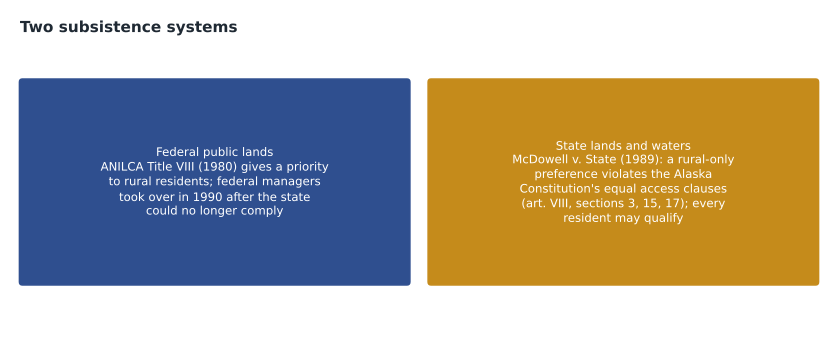
Federal law comes from the Alaska National Interest Lands Conservation Act of 1980, known as ANILCA, which set aside vast national parks, refuges and other conservation units. Title VIII of ANILCA requires a priority for subsistence uses by rural Alaska residents on federal public lands. Congress hoped the state would manage subsistence consistently with that priority, and for a time the state did.
State law collided with the federal priority in McDowell v. State, 785 P.2d 1 (Alaska 1989). The Alaska Supreme Court held that a state statute limiting subsistence eligibility to rural residents violated article VIII of the Alaska Constitution, specifically section 3 (fish and wildlife reserved to the people for common use), section 15 (no exclusive right of fishery) and section 17 (laws and regulations governing resources apply equally to all persons similarly situated). The state could not grant a preference based on where a person lives.
Because the state could no longer provide the rural priority ANILCA required, federal agencies took over subsistence management on federal public lands in 1990, and later on certain navigable waters within and next to federal conservation units. The result is a dual system: federal rules with a rural priority on federal lands, and state rules under which all Alaskans may qualify for subsistence uses on state lands and waters. Hunters and fishers sometimes need to know which system applies at a particular place and time, and lawyers advising Native corporations, villages, guides or individuals need to know both.
Why this matters in everyday practice
Alaska Native law is not confined to specialists. A real estate lawyer meets ANCSA land and village corporation surface rights. A business lawyer meets regional corporations, which are among the largest companies in the state. A family lawyer meets tribal court orders and ICWA. A criminal lawyer meets questions about tribal authority and village public safety. A natural resources lawyer meets subsistence. Owen's judge tells him that she sees some issue of Alaska Native law in a meaningful share of her civil docket every year.
Common mistakes
MistakeAssuming Alaska tribes govern reservations like tribes in the Lower 48.
InsteadANCSA revoked nearly all reserves; Venetie held ANCSA lands are not Indian country. Metlakatla is the exception.
MistakeConcluding that tribes without Indian country have no jurisdiction.
InsteadJohn v. Baker recognized inherent tribal jurisdiction over member children's custody.
MistakeGiving tribal custody orders full faith and credit automatically.
InsteadAlaska uses comity: recognize unless jurisdiction, due process or public policy problems exist.
MistakeApplying a rural subsistence preference on state land.
InsteadMcDowell v. State held a rural-only preference violates the Alaska Constitution; the federal rural priority applies on federal public lands.
Native corporations as businesses
ANCSA corporations have grown into some of the largest businesses headquartered in Alaska, with operations in oil field services, construction, government contracting, telecommunications and other industries across the country. They are for-profit corporations organized under Alaska law, but they also have special features under federal law, including the stock restrictions described above and, for many purposes, recognition in federal contracting programs. Their shareholders are Alaska Natives and their descendants, and many corporations pay dividends and fund scholarships and cultural programs. Business lawyers in Alaska regularly advise or deal with them.
Reading ANCSA cases
Owen's judge suggests he read the leading cases in a set order: Venetie for the Indian country question, John v. Baker for tribal jurisdiction, McDowell for subsistence under the Alaska Constitution, and then a few recent decisions applying them. Reading them together shows a pattern in Alaska law. Federal law sets the framework, through ANCSA, ANILCA and federal Indian law, while Alaska courts work out how state law and tribal authority fit inside it. A new lawyer who sees that pattern can place most new questions quickly, even before researching the details.
Alaska Native law questions also arise in ordinary cases: a custody dispute may involve the Indian Child Welfare Act, a contract dispute may involve a Native corporation, and a land dispute may involve an allotment or ANCSA conveyance. The skill is recognizing the issue early.
Summary and key terms
- ANCSA (1971) extinguished aboriginal title and conveyed about 44 million acres and 962.5 million dollars to Native-owned regional and village corporations.
- Section 7(i) requires regional corporations to share resource revenues; stock restrictions continue unless shareholders vote otherwise.
- Venetie (1998): ANCSA lands are not Indian country because they lack federal set-aside and superintendence.
- John v. Baker (1999): tribes have inherent jurisdiction over custody of member children; state courts recognize tribal judgments by comity.
- Subsistence is dual: ANILCA's rural priority on federal lands; McDowell (1989) bars a rural-only preference under state law.
- ANCSA
- The Alaska Native Claims Settlement Act of 1971.
- Regional corporation
- One of twelve Alaska-based Native corporations (plus a thirteenth outside Alaska) created by ANCSA.
- Indian country
- Reservations, dependent Indian communities and allotments under 18 U.S.C. section 1151.
- Comity
- The discretionary recognition of another sovereign's judgments, subject to jurisdiction, due process and public policy.
- ANILCA
- The Alaska National Interest Lands Conservation Act of 1980, whose Title VIII creates a rural subsistence priority on federal lands.
Practice problems
Work each problem on paper first, then reveal the answer to check.
Why could the Native Village of Venetie not tax a contractor on its former reservation land?
Show answer
The land was not Indian country: ANCSA removed the federal set-aside and federal superintendence.
Under John v. Baker, which children may a tribal court's custody jurisdiction reach?
Show answer
Children who are tribal members or eligible for membership.
Which Alaska constitutional provisions did McDowell rely on?
Show answer
Article VIII, sections 3, 15 and 17.
Lesson quiz · 5 questions
Score 60% or more to complete this lesson.
Create a free account to save your progress, take quizzes and earn a certificate.