
BAR-211 · Lesson 10 of 12 · 21 min
Georgia professional conduct, business organizations and remedies
▶ Video coming soon A video version of this lesson is on the way.
Three Georgia essay subjects share this lesson: professional ethics, business organizations and non-monetary remedies. Marchetti groups them because, on the Georgia essays, they often appear together. 'You'll get a fact pattern about two friends starting a company,' she tells Malik, 'and the last question will be whether one lawyer can represent both of them, and the one before it will be whether the company can get an injunction against a former employee. Same essay, three subjects.' This lesson covers the Georgia Rules of Professional Conduct and lawyer discipline, Georgia corporations and LLCs, and the equitable remedies the essays test, including Georgia's restrictive covenant statute.
The Georgia Rules of Professional Conduct
Georgia lawyers are governed by the Georgia Rules of Professional Conduct, which the Supreme Court of Georgia adopted effective January 1, 2001, as part of the rules of the State Bar of Georgia. They are based on the ABA Model Rules, follow their numbering and track most of their substance, so a candidate who knows the Model Rules from the MPRE starts with a strong base. The essays test whether the candidate can apply them to Georgia facts and recognize the places where Georgia's rules differ.
The most visible Georgia feature is that each rule states the maximum penalty for a violation, such as disbarment or a public reprimand. Many rules carry disbarment as the maximum, while some less serious rules carry a public reprimand. An essay answer that discusses a violation can note the maximum penalty stated in the rule, which shows the grader the candidate knows Georgia's rules rather than only the Model Rules.
Georgia's rules on the core duties follow the Model Rules closely: competence and diligence, communication with the client, reasonable fees with contingent fee agreements in writing, confidentiality of information relating to the representation with stated exceptions, conflicts of interest with current and former clients, safekeeping of client property in trust accounts, candor to the tribunal, fairness to opposing parties, communication only through counsel with a represented person, and the duty to report serious misconduct. Georgia lawyers holding nominal or short-term client funds must use interest-bearing trust accounts under the IOLTA program, with interest going to the Georgia Bar Foundation to fund legal services.
Candidates should check a few points against the current Georgia text rather than assuming the Model Rule, because Georgia has amended its rules at different times than the ABA. Examples include the exceptions to confidentiality, the rules on advertising and solicitation, and the rules on fee-sharing and referral arrangements. When the Georgia text is not known, the safest essay answer applies the Model Rule's principle and notes that Georgia's version follows it in substance.
Professionalism
Georgia has a long-standing professionalism program separate from the disciplinary rules. The Chief Justice's Commission on Professionalism, created in 1989, promotes A Lawyer's Creed and an Aspirational Statement on Professionalism, which describe ideals of civility, honesty and public service beyond the minimum the rules require. Georgia requires professionalism hours as part of CLE and as part of the program for new lawyers. The Creed is not enforced through discipline, but Georgia essays sometimes ask what a lawyer should do as a matter of professionalism, not just what the rules require.
Lawyer discipline
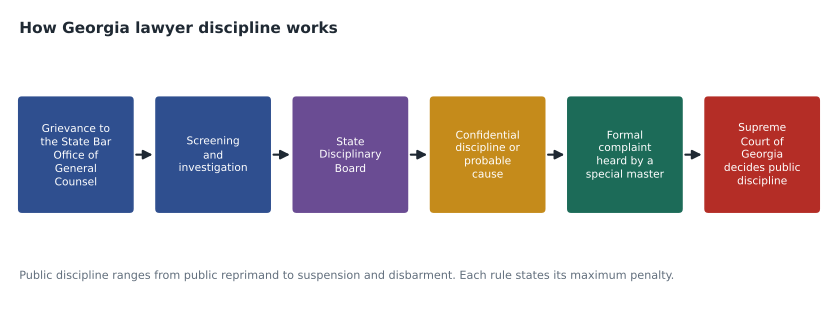
Lawyer discipline in Georgia is run by the State Bar under the Supreme Court's authority. A grievance is reviewed by the State Bar's Office of the General Counsel. Matters that warrant further action go to the State Disciplinary Board, which can dismiss, issue confidential discipline or find probable cause for formal proceedings. Formal complaints are heard by a special master, a lawyer appointed by the Supreme Court, and the Supreme Court of Georgia decides public discipline, which ranges from public reprimand to suspension to disbarment. Lawyers may also seek voluntary discipline, such as surrendering their license.
Worked problem
An ethics sub-question
Two friends, Tasha and Jordan, ask Malik's supervising lawyer to form an LLC for their new food truck business and to draft its operating agreement. Tasha is contributing most of the money; Jordan is contributing his recipes and his labor. They want one lawyer to save fees. What should the lawyer consider?
Show solution
- Conflict analysis: the clients' interests may diverge on capital contributions, profit shares, management and buyout terms, so joint representation is a concurrent conflict.
- Consentable conflict: the lawyer may represent both if the lawyer reasonably believes she can represent each competently and diligently, the representation is not prohibited by law, and each gives informed consent, confirmed in writing as the rule requires.
- Disclosure: explain the risks, including that confidentiality between the two clients will not apply in the usual way and that if a dispute arises the lawyer may have to withdraw from representing both.
- Alternative: represent the LLC as the client once formed, or represent one founder and advise the other to retain separate counsel.
- Georgia point: the conflicts rule follows the Model Rule in substance, and the rule states its maximum penalty.
Answer: The lawyer may represent both founders with informed consent confirmed in writing if she reasonably believes she can serve both, but she should explain the risks and the possibility of withdrawal, and consider representing only the LLC or one founder.
Georgia corporations
Georgia corporations are governed by the Georgia Business Corporation Code, Title 14, Chapter 2 of the Official Code, which was based on the Revised Model Business Corporation Act and adopted in 1988. A corporation is formed by filing articles of incorporation with the Georgia Secretary of State. The core MBCA concepts apply: shareholders elect directors, directors manage the business and appoint officers, and shareholders vote on fundamental changes such as mergers, sales of substantially all assets, dissolution and amendments to the articles.
Directors and officers owe duties of care and loyalty. In 2014, in FDIC v. Loudermilk, the Supreme Court of Georgia recognized that Georgia's business judgment rule protects directors' decisions made in good faith and with ordinary care in the process, and the General Assembly later amended the Code to strengthen the presumption that directors act in good faith and with ordinary care. Conflicting interest transactions can be protected by disinterested director or shareholder approval or by showing fairness. Shareholders may bring derivative suits after a written demand on the corporation, subject to the statute's waiting period, as under the MBCA.
Georgia courts will disregard the corporate entity, or pierce the corporate veil, only in limited circumstances, such as when shareholders have so abused the corporate form that the corporation is a mere alter ego used to commit fraud or evade obligations. Thin capitalization, commingling of funds and disregard of corporate formalities are relevant factors. The essays may ask whether a creditor can reach a shareholder's personal assets.
Georgia LLCs and partnerships
Georgia's Limited Liability Company Act, in Title 14, Chapter 11, gives members wide freedom to define their relationship in the operating agreement. An LLC may be member-managed or manager-managed. Members are not personally liable for the LLC's debts merely because they are members. Georgia's Act gives strong effect to the operating agreement and permits members to modify default fiduciary duties within the limits the statute sets. Because the operating agreement controls so much, essays involving LLCs often turn on what the agreement says or fails to say, such as how a member withdraws, how profits are shared or who may bind the company.
General partnerships form without any filing when two or more persons carry on a business for profit as co-owners. Partners are agents of the partnership and are personally liable for its obligations, which is why the essays often ask whether an informal arrangement created a partnership. Georgia also recognizes limited partnerships and limited liability partnerships, each formed by filing.
| Entity | Formation | Owner liability | Key Georgia source |
|---|---|---|---|
| Corporation | Articles filed with the Secretary of State | Limited, subject to veil piercing | Business Corporation Code (MBCA-based) |
| LLC | Articles of organization filed | Limited; operating agreement controls much | Limited Liability Company Act |
| General partnership | No filing; co-owners carrying on a business for profit | Personal liability for partnership debts | Partnership statutes |
| Limited partnership | Certificate filed | Limited partners generally limited; general partner liable | Limited partnership statutes |
Non-monetary remedies
Non-monetary remedies are a separate Georgia essay subject. Georgia's superior courts exercise equity jurisdiction; Georgia has no separate court of chancery. Equitable relief is available when the legal remedy, usually money damages, is inadequate. The main remedies the essays test are injunctions, specific performance, declaratory judgments, rescission, reformation and the imposition of constructive trusts.
An interlocutory injunction, which preserves the status quo while a case proceeds, requires the court to balance the equities, considering factors such as whether the movant faces irreparable harm, whether the harm to the movant outweighs the harm to the opposing party, whether the movant has a substantial likelihood of success on the merits, and whether an injunction would disserve the public interest. A temporary restraining order may be issued briefly without full notice in emergencies. A permanent injunction is entered after a final hearing on the merits.
Specific performance is the usual remedy for breach of a contract to sell land, because each parcel is unique. The buyer must show a valid, definite contract and that the buyer was ready, willing and able to perform. Specific performance of personal service contracts is not available. Georgia also has a Declaratory Judgment Act, which allows a party facing uncertainty about its rights to obtain a ruling before acting, and declaratory relief is often requested alongside an injunction.
Restrictive covenants
Georgia's restrictive covenant law changed significantly in 2011. Before then, Georgia courts were notoriously strict with noncompetition agreements and would strike an overbroad covenant entirely rather than narrow it. After voters approved a constitutional amendment in 2010, the General Assembly enacted the Georgia Restrictive Covenants Act, effective for covenants made on or after May 11, 2011. The Act allows courts to modify an overbroad covenant rather than void it, and it sets presumptions about reasonable duration, such as a presumption that a post-employment noncompete of two years or less is reasonable. It limits noncompetes to certain categories of employees, such as those who solicit customers, manage the business or hold key positions. Covenants signed before the Act's effective date are still judged under the old, stricter law.
Worked problem
An injunction against a former employee
A Savannah marketing agency's account manager signed a noncompete in 2023 agreeing not to work for a competitor within 50 miles for 18 months after leaving. She resigns in October 2026 and joins a competitor across town, taking a list of clients. What relief can the agency seek?
Show solution
- Governing law: the covenant was signed after May 11, 2011, so the Georgia Restrictive Covenants Act applies.
- Enforceability: an account manager who solicits customers is within the categories the Act permits; an 18-month term falls within the two-year presumption of reasonableness; a 50-mile area should be reasonable for the agency's market, and the court may modify it if it is overbroad.
- Interlocutory injunction: the agency must show irreparable harm (such as loss of client relationships), a balance of harms in its favor, a substantial likelihood of success and no disservice to the public interest.
- Trade secrets: if the client list qualifies as a trade secret, the agency may also seek relief under Georgia's trade secrets statute.
Answer: The agency has a strong case for an interlocutory injunction enforcing the noncompete, with the court able to narrow the geographic scope if needed. Under pre-2011 law, an overbroad covenant would have failed entirely.
Common mistakes
MistakeDiscussing an ethics violation without noting Georgia's rule structure.
InsteadEach Georgia rule states its maximum penalty; mentioning it shows command of Georgia's rules.
MistakeAssuming the State Bar alone imposes public discipline.
InsteadThe Supreme Court of Georgia decides public discipline after special master proceedings.
MistakeVoiding an overbroad noncompete signed in 2015.
InsteadUnder the 2011 Restrictive Covenants Act, courts may modify an overbroad covenant rather than void it.
MistakeSeeking specific performance of an employment contract.
InsteadCourts do not compel personal services; an injunction enforcing a valid restrictive covenant is the usual remedy.
Practice problems
Work each problem on paper first, then reveal the answer to check.
Who decides public discipline of Georgia lawyers?
Show answer
The Supreme Court of Georgia, after review by the State Disciplinary Board and a hearing before a special master.
What did FDIC v. Loudermilk (2014) recognize?
Show answer
That Georgia's business judgment rule protects good-faith decisions of directors made with ordinary care in the decision-making process.
Which law governs a noncompete signed in 2009?
Show answer
The pre-2011 common law, under which courts would not modify an overbroad covenant and would void it.
Trust accounts and client property
Trust account rules produce frequent Georgia essay points. A lawyer must keep client and third-party funds separate from the lawyer's own money, deposit nominal or short-term funds into an IOLTA account, keep records, and promptly deliver funds to the client or a third party entitled to them. When a dispute arises over part of the funds, the lawyer holds the disputed portion in trust until the dispute is resolved and distributes the undisputed portion promptly. Mixing a fee with client funds, or using client funds even briefly, is a serious violation regardless of the lawyer's intent to repay.
Malik applies the rule to a short hypothetical in the study group: a lawyer receives a settlement check, deposits it in the operating account to cover payroll and plans to pay the client the next week. That is conversion of client funds, and the grader will expect the answer to say so plainly, cite the safekeeping rule and note that discipline can be severe.
Summary and key terms
- The Georgia Rules of Professional Conduct follow the Model Rules but state a maximum penalty for each rule; discipline runs through the State Bar to the Supreme Court.
- Georgia corporations follow the MBCA-based Business Corporation Code; Loudermilk and later amendments confirm a business judgment rule.
- Georgia LLCs give wide effect to operating agreements; general partnerships form without filing and carry personal liability.
- Superior courts exercise equity; the 2011 Restrictive Covenants Act lets courts modify overbroad noncompetes and presumes two years or less reasonable.
- Maximum penalty
- The most severe discipline a Georgia rule states for its violation.
- Special master
- A lawyer appointed by the Supreme Court of Georgia to hear formal disciplinary complaints.
- Interlocutory injunction
- An order preserving the status quo while a case is pending.
- Restrictive Covenants Act
- Georgia's 2011 statute governing noncompetition and related covenants and allowing courts to modify overbroad ones.
Lesson quiz · 5 questions
Score 60% or more to complete this lesson.
Create a free account to save your progress, take quizzes and earn a certificate.