
BAR-211 · Lesson 7 of 12 · 19 min
Georgia courts and civil practice
▶ Video coming soon A video version of this lesson is on the way.
Georgia practice and procedure is one of the subjects Georgia candidates most often underestimate. Malik works on wreck cases every day at his Augusta firm, so he thinks he knows it. Marchetti asks him how many days a defendant has to answer a complaint in Georgia. 'Twenty-one,' he says, and then catches himself. 'No, that's federal. Thirty.' She nods. 'That's this whole lesson,' she says. 'Georgia procedure looks federal until it doesn't.' This lesson covers Georgia's court system, the Civil Practice Act, the deadlines that come up most often, and the 2025 procedural changes.
The court system
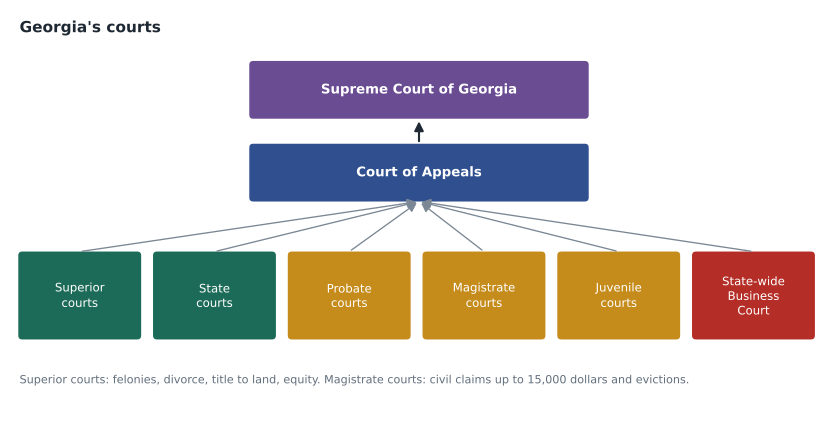
Georgia's trial courts are organized in layers, and essay questions often ask which court a case belongs in.
| Court | What it hears |
|---|---|
| Superior courts | Courts of general jurisdiction in every county, organized into judicial circuits; exclusive jurisdiction over felony trials, divorce, title to land and equity cases |
| State courts | Created by statute in many counties; civil cases at law of any amount and misdemeanors; no jurisdiction over divorce, title to land or felonies |
| Probate courts | Wills and estates, guardianships and conservatorships of adults and minors in many matters, marriage licenses and weapons carry licenses |
| Magistrate courts | Civil claims up to 15,000 dollars, dispossessory (eviction) cases, warrants and preliminary hearings, minor offenses |
| Juvenile courts | Delinquency, dependency (abuse and neglect) and related matters involving children |
| State-wide Business Court | Complex business disputes within its statutory categories and amount thresholds; sits in Atlanta or Macon |
Above the trial courts sit two appellate courts. The Court of Appeals hears most appeals from the trial courts. The Supreme Court of Georgia hears cases within its constitutional jurisdiction, such as constitutional questions and murder cases, reviews Court of Appeals decisions on certiorari, and answers certified questions. Legislation in 2016 expanded the Court of Appeals and moved several categories of cases that once went straight to the Supreme Court into the Court of Appeals' jurisdiction. The details of appellate jurisdiction are technical, and an essay that asks about them usually expects the candidate to know that most civil appeals go to the Court of Appeals and that constitutional questions go to the Supreme Court.
The State-wide Business Court
Georgia voters approved a constitutional amendment in 2018 creating a State-wide Business Court, the enabling statute followed in 2019, and the court opened in 2020. It hears listed categories of business disputes, such as disputes over the internal affairs of business entities, commercial contracts and certain complex commercial litigation, with equity powers. Cases seeking only money damages must meet minimum amounts, reported as one million dollars for disputes about commercial real property and 500,000 dollars for others. The court's judge is appointed by the Governor rather than elected. The consent and removal rules are specific, and a candidate should describe them in general terms unless the question gives them.
The Civil Practice Act
Georgia's main procedure statute is the Georgia Civil Practice Act, in Title 9, Chapter 11 of the Official Code of Georgia Annotated (O.C.G.A.). It was modeled on the Federal Rules of Civil Procedure, and its sections are numbered to track them: O.C.G.A. 9-11-12 corresponds to federal Rule 12, 9-11-56 to Rule 56, and so on. Georgia courts often look to federal decisions interpreting the parallel federal rule. But the Act has never been a copy, and the differences are what the essays test.
Georgia uses notice pleading. A complaint must contain a short and plain statement of the claim showing that the pleader is entitled to relief, and Georgia courts have historically read that standard more generously than the federal plausibility standard of Twombly and Iqbal. A defendant moving to dismiss for failure to state a claim must generally show that the plaintiff could not obtain relief under any state of provable facts. Candidates should not import the federal plausibility test into a Georgia answer without noting the difference.
Key deadlines
| Step | Georgia rule | Federal comparison |
|---|---|---|
| Answer to complaint | 30 days after service | 21 days after service |
| Opening a default as of right | Within 15 days after default, by filing a proper answer and paying costs | No automatic right; motion and good cause |
| Personal injury limitation period | Two years | Set by state law |
| Injury to personal property | Four years | |
| Written contracts | Six years | |
| Oral contracts | Four years | |
| Renewal after dismissal | Refile within the original period or six months after dismissal, whichever is later, if the first case was validly filed and served, generally once | No general federal equivalent |
Georgia's default rule deserves attention. If a defendant fails to answer within 30 days, the case is automatically in default. For the next 15 days, the defendant can open the default as a matter of right by filing an answer and paying costs. After that, the defendant must ask the court to open the default on specific grounds, such as excusable neglect or a proper case, and must show a meritorious defense. Georgia lawyers calendar day 30 and day 45 for every new case.
The renewal statute
Georgia's renewal statute, O.C.G.A. 9-2-61, is one of the most-tested Georgia procedure rules. When a case that was validly filed and served is dismissed, other than on the merits, the plaintiff can generally refile it within the original limitation period or within six months after the dismissal, whichever is later. The renewal privilege is generally available only once, and it does not save a case that was void from the start, such as one that was never properly served. A plaintiff who voluntarily dismisses a timely case on the eve of the limitation deadline may be able to refile within six months; a plaintiff whose first case was a nullity may not.
Discovery and motions
Georgia discovery tracks the federal tools: interrogatories, requests for production, requests for admission and depositions. Georgia has not adopted the federal rule's mandatory initial disclosures in the same form. Summary judgment under O.C.G.A. 9-11-56 follows the federal standard, which the Supreme Court of Georgia adopted in Lau's Corp. v. Haskins in 1991: a defendant who will not bear the burden at trial can win summary judgment by pointing to the absence of evidence on an essential element, after which the plaintiff must point to specific evidence creating a genuine issue.
Two Georgia-specific motions often appear. First, professional malpractice claims, such as claims against doctors, lawyers or engineers, must generally be filed with an expert affidavit under O.C.G.A. 9-11-9.1 setting out at least one negligent act or omission. Missing the affidavit can lead to dismissal, although the statute gives a chance to cure in some circumstances. Second, Georgia's offer of settlement statute, O.C.G.A. 9-11-68, allows either side in a tort case to make a written offer that shifts attorney's fees if the other side rejects it and the final judgment is far enough away from the offer: a defendant can recover fees and expenses incurred after the rejection if the final judgment is less than 75 percent of the defendant's offer, and a plaintiff can recover them if the final judgment is greater than 125 percent of the plaintiff's offer. The statute has detailed requirements for the form and timing of the offer, so a candidate should state the thresholds and describe the formalities in general terms.
The 2025 procedural changes
Georgia's 2025 tort reform law, Senate Bill 68, signed on April 21, 2025, changed several procedural rules, and law firm summaries describe the procedural changes as applying to pending as well as new cases. Among them:
A motion to dismiss now generally stays discovery while it is pending, with limited exceptions, so defendants can test a complaint before facing discovery.
The window for a plaintiff to dismiss a case voluntarily without prejudice was narrowed, so that a plaintiff can no longer dismiss as of right late in the case; the amended statute sets the window.
A party in a tort case may elect to have the trial divided into phases, separating liability from damages and, where applicable, punitive damages.
Plaintiffs may not recover attorney's fees twice for the same conduct under different statutes.
Lesson 8 covers the parts of the law that affect damages. For the essays, the safest course is to know that SB 68 exists, that it took effect on April 21, 2025, and that it changed motion-to-dismiss practice, voluntary dismissal, phased trials and damages evidence.
Worked problem
A Georgia procedure question
Corinne sued a roofing company in the State Court of Richmond County for damage to her house and for an injury she suffered when debris fell, filing in March 2026 and serving the company on April 1, 2026. The company did not answer. On May 12, 2026, the company asks how it can respond. Analyze.
Show solution
- Answer deadline: the company had 30 days after service, until about May 1, 2026, to answer.
- Default: the case went into default automatically when no answer was filed.
- Opening as of right: the company could open the default as of right within 15 days after default, roughly through May 16, 2026, by filing a proper answer and paying costs. On May 12 it is still within that window.
- Action: file the answer immediately and pay costs; no showing of excuse is required inside the 15-day period.
- Court: a state court has jurisdiction over this civil action at law; nothing about it requires the superior court.
Answer: The company should file its answer and pay costs at once to open the default as of right. Had it waited past the 15-day window, it would need a motion showing grounds such as excusable neglect and a meritorious defense.
Federal practice in Georgia
Georgia has three federal districts: the Northern, Middle and Southern Districts of Georgia, within the Eleventh Circuit. A case filed in a Georgia court may be removed to federal court if it could have been filed there, such as a diversity case between citizens of different states with more than 75,000 dollars in controversy, within 30 days after the defendant receives the initial pleading. After removal, the Federal Rules of Civil Procedure govern procedure, so the answer deadline, pleading standard and discovery rules change, while Georgia substantive law, such as the limitation period and the apportionment statute, generally continues to apply in a diversity case under the Erie doctrine.
Common mistakes
MistakeUsing the federal 21-day answer deadline in a Georgia court.
InsteadThe Civil Practice Act gives 30 days after service.
MistakeTelling a defaulted defendant it must show excusable neglect within the first 15 days.
InsteadWithin 15 days after default, the defendant can open it as of right by answering and paying costs.
MistakeApplying the federal plausibility standard to a Georgia motion to dismiss without comment.
InsteadGeorgia's notice pleading standard has traditionally been more generous; note the difference.
MistakeAssuming the renewal statute saves any dismissed case.
InsteadIt applies to cases that were validly filed and served, generally only once, and not to void filings.
Practice problems
Work each problem on paper first, then reveal the answer to check.
Which Georgia court has exclusive jurisdiction over a divorce?
Show answer
The superior court.
A plaintiff's timely personal injury case is dismissed without prejudice for failure to comply with a procedural rule three weeks after the two-year period ran. Can she refile?
Show answer
Generally yes, within six months after the dismissal under the renewal statute, if the first case was validly filed and served and she has not already used renewal.
What does a malpractice plaintiff usually need to file with the complaint in Georgia?
Show answer
An expert affidavit under O.C.G.A. 9-11-9.1 setting out at least one negligent act or omission.
Default and opening default in practice
Georgia's default rule is a frequent essay point because it differs from the federal approach. When a defendant fails to answer within 30 days after service, the case is automatically in default. The defendant may open the default as a matter of right within 15 days after the default by filing an answer and paying costs. After that window closes, opening requires a motion showing providential cause, excusable neglect or a proper case, along with a sworn showing of a meritorious defense and an offer to proceed to trial.
Malik practices the issue with a simple timeline: date of service, the 30th day, the 45th day, and the date the defendant actually acted. If the answer came on day 40, the defendant opened default as of right if costs were paid. If it came on day 60, the answer needs a motion and a showing under the statute. A strong answer names the steps in order rather than jumping straight to whether the court should excuse the delay.
Offers of settlement
Georgia's offer of settlement statute shifts attorney's fees in some tort cases. If a defendant's written offer is rejected and the final judgment is less than 75 percent of the offer, the defendant may recover fees and expenses incurred after the rejection. If a plaintiff's offer is rejected and the judgment is greater than 125 percent of the offer, the plaintiff may recover the same. The statute has detailed requirements about the content and timing of the offer, and a strong answer notes that a court will check those formalities before shifting fees.
Venue and the Georgia constitution
Venue in Georgia comes largely from the state constitution, which generally places civil cases in the county where a defendant resides, with special rules for joint defendants, corporations and certain kinds of cases. Essay questions sometimes test whether a case was filed in the right county and what happens if it was not. A short, accurate statement of the general rule usually earns the points.
Summary and key terms
- Georgia's trial courts include superior, state, probate, magistrate and juvenile courts and the State-wide Business Court; most appeals go to the Court of Appeals.
- The Civil Practice Act tracks the federal rules in numbering but differs in key places, such as the 30-day answer and automatic default with a 15-day right to open it.
- The renewal statute lets a validly filed case be refiled within six months after dismissal, generally once.
- SB 68 (April 21, 2025) changed motion-to-dismiss practice, voluntary dismissal, phased trials and fee recovery.
- Civil Practice Act
- Georgia's main civil procedure statute, O.C.G.A. Title 9, Chapter 11.
- Renewal statute
- O.C.G.A. 9-2-61, which allows refiling a dismissed, validly filed case within six months.
- Opening a default
- Setting aside a default; in Georgia it is available as of right within 15 days after default.
- Expert affidavit
- The affidavit required with most professional malpractice complaints under O.C.G.A. 9-11-9.1.
Lesson quiz · 5 questions
Score 60% or more to complete this lesson.
Create a free account to save your progress, take quizzes and earn a certificate.