
BAR-211 · Lesson 8 of 12 · 18 min
Georgia torts: apportionment, damages and the 2025 reforms
▶ Video coming soon A video version of this lesson is on the way.
Torts is an MBE subject, so Malik expects the Georgia essays to test the multistate rules. They do, but Marchetti spends a full call on the places where Georgia's answer differs. 'On the MBE you assume pure comparative fault unless they tell you otherwise,' she says. 'In Georgia you need the apportionment statute, the 50 percent bar, the punitive damages statute and the 2025 changes. A torts essay that doesn't mention any of them reads like it was written for another state.' This lesson covers those rules.
Negligence basics in Georgia
Georgia negligence law starts in the same place as everyone else's: duty, breach, causation and damages. Georgia's Code states general principles of tort law in Title 51, and much of the law is common law developed by Georgia's appellate courts. Most of the elements will look familiar. The differences come in how fault is divided among the people responsible, how damages are proven and capped, and how certain categories of defendants are treated.
Apportionment
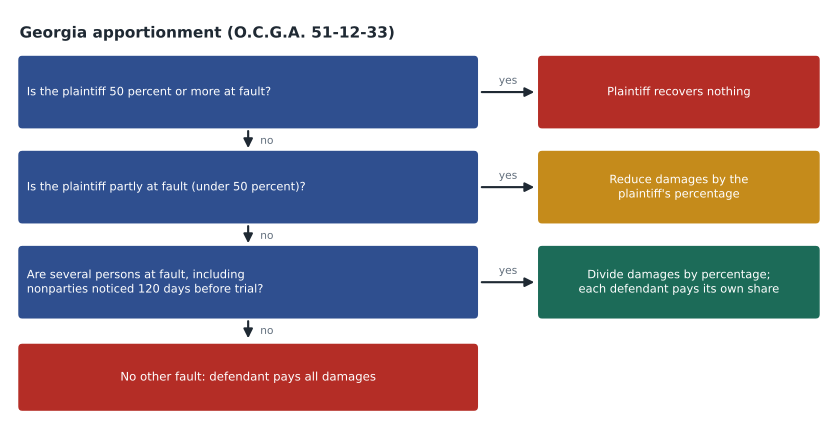
Georgia's apportionment statute, O.C.G.A. 51-12-33, governs how damages are divided when more than one person is at fault. It was rewritten in 2005 as part of an earlier tort reform, and it replaced much of the old system of joint and several liability.
First, if the plaintiff is partly at fault, the jury determines the plaintiff's percentage of fault and the plaintiff's damages are reduced in proportion. If the plaintiff is 50 percent or more responsible, the plaintiff recovers nothing. That is a modified comparative fault rule with a 50 percent bar, stricter for plaintiffs than the 51 percent bar used in some states and far stricter than pure comparative fault.
Second, the jury apportions the damages among the persons who are liable, according to each one's percentage of fault, and each defendant is generally liable only for its own share. Joint liability is largely gone in Georgia negligence cases.
Third, the jury may consider the fault of a nonparty, such as someone who settled, someone who cannot be sued or someone the plaintiff chose not to sue, if a defendant gives proper notice before trial that it intends to seek apportionment to that nonparty. The statute requires the notice not later than 120 days before the date of trial. Fault assigned to a nonparty reduces what the named defendants pay but does not create a judgment against the nonparty.
The Supreme Court of Georgia has decided a series of cases interpreting the statute, holding among other things that apportionment applies even in a case with a single defendant when the plaintiff is also at fault, and addressing when the fault of nonparties may be considered. An essay answer does not need the case names, but should state that the statute applies broadly and that fault is divided by percentages.
Worked problem
Apportioning a Georgia verdict
Keisha Wilkes sues the van driver and the delivery company that employed him for her June 2025 crash. The jury finds total damages of 200,000 dollars and assigns fault as follows: Keisha 20, the van driver (whose fault is imputed to the company as his employer) 60, and a nonparty road contractor, properly noticed, 20. What does Keisha recover, and from whom?
Show solution
- Check the bar: Keisha is 20 percent at fault, below 50, so she can recover.
- Reduce for her fault: her recoverable share is the 80 percent attributable to others.
- Divide by fault: the driver and company together are responsible for 60 percent of 200,000 dollars, or 120,000 dollars.
- Nonparty share: 20 percent of 200,000 dollars, or 40,000 dollars, is assigned to the nonparty contractor; no judgment is entered against the contractor in this case, so Keisha does not recover that share here.
- Result: Keisha obtains a judgment for 120,000 dollars against the driver and the company.
Answer: Keisha recovers 120,000 dollars. Had the jury put her at 50 percent or more, she would recover nothing. The nonparty apportionment cost her 40,000 dollars, which is why plaintiffs' lawyers in Georgia think carefully about whom to sue.
Punitive damages
Georgia's punitive damages statute, O.C.G.A. 51-12-5.1, allows punitive damages only when the plaintiff proves by clear and convincing evidence that the defendant's actions showed willful misconduct, malice, fraud, wantonness, oppression or an entire want of care raising a presumption of conscious indifference to consequences. The jury decides whether punitive damages are warranted, and the amount is determined in a separate phase. The statute generally caps punitive damages at 250,000 dollars, but the cap does not apply in product liability cases, in cases where the defendant acted with specific intent to cause harm, or where the defendant acted or failed to act while under the influence of alcohol or drugs. In product liability cases, a large share of a punitive award goes to the state rather than the plaintiff. Candidates should know the cap and its three exceptions.
Caps on noneconomic damages
Georgia once capped noneconomic damages in medical malpractice cases. In Atlanta Oculoplastic Surgery, P.C. v. Nestlehutt, decided in 2010, the Supreme Court of Georgia held the cap unconstitutional because it violated the right to a jury trial under the Georgia Constitution. There is no general cap on compensatory noneconomic damages in Georgia today. That history matters for the 2025 reforms, which did not impose a cap and instead regulated how damages are argued and proved.
The 2025 reforms: damages
Senate Bill 68, signed on April 21, 2025, made several changes to how damages are tried. Law firm summaries describe them as follows.
| Change | What it does | Timing |
|---|---|---|
| Anchoring | Limits how counsel may argue noneconomic damages to the jury, barring arguments that tie amounts to unrelated figures rather than the evidence; does not cap damages | Took effect on signing |
| Medical expenses ("phantom damages") | Allows evidence of the amounts actually paid or necessary to satisfy medical charges, not only the billed amounts; letters of protection and related arrangements become discoverable | Causes of action arising on or after April 21, 2025 |
| Phased trials | Lets a party elect to try liability, damages and punitive damages in separate phases | Procedural; applies to pending cases |
| Attorney's fees | Bars double recovery of fees for the same conduct | Procedural; applies to pending cases |
A companion bill, Senate Bill 69, regulated third-party litigation funding: it requires funders to register with the state, bars them from controlling litigation, makes funding agreements discoverable in some circumstances, and imposes other requirements, with the registration provisions taking effect on January 1, 2026.
Marchetti's advice for the essays is to know which provisions apply to which claims. The medical expense rule applies only to causes of action arising on or after April 21, 2025, so a crash in March 2025 is tried under the old rule even if the suit is filed later. The procedural provisions, such as phased trials, apply to pending cases. A strong answer states the timing rule when the dates in the fact pattern make it matter.
Premises liability
Georgia's premises liability statute, O.C.G.A. 51-3-1, makes an owner or occupier liable to invitees for failing to exercise ordinary care in keeping the premises and approaches safe. Georgia courts have long framed the question in terms of superior knowledge: the owner is liable when it had actual or constructive knowledge of the hazard and the invitee, exercising ordinary care, did not. Slip-and-fall essays in Georgia should apply that framework. Licensees and trespassers receive less protection, generally only from willful or wanton injury, with some additional protection for known licensees.
Other Georgia tort rules worth knowing
Georgia's dram shop statute, O.C.G.A. 51-1-40, sharply limits liability for serving alcohol. A provider is generally liable for injuries caused by an intoxicated adult only if it knowingly served a person who was noticeably intoxicated and knew the person would soon be driving. Liability for serving underage persons is broader. Essays on bar and party injuries often turn on that knowledge requirement.
Georgia's anti-SLAPP statute, O.C.G.A. 9-11-11.1, was rewritten in 2016 to follow California's model. It allows a defendant sued over speech on a public issue to move to strike the claim early, with discovery limited while the motion is pending and attorney's fees available to a prevailing defendant.
Claims against the state and its agencies are governed by the Georgia Tort Claims Act, which waives sovereign immunity for many torts by state employees acting within the scope of employment, subject to exceptions and caps, and requires an ante litem notice of the claim within 12 months. Claims against counties and cities have their own ante litem notice requirements, with shorter deadlines for cities. Missing an ante litem notice is a classic essay issue.
Georgia's early privacy tort
Georgia was the first state supreme court to recognize a common law right of privacy, in Pavesich v. New England Life Insurance Co. in 1905, a case about the unauthorized use of a man's photograph in an advertisement. Pavesich is still cited for the appropriation branch of privacy law, and it is a useful point to mention when a Georgia essay involves the use of someone's name or likeness.
Common mistakes
MistakeApplying pure comparative fault to a Georgia negligence essay.
InsteadGeorgia bars a plaintiff 50 percent or more at fault and otherwise reduces damages by the plaintiff's percentage.
MistakeAssuming joint and several liability.
InsteadUnder the apportionment statute, defendants generally pay only their own percentage share.
MistakeApplying the 2025 medical expense rule to every case decided after April 2025.
InsteadIt applies to causes of action arising on or after April 21, 2025.
MistakeStating that Georgia caps noneconomic damages in malpractice cases.
InsteadThe cap was struck down in Nestlehutt (2010); the 2025 law regulates argument and evidence, not amounts.
Practice problems
Work each problem on paper first, then reveal the answer to check.
A jury finds a plaintiff 50 percent at fault. What does she recover in Georgia?
Show answer
Nothing. Georgia bars recovery when the plaintiff is 50 percent or more at fault.
What must a plaintiff prove to recover punitive damages in Georgia, and what is the usual cap?
Show answer
Clear and convincing evidence of willful misconduct, malice, fraud, wantonness, oppression or conscious indifference; the usual cap is 250,000 dollars, with exceptions for product liability, specific intent to harm and impairment by alcohol or drugs.
A shopper slips on a spilled drink in a Georgia grocery store. What framework applies?
Show answer
Premises liability under O.C.G.A. 51-3-1: whether the store had actual or constructive knowledge of the hazard superior to the shopper's, and whether the shopper exercised ordinary care.
Working through a three-party apportionment
Apportionment problems reward careful arithmetic and careful language. In Keisha's case, the jury found total damages of 200,000 dollars and assigned 20 percent to Keisha, 60 percent to the van driver and 20 percent to a properly noticed nonparty road contractor. Keisha is under 50 percent at fault, so she may recover. Her award is reduced by her 20 percent, leaving 160,000 dollars. The remaining damages are divided by percentage of fault: the driver's share is 60 percent of 200,000, or 120,000 dollars, and the delivery company is liable for that same amount because the driver's fault is imputed to it as his employer. The contractor's 20 percent, or 40,000 dollars, is not recoverable from the defendants because Georgia's statute generally makes each defendant liable only for its own share.
Marchetti points out the trap. Under joint and several liability, Keisha could collect all 160,000 dollars from the driver and his employer. Under Georgia's apportionment statute she collects 120,000 dollars from them and bears the risk on the nonparty share. That difference is why defendants give nonparty notice and why plaintiffs often add the nonparty as a defendant if they can.
Punitive damages
Georgia's punitive damages statute requires clear and convincing evidence of willful misconduct, malice, fraud, wantonness, oppression or an entire want of care that would raise the presumption of conscious indifference to consequences. It generally caps punitive damages at 250,000 dollars, with exceptions such as product liability claims and cases where the defendant acted with specific intent to cause harm or was impaired by alcohol or drugs. A strong answer identifies whether an exception applies before discussing the cap.
Reading the 2025 reforms on an essay
The 2025 reforms are best handled by sorting them into two groups. Some provisions are procedural and apply to pending cases, such as phased trials, limits on anchoring arguments about noneconomic damages, the stay of discovery while a motion to dismiss is pending, and changes to the timing of voluntary dismissals. The rule on the evidence of medical expenses applies to causes of action arising on or after April 21, 2025. Keisha's crash occurred in June 2025, so the new medical expense rule applies to her claim. A candidate who notes the date and explains why it matters shows the grader that the answer is built from Georgia law, not memorized lists.
Premises and negligent security
Owners and occupiers in Georgia owe invitees ordinary care in keeping premises and approaches safe. Negligent security claims arise when a third party's crime injures an invitee, and the 2025 reforms added provisions on these claims, including how fault is assigned among the owner, the criminal actor and others. On an essay, a candidate should state the duty, discuss foreseeability, and apply apportionment to the parties at fault.
Summary and key terms
- Georgia's apportionment statute reduces damages by the plaintiff's fault, bars recovery at 50 percent or more and divides damages among liable persons by percentage.
- Punitive damages require clear and convincing evidence and are generally capped at 250,000 dollars, with three exceptions.
- There is no general cap on noneconomic damages after Nestlehutt (2010).
- SB 68 (April 21, 2025) limits anchoring, allows evidence of medical amounts actually paid for new claims, permits phased trials and bars double fee recovery.
- Apportionment
- Dividing damages among the plaintiff and the persons at fault by percentage, under O.C.G.A. 51-12-33.
- Superior knowledge
- The Georgia premises liability test comparing the owner's and the invitee's knowledge of a hazard.
- Ante litem notice
- A notice of claim that must be given to a government defendant before suit within a set period.
- Anchoring
- Arguing for a damages amount by reference to an unrelated figure; limited in Georgia by the 2025 law.
Lesson quiz · 5 questions
Score 60% or more to complete this lesson.
Create a free account to save your progress, take quizzes and earn a certificate.