
BAR-211 · Lesson 3 of 12 · 19 min
Fitness certification and the MPRE
▶ Video coming soon A video version of this lesson is on the way.
Malik's fitness file is done, but Marchetti spends a whole call on it anyway. 'Half the people in this group will move states at some point,' she says, 'and the other half have a friend who just failed fitness review for a reason that had nothing to do with the exam. Georgia's process is a good one to understand because it's front-loaded and thorough.' This lesson covers how Georgia's Board to Determine Fitness of Bar Applicants reviews character and fitness, what applicants are asked to disclose, how problems are handled, and the MPRE requirement.
The standard
Georgia, like every state, requires that a new lawyer have the character and fitness to practice law. The Board to Determine Fitness of Bar Applicants applies that standard, and the applicant carries the burden of showing that he or she meets it. The question is forward-looking: whether the applicant can be trusted to handle client money, keep client secrets, tell courts the truth, meet deadlines and follow the rules. Past conduct matters because it is the best evidence of future conduct, but the Board also weighs how long ago the conduct happened, how serious it was, what the applicant has done since, and, above all, whether the applicant has been candid about it.
The United States Supreme Court has held that a state may not deny admission arbitrarily or for reasons unrelated to fitness to practice, and that a character decision must rest on evidence rationally connected to that fitness. Within that limit, states have wide discretion, and Georgia's Board uses it.
Georgia runs its own review
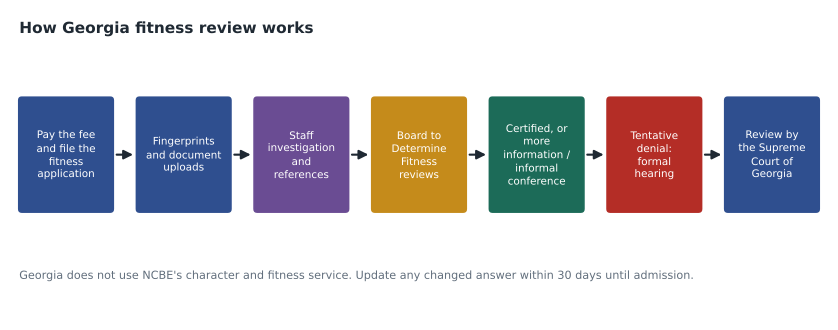
Many states send applicants to NCBE's character and fitness service, which collects the application and gathers records for the state. Georgia does not. NCBE's own Georgia information says Georgia does not use its character and fitness services and that applicants should follow Georgia's instructions. The Georgia application is filed through the Office of Bar Admissions' own online system, and the Office's staff and the Board handle the investigation.
The practical result is that a Georgia applicant cannot reuse an NCBE character report prepared for another state. An applicant applying in Georgia and in a UBE state at the same time completes two different character applications, on two schedules. Marchetti tells the group to keep a master file of addresses, jobs, traffic tickets and court cases so that the answers match from one application to the next. Inconsistent answers are one of the most common reasons a file is flagged.
What the application asks
The Georgia fitness application is long. It asks for the applicant's residences and employment, typically going back years; all schools attended and any academic discipline; every arrest, citation, charge and conviction, including matters that were dismissed, expunged or handled through diversion unless the instructions specifically exclude them; civil lawsuits in which the applicant was a party; financial matters such as defaults, collections, judgments and bankruptcies; driving history; prior bar applications and admissions elsewhere; and any professional licenses or discipline. It also asks for references. The specific wording changes over time, and the current application controls.
Two instructions recur. First, read every question as broadly as its words allow, and when in doubt, disclose. Second, if a question asks about a matter that was sealed, expunged or dismissed, read the instructions carefully, because many character applications require disclosure of such matters even when other forms do not. A matter disclosed and explained is rarely a problem. A matter discovered by the Board that the applicant left out often becomes the problem, because the omission itself is evidence of a lack of candor.
Fingerprints, documents and updates
After filing the application and paying the fee, the applicant completes fingerprinting for criminal history checks and uploads supporting documents, such as court records for any criminal or civil matter, proof of satisfaction of judgments, and records of any academic or employment discipline. Prep providers note that Georgia applications are not considered filed until the fee is paid, and that documents can be uploaded only after the application is filed.
The duty of candor does not end when the application is filed. Applicants must update the application within 30 days of any change that would make an answer inaccurate: a new address, a new job, a new traffic citation, a new lawsuit, a new debt in default. That duty runs until admission, and a certification already granted can be revisited if new information comes to light.
How problems are handled
Most applications are certified without any special step. When the Board has questions, it may ask for more information or documents, or invite the applicant to an informal conference to discuss specific concerns. An applicant who receives a request should answer it promptly and fully, and many applicants with significant issues retain a lawyer who handles bar admission matters.
If the Board believes it cannot certify the applicant, the Georgia rules provide notice of a tentative decision and an opportunity for a formal hearing before a hearing officer, with the right to present evidence and witnesses. The Board's final decision can be reviewed by the Supreme Court of Georgia. Applicants denied certification generally must wait a period before reapplying. Throughout, the question is the applicant's present fitness, and evidence of rehabilitation, such as treatment, restitution, steady employment and the passage of time, carries real weight.
Common issues
| Issue | What usually matters |
|---|---|
| Alcohol or drug offenses | Number and recency of incidents, compliance with sentences, any treatment and current conduct |
| Financial problems | Whether debts are being handled responsibly, not simply whether they exist; candor about defaults and collections |
| Academic misconduct | The nature of the conduct, the school's findings and the applicant's explanation, consistent with the school's records |
| Omissions and inconsistencies | Often treated more seriously than the underlying conduct |
| Mental health | Georgia, like many states, focuses on conduct; treatment alone should not be treated as disqualifying, but read the current questions carefully |
| Unauthorized practice | Any legal work in Georgia before admission without proper supervision |
Malik's file had two items that prompted no follow-up at all, because he disclosed both and attached the records. His college citation for underage possession of alcohol was eight years old, resolved through a pretrial diversion program, and never repeated. His credit card account had gone to collections during law school when a family emergency drained his savings, and he had paid it in full in 2025 and attached the letter showing it was satisfied. 'The Board sees a hundred files like yours,' Marchetti says. 'What they don't like to see is a file where the collection account shows up on the credit report and not on the application.'
Worked problem
Disclose or not?
Three members of the study group ask whether they must disclose: (1) a speeding ticket paid by mail six years ago; (2) a shoplifting charge at age 19 that was dismissed and later expunged; (3) a small claims case they filed against a former landlord and won.
Show solution
- Read each fitness question for its full scope. Traffic questions usually ask about all citations, sometimes with a narrow exception for parking; a paid speeding ticket is usually covered.
- Criminal history questions in character applications usually reach charges that were dismissed or expunged unless the instructions expressly exclude them. Disclose and attach the court record and expungement order.
- Civil litigation questions usually reach every case in which the applicant was a party, as plaintiff or defendant, including small claims.
- When unsure, disclose with a short, factual explanation. The cost of disclosing something unnecessary is a few minutes; the cost of omitting something required can be a lost exam cycle or a denial.
Answer: All three should almost certainly be disclosed under the wording typical of character applications, subject to the exact text of Georgia's current questions. None of the three is likely to cause trouble if disclosed.
The MPRE
The Multistate Professional Responsibility Examination is NCBE's two-hour, 60-question multiple-choice test on the rules governing lawyers, built mainly on the ABA Model Rules of Professional Conduct and the ABA Model Code of Judicial Conduct. Fifty questions are scored and ten are pretest questions. It is given three times a year at Pearson VUE test centers. The 2026 fee is 185 dollars. The MPRE Preparation course in this program covers the test in detail.
Georgia requires a scaled MPRE score of 75, among the lowest required scores in the country. An applicant may sit the bar exam before passing the MPRE, but the Office will not issue the Certificate of Eligibility until a qualifying score is on file. NCBE's Georgia information does not state a time limit on how old the score may be, and prep providers report that Georgia accepts earlier scores, including scores earned for another jurisdiction. Applicants should confirm the current rule with the Office if their score is several years old.
Most Georgia applicants take the MPRE during the second or early third year of law school, after a professional responsibility course. The published 2027 test dates are March 23 or 24, August 18 or 19, and November 4 or 5, 2027, with registration deadlines in January, June and September respectively and earlier deadlines for accommodation requests. Applicants report their scores to Georgia through their NCBE account.
| Requirement | Georgia rule (as of November 2026) |
|---|---|
| Minimum scaled MPRE score | 75 |
| When it must be earned | Before the Certificate of Eligibility is issued; may be after the bar exam |
| Score age | No time limit stated in NCBE's Georgia information; confirm with the Office |
| Score from another jurisdiction | Accepted if it meets 75, according to prep providers |
| Test format | 60 questions (50 scored), two hours, at Pearson VUE centers |
Why candor is the whole game
Marchetti ends the call the way she ends every fitness discussion. 'Your character file is the first thing you ever submit to a court as a lawyer-in-waiting,' she says. 'It is also the last time anyone will give you credit for admitting a mistake before they find it.' She reminds the group that the same duty of candor appears in the Georgia Rules of Professional Conduct, which forbid a bar applicant from knowingly making a false statement of material fact or failing to disclose a fact necessary to correct a misapprehension. Lying on a bar application is itself a disciplinary violation that can follow a lawyer after admission.
Common mistakes
MistakeAssuming an NCBE character report from another state will satisfy Georgia.
InsteadGeorgia runs its own fitness review and does not use NCBE's character and fitness service.
MistakeLeaving out a dismissed or expunged charge because it "no longer exists."
InsteadCharacter applications often reach such matters; read the instructions and disclose unless they are expressly excluded.
MistakeForgetting to update the application after filing.
InsteadApplicants must update any answer that becomes inaccurate within 30 days, until admission.
MistakeDelaying the MPRE because the bar exam comes first.
InsteadThe bar exam can come first, but the Certificate of Eligibility waits for a score of 75.
Practice problems
Work each problem on paper first, then reveal the answer to check.
An applicant receives a parking ticket two weeks after being certified as fit. What should she do?
Show answer
Read the traffic question; if it covers the citation, update her application within 30 days. Certification does not end the duty to keep the file accurate.
What score must a Georgia applicant earn on the MPRE, and when?
Show answer
A scaled score of 75, before the Certificate of Eligibility is issued; the applicant may sit the bar exam first.
Why is an omission often treated more seriously than the conduct omitted?
Show answer
Because the omission is fresh evidence of a lack of candor, the very quality the Board is trying to measure, while the conduct may be old and isolated.
Keeping the application current
Certification is not the end of the fitness process. Georgia requires applicants to update the Board when an answer changes, and the duty continues until admission. A new traffic citation, a change of address, a new job, a lawsuit, a late payment that goes to collections or a new academic matter can all require an update. Malik keeps a short running list in his application folder and checks it each month. If something changes, he files the update within 30 days rather than waiting to see whether it matters.
Marchetti explains why this matters more than the original filing. The Board reads an updated answer against the history already in the file. A candid update about a minor event rarely causes trouble. A matter that surfaces later through a background check, after the applicant failed to report it, raises a different question: whether the applicant is candid with a court. That is the trait the process exists to test.
What happens if the Board has concerns
When the Board needs more information, it usually asks for documents or an explanation in writing. It may invite the applicant to an informal conference. If concerns remain, the Board can issue a tentative order of denial, and the applicant can ask for a formal hearing before a hearing officer, with review by the Board and then by the Supreme Court of Georgia. Applicants facing a formal hearing often retain a lawyer who handles admission matters, and they gather evidence of rehabilitation, such as completed treatment, repaid debts, steady employment and letters from people who know them well.
The MPRE in the overall timeline
The MPRE is a separate national test, scheduled by NCBE several times a year. Georgia requires a scaled score of 75 and accepts it whether taken before or after the bar exam, as long as the score is in hand before the Certificate of Eligibility issues. Malik took it in August 2025, during the summer after his second year, and scored 88. Marchetti recommends that approach because it removes one task from the busy months before the bar exam. Tre, who has not taken it yet, plans to sit the March 2027 administration if he passes the February exam, which leaves him a few weeks of waiting before he can be admitted.
Summary and key terms
- Georgia's Board to Determine Fitness of Bar Applicants runs its own character review, without NCBE's character service.
- Applicants must disclose broadly, attach records and update answers within 30 days of any change until admission.
- Problems lead to requests for information, informal conferences and, if needed, a formal hearing and Supreme Court review.
- Georgia requires a scaled MPRE score of 75, which may be earned after the bar exam but before the Certificate of Eligibility.
- Character and fitness
- The review of whether an applicant has the honesty, judgment and reliability needed to practice law.
- Informal conference
- A meeting the fitness board may hold with an applicant to discuss concerns before deciding.
- MPRE
- The Multistate Professional Responsibility Examination, NCBE's test on the law governing lawyers.
Lesson quiz · 5 questions
Score 60% or more to complete this lesson.
Create a free account to save your progress, take quizzes and earn a certificate.