
BAR-225 · Lesson 11 of 12 · 21 min
Score transfer, admission on motion and practice after admission
▶ Video coming soon A video version of this lesson is on the way.
In mid-November 2026 Ora Lee Bankston asked Tavaris to help her with a hiring question. The firm was considering two lawyers for an opening in 2027. One, a Louisiana lawyer named Desmond Fontenot, had practiced in New Orleans for seven years and wanted to move to Greenwood to be near his wife's family. The other, a recent graduate who had taken the July 2026 bar exam in Tennessee, was waiting for results and wondered whether her score could be used in Mississippi. 'Find out what each of them would need to do,' Ms. Bankston said, 'and while you are at it, tell me what you will owe the Bar and the CLE Commission once you are admitted.'
Tavaris took the questions to Hollis Marchetti. 'This is the last administrative lesson,' she said, 'and it is the one people skip because it feels far away. But it matters to you twice: once if you ever move, and again the day you are sworn in, because the new-lawyer CLE clock starts running. It also matters to the firm, because you are about to be the person in the office who knows the rules.'
This lesson explains how scores move into and out of Mississippi, the requirements for admission on motion, the narrower options for out-of-state lawyers, and what a new Mississippi lawyer owes after admission.
Mississippi is not a UBE jurisdiction
The first point is the one that surprises candidates from other states. Mississippi does not give the Uniform Bar Examination and does not accept UBE scores earned elsewhere. NCBE lists Mississippi as a jurisdiction that does not accept legacy UBE scores. A lawyer who passed the UBE in Alabama or Tennessee cannot transfer that total score to Mississippi. The only part of another exam that Mississippi will consider is the MBE scaled score, and only under the conditions in the Rules.
The same is true in the other direction. A Mississippi exam score is not a UBE score, so a Mississippi lawyer cannot transfer a passing Mississippi score to a UBE state. Some states will accept a Mississippi MBE score toward their own exam, under their own rules, but that is a matter for the receiving state.
Transferring an MBE score into Mississippi
Under the Rules Governing Admission, an applicant who took the MBE in Mississippi or another jurisdiction may use that scaled score in place of taking the MBE again, if the earlier MBE was taken within the 20 months before the Mississippi exam. The applicant must petition the Board at least 30 days before the exam, and an applicant using an out-of-state score must sign the Board's authorization so the Board can verify the score with NCBE. The applicant then sits only for the written day: the six Mississippi essays, the MEE and the MPT. The transferred MBE score is combined with the new written scores under the usual weights.
For the recent graduate who took the July 2026 exam in Tennessee, that rule offers a choice. If she wants to be admitted in Mississippi, she can apply for the February 2027 Mississippi exam and petition to use her July 2026 MBE score, which would be about seven months old. She would then write only the Mississippi day. Whether that is wise depends on her MBE score: a strong MBE score carries 40 percent of the Mississippi total, while a weak one might be worth retaking.
Worked problem
Using a prior MBE score
A candidate took the MBE in Alabama in July 2025 and scored 141. She wants to sit for the Mississippi exam in February 2027 and use that score.
Show solution
- The Rules require the prior MBE to have been taken within 20 months before the Mississippi exam.
- July 2025 to February 2027 is about 19 months, so the score is within the window.
- She must petition the Board at least 30 days before the February exam and sign the authorization for the Board to verify the out-of-state score.
- She will write the six Mississippi essays, the MEE and the MPT, and her 141 will count for 40 percent of the combined score.
Answer: She may use the score if she petitions on time; her written scores will be combined with the 141 under Mississippi's weights.
Admission on motion
Admission on motion, sometimes called comity or reciprocity admission, lets an experienced lawyer from another state join the Mississippi bar without taking the exam. Under the Rules, the applicant must have practiced law for at least five years in a jurisdiction whose admission requirements are equivalent to Mississippi's and which grants similar privileges to Mississippi lawyers. The practice must be full time or a regular undertaking, not occasional, and must be general legal practice rather than very narrow in scope. NCBE's summary notes that qualifying practice can include law teaching, government work, military service, in-house corporate work and service as a judge in a court of record.
Reciprocity is the key word. Mississippi admits on motion only lawyers from jurisdictions that admit Mississippi lawyers on motion. The Board maintains a list of reciprocal jurisdictions, and where a reciprocal state's rules are stricter than Mississippi's, the Board applies the stricter rules to applicants from that state. A lawyer licensed in several states may find that the Board decides which state's rules govern.
Some applicants are ineligible even with the required practice. Under the Rules, a lawyer who failed the Mississippi bar exam within the previous five years cannot use admission on motion, and neither can a lawyer who was disciplined in another jurisdiction for conduct that would bar admission in Mississippi. Applicants must also satisfy the character and fitness requirements, including an NCBE background investigation. The admission on motion fee is 1,500 dollars, plus the cost of the character investigation. If the applicant turns out not to qualify, the fee is not refunded, but it can be applied toward the bar exam.
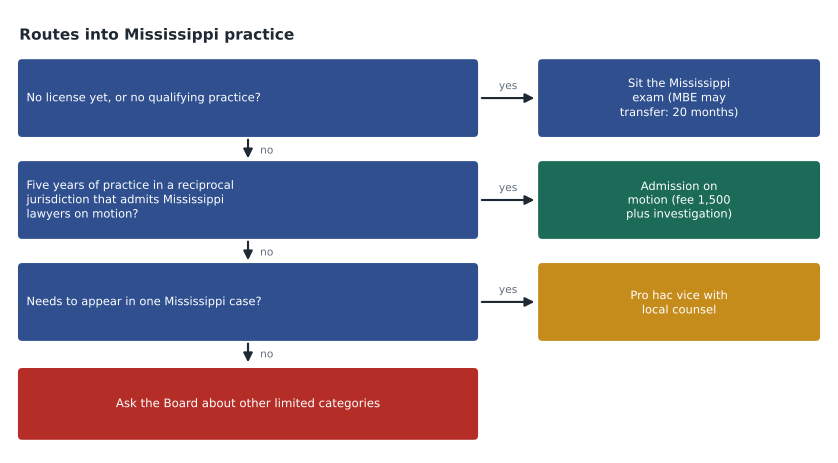
For Desmond Fontenot, the Louisiana lawyer, the questions are whether Louisiana is on the Board's list of reciprocal jurisdictions and whether his seven years of practice meet the full-time, general practice standard. If both answers are yes, and he has a clean disciplinary record, he can apply on motion. If Louisiana is not reciprocal, he would need to sit for the Mississippi exam, although he could petition to use any recent MBE score. Tavaris wrote in his memo that the firm should check the Board's current list before making an offer.
Pro hac vice and limited practice
A lawyer licensed elsewhere who needs to appear in a single Mississippi case can seek admission pro hac vice, for that case only. The Mississippi Rules of Appellate Procedure set out the requirements, which include association with a Mississippi lawyer who will be responsible for the case, disclosure of the lawyer's other pro hac vice appearances and payment of a fee. Courts limit how often a lawyer may appear this way, to prevent it from becoming a substitute for admission.
Rule 5.5 of the Mississippi Rules of Professional Conduct also allows certain lawyers to work in Mississippi without full admission. In-house lawyers providing services to their employer and lawyers authorized by federal law may practice under Rule 5.5(d) if they register with the Mississippi Bar and pay an annual fee. And Rule 5.5(c) permits temporary practice in limited circumstances, such as work in association with a Mississippi lawyer.
| Route | Who it fits | Key requirements |
|---|---|---|
| Bar exam | New graduates and lawyers without qualifying practice | Mississippi exam; MBE may transfer within 20 months |
| Admission on motion | Lawyers with five years of practice in a reciprocal jurisdiction | Equivalent requirements, reciprocity, 1,500 dollars plus investigation |
| Pro hac vice | Out-of-state lawyers for one case | Mississippi associated counsel; limits on frequency |
| Rule 5.5(d) registration | In-house and federally authorized lawyers | Register with the Mississippi Bar; annual fee |
After admission: the oath and the Mississippi Bar
Once the Board certifies that an applicant has passed the exam, satisfied the MPRE requirement and been approved by the Committee on Character and Fitness, the applicant takes the oath and is admitted by the Supreme Court. Admission brings mandatory membership in the Mississippi Bar, the state's integrated bar, along with annual dues and the obligation to keep contact information current. The Mississippi Bar offers practice management resources, an ethics hotline and opinions from its Ethics Committee, and sections for different practice areas.
Continuing legal education
Mississippi requires continuing legal education under rules adopted by the Supreme Court and administered by the Commission on Continuing Legal Education. Active attorneys must complete 12 hours of approved CLE each year, including at least one hour of ethics or professionalism. The ethics hour can cover legal ethics, professional responsibility, professionalism, malpractice prevention, or substance abuse and mental health. The CLE year runs through July 31, and attorneys report their hours on an annual report statement due by August 15.
Lawyers who earn more than the required hours can carry up to 12 general hours forward to the next year. Extra ethics hours carry forward only as general hours, not as ethics hours.
Newly admitted lawyers follow a special program. Instead of the regular requirement for their first years, they must complete 12 hours that include 6 hours of basic skills and 6 hours of ethics and professionalism, by the end of the second CLE year after admission. That satisfies the requirement for the admission year and the following year. A lawyer admitted in Mississippi after at least five years of active practice elsewhere may be exempt from the 6 basic skills hours by affidavit, but must still complete the 6 hours of ethics and professionalism within nine months of admission.
| Lawyer | CLE requirement | Deadline |
|---|---|---|
| Active attorney | 12 hours a year, including 1 hour of ethics or professionalism | Earn by July 31; report by August 15 |
| Newly admitted lawyer | 12 hours: 6 basic skills and 6 ethics and professionalism | By the end of the second CLE year after admission |
| Admitted after 5+ years elsewhere | May be exempt from basic skills; 6 hours ethics and professionalism | Within 9 months of admission |
| Carryover | Up to 12 general hours | To the next compliance year |
Answering Ms. Bankston
Tavaris's memo to Ora Lee Bankston ran to a page. Desmond Fontenot may qualify for admission on motion if Louisiana is on the Board's reciprocal list, his practice meets the five-year full-time standard and his record is clean; otherwise he would need to take the exam. The Tennessee graduate cannot transfer a UBE score, but she can petition to use her July 2026 MBE score on the February 2027 Mississippi exam and write only the Mississippi day. As for Tavaris himself, once admitted he will join the Mississippi Bar, pay annual dues and complete 12 new-lawyer CLE hours, half of them in ethics and professionalism, by the end of his second CLE year.
Ms. Bankston read it and nodded. 'Put a date at the top,' she said. 'Rules change.'
Common mistakes
MistakeA UBE score from another state transfers into Mississippi.
InsteadMississippi does not accept UBE scores; only a recent MBE scaled score may be used, within 20 months.
MistakeAny lawyer with five years of practice can be admitted on motion.
InsteadThe practice must be in a reciprocal jurisdiction with equivalent requirements, and recent failure of the Mississippi exam disqualifies.
MistakeNew Mississippi lawyers have no CLE until their third year.
InsteadThey must complete 12 hours, including 6 of ethics and professionalism, by the end of the second CLE year after admission.
MistakeThe Mississippi CLE year ends December 31.
InsteadHours must be earned by July 31 and reported by August 15.
Planning a multistate career
Candidates in border areas often wonder whether to seek admission in more than one state. A lawyer in DeSoto County may want Tennessee admission for Memphis clients; a lawyer on the Gulf Coast may want Louisiana or Alabama; a lawyer in Columbus may see clients from Alabama. Because Mississippi's exam is not the UBE, a Mississippi lawyer usually reaches a second state either by taking that state's exam, possibly with a transferred MBE score if the other state allows it, or, after years of practice, by admission on motion if the states have reciprocal arrangements.
The planning point is that admission on motion depends on years of practice, so a lawyer who expects to want a second license in five years should keep careful records of practice now: dates, employers, the nature of the work and whether it was full time. Those records make a later application far easier. A lawyer who might want a second license soon after admission, by contrast, should look at the other state's rules on MBE score transfer, because a recent MBE score may be usable for a limited time.
Keeping a license in good standing
Admission is the start of a set of ongoing obligations. Each year a Mississippi lawyer pays Mississippi Bar dues, completes and reports CLE, reports pro bono service under Rule 6.1(e) and keeps contact information current. Lawyers who move to inactive status or practice elsewhere should check the rules for changing status, since inactive lawyers are generally exempt from CLE but cannot practice in Mississippi until they return to active status and satisfy any make-up requirements.
Missing these obligations has consequences. A lawyer who fails to complete or report CLE may face a deficiency notice, fees and, ultimately, suspension of the license until the deficiency is cured. A suspended lawyer who keeps practicing commits the unauthorized practice of law. The simple habit of putting July 31 and August 15 on the calendar every year avoids most of that trouble.
A first-year checklist
Marchetti gave Tavaris a short checklist for his first year as a Mississippi lawyer. Take the oath and confirm enrollment with the Mississippi Bar. Set up the trust account properly before taking any client money. Register for new-lawyer CLE early, so that the 6 basic skills hours and 6 ethics and professionalism hours are done well before the end of the second CLE year. Read the Mississippi Rules of Professional Conduct once, cover to cover, paying special attention to Rules 1.5, 1.8, 1.15 and 7.2. And find a mentor, inside or outside the firm, who will answer the small questions that come up every week.
Summary and key terms
- Mississippi is not a UBE jurisdiction; it neither accepts UBE scores nor issues them.
- An MBE scaled score from the previous 20 months may be used on petition at least 30 days before the exam.
- Admission on motion requires five years of practice in a reciprocal jurisdiction with equivalent requirements; the fee is 1,500 dollars plus investigation costs.
- Pro hac vice admission requires associated Mississippi counsel; Rule 5.5(d) lawyers must register with the Mississippi Bar.
- Admitted lawyers join the mandatory Mississippi Bar.
- CLE: 12 hours a year with 1 hour of ethics or professionalism, earned by July 31 and reported by August 15; new lawyers complete 6 basic skills and 6 ethics hours by the end of the second CLE year.
- 0
- MBE score transfer
- 1
- admission on motion
- 2
- reciprocity
- 3
- pro hac vice
- 4
- Mississippi Bar
- 5
- Commission on Continuing Legal Education
- 6
- new-lawyer program
- 7
- carryover
Practice problems
Work each problem on paper first, then reveal the answer to check.
Can a lawyer transfer a UBE score earned in Alabama to Mississippi?
Show answer
No. Mississippi does not accept UBE scores; only a recent MBE score may be used.
How recent must a transferred MBE score be?
Show answer
Taken within the 20 months before the Mississippi exam.
How many years of practice does admission on motion require?
Show answer
At least five, in a reciprocal jurisdiction with equivalent requirements.
When must Mississippi CLE hours be earned and reported?
Show answer
Earned by July 31 and reported by August 15.
Lesson quiz · 5 questions
Score 60% or more to complete this lesson.
Create a free account to save your progress, take quizzes and earn a certificate.