
BAR-225 · Lesson 12 of 12 · 20 min
Capstone: Mississippi practice questions and an exam-day plan
▶ Video coming soon A video version of this lesson is on the way.
The final session of the course, in mid-November, was a dress rehearsal. Hollis Marchetti sent Tavaris three original Mississippi essay questions on Sunday night, asked him to write them under time, and spent Tuesday evening going through his answers line by line. Then they built his plan for the last twelve weeks and for the two days of the exam itself. 'You know the rules now,' she said. 'This is about using them under pressure, in the right order, with a clock running.'
This lesson works through three original Mississippi essay questions with model analysis, a set of short-answer drills on Mississippi rules, a twelve-week study plan for the February 23 and 24, 2027 exam and a practical plan for each exam day. The questions are original and written for this course; they are not released bar exam questions.
Practice essay 1: The Belzoni land dispute
Facts: Irene Halloway and her brother Curtis inherited a 160-acre farm near Belzoni from their father, who died without a will in 2019. Irene lives on the farm; Curtis lives in Memphis. In 2025 Curtis demanded that the farm be sold and the proceeds divided. Irene refused and fenced off a strip along the road that Curtis had been using to reach a hunting stand. Curtis wants the farm partitioned and the fence removed, and he wants 8,000 dollars for a deer stand Irene's farmhand destroyed. Irene says she has paid all the property taxes since 2019 and should be credited for them. Discuss the issues and the court in which Curtis should file.
Model analysis: Begin with the forum. Partition of land, the removal of an obstruction by injunction and claims between co-owners over land title are equitable matters within the chancery court's jurisdiction under Section 159 of the Mississippi Constitution. Curtis should file in the chancery court of Humphreys County, where the land lies. The 8,000-dollar property damage claim is legal in nature, but it arises from the same dispute between the same parties, and the chancellor may decide it together with the equitable claims. If Curtis filed in circuit court instead, Section 157 would require transfer to chancery rather than dismissal.
Next, ownership. Because the father died intestate, the farm passed to his heirs under the intestacy statutes. If Irene and Curtis are his only heirs, they hold the land as tenants in common in equal shares. Each cotenant has the right to possess the whole, and one cotenant's possession is not adverse to the other absent an ouster. Irene's fencing of the road strip to exclude Curtis may be treated as an ouster of that portion, which supports injunctive relief.
Then partition. A cotenant is generally entitled to partition. The chancellor may divide the land in kind or, if division in kind is impractical or would not be equitable, order a sale and divide the proceeds. A strong answer notes that the court will consider whether the land can be fairly divided before ordering a sale.
Finally, the accounting. In partition, the chancellor adjusts the equities between cotenants. Irene's payment of property taxes benefited both owners and is generally credited to her in the accounting, though her exclusive use of the farm may be offset against that credit. The destroyed deer stand is a separate damages claim; if the farmhand acted within the scope of employment, Irene may be liable for his conduct.
Worked problem
Grading checklist for essay 1
What would a Mississippi grader look for in an answer to the Belzoni question?
Show solution
- Forum: chancery court under Section 159; Section 157 transfer if filed in circuit court.
- Intestate succession creating a tenancy in common in equal shares.
- Cotenants' rights to possession and the significance of an ouster.
- Partition in kind or by sale, with a preference for a fair division.
- Accounting: credit for taxes paid, offsets for exclusive use, and the related damages claim.
Answer: An answer that names the chancery court in its first paragraph and addresses partition and the accounting earns most of the available points.
Practice essay 2: The Tupelo intersection
Facts: On June 4, 2026, a City of Tupelo garbage truck ran a red light and struck a car driven by Ramon Esquivel, who was looking at his phone and did not notice the truck in time. A pickup truck driven by Wade Tillery, who was following too closely, then rear-ended Ramon's car. Ramon suffered a back injury with 120,000 dollars in medical bills and lost wages and claims 1,500,000 dollars for pain and suffering. On October 1, 2026, Ramon's lawyer mailed a letter by regular mail to the Tupelo mayor's office describing the accident. Discuss Ramon's claims.
Model analysis: Start with the claim against the city. The city is a political subdivision, and its employee was acting in the course and scope of employment, so the Mississippi Tort Claims Act governs. Under Section 11-46-11, a notice of claim must be filed at least 90 days before suit, and for a municipality it goes to the city clerk. It must be delivered in person or by registered or certified mail. A letter sent by regular mail to the mayor's office does not satisfy those requirements. Ramon's lawyer should promptly serve a proper notice on the city clerk; the one-year limitations period runs from June 4, 2026, so there is still time to do so before June 4, 2027. Once proper notice is received, the limitations period is tolled for 95 days, and suit may be filed after a denial or the end of the tolling period, within the following 90 days.
Against the city, the claim will be tried to the judge without a jury under Section 11-46-13, recovery is capped at 500,000 dollars under Section 11-46-15, and no punitive damages are available. Ramon's claim against Wade is an ordinary negligence action in circuit court, with a jury available and a three-year limitations period under Section 15-1-49.
Fault: Under Section 11-7-15, Ramon's own negligence in looking at his phone reduces his recovery in proportion to his fault but does not bar it. Under Section 85-5-7, each defendant pays only its own share. If a fact finder allocated fault 20 percent to Ramon, 60 percent to the city and 20 percent to Wade, Wade would owe 20 percent of Ramon's damages and the city 60 percent, subject to the Act's cap. Neither would pay the other's share.
Damages: Economic damages of 120,000 dollars are not capped. Noneconomic damages against Wade are capped at 1,000,000 dollars under Section 11-1-60, applied after the verdict. Against the city, the Act's 500,000-dollar total cap controls. A strong answer notes both limits and explains that they apply differently to the two defendants.
Practice essay 3: The Hattiesburg fee arrangement
Facts: Attorney Lydia Fenwick, admitted in Mississippi, represents a client in a serious injury case on a one-third contingent fee. Ninety days after signing the contract, the client tells Lydia she is about to lose her apartment and asks for 1,000 dollars for rent. Lydia also wants to bring in an experienced trial lawyer from Jackson, Lucien Thibodeaux, and split the fee with him equally, though he will do less than half the work. She plans to tell the client about the arrangement but not about the split. Discuss Lydia's obligations under the Mississippi Rules of Professional Conduct.
Model analysis: The rent request falls under Mississippi Rule 1.8(e)(2). Lydia may advance reasonable and necessary living expenses in dire and necessitous circumstances, which an imminent eviction can be, if at least 60 days have passed since the client signed the contract, which they have. The amount must be minimal and the total under 1,500 dollars unless the Ethics Committee approves; 1,000 dollars is within that limit if no prior advances have been made, which Lydia must check, including with any prior counsel. She must not promise future payments, must document her inquiry into the client's circumstances and must report the payment to the Ethics Committee within seven days. Repayment is due upon a successful conclusion of the matter.
The fee division falls under Mississippi Rule 1.5(e). Because Lucien will not perform half the work, the equal split must rest on joint responsibility for the representation, agreed to by the client in writing. The client must be advised of the association and not object, and the total fee must remain reasonable. Under the Mississippi rule's comment, the client need not be told each lawyer's share. That differs from the Model Rule, which requires the client to agree to each lawyer's share in a writing. Lydia's contingent fee agreement must be in writing and specify the percentage and the treatment of expenses, and at the end of the matter she must give the client a written closing statement under Rule 1.5(c).
Short-answer drills
Marchetti ended the practice section with rapid drills. Tavaris answered each in one sentence. They are reproduced below as a practice set. Use them for spaced review in the final weeks: cover the answer, say it aloud and check.
| Drill | Answer |
|---|---|
| Passing score and scale | 132 on the 200-point scale; 129 to 131.9 is reappraised |
| Component weights | MBE 40, Mississippi essays 30, MEE 15, MPT 15 percent |
| MPRE | Scaled 75, within 24 months before or 12 months after the passing exam |
| Comparative fault | Pure, under Section 11-7-15 |
| Noneconomic caps | 500,000 dollars medical malpractice; 1,000,000 dollars other |
| Tort Claims Act | 90-day notice, one year, 95-day tolling, 90 days to sue, bench trial, 500,000-dollar cap |
| No-fault divorce | Irreconcilable differences: consent, 60 days on file |
| Holographic will | Wholly written and subscribed by the testator; no witnesses needed |
| Rule 1.8(e)(2) | Dire circumstances, after 60 days, up to 1,500 dollars, report in 7 days |
| CLE | 12 hours a year with 1 ethics hour; earn by July 31, report by August 15 |
A twelve-week plan
Twelve weeks before February 23, 2027 falls at the start of December 2026. Tavaris's plan divides the period into blocks. In weeks one through three, he reviews the MBE subjects with a diagnostic test and daily practice sets. In weeks four through six, he concentrates on the Mississippi essay subjects, writing one timed Mississippi essay a day and reviewing it against a model. In weeks seven and eight, he adds MEE practice and one full MPT every four days. In weeks nine and ten, he works on timed mixed sets and keeps a miss log of every rule he gets wrong. In week eleven he sits a simulated two-day exam. In week twelve he reviews lightly, confirms logistics and rests.
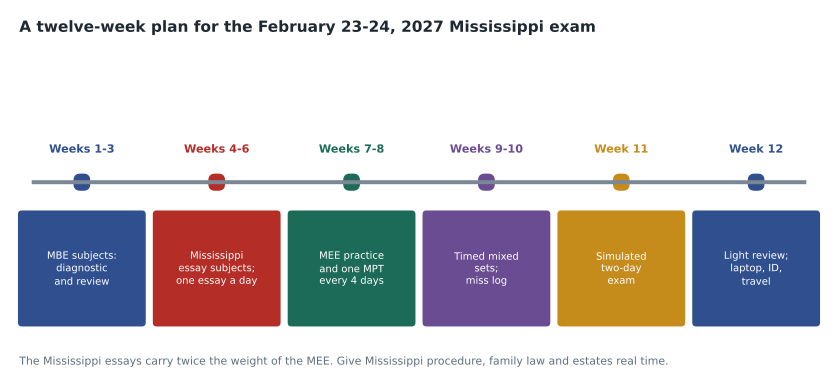
The plan reflects the weights. The Mississippi essays, at 30 percent, get a dedicated three-week block and continued practice afterward. The MPT, a single task worth 15 percent, gets regular practice because technique improves quickly. The MBE gets daily attention throughout, but not the lion's share of the time.
The day before
The day before the exam should be quiet. Tavaris plans to drive from Greenwood to the exam site the afternoon before, check in to his hotel, find the building and the parking, and lay out what he needs: his admission ticket, photo identification, the laptop registered under the Board's instructions with its charger, and only the items the Board allows. He will read the Board's instructions one more time, eat a normal dinner and stop studying by early evening.
Exam day one: the written day
Day one is long. Six Mississippi essays, six MEE questions and one 90-minute MPT task fill the day, in the order and sessions set out in the Board's schedule. Marchetti's rules for day one are simple. Before each essay, decide which law applies: Mississippi law on the Board's essays, general principles on the MEE, the library's law on the MPT. Spend about five minutes outlining each essay and the rest writing. Never leave an essay blank; a partial answer that names the right court and rule earns points. On the MPT, read the task memo first, then the library, then the file, and spend the first third of the time organizing before writing.
Between sessions, do not discuss answers with other candidates. Eat, drink water and reset. The essays you already wrote are finished; the next ones are what matter.
Exam day two: the MBE
Day two is the MBE: 100 questions in a three-hour morning session and 100 in a three-hour afternoon session, about 1.8 minutes per question. Tavaris plans to check his pace every 25 questions, mark and skip any question that takes more than three minutes and return to marked questions at the end. He will answer every question, since there is no penalty for wrong answers. On the MBE he will apply general principles, not Mississippi law.
After the exam
After the exam, the waiting begins. Tavaris will keep his character and fitness file current, respond to any Board requests promptly and keep a copy of everything. If he passes, he will take the oath, join the Mississippi Bar and start the new-lawyer CLE program. If he falls in the reappraisal band, he will wait for the second look. If he does not pass, he will review his scores, decide on the July exam and file the reexamination application by May 1.
Marchetti closed the session the way she closes every capstone. 'You will not know every answer. Nobody does. What you can control is whether you read each question carefully, decide which law it wants and write something organized for every issue you see. Do that for two days and the 132 takes care of itself.'
Common mistakes
MistakeA Tort Claims Act notice can be sent by regular mail to any city official.
InsteadIt must go to the city clerk for a municipality, in person or by registered or certified mail.
MistakeOn a Mississippi essay, the forum is a minor point.
InsteadNaming chancery or circuit court correctly is a frequent source of points.
MistakeThe day before the exam is best spent on a final full review.
InsteadLogistics and rest matter more; confirm the ticket, ID, laptop and route, and stop early.
MistakeBlank essays cost nothing if time runs out.
InsteadA partial answer that names the court and rule earns points; never leave an essay blank.
Summary and key terms
- Practice essays reward naming the Mississippi court, the Mississippi rule and its application, and noting where Mississippi differs from the general rule.
- Partition, injunctions and cotenant accountings belong in chancery court; Tort Claims Act claims require strict notice and are tried to the judge.
- Mississippi Rule 1.8(e)(2) advances and Rule 1.5(e) fee division are common ethics essay issues.
- A twelve-week plan gives the Mississippi essays a dedicated block, steady MPT practice and daily MBE work.
- On day one, decide which law each question wants; on day two, pace the MBE and answer every question.
- 0
- tenancy in common
- 1
- partition
- 2
- ouster
- 3
- accounting
- 4
- miss log
- 5
- pacing
- 6
- admission ticket
Practice problems
Work each problem on paper first, then reveal the answer to check.
Which court hears a partition action between cotenants of Mississippi land?
Show answer
Chancery court.
A Tort Claims Act claimant sent a letter by regular mail to the mayor. Is that proper notice?
Show answer
No. For a municipality it must go to the city clerk, in person or by registered or certified mail.
About how much time per question does the MBE allow?
Show answer
About 1.8 minutes.
When is the reexamination application due for the July exam?
Show answer
May 1.
Lesson quiz · 5 questions
Score 60% or more to complete this lesson.
Create a free account to save your progress, take quizzes and earn a certificate.