
BAR-225 · Lesson 6 of 12 · 21 min
The Mississippi essays and how Mississippi law appears
▶ Video coming soon A video version of this lesson is on the way.
Tavaris wrote his first timed Mississippi practice essay on a Sunday afternoon at his kitchen table. The question involved a husband and wife in Grenada County, a disputed farm and a will found in a desk drawer. He wrote for thirty minutes and felt good about it. When Hollis Marchetti returned it with comments on Tuesday, the margin was full. 'Good analysis of equitable distribution,' she had written, 'but you used the general rule for the will. Mississippi recognizes holographic wills, so the handwritten document may be valid. And you never said which court hears this. That is a chancery case, and a Mississippi grader expects you to say so.'
'I wrote it like an MEE answer,' Tavaris admitted. Marchetti nodded. 'That is the most common mistake on the Mississippi essays. The MEE wants general principles. The Mississippi essays want Mississippi law wherever it differs. Those six essays are worth 30 percent of your score, so learning to switch between the two is one of the most valuable things you can do between now and February.'
This lesson explains what the Mississippi essays cover, how they differ from the MEE, how Mississippi law shows up in an answer, and a method for writing a strong Mississippi essay under time pressure.
The six essays and their weight
On the first day of the exam, candidates write six essays prepared by the Mississippi Board of Bar Examiners. The Rules Governing Admission set their weight at 30 percent of the combined score, twice the 15 percent weight of the six MEE questions. Like the MEE and MPT, the Mississippi essay answers are graded by Mississippi graders, and the raw scores are scaled to the 200-point MBE scale before the weights are applied.
Because the Board writes these questions itself, they are the one part of the exam that tests Mississippi law directly. The MBE, MEE and MPT are national. That makes the Mississippi essays the jurisdiction-specific component of the Mississippi exam, and the part of the exam where knowing Mississippi law pays off most.
What the Mississippi essays can cover
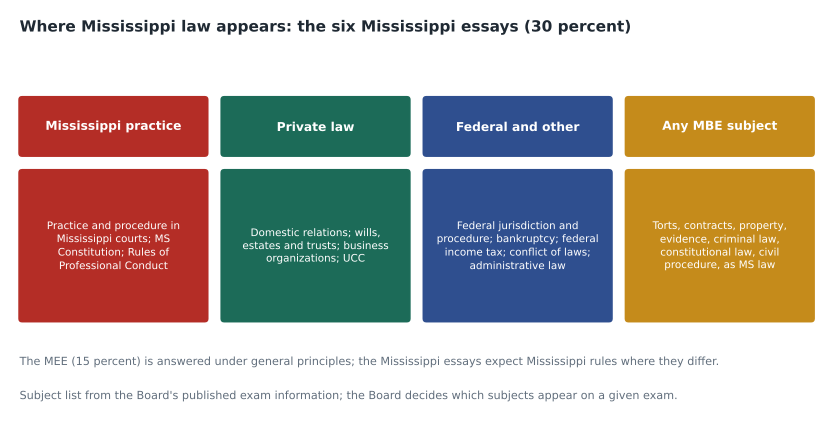
The Board's published exam information lists the subjects that may be tested on the Mississippi essays. The list is broad. It includes administrative law, bankruptcy, business organizations, conflict of laws, domestic relations, federal income taxation, federal jurisdiction and procedure, Mississippi constitutional law, practice and procedure in Mississippi courts, professional conduct and ethics, the Uniform Commercial Code, and wills, estates, trusts and future interests. It also includes every MBE subject: civil procedure, constitutional law, contracts, criminal law and procedure, evidence, real property and torts.
No exam can test all of these at once, and the Board decides which subjects appear on a given exam. Candidates should read the Board's current instructions for the administration they are taking, since the Board's materials are the only authoritative statement of what may be tested. Bar review courses and past candidates may describe which subjects seem to appear often, but those patterns are not promises.
The MEE and the Mississippi essays side by side
The two essay components look similar but call for different answers. An MEE question is written by NCBE for use in many jurisdictions. Its model answers rely on general principles: the majority rule, the Restatements, the Uniform Commercial Code, the Federal Rules of Civil Procedure and the Federal Rules of Evidence. When state law varies, MEE analyses often note that jurisdictions differ and then apply the majority approach.
A Mississippi essay is written for Mississippi candidates. The grader expects the Mississippi rule where Mississippi has one. That means pure comparative fault rather than a modified system, chancery court jurisdiction over divorce and estates, the twelve statutory grounds and irreconcilable differences for divorce, the Mississippi Tort Claims Act's notice requirements, the statutory caps on noneconomic damages and the Mississippi Rules of Professional Conduct, not the Model Rules.
| Feature | MEE | Mississippi essay |
|---|---|---|
| Author | NCBE | Mississippi Board of Bar Examiners |
| Law applied | General principles and majority rules | Mississippi law where it differs |
| Weight | 15 percent (six questions) | 30 percent (six questions) |
| Procedure | Federal Rules and general practice | Mississippi Rules of Civil Procedure and Mississippi courts |
| Ethics | ABA Model Rules | Mississippi Rules of Professional Conduct |
| Typical extra credit | Noting the majority and minority rule | Naming the right Mississippi court and statute |
How Mississippi law shows up in an answer
Mississippi law tends to appear in a few recognizable ways. Some questions turn on a Mississippi rule that differs from the majority, such as pure comparative fault, holographic wills or the Rule 1.8(e) allowance for limited living expense advances. Some turn on Mississippi's court structure, especially the division between chancery and circuit courts. Some test a Mississippi statute with deadlines, such as the Tort Claims Act's notice and limitations periods or the medical malpractice notice requirement. And some test a multifactor test the Mississippi Supreme Court uses, such as the Albright factors for child custody, the Ferguson factors for equitable distribution and the Armstrong factors for alimony.
Graders reward candidates who identify the Mississippi rule, state it accurately and apply it to the facts. They do not expect citations to case reporters, but naming a statute or a factor test by its common name shows command of the subject. 'Under Section 11-7-15, Mississippi follows pure comparative negligence' is stronger than 'Some states follow pure comparative negligence.'
A method for the Mississippi essay
Marchetti teaches a five-step method for each Mississippi essay. First, read the call of the question before the facts, so that you know what you are looking for. Second, identify the forum. If the question involves divorce, an estate, a minor's business, an equitable remedy or land title, ask whether chancery court is the right court; if it involves damages and a jury, circuit court. Third, list the issues and, for each, ask whether Mississippi has a distinctive rule. Fourth, write each issue in a short paragraph: the issue, the Mississippi rule, the application to the facts and a conclusion. Fifth, if a Mississippi rule differs from the general rule in a way that changes the outcome, say so in one sentence. That shows the grader you know both.
Time is tight. With six Mississippi essays, six MEE questions and a 90-minute MPT on the same day, candidates have roughly thirty minutes per essay. Spending five minutes outlining and twenty-five writing is a reasonable split. An answer that addresses every issue briefly scores better than one that develops two issues beautifully and misses a third.
Worked problem
Spotting the Mississippi issues
A Mississippi essay describes a woman injured when a Lee County road department truck backed into her car. She was speeding and 30 percent at fault. She sent a letter to the county board ten months after the accident and filed suit in circuit court five weeks later, asking a jury for 700,000 dollars.
Show solution
- Identify the governing statute: a claim against a county for an employee's negligence falls under the Mississippi Tort Claims Act.
- Timing and recipient: she had to give written notice, to the chancery clerk for a county, at least 90 days before suing. Filing suit five weeks after notice is premature.
- Limitations: the one-year period was tolled by the notice; she must wait for the denial or the end of the 95-day tolling period and then has 90 days to file.
- Fault: under pure comparative negligence, her 30 percent fault reduces her recovery by 30 percent but does not bar it.
- Damages and trial: the Act caps recovery at 500,000 dollars, bars punitive damages and calls for a bench trial, not a jury.
Answer: A strong answer names the Act, flags the premature filing, applies pure comparative fault and notes the cap and the bench trial.
Preparing for the Mississippi essays
Preparation for the Mississippi essays starts with a list of Mississippi rules that differ from the general rule. Lessons 7 through 10 provide the core of that list: court structure and procedure, torts and damages, family law and estates, and professional conduct. Candidates should add the Board's other listed subjects as time allows, giving priority to areas where Mississippi law differs from the national rule and to areas that overlap with the MBE and MEE.
The second step is practice under time. Writing a Mississippi essay in thirty minutes and then comparing it to a model answer, or having a coach or study partner review it, builds the habit of switching into Mississippi mode. Candidates who practice only MEE questions will default to general principles on the exam. Candidates should use any study materials the Board itself publishes and avoid relying on unverified collections of questions passed around online.
Mississippi law on the other components
The MBE, the MEE and the MPT do not test Mississippi law, and candidates should not bring Mississippi rules into them. On the MBE, answer under the general principles NCBE uses. On the MEE, answer under the majority rule unless the question says otherwise. On the MPT, use the law in the library provided, which may be from a fictional jurisdiction. Mixing Mississippi rules into these components is as costly as forgetting them on the Mississippi essays.
Tavaris began labeling each practice question with a colored dot: blue for national, red for Mississippi. 'It sounds childish,' he said, 'but the first thing I do now is ask which law the question wants.' Marchetti approved. 'That single question will save you more points than any outline.'
A note on Mississippi sources
Candidates sometimes ask which Mississippi sources to study. The Mississippi Code, the Mississippi Constitution of 1890, the Mississippi Rules of Civil Procedure, the Mississippi Rules of Evidence and the Mississippi Rules of Professional Conduct are the main ones. Mississippi Supreme Court decisions supply the multifactor tests in family law and the interpretation of the tort statutes. A good Mississippi outline organizes these by subject and highlights where Mississippi departs from the general rule. Candidates do not need to memorize section numbers, but knowing the common names of the key statutes and tests helps answers read with authority.
Common mistakes
MistakeA Mississippi essay should be answered like an MEE question, with general principles.
InsteadMississippi essays expect Mississippi law wherever it differs from the general rule.
MistakeThe forum does not matter on an essay.
InsteadMississippi graders expect candidates to identify whether chancery or circuit court hears the case.
MistakeMississippi rules should be used on the MBE and MEE too.
InsteadThe MBE and MEE use general principles; Mississippi law belongs on the Mississippi essays.
MistakeCandidates must cite Mississippi cases by reporter.
InsteadGraders reward accurate rules and analysis; naming a statute or factor test helps, but reporter citations are not expected.
A sample paragraph, two ways
Marchetti likes to show candidates the same paragraph written two ways. Suppose a Mississippi essay asks whether a plaintiff who was 55 percent at fault can recover. An MEE-style paragraph might read: 'Most jurisdictions follow modified comparative negligence, under which a plaintiff who is more at fault than the defendant recovers nothing. Here, the plaintiff was 55 percent at fault, so she likely recovers nothing.' On an MEE question that applies the majority rule, that is a fine answer.
A Mississippi-style paragraph reads differently: 'Mississippi follows pure comparative negligence under Section 11-7-15. A plaintiff's negligence does not bar recovery but reduces damages in proportion to her fault. Here, the plaintiff was 55 percent at fault, so she recovers 45 percent of her damages. Under the modified rule used in many states she would recover nothing, but that rule does not apply in Mississippi.' The second version names the Mississippi rule, applies it, and shows awareness of the contrast in one sentence. It earns the points the Board is testing.
Building a Mississippi rules sheet
Candidates who do well on the Mississippi essays usually build a rules sheet of their own: a few pages listing every Mississippi rule that differs from the general rule, organized by subject, each with a one-line statement and a short example. The act of writing the sheet is half the value, since it forces the candidate to decide exactly what the rule is. In the last weeks, the sheet becomes the main review tool for the Mississippi essays.
A good sheet for this course would include, at a minimum: chancery jurisdiction under Section 159 and the transfer provisions in Sections 157 and 162; Rule 81 summons in chancery matters; the limitations periods for negligence, intentional torts and medical malpractice; pure comparative fault and several liability; the noneconomic damages caps; the Tort Claims Act's notice, limitations, tolling, cap and bench trial; the divorce grounds, irreconcilable differences and the Ferguson, Armstrong and Albright tests; holographic wills and spousal renunciation; and Mississippi Rules 1.5(e), 1.8(e), 6.1 and 7.2.
Practicing with feedback
Writing essays without feedback improves speed but not necessarily quality. Candidates should arrange some form of review: a bar course with graded essays, a study partner who trades answers, a mentor at the office or a coach. Tavaris traded one essay a week with a classmate who was taking the exam in February as well. Each read the other's answer against a model, marked missed issues in one color and misstated rules in another, and returned it within a day.
Self-review works too, if it is honest. After writing an essay, compare it against a model answer issue by issue. For each missed issue, ask whether it was a knowledge gap, a reading error or a time problem. Knowledge gaps go on the rules sheet. Reading errors call for slower reading of the call of the question. Time problems call for shorter outlines and tighter paragraphs.
Balancing the two essay components
Because the MEE and the Mississippi essays are written on the same day and overlap in subject matter, candidates sometimes worry about mixing them up. The key is to treat the source of the question as the first fact. The Board's instructions and the exam booklets identify which questions are Mississippi essays and which are MEE questions. Once the candidate knows the source, the choice of law follows. If a candidate is unsure in the moment, a short sentence noting both rules is safer than silently choosing the wrong one.
Summary and key terms
- Six Mississippi essays written by the Board count for 30 percent of the combined score and are the exam's jurisdiction-specific component.
- Listed subjects include Mississippi practice and procedure, the Mississippi Constitution, professional conduct, domestic relations, wills and estates, business organizations, the UCC, federal topics and all MBE subjects.
- The MEE uses general principles; the Mississippi essays expect Mississippi rules where they differ.
- Mississippi law often appears through distinctive rules, the chancery and circuit court division, statutory deadlines and multifactor tests.
- A five-step method: read the call, identify the forum, list issues and Mississippi rules, write short issue paragraphs, and note where Mississippi differs.
- 0
- Mississippi essays
- 1
- jurisdiction-specific component
- 2
- general principles
- 3
- chancery court
- 4
- Albright factors
- 5
- Ferguson factors
- 6
- Armstrong factors
Practice problems
Work each problem on paper first, then reveal the answer to check.
What weight do the Mississippi essays carry compared with the MEE?
Show answer
Thirty percent, twice the 15 percent of the MEE.
On a Mississippi essay about a divorce, which court should you identify?
Show answer
Chancery court, which has constitutional jurisdiction over divorce and alimony.
Should a candidate use Mississippi law on the MEE?
Show answer
No. The MEE uses general principles; Mississippi law belongs on the Mississippi essays.
Name two Mississippi multifactor tests that may appear in a family law essay.
Show answer
The Albright factors for custody and the Ferguson factors for equitable distribution; the Armstrong factors for alimony are a third.
Lesson quiz · 5 questions
Score 60% or more to complete this lesson.
Create a free account to save your progress, take quizzes and earn a certificate.