
BAR-225 · Lesson 4 of 12 · 20 min
The Mississippi bar exam: format, scoring and the 132 passing score
▶ Video coming soon A video version of this lesson is on the way.
Tavaris brought a sheet of numbers to his fourth session. A friend in Memphis had told him that a 270 was a good UBE score, another friend had mentioned a 266 in Alabama, and a bar review ad promised to help him 'beat the 132.' He had written all three numbers at the top of the page with a question mark. 'I know Mississippi is 132,' he said. 'I do not know what it is 132 of, or how the essays turn into that number.'
Hollis Marchetti drew a horizontal line. 'Start with the scale. The UBE reports scores on a 400-point scale, so 266 and 270 are UBE numbers. Mississippi uses the MBE's own 200-point scale. The Board converts every written score onto that scale and then combines four components with fixed weights. A total of 132 passes. If you land between 129 and 131.9, your papers get a second look. Once you see where the points come from, you can decide where your study time pays off.'
This lesson explains the two days of the exam, the weight of each component, how written answers become scaled scores, the passing score and the reappraisal band. It closes with what the numbers mean for study planning.
The two days
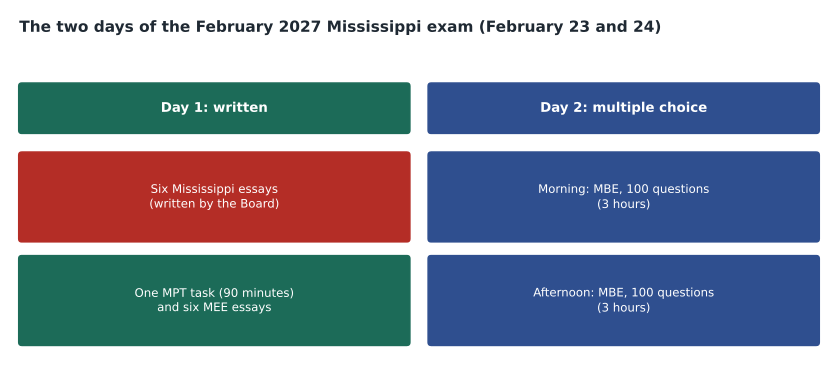
The Mississippi exam is a two-day test given in late February and late July. For February 2027 the dates are Tuesday, February 23, and Wednesday, February 24. The first day is the written day. Candidates write six Mississippi essays drafted by the Board of Bar Examiners, six Multistate Essay Examination questions and one Multistate Performance Test task of 90 minutes. The second day is the Multistate Bar Examination: 200 multiple-choice questions, 100 in a three-hour morning session and 100 in a three-hour afternoon session.
The Board publishes the schedule, the order of sessions on day one and the rules about laptops, admission tickets and permitted items in its instructions for each administration. Candidates should read that schedule closely, because the order of the Mississippi essays, the MEE and the MPT within the first day can differ from what classmates in other states describe.
The four components and their weights
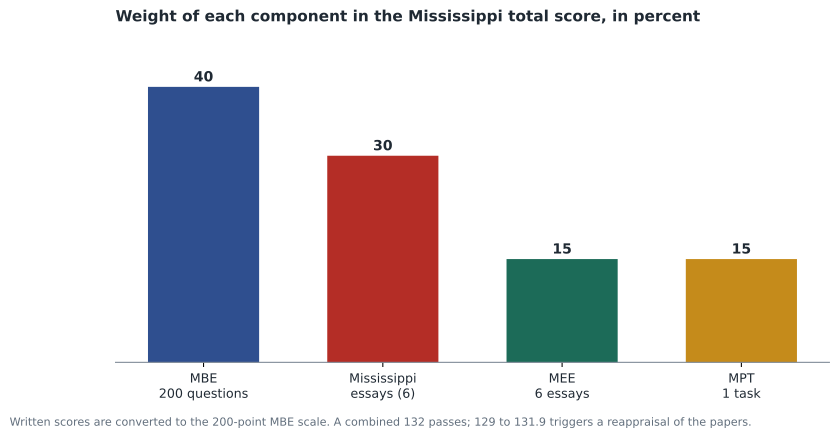
The Rules Governing Admission set the weight of each component. The Mississippi essays count for 30 percent of the total. The MEE counts for 15 percent and the MPT for 15 percent. The MBE scaled score counts for 40 percent. NCBE's summary groups the Mississippi essays and the MEE together as 45 percent of the score, which is the same thing described differently.
The weighting has a direct consequence. The six Mississippi essays carry twice the weight of the six MEE questions, and as much as the MEE and MPT combined. The single 90-minute MPT task is worth 15 percent on its own, as much as all six MEE essays. And the MBE, while still the largest single component at 40 percent, carries less weight in Mississippi than in UBE states, where it is 50 percent.
| Component | What it is | Time | Weight |
|---|---|---|---|
| Mississippi essays | Six essays written by the Board on Mississippi and general law | Day 1 | 30 percent |
| MEE | Six NCBE essays on general principles | Day 1 | 15 percent |
| MPT | One 90-minute performance task with a file and library | Day 1 | 15 percent |
| MBE | 200 multiple-choice questions in seven subjects | Day 2, six hours | 40 percent |
From raw answers to scaled scores
The MBE produces a scaled score directly from NCBE. Raw correct answers are converted through a statistical process called equating, which adjusts for differences in difficulty between exam forms, so that a given scaled score means the same level of performance whatever exam a candidate took. MBE scaled scores typically fall between about 100 and 180. The national mean for July exams has generally been around 140 in recent years, and February means, with more repeat takers, run several points lower.
The written components are graded by Mississippi graders. Each Mississippi essay, MEE answer and MPT answer receives a raw grade. The Board then converts the written raw scores to the 200-point MBE scale, a process called scaling. Scaling lines up the distribution of written scores with the distribution of the same group's MBE scores, so that a strong written performance relative to the group earns a high scaled written score. Under the Rules, essay and performance answers are converted to the 0 to 200 scale before the weights are applied. NCBE's summary describes the same thing: written components are scaled to the MBE.
Scaling has an important practical effect. A candidate's written score depends on how well the candidate wrote compared with everyone else who sat for that exam in Mississippi. There is no fixed number of raw points that guarantees a passing written score. That is why graders' comments about organization, issue spotting and use of rules matter: they are what separate answers within the group.
The combined score and the 132 standard
Once each component is on the 200-point scale, the Board applies the weights. The combined score is 40 percent of the MBE scaled score, plus 30 percent of the scaled Mississippi essay score, plus 15 percent each of the scaled MEE and MPT scores. A combined score of 132 or higher passes.
Worked problem
Computing a combined score
A candidate earns an MBE scaled score of 128. Her scaled scores on the written components are 140 for the Mississippi essays, 130 for the MEE and 134 for the MPT. Does she pass?
Show solution
- MBE: 0.40 times 128 = 51.2.
- Mississippi essays: 0.30 times 140 = 42.0.
- MEE: 0.15 times 130 = 19.5.
- MPT: 0.15 times 134 = 20.1.
- Total: 51.2 + 42.0 + 19.5 + 20.1 = 132.8.
Answer: She passes with 132.8, even with an MBE score below 132, because her Mississippi essays were strong.
The example shows why the Mississippi essays matter so much. A candidate who is weak on multiple choice can pass on the strength of the state essays, and a candidate who is strong on the MBE can fail by neglecting them. Each point on the scaled Mississippi essay score is worth 0.3 points in the total; each point on the MEE is worth only 0.15.
The reappraisal band
Mississippi builds in a second look for close cases. Under the Rules, an applicant whose combined score falls between 129 and 131.9 receives an individual reappraisal of the written work. The papers are reviewed again before results are final. Reappraisal is not an appeal and does not guarantee a change, but it reflects the Board's recognition that grading has some imprecision near the line.
Candidates should not plan around reappraisal. It applies only to a narrow band, and a candidate below 129 does not receive it. The point is that every written point counts: the difference between 128.9 and 129 decides whether a second look happens at all.
| Combined score | Result |
|---|---|
| 132 or higher | Pass |
| 129 to 131.9 | Individual reappraisal of the written answers before results are final |
| Below 129 | Fail; may apply for reexamination (subject to the four-failure limit) |
How 132 compares
Comparisons across states are tricky because Mississippi does not use the UBE. A rough comparison doubles the Mississippi score to put it on a 400-point scale: 132 on a 200-point scale corresponds to 264 on a 400-point scale. That would put Mississippi's standard among the lower UBE cut scores, below the 266 or 270 used in many states. But the comparison is imperfect, because Mississippi's components and weights differ from the UBE's, and its written scores are scaled within its own pool of candidates.
The more useful point for a candidate is that 132 sits a little below typical national MBE averages for July and close to them for February. A candidate who performs at roughly the national average across all components should pass. A candidate who is below average on multiple choice needs above-average written work, and especially strong Mississippi essays, to make up the difference.
MBE score transfer into Mississippi
A candidate who has taken the MBE recently, in Mississippi or elsewhere, may ask to use that scaled score instead of taking the MBE again. Under the Rules, the prior MBE must have been taken within the 20 months before the Mississippi exam, and the applicant must petition the Board at least 30 days before the exam, using the Board's authorization form so the Board can verify the score with NCBE. The candidate then sits only for the written day. Lesson 11 covers transfer in both directions in more detail.
What the numbers mean for study
Marchetti finished by turning the weights into hours. 'If you have 400 study hours between now and February, do not give 250 of them to the MBE because that is what national courses do. The MBE is 40 percent here. The Mississippi essays are 30 percent and test Mississippi law you will not find in a national outline. The MPT is a single task worth 15 percent, and two hours of practice on MPT technique can raise that score quickly. The MEE is 15 percent and overlaps heavily with the MBE subjects you are already studying.'
Tavaris redrew his plan. He kept MBE practice every day but cut its share of his time from about two thirds to about 45 percent. He set aside a block for Mississippi-specific law, organized around the Board's list of essay subjects, and scheduled one practice MPT every four days. 'I was about to spend most of my time on the part of the exam that counts the least relative to how much national courses push it,' he said.
Common mistakes
MistakeMississippi's 132 is a UBE score.
InsteadIt is on the 200-point MBE scale; the UBE uses a 400-point scale.
MistakeThe MEE is the main essay component.
InsteadThe six Mississippi essays carry 30 percent, twice the 15 percent weight of the MEE.
MistakeA candidate needs a 132 on the MBE to pass.
InsteadThe 132 is a combined weighted score; a strong written score can offset a lower MBE.
MistakeEvery failing candidate gets a reappraisal.
InsteadOnly combined scores from 129 to 131.9 are reappraised.
What graders reward on the written components
Because the written scores are scaled within the group, a candidate gains most by doing the things that separate a good answer from an average one. Graders consistently reward answers that are organized by issue, with headings or clear paragraph breaks; that state the rule accurately before applying it; that use the facts in the question rather than restating the rule in the abstract; and that reach a conclusion on each issue. They penalize answers that wander, that bury the analysis in long paragraphs of rule statements, or that miss an obvious issue.
On the Mississippi essays, graders also reward accuracy about Mississippi law. A candidate who writes that Mississippi uses pure comparative negligence under Section 11-7-15 and then applies it to the plaintiff's percentage of fault has shown both knowledge and analysis. A candidate who writes a general paragraph about comparative negligence without saying which form Mississippi uses has left points on the table.
MPT technique in one task
Mississippi gives one 90-minute MPT task, worth 15 percent, which makes it one of the most valuable single tasks on the exam. The MPT provides a file of facts, such as interview notes, letters and documents, and a library of legal authorities, such as cases and statutes, often from a fictional jurisdiction. The task memo tells the candidate what to write: a memo, a letter, a brief section, a contract provision or a similar document.
A reliable approach is to read the task memo first and note exactly what document is requested and for whom. Then read the library, extracting the rules and how the courts applied them. Then read the file, looking for facts that fit those rules. Spend roughly the first 35 to 40 minutes reading and organizing and the remaining time writing. Follow any format instructions in the memo exactly. Use only the law in the library, even if Mississippi law would answer the question differently.
MBE pacing and strategy
The MBE gives 100 questions in each three-hour session, so the average is 1.8 minutes per question. The seven subjects are civil procedure, constitutional law, contracts, criminal law and procedure, evidence, real property and torts. A small number of questions are unscored pretest questions mixed in with the scored ones, and candidates cannot tell which they are, so every question deserves full effort.
Strong MBE performance comes from practice with real-style questions, careful review of every wrong answer and a miss log that tracks recurring errors by rule. Candidates who simply read outlines improve slowly; candidates who work through thousands of questions and learn why each wrong option is wrong improve quickly. In Mississippi each point on the MBE scaled score is worth 0.4 points in the total, a little more than a point on the scaled Mississippi essay score at 0.3. The case for extra time on the Mississippi essays is not that each point is worth more, but that they test Mississippi law national courses leave out, so the gains there come faster.
Results and what to do with them
After results are released, a candidate who did not pass should study whatever score information the Board provides, component by component. A strong MBE score with weak Mississippi essays points to a gap in Mississippi law or essay technique; a weak MBE with solid written scores points to multiple-choice practice. Candidates who did not pass can apply to retake by the reexamination deadline, November 1 for February or May 1 for July, keeping in mind the four-failure limit.
A candidate who passed with a recent MBE score may also want to know how that score could be used elsewhere. Some states accept MBE scores earned in another jurisdiction toward their own exams, under their own time limits and minimums. That is the only portable part of a Mississippi result under the current format, which is one reason the move to NextGen may matter to future candidates.
Summary and key terms
- Day one has six Mississippi essays, six MEE questions and one 90-minute MPT task; day two is the 200-question MBE.
- Weights: MBE 40 percent, Mississippi essays 30 percent, MEE 15 percent, MPT 15 percent.
- Written scores are scaled to the 200-point MBE scale before the weights are applied.
- A combined score of 132 passes; scores from 129 to 131.9 receive an individual reappraisal.
- A prior MBE score from the previous 20 months may be used on petition at least 30 days before the exam.
- 0
- MBE
- 1
- MEE
- 2
- MPT
- 3
- Mississippi essays
- 4
- scaling
- 5
- equating
- 6
- combined score
- 7
- reappraisal
Practice problems
Work each problem on paper first, then reveal the answer to check.
What weight do the six Mississippi essays carry?
Show answer
30 percent of the combined score.
A candidate's combined score is 130.4. What happens?
Show answer
The written answers receive an individual reappraisal before results are final.
Why might a candidate with an MBE scaled score of 126 still pass?
Show answer
Because the combined score includes heavily weighted written components; strong Mississippi essays, MEE and MPT scores can lift the total to 132.
How long is the single MPT task on the Mississippi exam?
Show answer
90 minutes.
Lesson quiz · 5 questions
Score 60% or more to complete this lesson.
Create a free account to save your progress, take quizzes and earn a certificate.