
BAR-236 · Lesson 11 of 12 · 20 min
Score transfer, admission without examination and practice after admission in Ohio
▶ Video coming soon A video version of this lesson is on the way.
Hollis opened the eleventh session with a story from the study group. One member, a lawyer licensed in another UBE state, had asked whether she could move to Cincinnati without sitting again. Another, licensed for six years in a non-UBE state, had asked the same question. 'Different answers,' Hollis said. 'The first one may be able to transfer her score. The second one may qualify for admission without examination. And both of them will need to understand the same thing you do: what happens after the oath.'
This lesson covers Ohio's two main alternatives to sitting the exam, admission by transferred score and admission without examination, the narrower permissions Ohio grants to lawyers and students who are not fully admitted, and the obligations of a newly admitted Ohio lawyer: the ceremony, attorney registration, continuing legal education and New Lawyers Training.
Admission by transferred UBE score
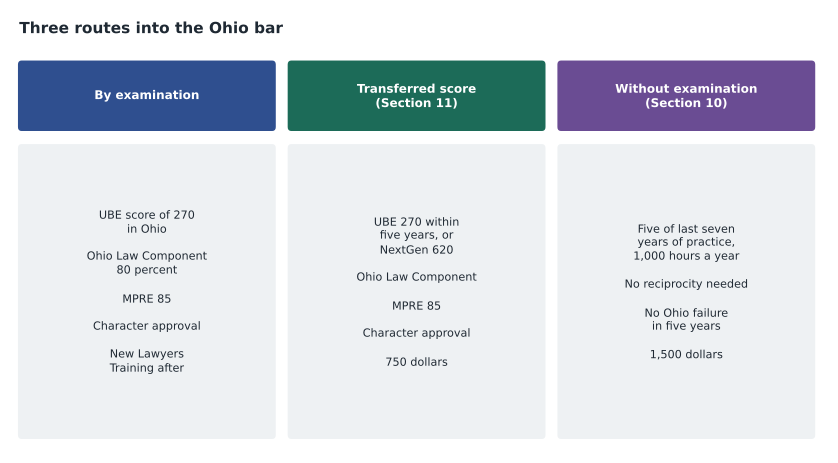
Section 11 of Gov.Bar.R. I allows an applicant to be admitted in Ohio on the basis of a Uniform Bar Examination score earned in another UBE jurisdiction. The requirements, as the Court's application materials describe them, are these. The applicant must have a UBE score of 270 or higher, from an administration within five years of the date of her Ohio application. She must have an MPRE score of 85 or higher. She must pass the Ohio Law Component with 80 percent or higher. And she must satisfy Ohio's character and fitness requirements.
The character process for transfer applicants mirrors the process for exam applicants. NCBE conducts a background investigation after a complete application is received, a local bar association conducts a personal interview, and the admissions committee makes a recommendation to the Board of Commissioners on Character and Fitness, which must approve the applicant. An adverse recommendation can be appealed to the Board. Transfer applicants, like exam applicants, have a continuing duty to report changes while the application is pending.
The Court's fee for an application for admission by UBE transfer score is 750 dollars, nonrefundable, with NCBE's investigation fees paid separately. A foreign education evaluation, if needed, costs 150 dollars, and a petition for waiver of a rule provision costs 30 dollars. NCBE's summary of Ohio's rules indicates that concurrent applications are permitted, so an applicant can apply in Ohio while her application elsewhere is pending, and that Ohio does not accept transferred MBE scores standing alone: only a full UBE score transfers.
Since November 1, 2026, Ohio has also accepted transferred NextGen scores of 620 or higher. A NextGen applicant from another jurisdiction must meet the same MPRE and character requirements. NCBE's summary lists Ohio's NextGen-era jurisdiction-specific requirement as to be announced, so a NextGen transfer applicant should confirm with the Office which Ohio component she must complete.
Transfer applicants who are already admitted and in good standing in another jurisdiction may also apply for practice pending admission, which allows them to begin practicing in Ohio, under the conditions the rule sets, while the transfer application is processed. The application for practice pending admission is filed through the Bar Admissions Portal after the transfer application.
Admission without examination
Section 10 of Gov.Bar.R. I allows experienced lawyers admitted in another United States jurisdiction to be admitted in Ohio without sitting the exam. The core requirement is practice: the applicant must have been primarily engaged in the active practice of law for at least five full years out of the last seven before applying. Ohio measures being primarily engaged by hours, with a benchmark of at least 1,000 hours of practice per year. The seven-year window is the result of amendments effective April 1, 2024; before then, the rule required five of the last ten years. The Court's description of the amendments also states that out-of-state lawyers who practiced part-time may now qualify, and an applicant whose practice was part-time should review the current rule's hour requirements carefully.
Qualifying practice is defined broadly. It includes private practice, service as in-house corporate counsel, work for a government agency, military service as a lawyer, law teaching at an accredited law school, and service as a judge or judicial law clerk in a court of record. Since the 2024 amendments, full-time judicial law clerks admitted in another jurisdiction are treated as engaged in active practice. Practice in a jurisdiction where the applicant was not admitted counts only if a rule or statute of that jurisdiction affirmatively permitted it; the Court's materials state that advisory opinions are not enough. Admission to practice in a foreign country, and practice abroad, do not count.
The other requirements are familiar. The applicant must have a bachelor's degree and a law degree from a school accredited by an agency the United States Department of Education recognizes; foreign-educated lawyers need the same 30 credit hours at an ABA-approved school within 48 months that exam applicants need. She must be admitted to the highest court of another jurisdiction and in good standing in every jurisdiction where she is licensed, with certificates dated within 60 days of filing. She must not have taken and failed an Ohio bar examination within the past five years. She files a certificate of presentation from an Ohio lawyer in good standing, an applicant's affidavit, and affidavits of employment covering everything she has done since her first admission. She completes the NCBE character questionnaire, and the Office may refer her application to a local bar association for an interview. The application fee is 1,500 dollars.
Ohio's rule is not based on reciprocity. Many states admit lawyers without examination only if the lawyer's home state would admit their lawyers on similar terms. Ohio does not impose that condition: a lawyer licensed in any state or territory can qualify if she meets the practice and other requirements.
Worked problem
Which route fits?
Two hypothetical lawyers want to move to Ohio in January 2027. Elowen Tolliver passed the UBE in a neighboring state in July 2023 with a score of 274 and has practiced there since. Rodrigo Saltonstall was admitted in a non-UBE state in 2018 after that state's own exam and has practiced full-time ever since. Neither has sat the Ohio exam. Which route should each use?
Show solution
- Elowen's 274 is above Ohio's 270 and was earned within five years of a January 2027 application, so she can transfer it under Section 11. She also needs an MPRE score of 85, the Ohio Law Component and character approval.
- Elowen has practiced only about three and a half years, short of the five years Section 10 requires, so admission without examination is not yet available to her.
- Rodrigo has no UBE score to transfer. He has practiced full-time for more than five of the last seven years, has never failed the Ohio exam, and Ohio does not require reciprocity, so he can apply without examination under Section 10.
- Each must complete NCBE's character questionnaire and receive approval; Rodrigo's 1,500 dollar fee is double Elowen's 750 dollars.
Answer: Elowen should transfer her UBE score under Section 11, including the Ohio Law Component. Rodrigo should apply for admission without examination under Section 10. Elowen could switch to Section 10 later, but by then her score would have aged out of the five-year window.
Narrower permissions
Ohio grants several forms of permission short of full admission. Law students can obtain a legal intern certificate, for a fee of 25 dollars, allowing them to perform certain legal services under the supervision of a licensed lawyer, for example in a law school clinic or a prosecutor's or public defender's office. Lawyers admitted elsewhere who work in specified roles in Ohio can apply for temporary certification, for a fee of 300 dollars, under the conditions the Court's rules set. In-house lawyers admitted in another jurisdiction who work for an Ohio employer can register as corporate counsel under Gov.Bar.R. VI, limiting their practice to their employer. Foreign lawyers can be certified as foreign legal consultants to advise on the law of their home country. And lawyers from other states can seek permission to appear in a particular Ohio case pro hac vice under the Court's rules.
The ceremony and the oath
Ohio admits most new lawyers at a ceremony after each exam's results. For the July 2026 exam, the Court scheduled its admission ceremony for Monday, November 16, 2026, at the Palace Theater in Columbus, with morning and afternoon sessions. Eligibility for the ceremony is confirmed by the applicant's result letter in the Bar Admissions Portal, and requires a passing bar exam score, an MPRE score of 85 or higher and an Ohio Law Component score of 80 percent or higher, along with final character approval.
The oath of office must be administered by a state or federal court judge, and it can be done remotely by videoconference. An admittee who cannot attend the ceremony may take the oath afterward, but not before the ceremony date, and must then pay 30 dollars for a replacement wall certificate. An applicant who passes but is not admitted within twelve months of the exam must file a supplemental character questionnaire and obtain a reissued approval, as Lesson 3 explained.
Attorney registration
Taking the oath does not by itself allow a new lawyer to practice. Under Gov.Bar.R. VI, she must also complete attorney registration with the Supreme Court's Office of Attorney Services, and the Court's ceremony materials state that registration must be completed within 30 days of the admission date. A lawyer may practice only after she has been sworn in and has registered. Registration is then renewed every two years, with a fee, a portion of which funds the Lawyers' Fund for Client Protection. Registration is also how the Court keeps track of lawyers' addresses, employment and status, and failing to register leads to suspension.
Continuing legal education
Gov.Bar.R. X requires every active Ohio lawyer to complete at least 24 hours of approved continuing legal education in each two-year compliance period. At least 2.5 of those hours must be in professional conduct, which can include legal ethics, professionalism, and mental health or substance abuse issues, as well as related subjects such as access to justice and fairness in the courts. Compliance periods are assigned by the first letter of the lawyer's last name at admission: lawyers whose names begin with A through L must comply by December 31 of each odd-numbered year, and those whose names begin with M through Z by December 31 of each even-numbered year. A later name change does not change the group.
A lawyer who completes more than 24 hours on time may carry over up to 12 excess hours to the next period, as general hours. Since January 1, 2023, Ohio lawyers may meet their requirements with approved self-study courses. There are no extensions. A lawyer who is short on December 31 receives a notice of apparent noncompliance in mid-February and has 90 days to cure, with a late fee based on the hours missed; continued noncompliance can lead to monetary sanctions and suspension.
New Lawyers Training
Lawyers admitted by examination must complete 12 hours of New Lawyers Training during their first biennial compliance period, in place of the general requirement for that period. At least three of those hours must include one hour each of professionalism, law office management and client fund management. Some hours can be earned through the Supreme Court's Lawyer to Lawyer Mentoring Program, which pairs new lawyers with experienced mentors for a year. Lawyers admitted without examination are not required to complete New Lawyers Training, on the view that they bring years of practice with them.
Wesley's last name begins with B, so he will be in the A through L group, reporting in odd-numbered years. Hollis told him to ask the CLE section, once he was admitted, exactly when his first compliance period ends, and to sign up for the mentoring program in his first month. 'Client fund management is one of the required hours for a reason,' she said. 'Go back and reread Lesson 10's trust account rules the week you open your first IOLTA.'
| Obligation | Ohio rule |
|---|---|
| Attorney registration | Within 30 days of admission; renewed every two years (Gov.Bar.R. VI) |
| CLE | 24 hours every two years, including 2.5 professional conduct (Gov.Bar.R. X) |
| Compliance deadline | December 31 of odd years (A to L) or even years (M to Z) |
| Carryover | Up to 12 hours, as general hours |
| New Lawyers Training | 12 hours in the first period, including professionalism, law office management and client fund management |
| Noncompliance | A notice in mid-February, 90 days to cure, late fees; no extensions |
Common mistakes
MistakeAny passing UBE score transfers to Ohio.
InsteadOhio requires 270 or higher, within five years of the application, plus the Ohio Law Component.
MistakeAdmission without examination in Ohio requires reciprocity.
InsteadOhio's Section 10 is not based on reciprocity.
MistakeOhio requires five of the last ten years of practice.
InsteadSince April 1, 2024, the rule requires five of the last seven years.
MistakeA new lawyer can practice as soon as she takes the oath.
InsteadShe must also complete attorney registration, within 30 days of admission.
Practice problems
Work each problem on paper first, then reveal the answer to check.
What UBE score and age does Ohio require for a transfer?
Show answer
A score of 270 or higher, from an exam within five years of the Ohio application.
How many years of practice does Section 10 require?
Show answer
Five full years of the last seven, at least 1,000 hours a year.
How many CLE hours does Ohio require, and in what period?
Show answer
24 hours every two years, including 2.5 hours of professional conduct.
Who must complete New Lawyers Training?
Show answer
Lawyers admitted by examination, 12 hours in their first compliance period.
Summary and key terms
- Section 11 transfer: UBE 270 within five years (or NextGen 620 since November 2026), MPRE 85, Ohio Law Component, character approval, 750 dollars.
- Section 10 without examination: five of the last seven years at 1,000 hours a year, no reciprocity, no Ohio failure in five years, 1,500 dollars.
- Narrower permissions include legal intern certificates, temporary certification, corporate counsel registration, foreign legal consultants and pro hac vice.
- The oath is given by a judge after the ceremony date; registration with the Office of Attorney Services must follow within 30 days.
- CLE is 24 hours every two years with 2.5 in professional conduct; deadlines depend on the last name.
- New Lawyers Training: 12 hours in the first period for exam admittees, with required hours in professionalism, law office management and client fund management.
- transferred UBE score
- A UBE score from another jurisdiction used for admission in Ohio under Section 11.
- admission without examination
- Ohio admission under Section 10 based on years of practice elsewhere.
- practice pending admission
- Permission for a lawyer admitted elsewhere to practice in Ohio while her application is processed.
- attorney registration
- The registration every Ohio lawyer completes under Gov.Bar.R. VI after admission and every two years.
- New Lawyers Training
- Ohio's 12-hour CLE requirement for lawyers admitted by examination in their first compliance period.
Lesson quiz · 5 questions
Score 60% or more to complete this lesson.
Create a free account to save your progress, take quizzes and earn a certificate.