
BAR-236 · Lesson 8 of 12 · 21 min
Ohio torts: modified comparative fault, damages caps and political subdivision immunity
▶ Video coming soon A video version of this lesson is on the way.
This was the session Wesley had been looking forward to. He has spent six years valuing injury claims under Ohio law, and he arrived with a list of the rules he uses every week. Hollis let him lead. 'Tell me how you value a file,' she said. He walked through it: fault first, because a claimant more at fault than everyone else combined recovers nothing; then the split among defendants, because it decides who pays what; then the damages caps, because they limit what a jury can award for pain and suffering; and, when a city or county is involved, immunity, because it can end the claim entirely. 'That,' Hollis said, 'is the outline of this lesson.'
The UBE tests general tort principles: duty, breach, causation, damages, and the general idea of comparative negligence. Ohio's tort law departs from the general picture in four places this lesson covers: the modified comparative fault bar, the rules on joint and several liability, statutory caps on noneconomic and punitive damages, and the Political Subdivision Tort Liability Act.
Modified comparative fault
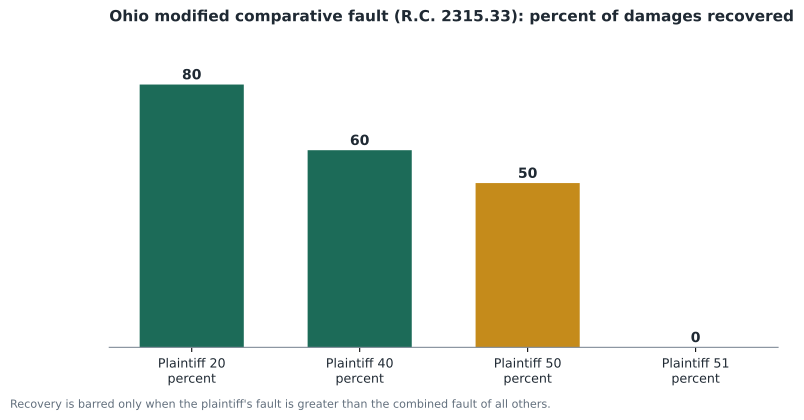
Ohio follows a modified comparative fault system set out in R.C. 2315.33. A plaintiff's own contributory fault does not bar recovery unless it is greater than the combined tortious conduct of all the other persons whose fault the trier of fact considers, including the defendants and others such as persons the plaintiff has released. If the plaintiff's fault is not greater, her recovery is reduced in proportion to her share. In practical terms, a plaintiff who is 50 percent at fault recovers half her damages, and a plaintiff who is 51 percent at fault recovers nothing.
The jury makes the findings. In a case with comparative fault, the trier of fact determines the total damages and the percentage of tortious conduct attributable to the plaintiff and to each other person, and the court then applies the statute. Ohio's system requires a comparison with the combined fault of everyone else, not with each defendant individually. A plaintiff who is 40 percent at fault can recover against two defendants found 30 percent each, even though she is more at fault than either of them.
Ohio's statute treats implied assumption of the risk as a form of contributory fault, so it reduces recovery rather than barring it. Two older doctrines survive as complete defenses. Express assumption of the risk, such as a valid signed release, can bar a claim. And primary assumption of the risk applies to the inherent risks of recreational and sporting activities: in Marchetti v. Kalish (1990), the Supreme Court of Ohio held that a participant in a recreational activity accepts its ordinary risks and can recover against another participant only for reckless or intentional conduct. 'No relation,' Hollis said, when Wesley looked up from the case name.
Joint and several liability
When more than one defendant is liable, R.C. 2307.22 decides how much each must pay. Ohio distinguishes between economic loss, such as medical bills and lost wages, and noneconomic loss, such as pain and suffering. A defendant found responsible for more than 50 percent of the tortious conduct is jointly and severally liable for all of the plaintiff's compensatory economic damages, so the plaintiff can collect the whole economic award from that defendant. A defendant responsible for 50 percent or less is liable only for her proportionate share of economic damages. For noneconomic damages, each defendant is liable only for her proportionate share, whatever her percentage. The statute contains exceptions, for example for certain intentional torts.
The distinction matters most when a defendant is uncollectible. Suppose the main defendant is insured and the other is not. If the insured defendant is more than 50 percent at fault, the plaintiff can recover all of her economic damages from that defendant, but she bears the loss of the uninsured defendant's share of noneconomic damages. If no defendant is more than 50 percent at fault, the plaintiff bears the loss of every uncollectible share.
Worked problem
Splitting a verdict
Ilona Kestler, a hypothetical plaintiff, is hurt in a three-car collision in Franklin County. The jury finds economic damages of 100,000 dollars and noneconomic damages of 50,000 dollars, and apportions fault: Ilona 20 percent, Edwina Fanshawe 60 percent and a delivery company 20 percent. The delivery company is insolvent. What can Ilona collect from Edwina?
Show solution
- Ilona's fault, 20 percent, is not greater than the combined 80 percent of the others, so she recovers, reduced by 20 percent: economic damages of 80,000 dollars and noneconomic damages of 40,000 dollars.
- Edwina is responsible for more than 50 percent of the tortious conduct, so she is jointly and severally liable for the full 80,000 dollars of economic damages.
- For noneconomic damages, each defendant pays only its proportionate share: Edwina owes 60 percent of 50,000, or 30,000 dollars; the delivery company owes 20 percent, or 10,000 dollars.
- The delivery company's insolvency shifts its economic share to Edwina but not its noneconomic share.
Answer: Ilona can collect 110,000 dollars from Edwina: all 80,000 dollars of economic damages and her 30,000 dollar share of noneconomic damages. The delivery company's 10,000 dollar noneconomic share is lost to her because the company is insolvent.
The noneconomic damages cap
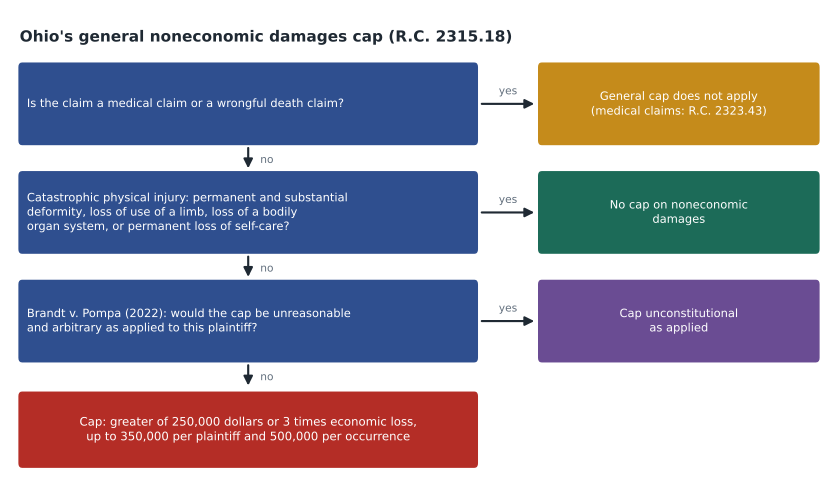
Ohio's general cap on noneconomic damages is in R.C. 2315.18, enacted as part of a 2005 tort reform package. In a tort action for injury to person or property, noneconomic damages are capped at the greater of 250,000 dollars or three times the plaintiff's economic loss, up to a maximum of 350,000 dollars for each plaintiff and 500,000 dollars for each occurrence. The cap does not apply where the plaintiff suffers a catastrophic physical injury: permanent and substantial physical deformity, loss of use of a limb, loss of a bodily organ system, or a permanent physical functional injury that permanently prevents the injured person from caring for herself and performing life-sustaining activities. The general cap does not apply to medical claims, which have their own caps, or to wrongful death claims.
In Arbino v. Johnson and Johnson (2007), the Supreme Court of Ohio upheld the noneconomic damages cap, and the cap on punitive damages, against a facial challenge under the Ohio Constitution, including the right to a jury trial and the guarantee of a remedy by due course of law. Fifteen years later, in Brandt v. Pompa (December 16, 2022), the Court held the noneconomic cap unconstitutional as applied to a plaintiff who had been sexually abused as a child and suffered severe, permanent psychological injuries. Because the catastrophic-injury exception covers only physical injuries, applying the cap to her limited her recovery to a small fraction of the jury's award. The Court concluded that, as applied to her, the cap was unreasonable and arbitrary and violated the due-course-of-law guarantee. Brandt did not strike the cap generally; it remains in force in ordinary cases, and its application to other severe non-physical injuries is a question Ohio lawyers continue to litigate.
Medical claims and punitive damages
Medical malpractice claims have their own cap in R.C. 2323.43. Noneconomic damages are generally limited to the greater of 250,000 dollars or three times economic loss, up to 350,000 dollars per plaintiff and 500,000 dollars per occurrence, with higher limits, 500,000 dollars per plaintiff and 1,000,000 dollars per occurrence, for catastrophic physical injuries of the kinds the statute lists. Economic damages are not capped.
Punitive damages are governed by R.C. 2315.21. They are available only on proof by clear and convincing evidence of actual malice, or of aggravated or egregious fraud, oppression or insult, and only if the plaintiff also recovers compensatory damages. On request, the trial is bifurcated so that the jury decides compensatory damages before it hears evidence relevant only to punitive damages. Punitive damages are capped at two times the compensatory damages awarded. For a defendant that is a small employer or an individual, the cap is the lesser of two times compensatory damages or 10 percent of the defendant's net worth, up to 350,000 dollars. Arbino upheld the punitive cap along with the noneconomic cap.
Ohio also has a distinctive rule on medical bills. In Robinson v. Bates (2006), the Supreme Court of Ohio held that both the amount originally billed for medical care and the amount accepted as full payment, after insurer write-offs, are admissible as evidence of the reasonable value of the care. Wesley said this was the most argued point in his settlement negotiations.
| Rule | Ohio statute or case | Effect |
|---|---|---|
| Modified comparative fault | R.C. 2315.33 | Bar if plaintiff's fault is greater than all others combined; otherwise reduced |
| Joint and several liability | R.C. 2307.22 | More than 50 percent: joint and several for economic loss; noneconomic always proportionate |
| General noneconomic cap | R.C. 2315.18; Arbino (2007); Brandt (2022) | 250,000 or 3 times economic, up to 350,000 / 500,000; no cap for catastrophic physical injury |
| Medical claims cap | R.C. 2323.43 | Same base; 500,000 / 1,000,000 for catastrophic injury |
| Punitive damages | R.C. 2315.21 | Clear and convincing proof; capped at 2 times compensatory |
| Recreational activity | Marchetti v. Kalish (1990) | Participant liable only for reckless or intentional conduct |
Suing cities, counties and school districts
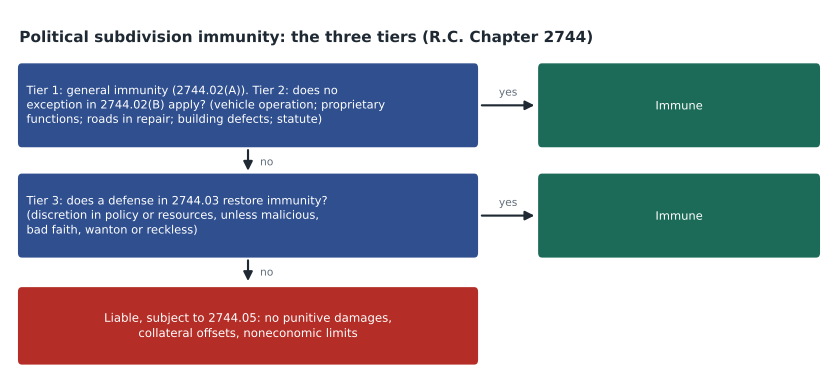
The Political Subdivision Tort Liability Act, R.C. Chapter 2744, governs tort claims against counties, cities, villages, townships, school districts and other political subdivisions. The State of Ohio itself is not covered; claims against the state go to the Court of Claims, as Lesson 7 explained. Ohio courts apply the Act through a three-tier analysis.
The first tier is the general grant of immunity. Under R.C. 2744.02(A), a political subdivision is not liable for injury caused by any act or omission of the subdivision or its employees in connection with a governmental or proprietary function. The Act defines the two kinds of function. Governmental functions include police, fire and emergency services, the provision of public schools, the regulation of roads and the operation of jails. Proprietary functions are those customarily engaged in by private persons, such as operating a public utility, a hospital in some cases, a cemetery or an off-street parking facility.
The second tier asks whether one of the exceptions in R.C. 2744.02(B) removes the immunity. There are five: negligent operation of a motor vehicle by an employee acting within the scope of employment; negligent performance of acts by employees with respect to proprietary functions; negligent failure to keep public roads in repair and to remove obstructions from them; negligence of employees that occurs within or on the grounds of buildings used in governmental functions and is due to physical defects there; and liability expressly imposed by another section of the Revised Code. The motor vehicle exception has its own defenses: a police officer or firefighter responding to an emergency call, for example, is generally covered unless the operation of the vehicle was willful or wanton.
The third tier asks whether, if an exception applies, one of the defenses in R.C. 2744.03 restores the immunity. Those defenses include immunity for the exercise of judgment or discretion in policy-making, planning or enforcement, and for the exercise of judgment or discretion in deciding how to use equipment, supplies, personnel and other resources, unless the judgment was exercised with malicious purpose, in bad faith or in a wanton or reckless manner.
Employees and damages limits under Chapter 2744
Employees of political subdivisions have their own immunity under R.C. 2744.03(A)(6). An employee is immune from liability unless her acts or omissions were manifestly outside the scope of employment, were done with malicious purpose, in bad faith or in a wanton or reckless manner, or civil liability is expressly imposed by statute. A plaintiff suing a police officer personally under Ohio law therefore has to prove at least recklessness.
When a political subdivision is liable, R.C. 2744.05 limits the recovery. Punitive damages may not be awarded against the subdivision. Noneconomic damages are limited in many cases to 250,000 dollars, and the award is reduced by collateral benefits the plaintiff receives, such as health insurance payments. Claims must generally be filed within two years under R.C. 2744.04. And an order denying a political subdivision or its employee the benefit of immunity is a final, appealable order under R.C. 2744.02(C), so the subdivision can appeal immediately rather than wait for trial. Wesley said that immediate appeal was why claims against cities took so long to resolve.
Two more Ohio rules a new lawyer meets
Ohio imposes strict liability on the owner, keeper or harborer of a dog for injury the dog causes, under R.C. 955.28, without proof of the dog's prior dangerous propensities, subject to exceptions such as when the injured person was trespassing or teasing the dog. A common-law negligence claim remains available too. And wrongful death claims under R.C. Chapter 2125 are brought by the personal representative of the decedent's estate for the benefit of the surviving spouse, children and other next of kin, generally within two years of death.
Common mistakes
MistakeA 50 percent at fault Ohio plaintiff recovers nothing.
InsteadShe recovers half; only fault greater than the combined fault of all others bars recovery.
MistakeAny defendant found at fault is jointly and severally liable.
InsteadOnly a defendant more than 50 percent at fault, and only for economic loss.
MistakeBrandt v. Pompa struck down Ohio's damages cap.
InsteadBrandt held the cap unconstitutional only as applied to that plaintiff; Arbino upheld it facially.
MistakeA city is liable for any negligence of its employees.
InsteadChapter 2744 grants general immunity, removed only by one of five exceptions and subject to defenses.
Practice problems
Work each problem on paper first, then reveal the answer to check.
When is an Ohio plaintiff's recovery barred by her own fault?
Show answer
When her fault is greater than the combined tortious conduct of all other persons considered.
What is Ohio's general noneconomic cap?
Show answer
The greater of 250,000 dollars or three times economic loss, up to 350,000 per plaintiff and 500,000 per occurrence, except for catastrophic physical injuries.
Name the five exceptions to political subdivision immunity.
Show answer
Negligent vehicle operation, proprietary functions, roads in repair and obstructions, physical defects in governmental buildings, and liability expressly imposed by statute.
Can a political subdivision appeal a denial of immunity before trial?
Show answer
Yes; R.C. 2744.02(C) makes it a final, appealable order.
Summary and key terms
- R.C. 2315.33: a plaintiff whose fault is greater than all others combined recovers nothing; otherwise damages are reduced by her share.
- R.C. 2307.22: a defendant more than 50 percent at fault is jointly and severally liable for economic loss; noneconomic loss is always proportionate.
- R.C. 2315.18 caps noneconomic damages except for catastrophic physical injury; Arbino (2007) upheld it, Brandt (2022) held it unconstitutional as applied to one plaintiff.
- Medical claims have separate caps in R.C. 2323.43; punitive damages require clear and convincing proof and are capped at twice compensatory damages.
- Chapter 2744 gives political subdivisions general immunity, five exceptions and defenses that restore immunity; employees are liable only for conduct outside scope, malicious, bad faith, wanton or reckless.
- No punitive damages against subdivisions, a 250,000 dollar noneconomic limit in many cases, two years to sue, and immediate appeals of immunity denials.
- modified comparative fault
- A system in which the plaintiff recovers reduced damages unless her fault passes a threshold; in Ohio, more than everyone else combined.
- joint and several liability
- Liability of one defendant for the whole award; in Ohio, for economic loss only and only above 50 percent fault.
- catastrophic injury
- Under R.C. 2315.18, a permanent and substantial physical deformity, loss of use of a limb, loss of a bodily organ system or permanent loss of self-care.
- political subdivision
- A county, city, village, township, school district or similar body covered by R.C. Chapter 2744.
- governmental function
- A function such as police, fire or public schools, defined in R.C. 2744.01 and generally immune.
Lesson quiz · 5 questions
Score 60% or more to complete this lesson.
Create a free account to save your progress, take quizzes and earn a certificate.