
BAR-236 · Lesson 3 of 12 · 21 min
Character and fitness and the MPRE
▶ Video coming soon A video version of this lesson is on the way.
Wesley's character interview happened on a weekday afternoon in late October 2026, in a small conference room at a law office in Columbus. Two volunteer lawyers from the local bar association admissions committee had his file in front of them: the character questionnaire he filed in 2023, the supplemental questionnaire from his October exam application, and the NCBE report. They were friendly and unhurried, and the interview lasted about forty minutes. Most of it was conversation about his work, his studies and why he wanted to practice. Ten minutes of it were about a single line on his questionnaire.
'In 2019 I had a medical bill go to collections,' he told Hollis. 'It was from an emergency room visit when I was between insurance plans. I set up a payment plan with the collection agency and paid it off in 2021. I disclosed it on the registration and on the supplemental questionnaire. They asked me what happened, how I paid it, and what my finances look like now. One of them asked whether I had a budget. I said yes and offered to show it to them. She said that wouldn't be necessary.'
Hollis said that was close to an ideal interview. 'They saw a problem, a responsible fix, full disclosure and a stable present. That is what the process is built to find. The applicants who get into trouble are rarely the ones with a past problem. They are the ones who hid it, minimized it, or let it continue.' This lesson covers Ohio's character and fitness standard, the review process, and the MPRE.
The standard
Every applicant for admission to the Ohio bar must establish that she possesses the requisite character, fitness and moral qualifications to practice law. The burden is on the applicant, not on the Board, and Ohio's rule requires the applicant to prove her qualifications by clear and convincing evidence. That allocation matters. A file that is incomplete or unexplained does not get the benefit of the doubt; an applicant who cannot show her fitness has not carried her burden.
The rule describes what the Board looks for in terms of conduct rather than labels. It lists kinds of conduct that may lead to disapproval, such as unlawful conduct, academic misconduct, false statements or omissions on the application, misconduct in employment, acts involving dishonesty, fraud, deceit or misrepresentation, abuse of legal process, neglect of financial responsibilities, violation of a court order, evidence of conduct indicating an inability to practice competently because of mental or emotional instability or substance dependence, denial of admission or discipline in another jurisdiction, and failure to provide complete and accurate information.
The rule also tells the reviewers how to weigh what they find. Relevant considerations include the applicant's age at the time of the conduct, how recent it was, how reliable the information is, how serious the conduct was, the circumstances surrounding it, the cumulative effect of multiple incidents, evidence of rehabilitation, positive social contributions since the conduct, and the applicant's candor in the admissions process. Wesley's collections debt touched the category of financial responsibility, but almost every mitigating consideration pointed his way: it was seven years old, it was caused by a medical emergency, he resolved it, and he disclosed it fully.
Candor is the center of the process
Every experienced reviewer will say the same thing: the cover-up is worse than the conduct. An applicant who discloses a twenty-year-old shoplifting charge, explains it and shows what changed is in a far better position than one who omits it and is found out by the NCBE investigation. The omission is itself new conduct, recent and directly relevant to a lawyer's honesty, and it is exactly the kind of false statement the rule lists as a ground for disapproval.
The duty of candor extends to things an applicant might assume are invisible. Expunged or sealed records, juvenile matters, dismissed charges, traffic citations, academic warnings, employment terminations and civil suits must be disclosed if the questionnaire asks about them, and Ohio's questionnaire asks about a great deal. When in doubt, the safe course is to disclose and explain. 'Nobody has ever been denied admission for disclosing a parking ticket,' Hollis said. 'People have been denied for hiding things that would have been nothing if disclosed.'
The duty is also continuing. Gov.Bar.R. I requires applicants to keep their files current until admission. A citation received in December, a new lawsuit, a job loss, a change in financial status: each must be reported promptly. The supplemental questionnaire filed with each exam application is one checkpoint, but the duty runs between checkpoints too.
The review process step by step
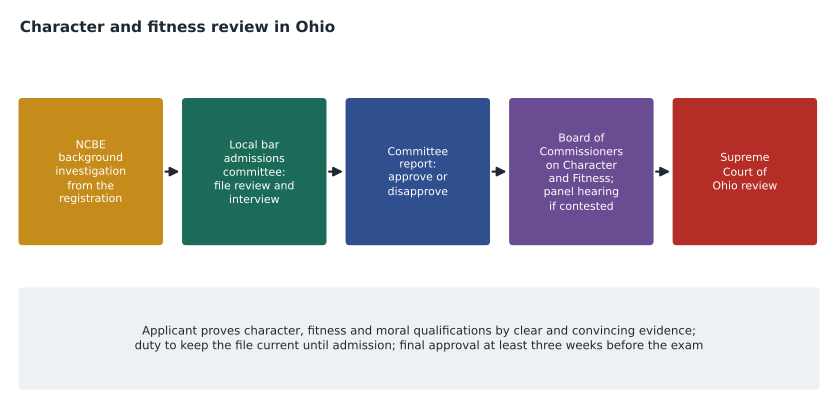
The Ohio process runs through three levels. First, NCBE conducts the background investigation, using the character questionnaire the applicant filed with her registration. NCBE contacts schools, employers and references, checks court and motor vehicle records, and reports its findings to Ohio. The applicant pays NCBE directly for this work.
Second, the file goes to an admissions committee of a local bar association, usually in the county where the applicant lives or attends school. Members of the committee review the file and conduct a personal interview. After the interview, the committee files a report recommending that the applicant be approved or disapproved. The interviewers may ask for more information before reporting, and an applicant who receives such a request should answer quickly and completely, because the clock to final approval keeps running.
Third, the Board of Commissioners on Character and Fitness makes the final determination. Most files are approved on the committee's favorable recommendation. If the committee recommends disapproval, the applicant may appeal to the Board, and the Board may also investigate a file on its own initiative. Contested matters are heard by a panel of commissioners, which takes evidence, hears witnesses and reports to the full Board. The Board's decision can, in turn, be reviewed by the Supreme Court of Ohio, which has the final word on every admission.
Outcomes
A disapproval is not always permanent. The Board can disapprove an applicant but permit her to reapply for a later exam, often after a period during which she can demonstrate rehabilitation, such as continued sobriety, resolution of debts or completion of a treatment program. In more serious cases, the Board can recommend that the applicant never be permitted to reapply. Supreme Court of Ohio decisions on character applications show the full range: approvals after a hearing, disapprovals with permission to reapply, and permanent disapprovals for applicants whose dishonesty during the process itself made rehabilitation impossible to show.
Timing is the practical problem. An applicant whose file is in contested review in January may not have final approval three weeks before a February exam, and so may lose that exam. That is one more reason the registration comes in the second year of law school: problems surface early enough to be resolved before the third-year exam calendar takes over.
After passing: the twelve-month rule
Character approval does not last indefinitely. If an applicant passes the exam but is not admitted within twelve months after the exam, she must file another supplemental character questionnaire, and the Board must reissue its final approval, dated no more than six months before her admission. The rule catches the applicant who passes, moves abroad for a year and returns: the Court wants a current picture of every lawyer it admits.
The MPRE
Ohio requires a scaled score of 85 or higher on the Multistate Professional Responsibility Examination. The MPRE is a two-hour, multiple-choice exam on the rules of professional conduct and judicial conduct, written by NCBE and scored on a scale that runs from 50 to 150. NCBE offers it several times a year at testing centers.
Two features of Ohio's MPRE rule make it unusually flexible. First, Ohio does not require the MPRE before the bar exam. A candidate may take it before or after, and the requirement must be satisfied only before admission. Second, NCBE's summary of Ohio's rules shows no time limit on when the qualifying score must have been earned. An MPRE score of 85 earned during law school years earlier still counts. Wesley took the MPRE in August 2026 and scored 98, so this requirement was already behind him.
The MPRE score requirement also applies to the alternative routes. An applicant transferring a UBE score needs an MPRE score of 85 as well. Candidates who passed the MPRE for another state with a lower minimum need to check their actual scaled score, because a score that met a 75 or 80 minimum elsewhere may not meet Ohio's 85.
| Requirement | Ohio rule |
|---|---|
| Burden of proof | On the applicant, by clear and convincing evidence |
| Who investigates | NCBE background investigation, then a local bar admissions committee interview |
| Who decides | Board of Commissioners on Character and Fitness, subject to Supreme Court review |
| Deadline for final approval | At least three weeks before the exam |
| After passing | New supplemental questionnaire if not admitted within twelve months |
| MPRE score | 85, with no time limit and no requirement to pass before the bar exam |
Help for applicants who need it
Some applicants have conduct in their history connected with substance use or mental health. The rule focuses on whether conduct shows an inability to practice competently and on evidence of rehabilitation, not on a diagnosis in itself. Applicants who are concerned about how their history will be viewed can contact the Ohio Lawyers Assistance Program, which offers confidential help to law students and lawyers, and many applicants with a history of this kind are admitted after showing sustained recovery. The worst approach is silence followed by discovery.
Worked problem
A dismissed charge
Ignatius Pellow, a hypothetical third-year student, was charged with disorderly conduct at 19 after an argument outside a bar. The charge was dismissed and the record sealed. On his registration he answered no to the question asking whether he had ever been charged with an offense, reasoning that a sealed, dismissed charge did not count. The NCBE investigation found a reference to the charge in a newspaper archive. How should the reviewers see this, and what should Ignatius do now?
Show solution
- The original conduct is minor, old and resolved in his favor; on its own it would carry little weight.
- The omission is new conduct: a false answer on the application, made recently, by an applicant seeking a license that depends on honesty.
- Rule I requires complete and accurate information and lists failure to provide it as a ground for concern; candor weighs heavily in the analysis.
- Ignatius should immediately file an amendment disclosing the charge, explain the circumstances and the reason for his original answer, and answer the committee's questions candidly.
Answer: The dismissed charge is not the real problem; the omission is. Ignatius should correct the record at once and explain it. Prompt, full correction gives him the best chance of approval, though the omission will receive close attention.
Common mistakes
MistakeThe Board must prove an applicant unfit.
InsteadThe applicant must prove her character, fitness and moral qualifications by clear and convincing evidence.
MistakeSealed or expunged matters need not be disclosed.
InsteadIf the questionnaire asks about them, they must be disclosed; omission is treated as a lack of candor.
MistakeOhio requires the MPRE before the bar exam.
InsteadOhio requires an MPRE score of 85 before admission, with no requirement that it come first.
MistakeApproval once given lasts until admission whenever it happens.
InsteadAn applicant not admitted within twelve months of the exam must file again and receive a reissued approval.
Practice problems
Work each problem on paper first, then reveal the answer to check.
What standard of proof applies to an Ohio applicant's character showing?
Show answer
Clear and convincing evidence, with the burden on the applicant.
Who interviews an Ohio applicant in person?
Show answer
Members of a local bar association admissions committee.
What MPRE score does Ohio require, and is there a time limit?
Show answer
A scaled score of 85, with no time limit on when it was earned.
When must final character approval be in place?
Show answer
At least three weeks before the bar exam.
Unauthorized practice before admission
One of the affidavits in the exam application is that the applicant has not engaged in the unauthorized practice of law. For most law students the affidavit is routine. For applicants who already work in law-adjacent jobs, it deserves a careful read, and Wesley's interviewers asked him about it directly. As an adjuster, he negotiates settlements with injured people, some of whom are unrepresented, and he reads police reports, medical records and the occasional complaint.
Hollis walked through the distinction with him. An adjuster who evaluates and negotiates claims on behalf of his employer, the insurer, is doing the insurer's business, not practicing law for others. What an adjuster must not do is advise an unrepresented claimant about her legal rights, tell her she does not need a lawyer, or prepare legal documents for her. The same caution applies to law clerks, paralegals and students working in clinics: the work is permitted when it is supervised by a licensed lawyer or authorized by a rule such as Ohio's legal intern certificate, and it becomes a problem when the person holds herself out as able to give legal advice independently.
Ohio takes unauthorized practice seriously. The Supreme Court of Ohio has a Board on the Unauthorized Practice of Law that hears complaints, and an applicant who has crossed the line may face both a character problem and a separate proceeding. Wesley told his interviewers that his company's practice was to tell unrepresented claimants in writing that he represented the insurer and could not advise them, and that he followed it. They noted the answer and moved on.
Preparing for the interview
Hollis gave Wesley the checklist she gives every Ohio candidate before a committee interview. Reread both questionnaires the night before, so that nothing in them surprises you. Bring copies of any documents that resolve a disclosed problem, such as a satisfaction of judgment, a payoff letter or a court entry. Answer the question asked, directly and without defensiveness, and if you do not remember a detail, say so and offer to follow up in writing. Dress as you would for a court appearance. And send any promised follow-up within a day or two, because the committee's report, and with it your final approval, waits on it.
Summary and key terms
- Ohio applicants must prove character, fitness and moral qualifications by clear and convincing evidence.
- The rule lists conduct of concern and considerations of weight, including recency, seriousness, rehabilitation and candor.
- NCBE investigates, a local admissions committee interviews and recommends, and the Board of Commissioners on Character and Fitness decides, subject to Supreme Court review.
- Applicants must keep their files current until admission; omissions are treated as serious misconduct.
- A new supplemental questionnaire and reissued approval are needed if admission comes more than twelve months after the exam.
- Ohio requires an MPRE score of 85, at any time before admission, with no time limit on the score.
- character and fitness
- The review of whether an applicant has the honesty, judgment and reliability to practice law.
- clear and convincing evidence
- A standard of proof higher than a preponderance, which Ohio applicants must meet.
- supplemental character questionnaire
- The update filed with each exam application and after a delay in admission.
- MPRE
- The Multistate Professional Responsibility Examination; Ohio requires a scaled score of 85.
- rehabilitation
- Evidence that an applicant has addressed past conduct, weighed in her favor in character review.
Lesson quiz · 5 questions
Score 60% or more to complete this lesson.
Create a free account to save your progress, take quizzes and earn a certificate.