
BAR-236 · Lesson 4 of 12 · 20 min
The Ohio bar exam: the UBE, scoring and the 270 passing score
▶ Video coming soon A video version of this lesson is on the way.
At the fourth session Hollis put a single number on the screen: 270. 'This is the only number on the exam that really matters to you,' she said. 'Not your MBE raw score, not your essay grades, not your percentile. Your total scaled score on the Uniform Bar Examination, on a scale that tops out at 400. If it is 270 or higher, you pass in Ohio. If it is 268 or 269, your written answers get a second look before results come out. Below that, you sit again.'
Wesley wanted to know how a score of 270 is built. That is the subject of this lesson: what the Ohio bar exam consists of, how each part is graded and scaled, how the pieces are combined into a total, and what the 270 passing score means in practice. The February 2027 exam is a legacy Uniform Bar Examination, the same format Ohio has given since it switched to the UBE, and it is the format Wesley will sit.
Ohio and the UBE
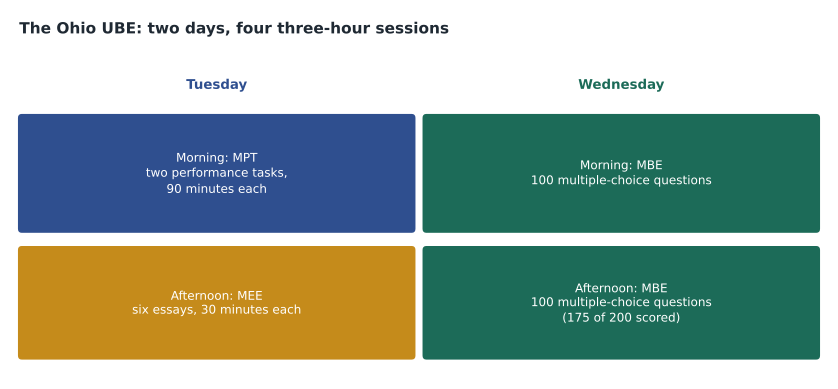
The Supreme Court of Ohio announced on August 14, 2018 that it would adopt the Uniform Bar Examination, with the change originally planned for July 2020. The pandemic disrupted that schedule, and the Court's materials give February 2021 as Ohio's first UBE administration. Since then, Ohio's bar exam has been the UBE in full: the Multistate Bar Examination, the Multistate Essay Examination and two Multistate Performance Test items, all written by NCBE, given over two days in four half-day sessions, as Section 5 of Rule I provides.
Ohio gives the exam twice a year, in February and July, on the dates NCBE sets for the UBE. For February 2027, those dates are Tuesday, February 23 and Wednesday, February 24. Results for a February exam come out in the spring, and results for a July exam in the fall; the Court posts lists of successful applicants and each applicant learns her own result through the Bar Admissions Portal.
Day one: the MPT and the MEE
The first day begins with the Multistate Performance Test. Ohio, like every UBE jurisdiction, uses both MPT items, each designed to take 90 minutes, in a three-hour morning session. Each MPT gives the applicant a file of facts, a task memo from a supervising lawyer and a library of legal authorities, often from fictional jurisdictions, and asks for a lawyering task such as an objective memo, a persuasive brief, a client letter or a set of discovery requests. The MPT tests skills, not knowledge: everything needed is in the file and library.
The afternoon is the Multistate Essay Examination: six essay questions, each designed to take 30 minutes, in a three-hour session. Beginning with the July 2026 administration, NCBE removed four subjects from the MEE, Conflict of Laws, Family Law, Trusts and Estates, and Secured Transactions, to align the legacy exam with the NextGen content. The MEE now draws from Business Associations (agency and partnership, corporations and limited liability companies), Civil Procedure, Constitutional Law, Contracts including Article 2 of the Uniform Commercial Code, Criminal Law and Procedure, Evidence, Real Property and Torts. NCBE has said Family Law and Trusts and Estates may still appear on the MPT, where the necessary law is supplied in the library.
The MEE change matters for Ohio in a way Wesley had not considered. 'Wills and trusts used to be a regular essay subject,' Hollis said. 'Now it is gone from the essays nationwide. That is one reason Ohio's NextGen committee said the Ohio component should start testing wills and trusts.' Lesson 5 returns to that recommendation.
Day two: the MBE
The second day is the Multistate Bar Examination: 200 multiple-choice questions in two three-hour sessions of 100 questions each. Of the 200 questions, 175 are scored and 25 are unscored pretest questions that NCBE is trying out for future exams; the pretest questions are mixed in and cannot be identified. The scored questions are spread across seven subjects: Civil Procedure, Constitutional Law, Contracts, Criminal Law and Procedure, Evidence, Real Property and Torts, with 25 scored questions in each.
Each MBE question gives a fact pattern and four answer choices, and asks for the best answer. There is no penalty for guessing, so an applicant should answer every question. The MBE rewards both knowledge and pace: at 100 questions in three hours, an applicant has an average of one minute and 48 seconds per question.
How the parts are scored
The MBE is scored by NCBE. An applicant's raw score, the number of scored questions answered correctly, is converted to a scaled score through a statistical process called equating, which adjusts for small differences in difficulty between exam forms. Equating is what makes a scaled MBE score from February 2027 mean the same thing as one from July 2025. Scaled MBE scores run roughly from the 40s to the high 100s, and a typical passing applicant's MBE score falls in the 130s or 140s.
The MEE and MPT are graded in Ohio. NCBE supplies the questions, analyses and grading materials, and graders appointed under the Board of Bar Examiners' supervision grade the answers. Graders use a relative scale, ranking answers against each other rather than against a fixed standard of perfection. The raw written scores are then scaled to the MBE: NCBE converts them to the same score distribution as the group's MBE scores. Scaling to the MBE ties the essay grading to an equated measure and keeps scores comparable over time and across UBE jurisdictions.
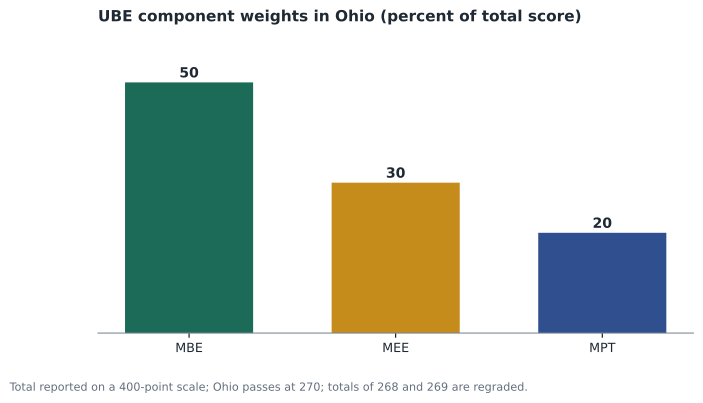
The total UBE score combines the three components with fixed weights that Section 5 of Rule I sets: the MBE counts for 50 percent, the MEE for 30 percent and the MPT for 20 percent. The total is reported on a 400-point scale. The total is what Ohio compares with its passing score, and it is the score that transfers to other UBE jurisdictions.
The 270 passing score
Section 5 of Rule I directs the Board of Bar Examiners to set and publish the passing score, subject to the Court's approval, and Ohio's is 270. Among UBE jurisdictions, passing scores range from 260 to 270, and 270 is at the top of that range, shared by only a few jurisdictions. That matters in two directions. A score of 270 earned in Ohio is enough to transfer to every UBE jurisdiction. But an applicant transferring into Ohio from a jurisdiction with a lower passing score needs 270, not just a passing score where she sat.
Because the components are weighted, a strong performance in one area can offset weakness in another. Roughly, an applicant whose scaled MBE score is around 135 and whose scaled written score is similar will land near 270, since the total is about twice the weighted average of the two halves. Hollis gave Wesley a rule of thumb: aim for a scaled MBE score in the mid-140s on practice exams, because that cushion absorbs a weaker essay day.
Worked problem
Reading a score report
Wesley's hypothetical friend Liesl sat the Ohio UBE and received a scaled MBE score of 138 and a scaled written score of 131. Did she pass in Ohio, and would her score transfer to a jurisdiction with a 266 passing score?
Show solution
- The UBE total weights the MBE at 50 percent and the written portion (MEE plus MPT) at 50 percent combined.
- On the 400-point total scale, each half contributes its scaled score multiplied by two times its weight: 138 for the MBE half and 131 for the written half.
- Her total is therefore about 138 plus 131, or 269.
- A 269 is within two points below 270, so her written answers are regraded before results are released; if the regrade does not raise her total to 270, she does not pass in Ohio.
- A 269 would exceed a 266 passing score in another UBE jurisdiction, so it could be transferred there if that jurisdiction's other requirements were met.
Answer: Liesl's total is about 269: one point short of Ohio's 270, so her written portion is regraded before results come out. If her total stays at 269, she does not pass in Ohio, but her score would be good enough to transfer to a 266 jurisdiction.
The two-point regrade
Section 5 of Rule I includes a safety valve. Before results are announced, the written portion of every applicant whose scaled total falls within two points below the passing score is regraded. In Ohio that means applicants with totals of 268 and 269. The regrade is automatic; the applicant does not request it and is not told about it until results come out. The Court's UBE materials note that the regrade window was one point before Ohio adopted the UBE and was widened to two points with the change.
Outside that window, scores are final. Section 5 provides that UBE scores are not subject to appeal, except for mathematical or clerical errors. Ohio publicly lists which applicants took and passed the exam, but individual scores are not public. An applicant who fails may obtain copies of her written answers for a small fee and use them, with the NCBE analyses, to prepare for the next attempt.
| Component | Format | Time | Weight |
|---|---|---|---|
| MPT | Two performance tasks from a file and library | Three hours, Tuesday morning | 20 percent |
| MEE | Six essays from eight subject areas | Three hours, Tuesday afternoon | 30 percent |
| MBE | 200 multiple-choice questions, 175 scored | Six hours, Wednesday | 50 percent |
| Total | Scaled on a 400-point scale | Two days | Pass at 270 in Ohio |
Portability and attempts
To earn a portable score, an applicant must take all three components in a single administration; Ohio does not combine components from different exams. A UBE score earned in Ohio can be transferred to other UBE jurisdictions for the period each receiving jurisdiction allows, and Ohio itself accepts incoming scores for five years.
Ohio does not limit the number of times an applicant may sit the exam. The practical limit is the four-exam rule from Lesson 2: an applicant who fails and does not retake within the next four exams has her file deemed withdrawn. An applicant who has failed should also think carefully about Section 10 of Rule I, which bars admission without examination for anyone who has taken and failed the Ohio bar exam within the past five years. A failed Ohio exam can affect a lawyer's options years later.
Laptops, rules and test day
Most Ohio applicants type their essays and MPT answers using exam software, for which they pay a laptop fee with the application. Applicants who handwrite receive answer booklets. The Office sends detailed testing rules about two weeks before the exam: what may be brought into the room, identification requirements, timing, and the consequences of rule violations, which can include disqualification. Wesley planned to read those instructions twice, once when they arrived and again the weekend before the exam.
Common mistakes
MistakeThe Ohio exam includes Family Law and Trusts and Estates essays.
InsteadSince July 2026 those subjects are no longer MEE subjects; they may appear only on the MPT with the law supplied.
MistakeAll 200 MBE questions count.
Instead175 are scored; 25 are unscored pretest questions mixed in.
MistakeAn applicant with a 269 can appeal her score.
InsteadThe written portion is automatically regraded within two points below 270; otherwise scores are final except for clerical errors.
MistakeAny passing UBE score transfers into Ohio.
InsteadOhio requires a transferred score of 270 or higher.
Practice problems
Work each problem on paper first, then reveal the answer to check.
What are the weights of the UBE components in Ohio?
Show answer
MBE 50 percent, MEE 30 percent, MPT 20 percent.
What is Ohio's UBE passing score?
Show answer
270 on the 400-point scale.
Which scores trigger an automatic regrade?
Show answer
Totals within two points below 270, that is 268 and 269.
When was Ohio's first UBE administration, according to the Court?
Show answer
February 2021, after the Court announced adoption in 2018.
What the MEE graders reward
Because MEE answers are graded relatively, an applicant does not need a perfect answer to earn a strong score; she needs a better answer than most of the group. Graders look first for whether the applicant identified the issues the question raises, then for whether she stated the governing rule accurately, applied it to the specific facts, and reached a conclusion. An organized answer, with a short heading for each issue and a clear conclusion, is easier to grade and tends to score better than a long answer with the same content buried in it.
Hollis gave Wesley her standard advice on the six essays. Read the call of the question first so you know what is being asked. Spend about five minutes outlining, then write for about twenty-five. State each rule in a sentence or two. Use the facts: an answer that recites the law without explaining how specific facts satisfy each element earns far less credit than one that does. And never leave a question blank: a partial answer that identifies the issues earns points, while a blank earns none.
What the MPT rewards
The MPT is the component candidates most often underprepare, because it does not require memorization. But it is worth 20 percent of the total, as much as roughly two-thirds of the essays combined, and it rewards practice. Each item asks the applicant to read a task memo carefully, use only the law in the library, and produce a document in the format requested. Graders look for responsiveness to the task, accurate use of the authorities, and organization. Applicants who practice several full MPTs under timed conditions usually find that their speed improves markedly, and that improvement is worth more points than an extra week of rule memorization for most candidates.
Wesley found the MPT the most familiar part of the exam. His claims files are, in effect, MPT files: facts, documents, a policy, and a question about what the policy requires. Hollis told him to treat that as an advantage but not to rely on it. 'The MPT wants a lawyer's work product in a lawyer's format. A coverage letter is not an objective memo. Practice the formats.'
Building a study plan around the weights
The weights suggest how to divide study time, although they should not dictate it mechanically. Half the score comes from the MBE, so most candidates spend roughly half their time on multiple-choice practice and the rules it tests. The essays and MPT together make up the other half. Because the seven MBE subjects are also MEE subjects, rule study does double duty. Business Associations, which appears on the MEE but not the MBE, needs its own time.
Summary and key terms
- Ohio gives the legacy UBE through February 2028: MPT and MEE on Tuesday, MBE on Wednesday.
- Since July 2026, the MEE no longer includes Conflict of Laws, Family Law, Trusts and Estates or Secured Transactions.
- The MBE has 200 questions, 175 scored, across seven subjects; it is equated and scaled by NCBE.
- Written answers are graded in Ohio on a relative scale and scaled to the MBE.
- Weights are 50, 30 and 20 percent; the total is on a 400-point scale and Ohio passes at 270.
- Totals of 268 and 269 are regraded automatically; scores are otherwise final.
- UBE
- The Uniform Bar Examination, made up of the MBE, MEE and MPT and scored on a 400-point scale.
- equating
- NCBE's statistical adjustment that makes MBE scores comparable across exam forms.
- scaling
- The conversion of written scores to the MBE score distribution.
- pretest question
- An unscored MBE question NCBE is testing for future use.
- portable score
- A UBE score earned in one administration that other UBE jurisdictions may accept.
Lesson quiz · 5 questions
Score 60% or more to complete this lesson.
Create a free account to save your progress, take quizzes and earn a certificate.