
BAR-243 · Lesson 10 of 12 · 19 min
The Tennessee Rules of Professional Conduct
▶ Video coming soon A video version of this lesson is on the way.
Beckett had studied the ABA Model Rules for the MPRE and scored 88. In his first month at Ozment & Hargis he discovered that the rules on his office wall were not quite the ones he had studied. A prospective client told him, during an intake call, that her former boyfriend had said he was going to drive to her mother's house that night with a gun. Beckett called Henrietta Ozment, who called the police and then turned to him. 'Under the Model Rules you may disclose to prevent death or substantial bodily harm,' she said. 'Under Tennessee's rules, you must. Learn the differences now, before a client teaches them to you.'
Tennessee's Rules of Professional Conduct are Supreme Court Rule 8. They are based on the ABA Model Rules, and the numbering is the same, but the Court has made many changes. The Board's supplemental professional responsibility outline for the Tennessee Law Course lists the most important differences. This lesson covers those differences, the trust account and IOLTA rules, the disciplinary system under Rule 9, advertising and solicitation, and a few Tennessee positions on proposed national changes. The MPRE tests the Model Rules; practice in Tennessee is governed by Rule 8.
Citation and structure
The rules are cited as Tennessee Supreme Court Rule 8, RPC, followed by the rule number, for example Tenn. Sup. Ct. R. 8, RPC 1.6. Tennessee's preamble has a descriptive opening paragraph with no ABA counterpart, and the rules use defined terms in RPC 1.0. Two definitions differ from the Model Rules: Tennessee's definition of fraud is broader and includes intentionally misleading omissions, and Tennessee defines material, which the Model Rules do not.
Confidentiality: Tennessee RPC 1.6
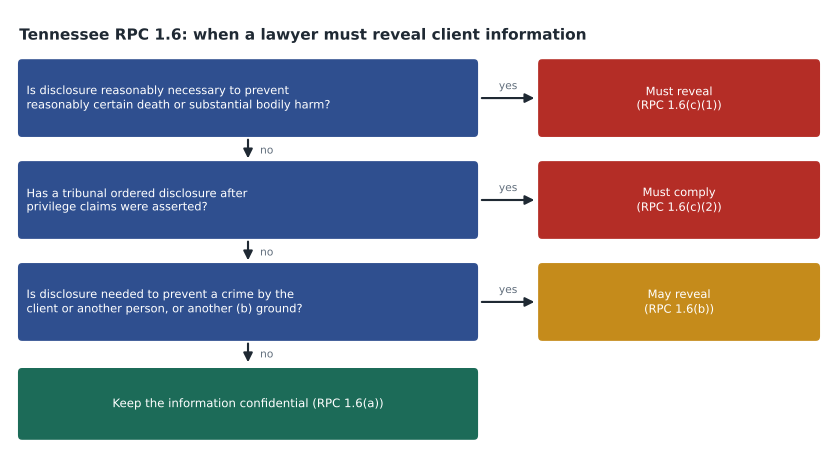
Confidentiality is where Tennessee departs most visibly from the Model Rules. RPC 1.6(a) protects all information relating to the representation, whatever its source, like the Model Rule. The differences are in the exceptions.
Permissive disclosure. RPC 1.6(b)(1) permits disclosure to prevent the client or another person from committing a crime, a broader permission than the Model Rule, which focuses on the client's own crimes and frauds involving the lawyer's services. Other permissive exceptions follow the familiar categories, such as securing ethics advice and establishing a claim or defense in a dispute with the client.
Mandatory disclosure. RPC 1.6(c)(1) requires a lawyer to reveal information to the extent reasonably necessary to prevent reasonably certain death or substantial bodily harm. The Model Rule only permits that disclosure. RPC 1.6(c)(2) requires disclosure when a tribunal orders it, but only after the lawyer has asserted on the client's behalf all non-frivolous claims that the information is protected by privilege or other law.
Inadvertent disclosure. RPC 1.6(d) requires reasonable efforts to prevent inadvertent or unauthorized disclosure. Under RPC 4.4(b), a lawyer who receives information the lawyer knows or reasonably should know was inadvertently sent must stop reading, notify the sender and either abide by the sender's instructions or await a definitive ruling from a tribunal, a more detailed duty than the Model Rule's notice requirement.
Candor to the tribunal
Tennessee's RPC 3.3 spells out the steps for client perjury in more detail than the Model Rule. If a client intends to testify falsely, the lawyer must try to dissuade the client and, if that fails, seek to withdraw; if the court refuses to allow withdrawal, Tennessee permits the client to testify in narrative form. If the lawyer learns afterward that a client gave false material testimony, the lawyer must try to persuade the client to correct it and, failing that, withdraw, without disclosing information protected by RPC 1.6. RPC 3.3 also requires the lawyer to inform the tribunal in some circumstances, such as when a person other than the client has lied or someone has engaged in improper conduct toward a juror. The comments explain that in Tennessee confidentiality generally prevails over the duty of candor, except for juror misconduct. Model Rule 3.3, by contrast, requires remedial measures including disclosure to the tribunal even if that reveals confidential information.
Fees
RPC 1.5 adds two factors to the Model Rule's list for judging whether a fee is reasonable: prior statements the lawyer made about the fee, and whether the fee agreement is in writing. RPC 1.5(d) limits contingent fees in domestic relations matters more strictly than the Model Rule, with a narrow exception for collecting arrearages. Tennessee also permits a non-refundable fee if the client agrees to it in a writing signed by the client; such a fee is earned when paid and is not placed in trust, though it remains subject to the reasonableness requirement. A lawyer may divide a fee with a lawyer in another firm with the client's written consent, without disclosing each lawyer's share. The comments remind lawyers that statutes can limit fees, such as the health care liability fee limit in Tennessee Code section 29-26-120.
Conflicts of interest
Tennessee's conflict rules have several distinctive features. RPC 1.7(c) and its comments impose extra protections on multiple representation of defendants in criminal and juvenile cases, requiring informed consent and a showing of good cause. The comments permit some common family estate-planning representations. RPC 1.8(g) and (h) require the lawyer to advise the client to seek independent counsel in aggregate settlements and in settlements of malpractice claims. RPC 1.9(c) defines generally known information broadly for the purpose of using a former client's information.
Imputation and screening differ too. Under RPC 1.10, the conflicts of nonlawyer staff are imputed within a firm in some circumstances. Screening is available only for lateral lawyers, requires written notice to the former client, and is unavailable in certain pending matters in which the lateral lawyer was substantially involved and is now directly adverse. Unlike the Model Rule, Tennessee allows the screened lawyer to share in the fee. The rule reflects Clinard v. Blackwood, a Tennessee Supreme Court case on disqualification.
Trust accounts and IOLTA
Under RPC 1.15(b), client and third-party funds must be held in an account at a financial institution insured by the FDIC or NCUA that participates in the overdraft notification program required by Supreme Court Rule 9, section 35.1. The bank reports any overdraft on a trust account to the BPR, which typically asks the lawyer for an explanation. Nominal or short-term client funds must be placed in an IOLTA account under Supreme Court Rule 43, with the interest used for access-to-justice purposes as the rule provides. Lawyers report IOLTA compliance on their annual BPR registration.
The BPR publishes an Attorney's Trust Account Handbook, and its ethics counsel answer trust account questions. Marchetti's advice to every new Tennessee lawyer is to read the handbook during the first week of practice and to reconcile the trust account monthly, even if the rule does not seem to demand it.
Advertising and solicitation
Tennessee's advertising rules are more detailed than the Model Rules. Under RPC 7.2, lawyers must keep a copy or recording of each advertisement for two years after its last dissemination, and each advertisement must name at least one lawyer or firm responsible for its content. Paying for referrals is prohibited, with exceptions for reasonable advertising charges and registered intermediary organizations under Supreme Court Rule 44. RPC 7.3 restricts live solicitation for pecuniary gain and imposes a 30-day waiting period after certain events, such as a personal injury, before a lawyer may send a targeted written solicitation in some matters. Written solicitations must be labeled as advertising material and, if they include a sample contract, marked as a sample not to be signed. Under RPC 7.4, a lawyer may claim to be a certified specialist only if certified by an organization accredited by the Commission on CLE.
| Topic | ABA Model Rule | Tennessee RPC |
|---|---|---|
| Disclosure to prevent death or serious bodily harm | Permitted (1.6(b)(1)) | Required (1.6(c)(1)) |
| Disclosure to prevent a crime | Client's crime or fraud using the lawyer's services | Crime by the client or another person (1.6(b)(1)) |
| Client perjury discovered later | Remedial measures, including disclosure if necessary | Remonstrate and withdraw without disclosing protected information (3.3) |
| Non-refundable fees | Not addressed expressly | Allowed if agreed in a client-signed writing (1.5(f)) |
| Screening laterals | Allowed broadly; no fee share | Limited; screened lawyer may share the fee (1.10) |
| Discrimination and harassment rule 8.4(g) | Adopted by the ABA in 2016 | Petition denied April 23, 2018 |
Other distinctive rules
RPC 4.4(a)(2) prohibits threatening to present a criminal or lawyer disciplinary charge to gain an advantage in a civil matter, a rule the Model Rules dropped decades ago. RPC 3.4 prohibits paying a witness contingent on the content of the testimony or the outcome of the case, while allowing reasonable expenses and compensation for lost time. RPC 1.17 allows the sale of an area of practice, not just an entire practice. RPC 5.5 prohibits a lawyer from employing a disbarred or suspended lawyer in certain law-related roles. RPC 6.1 sets an aspirational goal of at least 50 hours of pro bono legal services each year; it is not enforced through discipline.
Tennessee and Model Rule 8.4(g)
In 2016 the ABA added Model Rule 8.4(g), which treats harassment and discrimination in conduct related to the practice of law as professional misconduct. The Tennessee Board of Professional Responsibility and the Tennessee Bar Association jointly petitioned the Supreme Court to adopt a version of it. After public comments, including an opinion of the Tennessee Attorney General in March 2018 strongly opposing the rule on constitutional grounds, the Court denied the petition on April 23, 2018. A candidate who studied Model Rule 8.4(g) for the MPRE should know that it is not part of Tennessee's rules.
Discipline under Rule 9
Lawyer discipline in Tennessee is governed by Supreme Court Rule 9 and administered by the Board of Professional Responsibility. Complaints are investigated by disciplinary counsel. Minor matters may be resolved by diversion or a private informal admonition; more serious matters proceed by a petition for discipline heard by a hearing panel of lawyers, with review available in the trial courts and ultimately the Supreme Court, which imposes public discipline such as public censure, suspension or disbarment. The BPR's ethics counsel also provide informal ethics guidance to lawyers who call before they act, and the BPR publishes formal ethics opinions.
Worked problem
The intake call
Return to the intake call. The prospective client, Seraphina Mabe, says her former boyfriend told her that night that he would drive to her mother's house with a gun. She has not hired the firm. Must Beckett disclose, and to whom?
Show solution
- Duties to prospective clients: RPC 1.18 protects information learned from a prospective client, and the RPC 1.6 exceptions still apply.
- The threat is by a third party, not the client, but RPC 1.6(c)(1) applies to information relating to the representation whatever the source: disclosure is required to the extent reasonably necessary to prevent reasonably certain death or substantial bodily harm.
- Is the harm reasonably certain? A specific threat to go to a named place that night with a gun likely meets the standard.
- Scope: disclose only what is reasonably necessary, such as the threat, the location and the person, to the police or others who can prevent the harm.
Answer: Yes. Under Tennessee's mandatory rule, the firm must disclose what is reasonably necessary to prevent the harm, as Ozment did by calling the police.
Common mistakes
MistakeTennessee follows Model Rule 1.6 exactly.
InsteadTennessee requires disclosure to prevent reasonably certain death or substantial bodily harm and permits disclosure to prevent crimes by others.
MistakeNon-refundable fees are never allowed.
InsteadTennessee allows them if agreed in a writing signed by the client, subject to reasonableness.
MistakeTennessee has adopted Model Rule 8.4(g).
InsteadThe Supreme Court denied the petition on April 23, 2018.
MistakeTrust accounts can be at any bank.
InsteadThey must be at an insured institution in the overdraft notification program.
MistakeThreatening criminal charges to gain leverage in a civil case is allowed.
InsteadTennessee RPC 4.4(a)(2) prohibits it.
Asking for ethics help before acting
Tennessee gives lawyers a practical resource that new lawyers underuse: the BPR's ethics counsel. A lawyer facing a hard question, such as whether a conflict can be waived, how to handle a client's false testimony or whether a fee arrangement is permitted, can call before acting and get informal guidance. The guidance does not bind the BPR in a later disciplinary matter, but a lawyer who asked for and followed it is in a far better position than one who guessed. Formal ethics opinions published by the BPR address recurring questions and are worth searching before calling.
Summary and key terms
- Tennessee's rules are Supreme Court Rule 8, based on the Model Rules with significant changes.
- RPC 1.6(c)(1) makes disclosure mandatory to prevent reasonably certain death or substantial bodily harm; 1.6(b)(1) permits disclosure to prevent crimes by anyone.
- RPC 3.3 resolves most conflicts between candor and confidentiality in favor of confidentiality, except juror misconduct.
- Tennessee allows non-refundable fees agreed in a client-signed writing and limits contingent fees in domestic relations matters.
- Trust accounts must participate in overdraft notification; IOLTA is governed by Rule 43.
- The Court denied Model Rule 8.4(g) in 2018; discipline runs through the BPR under Rule 9.
- 0
- Rule 8
- 1
- mandatory disclosure
- 2
- narrative testimony
- 3
- non-refundable fee
- 4
- screening
- 5
- IOLTA
- 6
- overdraft notification
- 7
- Board of Professional Responsibility
Practice problems
Work each problem on paper first, then reveal the answer to check.
What does Tennessee RPC 1.6(c)(1) require?
Show answer
Disclosure to the extent reasonably necessary to prevent reasonably certain death or substantial bodily harm.
When did the Supreme Court deny the petition to adopt Model Rule 8.4(g)?
Show answer
April 23, 2018.
Which rule governs IOLTA accounts in Tennessee?
Show answer
Supreme Court Rule 43.
What is Tennessee's aspirational pro bono goal?
Show answer
At least 50 hours a year (RPC 6.1).
Lesson quiz · 5 questions
Score 60% or more to complete this lesson.
Create a free account to save your progress, take quizzes and earn a certificate.