
BAR-243 · Lesson 8 of 12 · 21 min
Tennessee torts: modified comparative fault, damages caps and claims against government
▶ Video coming soon A video version of this lesson is on the way.
The firm's biggest pending case in November 2026 was a crash at an intersection on the edge of Cookeville. A Putnam County road department truck ran a stop sign and hit a pickup, which then struck the firm's client, a cyclist waiting at the corner. The truck driver blamed the pickup driver for speeding; the pickup driver blamed the county; and the county's adjuster suggested the cyclist should not have been so close to the road. 'Three defendants, a government entity, and everyone pointing at everyone else,' Fern Hargis said. 'Welcome to Tennessee tort law.' Beckett was asked to write a memo on how fault, liability and damages would work. The facts are a hypothetical teaching file, but the law is real.
This lesson covers Tennessee's system of modified comparative fault, the rules on several liability and its exceptions, the Civil Justice Act's caps on noneconomic and punitive damages and the cases that upheld and applied them, and the Governmental Tort Liability Act and the Claims Commission for claims against local governments and the state.
McIntyre v. Balentine and modified comparative fault
Until 1992, Tennessee followed the traditional rule of contributory negligence: a plaintiff whose own negligence contributed to the injury recovered nothing. In McIntyre v. Balentine, 833 S.W.2d 52 (Tenn. 1992), the Supreme Court of Tennessee replaced that rule with a system of modified comparative fault.
Under McIntyre, a plaintiff may recover so long as the plaintiff's fault is less than the combined fault of all the tortfeasors. The plaintiff's damages are reduced in proportion to the plaintiff's percentage of fault. A plaintiff whose fault equals or exceeds the defendants' combined fault recovers nothing. Lawyers often call this the 49 percent rule: a plaintiff 49 percent at fault recovers 51 percent of the damages, while a plaintiff 50 percent at fault recovers nothing.
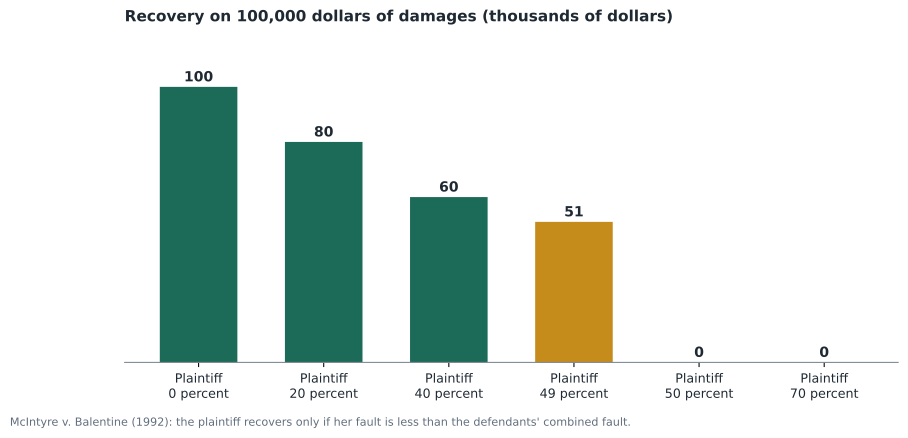
McIntyre also changed how fault is allocated. The jury assigns a percentage of fault to every person whose negligence contributed to the injury, and each defendant is generally liable only for the percentage of damages that matches its own share of fault. Later cases and statutes filled in the details. Fault can be allocated to nonparties, including immune nonparties and settling parties, though the defendant who wants that allocation must prove the nonparty's fault. Doctrines that once barred recovery entirely, such as implied assumption of risk, the sudden emergency doctrine and the open and obvious danger rule, are now considered as part of the comparative fault analysis rather than as complete bars.
Comparative fault is an affirmative defense under Tennessee Rule of Civil Procedure 8.03 and must be pleaded. When the answer identifies a nonparty, the plaintiff has the 90-day window under section 20-1-119, covered in Lesson 7, to add that person.
Several liability and its exceptions
The General Assembly codified the post-McIntyre rule in Tennessee Code section 29-11-107. The default is several liability: each defendant pays only its share. The statute and the cases recognize important exceptions in which defendants remain jointly and severally liable, including civil conspiracy and concerted action, manufacturers in product liability actions, and vicarious liability, such as an employer's liability for an employee under respondeat superior. The Board's torts outline also lists case-law examples, such as defendants in the chain of distribution of a product and the family purpose doctrine for automobiles.
| Situation | Liability rule in Tennessee | Source |
|---|---|---|
| Independent negligent defendants | Several only: each pays its own percentage | McIntyre; section 29-11-107(a) |
| Civil conspiracy or concerted action | Joint and several | Section 29-11-107 |
| Employer for employee's negligence | Joint and several (vicarious liability) | Section 29-11-107 |
| Manufacturer in a product liability action | Joint and several | Section 29-11-107 |
| Plaintiff at 50 percent or more | No recovery | McIntyre |
Worked problem
Allocating fault in the intersection crash
Assume a jury finds total damages for the cyclist of 900,000 dollars, of which 400,000 dollars are economic and 500,000 dollars noneconomic. It assigns fault as follows: county truck driver 60 percent, pickup driver 20 percent, cyclist 20 percent. The truck driver was acting within the scope of his county employment. How much can the cyclist recover from whom, before any governmental caps?
Show solution
- The cyclist's 20 percent is less than the defendants' combined 80 percent, so she recovers, reduced by 20 percent: 720,000 dollars.
- Several liability: the county, liable for its driver's negligence, owes 60 percent of 900,000, or 540,000 dollars. The pickup driver owes 20 percent, or 180,000 dollars.
- The pickup driver is not liable for the county's share, and the county is not liable for the pickup driver's share.
- The noneconomic award of 500,000 dollars is below the 750,000-dollar cap, so the Civil Justice Act cap does not reduce it. But the county's liability is subject to the Governmental Tort Liability Act, discussed below.
Answer: The cyclist recovers 720,000 dollars in total: 540,000 attributable to the county and 180,000 from the pickup driver, subject to the GTLA's limits on the county's share.
The Civil Justice Act of 2011: noneconomic damages
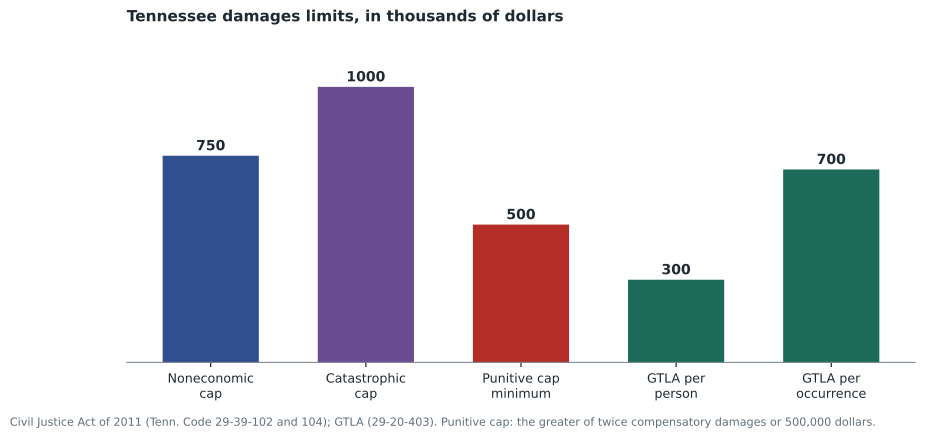
The Tennessee Civil Justice Act of 2011 capped damages in most civil actions. Under Tennessee Code section 29-39-102, noneconomic damages, such as pain and suffering, emotional distress, loss of enjoyment of life and loss of consortium, are limited to 750,000 dollars for all injuries to each injured plaintiff. The cap rises to 1,000,000 dollars for catastrophic losses, which the statute defines to include spinal cord injuries resulting in paraplegia or quadriplegia, amputation of both hands, both feet or one of each, severe burns as the statute defines them, and the wrongful death of a parent leaving a minor child. Economic damages, such as medical expenses and lost earnings, are not capped.
The cap does not apply in some cases: where the defendant had a specific intent to inflict serious physical injury, where the defendant intentionally falsified or destroyed records to evade liability, where the defendant was under the influence of alcohol or drugs to the point of impairment and that caused the injury, or where the defendant's act resulted in a felony conviction. The jury is not told about the cap; the court applies it after the verdict. Among multiple defendants, the total noneconomic recovery cannot exceed the cap.
McClay and Yebuah
Two Supreme Court decisions settled the cap's validity and its reach. In McClay v. Airport Management Services, LLC (Tenn. Feb. 26, 2020), the Court answered certified questions from the United States District Court for the Middle District of Tennessee. A jury had awarded a woman injured in a store at Nashville International Airport 930,000 dollars in noneconomic damages, and the defendant sought to reduce the award to 750,000 dollars. In an opinion by Chief Justice Bivins, the Court held that the cap does not violate the right to trial by jury, because the jury still finds the facts and the court then applies the cap as a matter of law; does not violate the separation of powers, because the legislature may change the substantive law of remedies; and does not violate equal protection. Two justices dissented.
In Yebuah v. Center for Urological Treatment, PLC (Tenn. June 2, 2021), the Court decided whether the cap applies separately to an injured person and to a spouse's derivative claim for loss of consortium. The jury had awarded the injured wife 4,000,000 dollars and her husband 500,000 dollars in noneconomic damages for a surgical ring left in her abdomen for eight years. In a 3 to 2 decision, the Court held that the 750,000-dollar cap applies to the injured person and the derivative consortium claim together, so the couple's combined noneconomic recovery was limited to 750,000 dollars.
Punitive damages
Punitive damages require clear and convincing evidence that the defendant acted maliciously, intentionally, fraudulently or recklessly, under section 29-39-104. The trial is bifurcated, and the jury considers listed factors such as the defendant's financial condition, the reprehensibility of the conduct and any remedial action. Punitive damages are capped at the greater of twice the total compensatory damages or 500,000 dollars, with the same exceptions as the noneconomic cap. In Lindenberg v. Jackson National Life Insurance Co. (2018), the United States Court of Appeals for the Sixth Circuit held the punitive cap unconstitutional under the Tennessee Constitution's jury trial right. That decision does not bind Tennessee courts, and McClay later upheld the noneconomic cap against a similar jury trial challenge, so a Tennessee lawyer must track how courts treat the punitive cap in each case.
The Governmental Tort Liability Act
Claims against Tennessee counties, cities, school districts and other local governmental entities are governed by the Governmental Tort Liability Act, Tennessee Code section 29-20-101 and following. Its starting point is immunity: under section 29-20-201, local governmental entities are immune from suit for injuries resulting from their activities, except where the Act removes immunity.
The Act removes immunity in specific categories: injuries from the negligent operation of motor vehicles by employees within the scope of employment (section 29-20-202), defective, unsafe or dangerous streets and highways (section 29-20-203), dangerous or defective public buildings and structures (section 29-20-204), and, under section 29-20-205, other negligent acts or omissions of employees within the scope of employment, subject to a list of exceptions. Those exceptions preserve immunity for discretionary functions, intentional torts such as assault and battery and false imprisonment, misrepresentation, civil rights claims and several others.
Procedure under the Act is distinctive. Circuit courts have jurisdiction over suits under the Act, which are generally decided by the judge without a jury, under section 29-20-307; the Board's outline notes concurrent general sessions jurisdiction in the most populous counties. The limitation period is twelve months under section 29-20-305(b), and the Board's outline notes that the savings statute does not extend it, although the discovery rule applies. Damages are limited by section 29-20-403: for bodily injury or death, 300,000 dollars per person and 700,000 dollars per accident or occurrence, and for property damage, 100,000 dollars per accident. Employees are generally immune when the entity's immunity has been removed for the same conduct, under section 29-20-310(b), with an exception for health care practitioners.
Claims against the state: the Claims Commission
Claims against the State of Tennessee itself are not governed by the Governmental Tort Liability Act. They go to the Tennessee Claims Commission under Tennessee Code section 9-8-307, which lists the categories of claims for which the state has waived immunity, such as negligent operation of state vehicles, dangerous conditions on state property and negligent care of persons in state custody. A claimant first gives written notice to the Division of Claims and Risk Management under section 9-8-402. Filing a claim with the Commission waives other actions against state employees for the same occurrence under section 9-8-307(b).
Worked problem
Applying the GTLA to the crash
Continue the intersection crash. The cyclist's share of damages attributable to the county is 540,000 dollars. The county truck driver was acting within the scope of his employment. Is the county immune, and what can the cyclist recover from it?
Show solution
- Immunity is removed for injuries caused by the negligent operation of a motor vehicle by an employee within the scope of employment (section 29-20-202).
- The claim must be filed in circuit court in Putnam County within twelve months of the August 14, 2026 crash, and the savings statute will not rescue a late filing.
- The GTLA limits recovery for bodily injury to 300,000 dollars per person (section 29-20-403).
- The county's liability is therefore limited to 300,000 dollars, even though its share of fault produces 540,000 dollars.
- The truck driver personally is generally immune because the county's immunity is removed for the same conduct (section 29-20-310(b)).
Answer: The county is liable, but only up to 300,000 dollars for the cyclist's bodily injury. The pickup driver remains severally liable for 180,000 dollars.
Wrongful death
Tennessee's wrongful death statutes, sections 20-5-106, 20-5-107 and 20-5-113, preserve the decedent's own claim, which passes to the surviving spouse, then to children or next of kin, and allow recovery both for the decedent's losses, such as pain, medical expenses and lost earning capacity, and for the survivors' loss of consortium and the pecuniary value of the decedent's life. The noneconomic caps apply, with the 1,000,000-dollar catastrophic cap available for the wrongful death of a parent leaving a minor child.
Common mistakes
MistakeTennessee follows contributory negligence.
InsteadMcIntyre (1992) adopted modified comparative fault.
MistakeA plaintiff 50 percent at fault recovers half.
InsteadIn Tennessee she recovers nothing; her fault must be less than the defendants' combined fault.
MistakeDefendants are jointly and severally liable by default.
InsteadSection 29-11-107 makes several liability the default, with listed exceptions.
MistakeEach spouse gets a separate 750,000-dollar cap.
InsteadYebuah (2021): the injured person and the derivative consortium claim share one cap.
MistakeClaims against the state go under the GTLA.
InsteadThe GTLA covers local governments; claims against the state go to the Claims Commission.
Summary and key terms
- McIntyre v. Balentine (1992): a plaintiff recovers only if her fault is less than the defendants' combined fault, reduced by her share.
- Several liability is the default under section 29-11-107, with exceptions for conspiracy, products and vicarious liability.
- Noneconomic damages are capped at 750,000 dollars, or 1,000,000 for catastrophic losses; punitive damages at the greater of twice compensatory or 500,000 dollars.
- McClay (2020) upheld the noneconomic cap; Yebuah (2021) applied one cap to an injured spouse and the consortium claim together.
- The GTLA removes local government immunity only in listed categories, with a twelve-month limit and caps of 300,000 per person and 700,000 per occurrence.
- Claims against the state go to the Claims Commission under section 9-8-307.
- 0
- modified comparative fault
- 1
- several liability
- 2
- noneconomic damages
- 3
- catastrophic loss
- 4
- punitive damages
- 5
- Governmental Tort Liability Act
- 6
- Claims Commission
- 7
- removal of immunity
Practice problems
Work each problem on paper first, then reveal the answer to check.
What is the Tennessee cap on noneconomic damages in most cases?
Show answer
750,000 dollars per injured plaintiff, or 1,000,000 dollars for catastrophic losses.
What did McClay hold?
Show answer
The noneconomic cap does not violate the jury trial right, the separation of powers or equal protection.
What are the GTLA limits for bodily injury?
Show answer
300,000 dollars per person and 700,000 dollars per occurrence.
Where are claims against the State of Tennessee heard?
Show answer
The Tennessee Claims Commission.
Lesson quiz · 5 questions
Score 60% or more to complete this lesson.
Create a free account to save your progress, take quizzes and earn a certificate.