
BAR-243 · Lesson 6 of 12 · 19 min
The Tennessee Law Course and how Tennessee law appears
▶ Video coming soon A video version of this lesson is on the way.
Fern Hargis, the younger partner at Ozment & Hargis, gave Beckett a research assignment in October: a client had been rear-ended on Highway 111 thirteen months earlier and wanted to know whether it was too late to sue. Beckett's first instinct, trained by a summer of MBE torts questions, was to think about comparative negligence and damages. Hargis stopped him. 'In Tennessee, the first question is the calendar,' she said. 'Personal injury has a one-year statute of limitations here. Check that before you think about anything else.' The client's claim was almost certainly time-barred. Beckett told Marchetti about it the next Tuesday. 'I have been studying the wrong body of law,' he said. 'Or the right body of law for the wrong purpose.'
Marchetti liked that phrasing. 'You need two bodies of law and you need to know which one you are using,' she said. 'For the exam, you need the general law and federal rules the UBE tests. For practice, and for the Tennessee Law Course, you need Tennessee law. Tonight is about keeping them apart.'
Tennessee's jurisdiction-specific requirement
Every UBE jurisdiction can add a requirement on its own law. Some give a separate test on state law; others require a course. Tennessee requires the Tennessee Law Course. NCBE's charts list it as Tennessee's jurisdiction-specific component, required before admission for exam applicants and for applicants transferring a UBE score.
The Board's description of the course is practical. It is a mandatory online course on Tennessee-specific law that takes about seven and a half hours. It can be completed across several sessions; the Board recommends using the same device throughout and says the course works best on a desktop, laptop or tablet-sized screen. Completing it is a prerequisite for licensing approval.
How to register and when
The steps are short. The applicant completes the Tennessee Law Course registration in Synergy, pays the registration fee online or by check or money order, and receives login credentials by email within five business days of payment. The Board's FAQ lists the registration fee as 15 dollars.
Timing depends on the route. Exam applicants get access to the course within ten days after the bar exam. Applicants for admission by transferred UBE score, comity or military spouse admission get access within five business days after the Board receives the NCBE background report. For Beckett, that means access in early March 2027, before results are released.
The Board also posts supplemental outlines that candidates can download for several topics, including torts, wills, estates, trusts and probate, professional responsibility and constitutional law. They summarize Tennessee rules with statute and case citations and are a useful reference long after the course is finished.
| Item | Tennessee Law Course detail |
|---|---|
| What it is | A mandatory online course on Tennessee-specific law |
| Length | About seven and a half hours, in one or several sessions |
| Registration | In Synergy; fee of 15 dollars; credentials within five business days |
| Access for exam applicants | Within ten days after the bar exam |
| Access for transfer, comity and military spouse applicants | Within five business days after the NCBE report arrives |
| Effect | A prerequisite for licensing approval, with the MPRE and the character and fitness interview |
Why the UBE does not test Tennessee law
The UBE is uniform. The same MBE, MEE and MPT are given in every UBE jurisdiction, and a score earned in one can be transferred to another. That portability is the reason Tennessee adopted it. But it means the exam cannot test any one state's law. The MBE and MEE test generally accepted principles, the Federal Rules of Civil Procedure and Evidence, and the United States Constitution. The MPT gives the candidate the law in the library.
The practical rule for the exam is therefore simple: do not import Tennessee law into UBE answers. A candidate who writes an MEE civil procedure answer under the Tennessee Rules of Civil Procedure, or who chooses an MBE torts answer by applying Tennessee's 49 percent comparative fault bar, risks losing points even if the Tennessee rule is correct for Tennessee.
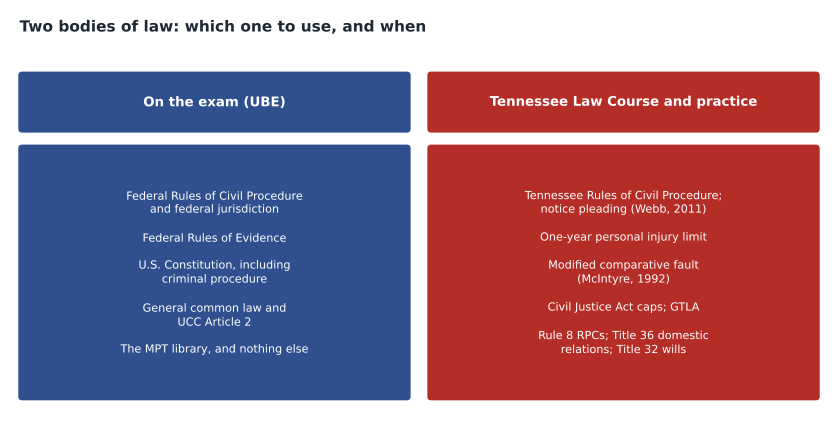
Where Tennessee law and the exam differ
Knowing where Tennessee departs from the general rules protects a candidate twice: it prevents Tennessee rules from creeping into exam answers, and it prepares the candidate for the Tennessee Law Course and the first months of practice. The most important differences follow. Lessons 7 to 10 develop each one.
Pleading. Federal courts apply the plausibility standard of Bell Atlantic v. Twombly and Ashcroft v. Iqbal. In Webb v. Nashville Area Habitat for Humanity (2011), the Supreme Court of Tennessee declined to adopt plausibility pleading and kept Tennessee's traditional notice pleading standard for motions to dismiss under Tennessee Rule 12.02(6). An MEE answer on federal pleading uses Twombly and Iqbal; a Tennessee complaint is tested under Webb.
Summary judgment. Here the two bodies of law have moved closer together. In Rye v. Women's Care Center of Memphis (2015), the Tennessee Supreme Court adopted a standard for summary judgment that tracks the federal approach of Celotex. The General Assembly had already enacted a similar standard by statute for cases filed after July 1, 2011, in Tennessee Code section 20-16-101.
Statutes of limitation. The UBE rarely tests specific limitation periods, but in Tennessee practice they control everything. Personal injury claims must be filed within one year under Tennessee Code section 28-3-104, one of the shortest periods in the country. Injury to property has three years under section 28-3-105. The one-year savings statute, section 28-1-105, lets a plaintiff refile once within a year after a dismissal not on the merits.
Comparative fault. MBE questions state the fault rule when it matters, and the general principles include pure and modified comparative negligence and the traditional contributory negligence bar. Tennessee follows modified comparative fault under McIntyre v. Balentine (1992): a plaintiff recovers only if the plaintiff's fault is less than the combined fault of the defendants, and the award is reduced by the plaintiff's share.
Joint and several liability. The general common law has joint and several liability for indivisible injuries, with many states modifying it. Tennessee's default, by statute in section 29-11-107, is several liability only, subject to exceptions such as civil conspiracy, certain product cases and vicarious liability.
Damages caps. Tennessee caps noneconomic damages in most civil cases at 750,000 dollars, or 1,000,000 dollars for catastrophic injuries, and caps punitive damages at the greater of twice compensatory damages or 500,000 dollars, under the Civil Justice Act of 2011. The UBE does not test state caps.
Wills. Tennessee recognizes holographic wills, and its elective share for a surviving spouse is a sliding percentage of the net estate based on the length of the marriage. MEE questions on wills are no longer asked as of July 2026, and when trusts and estates appear on the MPT, the library supplies the law.
Professional conduct. The MPRE tests the ABA Model Rules. Tennessee's Rules of Professional Conduct, in Supreme Court Rule 8, differ in several ways, including a mandatory duty to reveal information to prevent reasonably certain death or substantial bodily harm. Lesson 10 covers these differences.
| Topic | On the UBE | In Tennessee |
|---|---|---|
| Pleading standard | Plausibility (Twombly, Iqbal) | Traditional notice pleading (Webb, 2011) |
| Summary judgment | Celotex burden shifting | Rye (2015) and section 20-16-101, similar to Celotex |
| Personal injury limitation | Rarely tested | One year (28-3-104) |
| Plaintiff's fault | As stated in the question; general principles | Recovery only if plaintiff's fault is less than defendants' combined fault (McIntyre) |
| Multiple defendants | Joint and several liability as the general rule | Several liability by default (29-11-107) |
| Holographic wills | Not on the MEE from July 2026 | Valid if signature and material provisions are in the testator's handwriting |
| Professional conduct | ABA Model Rules (MPRE) | Tennessee RPCs in Supreme Court Rule 8 |
Worked problem
Choosing the right body of law
On an MEE torts question, a pedestrian who was 45 percent at fault sues a driver who was 55 percent at fault. The call of the question says the jurisdiction follows pure comparative negligence. In a practice note, Beckett writes that the pedestrian recovers 55 percent of her damages. On a Tennessee Law Course quiz, the same facts arise with no instruction about the fault rule. What should Beckett write in each setting?
Show solution
- On the MEE, follow the question's instruction. Under pure comparative negligence, the pedestrian recovers 55 percent of her damages. Tennessee law is irrelevant.
- In the Tennessee setting, apply McIntyre. The pedestrian's 45 percent is less than the driver's 55 percent, so she recovers, reduced by her 45 percent. The result happens to be the same: 55 percent of her damages.
- Change the facts so the pedestrian is 50 percent at fault. Under pure comparative negligence she recovers 50 percent; under Tennessee law she recovers nothing, because her fault is not less than the driver's.
Answer: Use the rule the exam gives or the general principle on the UBE, and Tennessee's 49 percent rule in Tennessee practice and in the Tennessee Law Course.
How to study both without confusion
Marchetti suggests a simple discipline. Before the exam, keep a separate notebook, or a separate document, labeled Tennessee. Whenever a Tennessee rule comes up at work or in reading, write it there with its source. Do not mix those notes into MBE or MEE outlines. After the exam, the Tennessee notebook becomes the starting point for the Tennessee Law Course and for the first year of practice.
For Beckett, the Tennessee notebook started with the one-year limitation period and the client on Highway 111. By November it had three pages: limitation periods, McIntyre, the damages caps, the Governmental Tort Liability Act notice rules and a note on holographic wills from a probate file at the firm. 'Every page is something a client paid for,' Henrietta Ozment, the firm's senior partner, told him. 'Learn it once and you will never forget it.'
What the course is not
The Tennessee Law Course is not a second bar exam. It does not add to the UBE score, and the Board's materials do not describe it as a pass-or-fail test of the same kind as the UBE. It is a requirement to complete before licensing. But treating it as a box to tick misses its value. The course is the Board's chance to make sure new lawyers know the Tennessee rules that most often catch out lawyers trained elsewhere, and the supplemental outlines are some of the best free summaries of Tennessee law available.
Common mistakes
MistakeTennessee has its own essay section on the bar exam.
InsteadTennessee gives the standard UBE; its jurisdiction-specific requirement is the Tennessee Law Course.
MistakeUse Tennessee law on the MEE to show local knowledge.
InsteadThe MEE tests general principles and federal rules; Tennessee law can cost points.
MistakeTennessee uses federal plausibility pleading.
InsteadWebb (2011) kept notice pleading in Tennessee courts.
MistakeTennessee personal injury claims have two years.
InsteadOne year under section 28-3-104, with limited exceptions.
MistakeThe Tennessee Law Course can be taken any time after licensing.
InsteadIt is a prerequisite for licensing approval.
Getting the most out of the course
Because the Tennessee Law Course comes after the exam, many candidates rush through it while waiting for results. Marchetti suggests a different approach. Do it in two or three sessions of two to three hours each, with the Tennessee notebook open. When a module covers a rule that came up at work, add the citation to the notebook. Download the supplemental outlines for the subjects you expect to practice, such as torts for litigation, wills and probate for general practice, and professional responsibility for everyone, and save them where you can find them on your first day in practice. The course takes a working day; the outlines last a career.
Five Tennessee rules that catch new lawyers
Hargis keeps a list of the Tennessee rules that most often catch lawyers who trained or practiced elsewhere. The first is the one-year personal injury limitation period. The second is the twelve-month limit and the special procedure for claims against local governments under the Governmental Tort Liability Act, where the savings statute does not help. The third is the 60-day pre-suit notice and the certificate of good faith in health care liability cases. The fourth is the 90-day window under section 20-1-119 to add a nonparty blamed in an answer. The fifth is Tennessee's mandatory duty to disclose information to prevent reasonably certain death or substantial bodily harm, which differs from the Model Rule most lawyers studied. Each is an easy way to lose a client's claim, and each is covered in the lessons that follow.
How Tennessee law appears on the MPT
The MPT occasionally gives candidates a library containing the law of a real state, but more often it uses a fictional jurisdiction. Either way, the instructions are the same: use only the law in the library. A candidate who recognizes a Tennessee rule in an MPT library should apply it as written in the library, not as remembered from practice. If the library's rule differs from Tennessee's, the library controls.
Summary and key terms
- Tennessee's jurisdiction-specific requirement is the Tennessee Law Course, a mandatory online course of about seven and a half hours.
- Exam applicants get access within ten days after the exam; registration costs 15 dollars and is done in Synergy.
- The UBE tests general principles and federal law, not Tennessee law.
- Key Tennessee differences: notice pleading (Webb), a one-year personal injury limit, McIntyre modified comparative fault, several liability and damages caps.
- Tennessee recognizes holographic wills and uses a sliding elective share.
- Keep a separate Tennessee notebook; keep Tennessee law out of UBE answers.
- 0
- Tennessee Law Course
- 1
- jurisdiction-specific component
- 2
- notice pleading
- 3
- plausibility pleading
- 4
- savings statute
- 5
- several liability
- 6
- supplemental outlines
Practice problems
Work each problem on paper first, then reveal the answer to check.
What is Tennessee's jurisdiction-specific requirement?
Show answer
The Tennessee Law Course.
When do exam applicants get access to it?
Show answer
Within ten days after the bar exam.
Which case kept notice pleading in Tennessee?
Show answer
Webb v. Nashville Area Habitat for Humanity (2011).
What is the Tennessee limitation period for personal injury?
Show answer
One year, under section 28-3-104.
Lesson quiz · 5 questions
Score 60% or more to complete this lesson.
Create a free account to save your progress, take quizzes and earn a certificate.