
BAR-243 · Lesson 11 of 12 · 21 min
Score transfer, admission by comity and practice after admission
▶ Video coming soon A video version of this lesson is on the way.
In mid-November, Fern Hargis asked Beckett to help with a hiring question. The firm was talking to two lawyers who wanted to join it. One, Barnabas Jessup, had passed the UBE in Kentucky in July 2025 with a 271 and had never been licensed anywhere else. The other, Celestine Marrow, had practiced in Alabama for eleven years and had never taken the UBE at all. 'Can either of them practice here without sitting the Tennessee exam?' Hargis asked. 'And how long would it take?' The two lawyers are hypotheticals for this lesson, but their questions are the ones Tennessee firms ask every year.
This lesson covers admission by transferred UBE score, admission without examination by comity, the limited forms of practice available to lawyers not yet admitted, and what every new Tennessee lawyer must do after the oath: registration with the Board of Professional Responsibility and continuing legal education.
Admission by transferred UBE score
Tennessee accepts UBE scores earned in other jurisdictions under Rule 7 section 3.05 and Board Policy P-3.05. The Board's transfer page sets out the requirements.
The score. A legacy UBE score must be at least 270. A NextGen score must be at least 620, and Tennessee accepts NextGen scores beginning with the July 2026 administration. The score must come from a single administration; Tennessee does not combine scores from different exams and does not accept transferred MBE scores standing alone. The score must already have been released and reported in another jurisdiction before the applicant applies, and NCBE's chart notes that a concurrent application is not allowed.
The age of the score. Under Rule 7 section 4.07(d), a transferred UBE score is valid for three years from the Tennessee grade release date for the administration in which it was earned. The Board publishes a table of expiration dates; for the July 2026 exam, for example, a transferred score expires on October 6, 2029. The score must still be valid when the Board approves the application, and it must not be within six months of final expiration on the date the application is filed and the fee paid, whichever is later. Because approval typically takes six to eight months, an applicant with an older score should apply early.
The other requirements. Transfer applicants complete the NCBE character and fitness application and the Tennessee transfer application in Synergy, upload the official NCBE score report, transcripts, Law Degree Verification forms, a resume and proof of citizenship or qualified-alien status, and complete the Tennessee Law Course. The MPRE requirement in Rule 7 section 4.07(e), a score of 82 earned no more than two years before the qualifying UBE, applies, with the section 4.07(f) exception for lawyers already licensed by examination elsewhere. An applicant who failed the UBE five or more times before passing must show proof of a review course for the successful exam or explain what changed in the study approach, under Policy P-4.05(a)(3). NCBE's chart lists the fee as 675 dollars plus the character and fitness fee.
Worked problem
Can Barnabas transfer his Kentucky score?
Barnabas Jessup passed the July 2025 UBE in Kentucky with a 271, was admitted in Kentucky in fall 2025, and scored 80 on the MPRE in March 2025. He wants to apply in Tennessee in December 2026. Does he qualify for admission by transferred score?
Show solution
- Score: 271 is above Tennessee's 270 minimum and comes from a single administration. It has been reported in Kentucky.
- Age: a July 2025 score is valid in Tennessee for three years from Tennessee's grade release date for July 2025, so it remains valid into fall 2028. Filing in December 2026 leaves far more than six months before expiration.
- MPRE: 80 is below Tennessee's 82. The section 4.07(f) exception concerns the age of an MPRE score, not a score below 82, so he must retake the MPRE and score at least 82.
- Other steps: NCBE character and fitness application, the Synergy transfer application, the Tennessee Law Course and the fee of 675 dollars plus the character and fitness fee.
Answer: Barnabas can transfer his 271, but only after he earns an MPRE score of at least 82.
Admission without examination: comity
Experienced lawyers licensed in other jurisdictions may be admitted without examination under Article V of Rule 7 and Board Policy P-5.01. Tennessee calls this admission by comity. Tennessee does not require reciprocity: an applicant need not come from a state that would admit a Tennessee lawyer on the same terms.
The practice requirement. The Board's current comity page, reflecting Rule 7 as amended, states that the applicant must have been primarily engaged in the active practice of law for three of the five years immediately before the application, and that the Board cannot waive this requirement. NCBE's chart, updated in October 2026, still lists five of the past seven years. The Court amended Rule 7 on October 2, 2026, so an applicant near either line should read the current rule and confirm with the Board. Earlier versions of the rule required full-time practice in five of the previous seven years, and a 2022 petition asked the Court to loosen that requirement.
What counts as practice. Qualifying work includes private or public practice, teaching at a law school, judicial clerkships, service as a judge of a court of record, work as a government lawyer including military service, in-house work where the lawyer was registered where required, and practice under a military spouse license comparable to Tennessee's. The Board may count other work requiring legal knowledge case by case. Work does not count if the lawyer was not licensed, active and in good standing at the time, if it was unauthorized practice, or if it was performed under Tennessee's supervised practice or practice pending admission provisions.
Education. A comity applicant must hold a J.D. from an ABA-accredited or Tennessee-approved law school located in the United States. Foreign legal education without such a J.D. makes the applicant ineligible for comity, even after many years of practice elsewhere. NCBE's chart also notes that lawyers first admitted by diploma privilege are eligible.
Process and fee. The applicant completes the NCBE character and fitness application and the Tennessee comity application, uploads an Affidavit of Past Practice, certificates of admission and good standing from each jurisdiction of admission, a resume, transcripts and proof of citizenship or qualified-alien status, and pays the fee, which NCBE's chart lists as 1,400 dollars plus the character and fitness fee. NCBE's chart lists no MPRE time limits for comity applicants.
A warning on timing. RPC 5.5 allows some temporary practice by out-of-state lawyers, but the Board's page reminds applicants to apply before establishing a continuous presence in Tennessee for the practice of law.
Worked problem
Can Celestine be admitted by comity?
Celestine Marrow graduated from an ABA-approved law school in 2015, was admitted in Alabama by examination that year and has practiced full-time in a Birmingham firm ever since. She is in good standing and wants to join the Cookeville firm in 2027.
Show solution
- Practice: eleven years of active practice easily satisfies three of the last five years, and also five of the last seven, whichever version applies.
- Education: a J.D. from an ABA-approved law school.
- Licensing: active and in good standing throughout, so her practice counts.
- Process: NCBE character and fitness application, the comity application with an Affidavit of Past Practice and certificates of good standing, and the fee.
- Timing: she should apply before she begins practicing from a Tennessee office.
Answer: Celestine appears to qualify for comity and does not need to sit the Tennessee exam.
Limited forms of practice
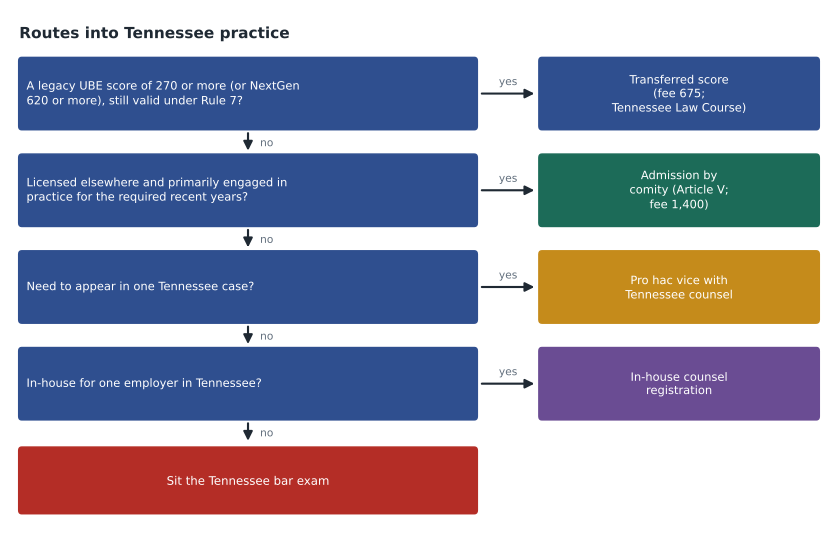
Not every lawyer who works in Tennessee needs full admission. Rule 7 and the Supreme Court's rules provide several limited forms. A lawyer licensed elsewhere who works in-house for a single employer in Tennessee can register as in-house counsel and advise that employer; the registration does not allow appearing in court for other clients. A lawyer who needs to appear in a single Tennessee case can seek admission pro hac vice, associated with Tennessee counsel. Military spouses can seek a special license. Rule 7 also has provisions for supervised practice and for practice pending admission, in sections 10.04 and 10.07, which allow some applicants to work under supervision while their applications are pending. Each route has its own conditions, and none substitutes for full admission when a lawyer plans a general Tennessee practice.
After the oath: BPR registration
Every lawyer licensed in Tennessee registers with the Board of Professional Responsibility and pays an annual registration fee. The registration keeps the lawyer's office address, email, trust account information and IOLTA compliance current, and the BPR uses it to send notices. A lawyer who fails to register or pay can be suspended administratively. New lawyers complete their first BPR registration before receiving the Certificate of Eligibility, as Lesson 1 described.
Continuing legal education
Tennessee's CLE requirement is set by Supreme Court Rule 21 and tracked by the Commission on Continuing Legal Education. Every lawyer must complete 15 hours each compliance year, which runs from January 1 to December 31. At least 3 of those hours must be in ethics and professionalism; the rest, at least 12 hours, are general credit. Ethics and professionalism hours count as dual credit, applying first to the ethics requirement and then to the general requirement.
The calendar matters. Hours must be completed by 11:59 p.m. on December 31 to avoid a late penalty, which the Commission's FAQ lists as 200 dollars. The annual report statement is due March 1. Noncompliant lawyers receive notices in March, face an additional penalty if compliance is not shown by April 15, and can be suspended if they do not file an affidavit of compliance by the end of May; the Commission's FAQ lists May 31 as the last day to avoid suspension and a further fee if a suspension order is submitted.
Carryover. Up to 12 general hours and 3 ethics and professionalism hours can be carried forward to the next compliance year.
New lawyers. Under the Commission's FAQ, a lawyer sworn in before September 1 must complete the full 15 hours for that year; a lawyer sworn in on or after September 1 begins the obligation the following year. Beckett, if he passes in February 2027 and is sworn in during spring 2027, would therefore owe 15 hours for 2027.
Format. Tennessee no longer requires a minimum number of in-person hours. Distance learning counts if it includes interactive components, a tracking mechanism and certification of attendance by the provider. Self-study, such as watching videos or listening to podcasts that do not meet those standards, does not count.
| Requirement | Rule |
|---|---|
| Annual hours | 15 each calendar year: at least 12 general and 3 ethics and professionalism |
| Completion deadline | December 31, with a 200-dollar late penalty after that |
| Annual report | Due March 1 |
| Carryover | Up to 12 general and 3 ethics and professionalism hours |
| New admittees | Sworn in before September 1: full 15 hours that year; on or after September 1: start the next year |
| Format | No in-person minimum; distance programs must be interactive and tracked |
Support after admission
The Tennessee Lawyers Assistance Program provides confidential help to lawyers, judges and law students. The BPR's ethics counsel answer questions about the Rules of Professional Conduct before a lawyer acts. Local bar associations and the Tennessee Bar Association offer mentoring, practice sections and inexpensive CLE. Marchetti's advice to every new Tennessee lawyer is to use all three in the first year.
Common mistakes
MistakeAny passing UBE score transfers to Tennessee.
InsteadThe score must be at least 270 (legacy) or 620 (NextGen), from one administration, and still valid.
MistakeTennessee accepts transferred MBE scores.
InsteadIt does not; only full UBE scores transfer.
MistakeComity requires reciprocity.
InsteadTennessee does not require reciprocity.
MistakeA lawyer with foreign legal education and twenty years of practice can use comity.
InsteadComity requires a J.D. from an ABA-accredited or Tennessee-approved United States law school.
MistakeNew lawyers are exempt from CLE in their first year.
InsteadLawyers sworn in before September 1 must complete the full 15 hours that year.
Planning a CLE year
Fifteen hours sounds modest, but new lawyers often leave them until December, when the best programs are full and the choices are poor. Marchetti suggests a simple plan for a first compliance year: one substantive program in the lawyer's main practice area each quarter, the three ethics and professionalism hours early in the year, and one program on practice management or trust accounting. Local bar associations offer many of these at low cost, and some are designed specifically for new lawyers. Keeping certificates in one folder makes the March 1 annual report a five-minute task.
Summary and key terms
- Tennessee accepts transferred legacy UBE scores of 270 or more and NextGen scores of 620 or more, from a single administration.
- Transferred scores are valid for three years from Tennessee's grade release date for that exam and must have at least six months left when filed.
- Transfer applicants still need an MPRE of 82, character and fitness and the Tennessee Law Course.
- Comity under Article V requires recent active practice and a J.D. from an ABA-accredited or Tennessee-approved United States school; reciprocity is not required.
- In-house registration, pro hac vice, military spouse licensing and supervised practice provide limited routes.
- CLE: 15 hours a year by December 31, including 3 in ethics and professionalism, reported by March 1.
- 0
- transferred UBE score
- 1
- score expiration
- 2
- comity
- 3
- Affidavit of Past Practice
- 4
- pro hac vice
- 5
- in-house counsel registration
- 6
- dual credit
- 7
- compliance year
Practice problems
Work each problem on paper first, then reveal the answer to check.
What is the minimum transferred legacy UBE score in Tennessee?
Show answer
270.
For how long is a transferred UBE score valid?
Show answer
Three years from the Tennessee grade release date for the administration in which it was earned.
Does Tennessee require reciprocity for comity?
Show answer
No.
How many CLE hours does Tennessee require each year?
Show answer
15, including 3 in ethics and professionalism.
Lesson quiz · 5 questions
Score 60% or more to complete this lesson.
Create a free account to save your progress, take quizzes and earn a certificate.