
BUS-120 · Lesson 12 of 12 · 35 min
Ethical, legal and AI-assisted communication, and capstone: a communication portfolio
Every message you send at work carries ethical and legal weight. Words can defame, mislead, breach privacy, violate anti-spam law or create records that surface years later in a lawsuit. At the same time, generative artificial intelligence (AI) tools have become everyday writing assistants, raising new questions about accuracy, confidentiality, authorship and disclosure. This final lesson covers the ethics of business communication, the main legal risks (defamation, privacy, electronic marketing and records), responsible use of AI writing tools, and then brings the course together in a capstone communication portfolio.
Ethical communication
Ethical communication is truthful, fair and respectful. It does not lie, but it also avoids subtler forms of deception: omitting material facts, burying important terms in fine print, using technically true statements to create a false impression, presenting opinions as facts, exaggerating, or using visuals that distort data (lesson 8). It respects confidentiality, gives credit for others' work and ideas, and avoids language that demeans people or groups. Most professional bodies, from accounting and engineering associations to public relations societies, include honest communication in their codes of conduct.
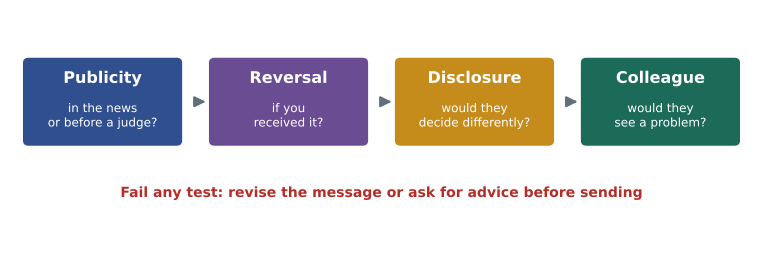
A few practical tests help when you are unsure. The publicity test: would you be comfortable if this message appeared in the news or in front of a judge? The reversal test: how would you feel if you received it? The disclosure test: would the reader make a different decision if they knew what you know? And the trusted-colleague test: would a respected colleague see a problem with it? If a message fails any of these tests, revise it or seek advice before sending.
Worked problem
Spotting deception by omission
A gym's promotional email says: "Join today for just $10 a month!" The fine print at the bottom, in light gray 8-point type, says the rate applies for the first three months, then rises to $49 a month on a 24-month contract, with a $99 enrollment fee and a $150 cancellation fee. Calculate the true minimum cost of the contract and rewrite the headline honestly.
Show solution
- First 3 months = 3 × $10 = $30.
- Remaining 21 months = 21 × $49 = $1,029.
- Enrollment fee = $99. Minimum total = $30 + $1,029 + $99 = $1,158 over 24 months.
- Effective monthly cost = $1,158 ÷ 24 = $48.25, nearly five times the advertised $10.
- Honest headline: "$10 a month for your first 3 months, then $49 a month (24-month membership; $99 enrollment fee)." Show the total and the terms in readable type near the price.
Answer: The true minimum cost is $1,158, about $48.25 a month. The original headline is technically true but misleading, and in many jurisdictions it could breach consumer protection or deceptive marketing law.
Defamation
Defamation is a false statement of fact, communicated to at least one other person, that harms someone's reputation. Written defamation (including emails, posts and reviews) has traditionally been called libel, and spoken defamation slander. Businesses face defamation risks when employees criticize competitors, former employees, customers or suppliers, and when they write references or post online. The main defenses include truth (justification), opinion or fair comment on a matter of public interest, privilege (for example, statements in court or, in some circumstances, references given in good faith) and, for the media and others, responsible or public-interest communication.
In the United States, defamation is governed by state law, shaped by the First Amendment. Since New York Times Co. v. Sullivan (1964), public officials, and later public figures, must prove actual malice: that the speaker knew the statement was false or acted with reckless disregard for the truth. Private individuals usually need to show at least negligence. Statements of pure opinion are generally protected. More than 30 states have anti-SLAPP laws, and Section 230 of the Communications Decency Act generally shields online platforms from liability for content posted by users, though not the users themselves.
Practical rules reduce the risk: stick to verifiable facts, label opinions as opinions, avoid speculation about people's motives or character, keep criticism of competitors to documented comparisons, and give references that are honest and limited to facts you know. When responding to a negative online review, stay factual and courteous; an angry response can create a new problem.
Privacy
The United States has no single comprehensive federal privacy law. Instead, federal laws protect particular kinds of information, such as health information under HIPAA, financial information under the Gramm-Leach-Bliley Act and children's information online under COPPA, while the Federal Trade Commission treats broken privacy promises and lax data security as unfair or deceptive practices. About 20 states, led by California with the California Consumer Privacy Act as amended by the California Privacy Rights Act, have passed comprehensive consumer privacy laws that give residents rights to know, delete and opt out of the sale or sharing of their data, and every state has a data breach notification law. For communicators, privacy means collecting only the personal information you need, using it only for the purposes you stated, sending it only to people entitled to see it and protecting it in emails and files.
Commercial electronic messages: CASL and CAN-SPAM
Marketing emails and texts are regulated on both sides of the border, and the two laws take different approaches. Canada's anti-spam legislation (CASL) is an opt-in law: in general, you need the recipient's consent before sending a commercial electronic message. The US CAN-SPAM Act is an opt-out law: you may send commercial email without prior consent, but you must follow content rules and honor unsubscribe requests. A message sent from or to Canada must comply with CASL, and a message sent to US recipients must comply with CAN-SPAM, so organizations that market in both countries usually design to the stricter Canadian standard.
| Requirement | CASL (Canada) | CAN-SPAM (United States) |
|---|---|---|
| Consent model | Opt-in: express or implied consent required before sending | Opt-out: no prior consent needed for email |
| Implied consent | For example, an existing business relationship (purchase within the past two years) or a published business address relevant to the message | Not applicable |
| Identification | Sender's name and contact information (mailing address plus phone, email or web address) | Accurate header information and a valid physical postal address |
| Subject line and content | No false or misleading representations | No deceptive subject lines; messages must be identified as ads |
| Unsubscribe | Free, easy mechanism; honored within 10 business days | Clear opt-out; honored within 10 business days |
| Scope | Email, text messages, social media direct messages and other electronic messages | Commercial email (text messages are covered mainly by other rules, such as the Telephone Consumer Protection Act) |
| Maximum penalties | Administrative penalties up to $1 million per violation for individuals and $10 million for organizations, imposed by the CRTC | Civil penalties of up to $53,088 per email (2025 adjusted amount, unchanged for 2026), enforced by the FTC |
Worked problem
Checking a marketing email for compliance
A Vancouver software company wants to email a promotion to 8,000 contacts: 3,000 customers who bought in the past 18 months, 2,500 people who downloaded a free guide and ticked a box agreeing to receive marketing emails, and 2,500 addresses bought from a list broker, half in Canada and half in the United States. Which contacts can it email, and what must every message include?
Show solution
- Customers who bought in the past 18 months: implied consent under CASL (an existing business relationship within two years); they may be emailed, and consent should be renewed before it expires.
- Guide downloaders who ticked the box: express consent under CASL, provided the request clearly identified the company and explained that consent could be withdrawn; they may be emailed.
- Purchased Canadian addresses: no consent from the company, so emailing them would breach CASL; do not send.
- Purchased US addresses: CAN-SPAM does not require prior consent, so emails are legally possible if they meet its content rules, but bought lists carry high bounce and spam-complaint rates and reputational risk; many companies avoid them.
- Every message: identify the company with a mailing address and contact details, use a truthful subject line, include a working unsubscribe link and honor requests within 10 business days.
Answer: The company can email 5,500 Canadian-consented contacts; it must not email the 1,250 purchased Canadian addresses, and should think carefully before using the 1,250 purchased US addresses.
Business records and retention
Emails, chat messages, documents and recordings are business records. Organizations keep records to meet legal and tax requirements, to support decisions and to defend themselves in disputes, and they destroy records on a schedule to limit cost and risk. A records retention schedule sets how long each type of record is kept.
In the United States, the Internal Revenue Service generally requires tax records to be kept for at least three years after filing, and up to seven years in some cases, and federal employment laws require payroll and personnel records to be kept for set periods (for example, three years for payroll records under the Fair Labor Standards Act).
When litigation is reasonably anticipated, an organization must preserve relevant records, including emails and chat messages, under a legal hold, even if the normal schedule would destroy them. Deleting relevant records after that point can lead to severe court sanctions. In discovery, the other side can request relevant electronic records, which is why the advice in lesson 1, to write every message as if a judge might read it, is practical rather than theoretical.
Using AI writing tools responsibly
Generative AI tools can draft emails, summarize documents, suggest rewrites, translate and create slide outlines in seconds. Used well, they save time and can improve clarity. Used carelessly, they create serious problems. AI models can produce confident, fluent text that is wrong, including invented facts, figures and citations (often called hallucinations). Text pasted into a public AI tool may be stored or used in ways that breach confidentiality, privacy law or a client agreement. AI output may echo biased patterns in its training data. And readers may feel misled if they discover that a message presented as personal was generated by a machine.
| Risk | Responsible practice |
|---|---|
| Inaccurate or invented content | Verify every fact, number, name, quotation and citation against a reliable source before using it |
| Confidential or personal information | Use only tools approved by your organization; never paste confidential, client or personal information into unapproved public tools |
| Bias | Review output for stereotypes and unfair assumptions, especially in hiring, performance and customer communications |
| Loss of voice and accountability | Edit drafts into your own words; you are responsible for anything you send |
| Transparency | Follow your organization's disclosure policy; disclose AI assistance where readers would reasonably expect to know |
| Intellectual property | Do not present AI output as original creative work where that matters; check rights for images and long passages |
Disclosure norms are still developing. There is no general federal AI disclosure law in the United States, but the Federal Trade Commission has warned that using AI to deceive consumers, such as fake reviews or undisclosed chatbots posing as people, can violate the FTC Act, and its 2024 rule on fake reviews bans AI-generated reviews attributed to people who do not exist. Several states have disclosure laws: California requires bots used to sell goods or influence votes to identify themselves, and Utah requires disclosure of generative AI in certain consumer interactions. New York City and Illinois regulate AI in hiring (lesson 11). For organizations that also operate in Europe, the European Union's AI Act sets transparency obligations, such as telling people when they are interacting with a chatbot and labeling certain AI-generated content, which began to apply in August 2026.
Worked problem
Writing an AI disclosure and review note
A communications team used an approved AI tool to draft a first version of its annual sustainability summary for customers, then edited and fact-checked it. Write a short disclosure for the document and a three-step review note for the internal file.
Show solution
- Disclosure (at the end of the summary): "This summary was drafted with the help of an AI writing tool and was reviewed, edited and fact-checked by our communications and sustainability teams, who are responsible for its content."
- Review step 1: every figure (emissions, energy use, waste diverted) was checked against the audited sustainability data, and two figures the tool had rounded incorrectly were corrected.
- Review step 2: every environmental claim was checked for substantiation, since unsupported green claims can breach deceptive marketing rules.
- Review step 3: the final text was edited for the company's voice and reviewed by legal before publication; no confidential data was entered into the tool.
Answer: A brief, plain disclosure tells readers how the document was made and who is accountable; the internal note records the checks that make that accountability real.
Capstone: building your communication portfolio
Throughout this course, each lesson has ended with a portfolio task. The capstone brings the best of that work together into a professional communication portfolio that shows an employer what you can do. The portfolio has three core pieces built around one realistic business scenario, plus a reflection.
- A business email or memo (lessons 3 to 5): a purpose-first message to a decision-maker, for example announcing a recommendation, requesting approval or delivering bad news, with a specific subject line and a clear action and deadline.
- A short report or proposal (lessons 6 to 8): four to six pages with an executive summary, talking headings, at least one accessible chart with a takeaway title, a weighted decision matrix or budget table, and at least three sources cited in APA or Chicago style.
- A presentation (lesson 9): six to eight slides and a recorded five-minute talk presenting the report's recommendation, with takeaway headlines, minimal text and a call to action.
- A reflection of about 500 words: what you learned, which feedback changed your work, how you adapted to your audience, and how you used (or chose not to use) AI tools, with a note of what you verified.
| Criterion | Weight | What strong work shows |
|---|---|---|
| Purpose and audience | 20 % | A clear purpose; content, order and tone adapted to each audience |
| Organization | 15 % | Main points first; logical structure; informative headings |
| Style and plain language | 20 % | Concise, active, readable sentences; consistent conventions |
| Evidence and accuracy | 15 % | Correct figures, verified facts, credited sources |
| Visual design and accessibility | 15 % | Readable layout, honest charts, alt text, sufficient contrast |
| Delivery | 10 % | Confident, well-timed presentation within the time limit |
| Ethics and compliance | 5 % | Truthful claims, privacy respected, AI use disclosed and checked |
Worked problem
Scoring a portfolio with the rubric
A student's portfolio receives these scores out of 10: purpose and audience 8, organization 9, style 7, evidence 9, visual design 6, delivery 8, ethics 10. Calculate the weighted score, and identify where improvement would raise it most.
Show solution
- Weighted score = 0.20 × 8 + 0.15 × 9 + 0.20 × 7 + 0.15 × 9 + 0.15 × 6 + 0.10 × 8 + 0.05 × 10.
- = 1.60 + 1.35 + 1.40 + 1.35 + 0.90 + 0.80 + 0.50 = 7.90 out of 10, or 79 %.
- Each extra point on style adds 0.20, and each on visual design adds 0.15.
- Raising visual design from 6 to 9 (fixing contrast, adding alt text and redesigning one chart) adds 3 × 0.15 = 0.45, giving 8.35, or 83.5 %.
Answer: The portfolio scores 79 %. Visual design has the most room for improvement, and fixing it would lift the score to 83.5 %.
Keep your portfolio after the course. Remove confidential details, store it as a PDF or a simple website, and update it as you produce new work. In interviews, a portfolio turns claims such as "strong communication skills" into evidence.
Common mistakes
MistakeMaking technically true statements that create a false impression.
InsteadApply the disclosure test and present material terms clearly and prominently.
MistakeStating opinions about people as facts.
InsteadStick to verifiable facts and label opinions as opinions.
MistakeEmailing purchased lists in Canada.
InsteadUnder CASL, send commercial electronic messages only with express or implied consent.
MistakeDeleting emails once a dispute is expected.
InsteadPreserve relevant records under a legal hold.
MistakePasting client data into a public AI tool.
InsteadUse only approved tools and never enter confidential or personal information without authorization.
MistakeTrusting AI-generated facts and citations.
InsteadVerify every fact, figure and citation against a reliable source.
Summary and key terms
- Ethical communication is truthful, fair and respectful, and avoids deception by omission, fine print and distortion.
- Use the publicity, reversal, disclosure and trusted-colleague tests when unsure.
- Defamation is a false statement of fact that harms reputation; defenses include truth, opinion and privilege.
- US privacy law is sectoral and state-based; CAN-SPAM sets opt-out and content rules for commercial email.
- Records must be kept according to retention schedules and preserved under a legal hold when litigation is expected.
- Use AI tools responsibly: verify, protect confidential data, check for bias, keep accountability and disclose where expected.
- The capstone portfolio combines an email, a report and a presentation with a reflection, assessed with a weighted rubric.
- Defamation
- A false statement of fact, communicated to others, that harms someone's reputation.
- Fair comment
- A defense protecting honest opinion on a matter of public interest.
- Personal information
- Information about an identifiable individual.
- Express consent
- Clear, positive agreement to receive messages or allow a use of information.
- Implied consent
- Consent inferred from circumstances, such as an existing business relationship.
- Commercial electronic message
- An electronic message that encourages participation in a commercial activity.
- Retention schedule
- A policy setting how long each type of record is kept.
- Legal hold
- An obligation to preserve records relevant to anticipated or actual litigation.
- Hallucination
- Fluent but false content produced by an AI model.
- Communication portfolio
- A curated collection of work samples that demonstrates communication skills.
Practice problems
Work each problem on paper first, then reveal the answer to check.
Name the four ethical tests in this lesson.
Show answer
Publicity, reversal, disclosure and trusted-colleague tests.
A plan advertises $15 a month for 2 months, then $40 a month for 10 months, with a $50 setup fee. What is the true 12-month cost?
Show answer
$30 + $400 + $50 = $480, or $40 a month on average.
Is "Their product is a scam run by crooks" defamatory risk or safe opinion?
Show answer
A serious defamation risk: it presents damaging claims about people as fact.
Under CASL, may a business email a customer who bought from it 14 months ago?
Show answer
Yes, under implied consent from an existing business relationship within two years, if the message meets content rules.
What must every CAN-SPAM-compliant email include?
Show answer
Accurate headers, a non-deceptive subject, identification as an ad, a physical postal address and a working opt-out.
Within how many business days must unsubscribe requests be honored under both laws?
Show answer
10 business days.
What is a legal hold?
Show answer
An obligation to preserve records relevant to anticipated or actual litigation.
Give two responsible practices for AI writing tools.
Show answer
Verify facts and citations; never paste confidential data into unapproved tools (also check bias, keep accountability, disclose).
A portfolio scores 9, 8 and 6 on criteria weighted 50 %, 30 % and 20 %. What is the weighted score?
Show answer
4.5 + 2.4 + 1.2 = 8.1 out of 10.
What three core pieces make up the capstone portfolio?
Show answer
A business email or memo, a short report or proposal, and a presentation (plus a reflection).
Lesson quiz · 5 questions
Score 60% or more to complete this lesson.
Create a free account to save your progress, take quizzes and earn a certificate.