
BUS-120 · Lesson 5 of 12 · 32 min
Routine, positive and negative messages
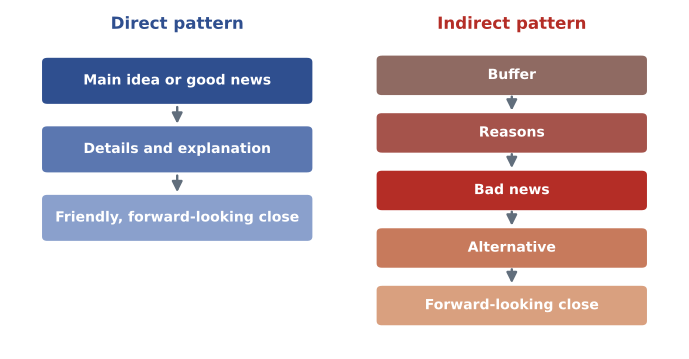
Most business messages are routine: requests for information, replies, confirmations, instructions, thank-you notes and announcements. A smaller but more delicate group delivers bad news: a refused request, a price increase, a rejected proposal, a layoff, a product recall. This lesson shows how to write both kinds. Routine and positive messages use the direct pattern, getting straight to the point. Negative messages call for more judgment: sometimes the direct pattern is best, but often an indirect pattern, which explains before it refuses, helps the reader accept the news and keeps the relationship intact.
Routine requests
A routine request asks for information, action or a favor that the reader is likely to provide. Open with the request itself, phrased as a polite question or a statement ("Could you send…" or "Please send…"). Explain in the body any background the reader needs and break multiple questions into a numbered list, so the reader can answer each one. Close with the deadline and the reason for it, and with appreciation that does not presume ("Thank you for your help" rather than "Thank you in advance", which some readers find pushy).
Worked problem
A routine request for information
A purchasing officer at a Saskatoon school board needs information from a furniture supplier before ordering 300 student desks. Write the opening and body of the request.
Show solution
- Opening: "Could you please send pricing and delivery information for 300 adjustable student desks (model SD-40 in your catalog) by Friday, March 6?"
- Body as a numbered list: (1) unit price at 300 units and any volume discount; (2) delivery time to Saskatoon and the delivery charge; (3) warranty terms; (4) whether you can deliver in two batches, in July and August.
- Closing: "We plan to place the order on March 13, in time for the new school year. Thank you for your help."
Answer: The request comes first, the questions are numbered and specific, and the deadline is explained.
Positive replies and good-news messages
When the answer is yes, say so in the first sentence: "Yes, we can deliver the desks in two batches." Then answer any other questions in the order asked, add helpful information the reader may not have thought to ask for, and close with a friendly, forward-looking statement. The same pattern works for good-news announcements: a promotion, an approved request, a new benefit. Lead with the news and the benefit to the reader, then give the details and any action needed.
| Part | Purpose | Example |
|---|---|---|
| Opening | Give the good news or answer immediately | Your request for flexible hours from September has been approved. |
| Body | Explain details, conditions and next steps | Your core hours will be 10 a.m. to 3 p.m. Please update your calendar and let your team know. |
| Close | End warmly and look ahead | I hope the new schedule makes the school run easier. Let me know how it works after the first month. |
Instructions, confirmations and goodwill messages
Instructions should use numbered steps in the order they are done, each starting with a command verb: "Open the claim form. Enter your employee number." Confirmations restate the key facts of an agreement or booking (who, what, when, where, how much) so that errors can be caught. Goodwill messages, such as thanks, congratulations and sympathy, should be prompt, sincere and specific; a thank-you that names exactly what the person did ("your extra weekend to finish the inventory count") means far more than a generic one. Goodwill messages should not include sales pitches.
Claims and adjustments
A claim is a message asking for a correction: a refund, a replacement, a repair or a credit. When the claim is reasonable, the direct pattern works best: state clearly what went wrong and what you want, give the facts (order numbers, dates, amounts) and attach evidence. Keep the tone calm and factual; anger rarely helps. An adjustment message is the organization's reply. When the answer is yes, grant the claim in the first sentence, explain what will happen, apologize briefly if the organization was at fault and rebuild confidence without over-promising.
Worked problem
Calculating and granting an adjustment
A customer ordered 40 boxes of printer paper at $42.50 a box, plus 5 % sales tax. Twelve boxes arrived water-damaged. The customer asks for a refund for the damaged boxes and the tax on them. The supplier agrees and also offers a 10 % credit on the next order as goodwill. Calculate the refund and draft the opening.
Show solution
- Value of damaged boxes = 12 × $42.50 = $510.00.
- Tax on damaged boxes = 0.05 × $510.00 = $25.50.
- Refund = $510.00 + $25.50 = $535.50.
- Opening: "We have refunded $535.50 to your credit card for the 12 damaged boxes and the sales tax on them; you should see it within five business days."
- Body: a brief apology and explanation (a pallet was left uncovered during unloading at our warehouse; we have changed our procedure), then the goodwill offer: "As an apology, you will receive 10 % off your next order; the credit is already on your account."
Answer: The refund is $535.50. The message grants it in the first sentence, explains briefly, says what has changed and offers goodwill without excessive apology.
Delivering bad news
Bad-news messages have several goals at once: deliver the news clearly so there is no misunderstanding; help the reader accept it; maintain goodwill and the relationship; and protect the organization from legal liability. These goals pull in different directions, which is why bad news needs careful planning.
Choose the direct pattern when the news is minor, when the reader prefers directness (many colleagues and managers do), when firmness is needed (a final notice of an overdue account) or when the reader might miss the news if it is buried. Choose the indirect pattern when the news is significant and personal, when the reader may be upset, or when you need to explain the reasons before the reader will accept the decision.
| Step in the indirect pattern | What it does | Example (refusing a request to sponsor a charity run) |
|---|---|---|
| Buffer | Opens with a neutral or positive statement relevant to the topic, without misleading | Your work to raise funds for the children's hospital has made a real difference in our community. |
| Reasons | Explains the decision logically and, where possible, in terms of shared values | Each year our community fund supports organizations chosen by an employee committee in January, and this year's budget is fully committed. |
| Bad news | States the decision clearly but without dwelling on it, often in a subordinate clause or passive voice | Although we cannot sponsor this year's run, |
| Alternative | Offers what you can do | we would be glad to share your event in our staff newsletter and invite you to apply for next year's fund before December 15. |
| Close | Ends in a friendly, forward-looking way, without repeating the refusal | We wish you every success on race day. |
Several techniques soften bad news without hiding it. Place the refusal in the middle of a paragraph or in a subordinate clause ("Although we cannot…"). Use the passive voice to avoid blaming ("The deadline was missed" rather than "You missed the deadline"). Imply the refusal only when it will be clearly understood ("We have chosen to work with a local supplier" implies "not you"). Emphasize what you can do rather than what you cannot. Avoid apologizing for a decision you would make again, which can sound insincere and invite argument, and avoid hollow phrases such as "We regret any inconvenience".
Worked problem
Rewriting a harsh refusal
A landlord sent this message to a tenant: "Your request to install a dishwasher is denied. Per section 12 of the lease, no alterations to plumbing are allowed. Do not proceed with any installation." Rewrite it using the indirect pattern.
Show solution
- Buffer: "Thank you for checking with us before making changes to your unit; we appreciate your care with the apartment."
- Reasons: "The building's plumbing was not designed for additional appliances, and under section 12 of your lease, changes to the plumbing must be made by the building's contractor to protect all units from leaks."
- Bad news: "For that reason, we are not able to approve a built-in dishwasher."
- Alternative: "Many tenants use a portable countertop dishwasher that connects to the kitchen tap without any plumbing changes; you are welcome to use one of those."
- Close: "If you have any questions, please call the office at 555-0142."
Answer: The rewrite keeps the decision clear and the lease reference, explains the reason in terms of protecting all units, offers a workable alternative and ends courteously.
Bad news inside the organization
Some of the hardest messages go to employees: layoffs, restructuring, canceled bonuses, denied promotions. For news that affects someone's job or income, the first communication should usually be in person or by video, delivered by the person's manager, followed by a written confirmation. Organization-wide bad news should be shared early, honestly and consistently through several channels, ideally before rumors spread. Explain the reasons, say what will happen next and when, describe the support available (such as an employee assistance program or outplacement services) and give people a way to ask questions. In unionized workplaces, collective agreements may set out notice and consultation requirements, and employment standards laws in every province and state set minimum notice or pay for terminations, so involve human resources and legal advisers before announcing.
Apologies
When your organization has made a mistake, an effective apology acknowledges the specific error, takes responsibility, explains briefly (without excuses), describes what is being done to fix it and prevent a repeat, and offers a remedy where appropriate. Avoid conditional apologies ("We apologize if anyone was offended"), which sound insincere. Many readers wonder whether apologizing admits legal liability. Most Canadian provinces and territories have apology acts, and many US states have apology laws, which limit the use of an apology as evidence of liability, though the scope varies widely by jurisdiction. When the stakes are high, the wording should be reviewed by a lawyer.
In the United States, for example, many state apology laws protect statements of sympathy, but only some protect admissions of fault, so a sincere expression of regret may be protected while a statement such as "It was our fault" may not be.
Worked problem
Writing a service apology
A software company's online booking system was down for six hours on a Monday, affecting 2,300 small-business customers. Write the key parts of an email apology.
Show solution
- Subject: "Monday's booking outage: what happened and what we are doing".
- Acknowledge and take responsibility: "On Monday, our booking system was unavailable from 8 a.m. to 2 p.m. Eastern. We know many of you lost bookings during your busiest morning, and we are sorry."
- Explain briefly: "A software update we released on Sunday night contained an error that our testing did not catch."
- Fix and prevention: "We restored service at 2 p.m. and have changed our process so that updates are released in stages and can be reversed within minutes."
- Remedy: "We have credited one week of your subscription to every account. You do not need to do anything."
Answer: The apology is specific, takes responsibility, explains without excuses, describes the fix and offers a concrete remedy.
Portfolio task for lesson 5: write a refusal using the indirect pattern for a request you have received or can imagine (for example, a request for a discount, a refund outside the policy or time off at a busy period). Then write a short, specific thank-you note to someone who helped you recently.
Common mistakes
MistakeOpening a good-news message with background.
InsteadGive the good news in the first sentence.
MistakeUsing a buffer that misleads the reader into expecting a yes.
InsteadUse a neutral, relevant buffer that does not imply approval.
MistakeHiding bad news so well that the reader misses it.
InsteadState the decision clearly, even if gently.
MistakeBlaming the reader with "you" statements.
InsteadUse neutral or passive wording for errors and refusals.
MistakeEnding with "Please do not hesitate to contact us if you have any questions regarding this refusal."
InsteadEnd positively and look ahead without repeating the bad news.
MistakeDelivering layoffs or major personal news by email alone.
InsteadDeliver significant personal news in person or by video, then confirm in writing.
Summary and key terms
- Routine requests and positive messages use the direct pattern: main idea, details, friendly close.
- Number multiple questions and explain deadlines.
- Goodwill messages should be prompt, sincere and specific.
- Grant reasonable claims in the first sentence and explain the remedy.
- Bad news aims to be clear, accepted, relationship-preserving and legally safe.
- The indirect pattern runs from buffer to reasons, bad news, alternative and close; the direct pattern suits minor news or firm messages.
- Effective apologies are specific, responsible and include a fix and a remedy; apology laws vary by jurisdiction.
- Routine request
- A request the reader is likely to grant, written in the direct pattern.
- Goodwill message
- A message of thanks, congratulations or sympathy that builds relationships.
- Claim
- A request for a correction such as a refund or replacement.
- Adjustment
- A response to a claim.
- Buffer
- A neutral or positive opening that prepares the reader for bad news.
- Indirect pattern
- An organization that gives reasons before the main idea.
- Subordinate clause
- A clause that cannot stand alone, used to de-emphasize information.
- Implied refusal
- A refusal conveyed without stating "no", used only when it will be clearly understood.
- Apology law
- A statute limiting the use of an apology as evidence of legal liability.
- Employee assistance program
- An employer-funded confidential counseling and support service.
Practice problems
Work each problem on paper first, then reveal the answer to check.
Write an opening for a request for a reference letter.
Show answer
"Could you write a reference letter for my application to the Pinecrest Hospital administrator role by June 2?"
Why number questions in a request?
Show answer
So the reader can answer each one and none is missed.
What should the first sentence of a yes reply do?
Show answer
Say yes, or give the good news.
An order of 25 items at $18 each has 4 defective items. With 13 % sales tax, what is the refund for the defective items?
Show answer
4 × $18 = $72; tax = $9.36; refund = $81.36.
List the five parts of the indirect bad-news pattern.
Show answer
Buffer, reasons, bad news, alternative, close.
When is the direct pattern better for bad news?
Show answer
When the news is minor, the reader prefers directness, firmness is needed or the news might be missed.
Rewrite: "You failed to include your receipt."
Show answer
"The receipt was not included with the claim; please send it so we can process your refund."
What is wrong with "We apologize if anyone was offended"?
Show answer
It is conditional and does not acknowledge a specific error or take responsibility.
How should significant personal news, such as a layoff, be delivered?
Show answer
In person or by video by the manager, followed by written confirmation, with HR involved.
Name two elements of an effective apology.
Show answer
Acknowledge the specific error and take responsibility (also explain briefly, describe the fix and offer a remedy).
Lesson quiz · 5 questions
Score 60% or more to complete this lesson.
Create a free account to save your progress, take quizzes and earn a certificate.