
BUS-120 · Lesson 2 of 12 · 33 min
Audience and purpose
Before you write a word, two questions decide whether a message will work: why am I writing, and who will read it? Professional writers spend a surprising share of their time on these questions, because a clear purpose and a well-understood audience make every later decision easier, from what to include and in what order, to how formal to be and which channel to use. This lesson gives you tools for defining purpose, analyzing audiences, adapting your message and writing in plain language, and it maps the plain-language rules that governments in Canada and the United States apply to their own writing.
Defining your purpose
Most business messages have one of three broad purposes: to inform (share facts, updates or instructions), to persuade (change a belief or prompt an action) or to build goodwill (strengthen a relationship). Many messages combine them; a good-news message informs and builds goodwill, and a proposal informs in order to persuade. Beyond the broad purpose, you need a specific purpose: the precise result you want. A useful test is to complete the sentence "After reading this, the reader will…" with an observable action or decision.
| Weak purpose | Specific purpose |
|---|---|
| Tell the team about the new expense system | After reading this, every employee will submit October expenses in the new system by November 5 |
| Update the client on the project | After reading this, the client will approve the revised delivery date of March 14 or call to discuss it |
| Ask for budget | After reading this, the director will approve $18,500 for two contract designers for the spring campaign |
| Respond to the complaint | After reading this, the customer will accept a replacement unit and remain a customer |
A second test is the elevator summary: can you state your main message in one or two sentences that a busy reader could act on? If you cannot, you are not ready to write. Many professional writers type this summary at the top of their draft as a working note; often it survives, slightly edited, as the opening of the final message.
Analyzing your audience
Audience analysis asks who will read the message and what they need. Start by identifying the different audiences. The primary audience will act on the message or make the decision. The secondary audience will be affected or will implement it. A gatekeeper, such as an executive assistant or a manager who must approve forwarding, can stop the message before it reaches the primary audience. A watchdog audience, such as a regulator, a union, the media or a future auditor, may not be addressed directly but will judge the message later.
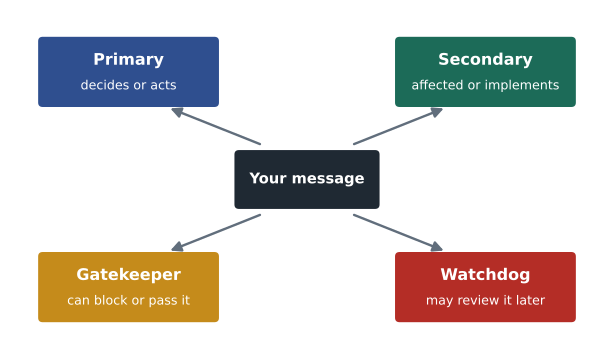
For each audience, consider five factors. Knowledge: what do they already know about the topic, and what terms will they understand? Interests: what do they care about, and what is in it for them? Attitude: are they likely to be supportive, neutral or resistant? Expectations: what format, length and level of formality do they expect? Situation: how and when will they read the message, on a phone between meetings, at a desk, or printed for a board meeting?
| Factor | Questions to ask | How it shapes the message |
|---|---|---|
| Knowledge | What do they know? Which terms are familiar? | Level of detail; whether to define terms |
| Interests | What do they gain or lose? What do they value? | Which benefits and evidence to emphasize |
| Attitude | Supportive, neutral or resistant? | Direct or indirect order; how much evidence |
| Expectations | What format, length and tone are normal? | Template, formality, length |
| Situation | Where, when and on what device will they read? | Length, layout, subject line, attachments versus links |
Worked problem
One message, three audiences
A hospital is changing its staff parking: the east lot will close for 18 months during construction, and staff will use a shuttle from a new lot 2 km away. Analyze three audiences: nurses on rotating shifts, the hospital's board, and the unions that represent support staff.
Show solution
- Nurses (primary): know the site well but not the plan; care about safety at night, travel time and shift start times; likely resistant; will read on phones between shifts. Lead with what changes for them, the shuttle frequency at shift changes and the start date, in a short, scannable format.
- Board (secondary): needs the cost, the risk and the reason; is supportive of the construction but sensitive to staff morale and reputation; expects a brief formal summary with a budget line.
- Unions (watchdog and stakeholder): will check whether the change respects collective agreements on parking and travel time; expect early consultation and precise terms; a formal letter and a meeting are appropriate.
- Result: one decision, three messages with different content, order, tone and channel.
Answer: Analyzing each audience shows that a single announcement would serve none of them well; tailor content, order, tone and channel to each.
Adapting the message: the "you" view and positive language
Once you know your audience, adapt the message to them. The "you" view (sometimes called the you attitude) frames information from the reader's perspective: what they get, what they need to do, how it affects them. It is not about using the word "you" mechanically; it is about putting the reader's interests at the center. Positive language tells the reader what can be done rather than what cannot, without hiding real limits. Bias-free language avoids assumptions about gender, age, race, disability or other characteristics. Together these adaptations make a message easier to accept.
| Writer-centered or negative | Reader-centered and positive |
|---|---|
| We are pleased to announce that we have extended our hours. | You can now reach our support team until 9 p.m. on weekdays. |
| We cannot process your claim without the receipt. | As soon as we receive your receipt, we will process your claim within three business days. |
| Our policy does not allow returns after 30 days. | You can return items within 30 days of purchase for a full refund. |
| Each manager should submit his report. | Managers should submit their reports. / Please submit your report. |
| The handicapped employee needs a special desk. | The employee needs an adjustable-height desk. |
Use the "you" view carefully with negative messages. "You failed to submit the form" is reader-centered in a bad way: it blames. In negative situations, a neutral or passive construction is kinder: "The form had not been received by the deadline." Lesson 5 develops strategies for bad news in detail.
What plain language means
Plain language is communication your audience can understand the first time they read or hear it. A widely used international definition, adopted by the International Plain Language Federation and reflected in the ISO 24495-1 standard on plain language published in 2023, says that a communication is in plain language if its wording, structure and design are so clear that the intended readers can easily find what they need, understand what they find and use that information. Plain language is not dumbing down. Experts prefer it too; studies of lawyers and judges have found that most prefer plain versions of legal documents.
Plain-language techniques fall into four groups. Organize for the reader: put the most important information first, group related material and use informative headings. Write clear sentences: prefer short sentences (an average of 15 to 20 words), active voice, strong verbs and the most common word that fits. Choose words carefully: use familiar terms, define necessary technical terms and use the same term for the same thing. Design for ease: use lists for steps and options, tables for comparisons, white space and readable type.
| Instead of | Try |
|---|---|
| utilize | use |
| commence | start or begin |
| in the event that | if |
| prior to | before |
| at this point in time | now |
| in order to | to |
| make a decision | decide |
| is in compliance with | complies with |
| due to the fact that | because |
| a large number of | many |
Plain language in government: Canada and the United States
In the United States, the Plain Writing Act of 2010 requires federal agencies to use clear, concise, well-organized writing in documents that the public uses to get benefits or services, file taxes or comply with requirements. Agencies must name a senior official for plain writing, train staff and report on compliance. For years the Federal Plain Language Guidelines were published on plainlanguage.gov; that address now redirects to plain-language guides on Digital.gov, and the Center for Plain Language publishes an annual federal report card. Plain-language requirements also apply in particular fields, such as the SEC's plain English rules for parts of securities disclosure documents and the plain-language rules many states apply to consumer contracts and insurance policies.
| Element | Canada | United States |
|---|---|---|
| Federal framework | Policy on Communications and Federal Identity; Canada.ca Content Style Guide | Plain Writing Act of 2010; agency plain-writing plans |
| Main guidance | Canada.ca Content Style Guide; Language Portal of Canada (The Canadian Style, Writing Tips Plus) | Plain-language guides on Digital.gov (formerly plainlanguage.gov); Federal Plain Language Guidelines |
| Language duty | Communications in English and French under the Official Languages Act | English, with language access services for people with limited English proficiency |
| Reading level | Formula targets dropped in 2024; usability testing preferred | No fixed level in the Act; many agencies aim for about grade 8 |
| Private sector | Plain-language rules in some consumer, insurance and securities contexts | SEC plain English rules; state consumer contract laws |
Readability formulas: useful, but limited
Readability formulas estimate how hard a text is to read from sentence length and word length. The two most common are the Flesch Reading Ease score, where higher numbers mean easier text (60 to 70 is plain English; 30 or below is very difficult), and the Flesch–Kincaid Grade Level, which estimates the school grade needed to understand the text.
Worked problem
Scoring a before-and-after rewrite
A notice to tenants originally read: "In the event that remediation activities are necessitated by the identification of moisture infiltration, occupants will be required to facilitate access to the premises." It has 1 sentence, 24 words and 54 syllables. The rewrite reads: "If we find a leak, we will need to fix it. Please let our crew into your unit." It has 2 sentences, 18 words and 20 syllables. Compute both Flesch scores.
Show solution
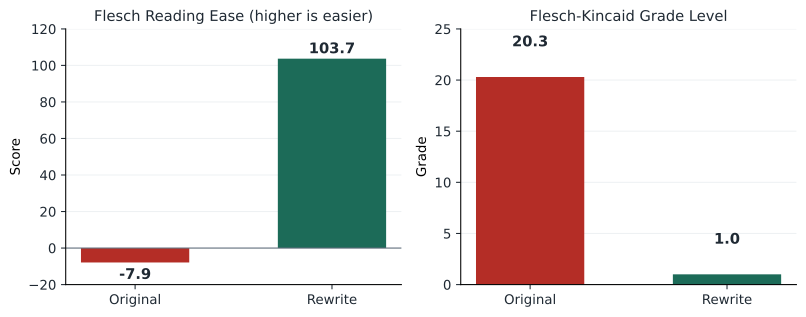
- Original: words per sentence = 24; syllables per word = 54 ÷ 24 = 2.25.
- Original Reading Ease = 206.835 − 1.015 × 24 − 84.6 × 2.25 = 206.835 − 24.36 − 190.35 = −7.9 (scores below zero are possible for very dense text).
- Original Grade Level = 0.39 × 24 + 11.8 × 2.25 − 15.59 = 9.36 + 26.55 − 15.59 = 20.3.
- Rewrite: words per sentence = 18 ÷ 2 = 9; syllables per word = 20 ÷ 18 = 1.11.
- Rewrite Reading Ease = 206.835 − 1.015 × 9 − 84.6 × 1.11 = 206.835 − 9.135 − 94.0 = 103.7 (scores above 100 are possible for very simple text).
- Rewrite Grade Level = 0.39 × 9 + 11.8 × 1.11 − 15.59 = 3.51 + 13.11 − 15.59 = 1.0.
Answer: The rewrite moves from beyond graduate-school difficulty (about grade 20) to about grade 1, without losing the meaning: if there is a leak, tenants must let the crew in.
Formulas count; they do not understand. A text of short, simple words can still be confusing if it is badly organized, and a necessary technical term will raise the score even when every reader knows it. Use formulas as a quick warning signal, then test with real readers when the stakes are high: ask a few people from the intended audience to find a piece of information or explain what they must do, and watch where they struggle.
import re

def syllables(word):
    word = word.lower().strip(".,;:!?\"'")
    groups = re.findall(r"[aeiouy]+", word)
    n = len(groups)
    if word.endswith("e") and n > 1 and not word.endswith("le"):
        n -= 1
    return max(n, 1)

def flesch(text):
    sentences = max(len(re.findall(r"[.!?]+", text)), 1)
    words = re.findall(r"[A-Za-z']+", text)
    syl = sum(syllables(w) for w in words)
    wps, spw = len(words) / sentences, syl / len(words)
    ease = 206.835 - 1.015 * wps - 84.6 * spw
    grade = 0.39 * wps + 11.8 * spw - 15.59
    return len(words), sentences, syl, round(ease, 1), round(grade, 1)

before = ("Please be advised that all personnel are required to complete the mandatory "
          "cybersecurity awareness training module prior to the expiration of the current quarter.")
after = "Please finish the online security training by March 31. It takes about 20 minutes."
for label, t in [("before", before), ("after", after)]:
print(label, flesch(t))before (24, 1, 50, 6.2, 18.4) after (12, 2, 22, 45.6, 8.4)
The script above uses a rough syllable counter, so its counts may differ slightly from a word processor's, but the pattern is clear: the rewrite is shorter, uses familiar words and adds a useful fact (how long the training takes).
Purpose, audience and the plain-language checklist
Bring the lesson together with a short checklist you can apply before sending any important message. What is my specific purpose? Who are the primary, secondary, gatekeeper and watchdog audiences? What do they know, want and expect? Is the main point first? Are the sentences short and active? Have I replaced or defined jargon? Would a list, table or heading help? Have I tested the text with someone like the reader?
Worked problem
Applying the checklist to a policy update
An HR team drafted this opening for an all-staff message: "Pursuant to a comprehensive review of organizational travel expenditures undertaken in Q2, the Finance Committee has determined that modifications to the reimbursement framework are warranted, effective at the commencement of the next fiscal period." Rewrite it using the checklist.
Show solution
- Purpose: staff should know what changes, when, and what they need to do.
- Audience: all employees who travel; they want to know how it affects their claims; they will skim on a phone.
- Main point first: the change and the date.
- Plain words: "pursuant to" becomes "after"; "expenditures" becomes "costs"; "commencement of the next fiscal period" becomes the actual date.
- Rewrite: "From April 1, the travel meal allowance is changing and you will need to submit receipts for hotel stays over $200 a night. The details and the new claim form are below."
Answer: The rewrite gives the reader the change, the date and the action in two sentences, then points to details.
Portfolio task for lesson 2: choose a document from your workplace or school that the public or new staff must read (a policy, a form or a set of instructions). Analyze its audiences, rewrite one page in plain language, and calculate the Flesch Reading Ease and Grade Level before and after. Record what the formulas missed.
Common mistakes
MistakeStarting to write before deciding what you want the reader to do.
InsteadWrite a specific purpose statement first: "After reading this, the reader will…".
MistakeWriting for yourself or for an imagined average reader.
InsteadIdentify the primary, secondary, gatekeeper and watchdog audiences and what each needs.
MistakeThinking plain language means childish language.
InsteadPlain language means the intended reader can find, understand and use the information; experts benefit too.
MistakeUsing "you" to blame the reader.
InsteadUse the "you" view for benefits and actions; use neutral wording for errors and refusals.
MistakeTreating a readability score as proof of clarity.
InsteadUse formulas as a quick signal and test important documents with real readers.
MistakeReplacing every technical term.
InsteadKeep necessary terms your readers use, and define them on first use.
Summary and key terms
- Define a specific purpose: the action or decision you want after the reader finishes.
- Identify primary, secondary, gatekeeper and watchdog audiences.
- Analyze knowledge, interests, attitude, expectations and reading situation.
- Adapt with the "you" view, positive language and bias-free language.
- Plain language means readers can find, understand and use information the first time.
- In the United States, the Plain Writing Act of 2010 requires plain writing in federal public documents.
- Readability formulas measure sentence and word length; they are a warning signal, not a verdict.
- Specific purpose
- The precise, observable result a message should produce.
- Primary audience
- The readers who will act on the message or make the decision.
- Secondary audience
- Readers affected by the message or responsible for carrying it out.
- Gatekeeper
- A person who can block or pass a message on its way to the primary audience.
- Watchdog audience
- A party, such as a regulator or the media, who may judge the message later.
- "You" view
- Framing a message from the reader's perspective and interests.
- Plain language
- Communication whose wording, structure and design let intended readers find, understand and use it easily.
- Flesch Reading Ease
- A readability score from 0 to about 100 based on sentence and word length; higher is easier.
- Flesch–Kincaid Grade Level
- A readability formula that estimates the school grade needed to understand a text.
- Bias-free language
- Wording that avoids unnecessary or stereotyped references to gender, age, race, disability or other characteristics.
Practice problems
Work each problem on paper first, then reveal the answer to check.
Write a specific purpose for an email asking a supplier for a quote.
Show answer
For example: "After reading this, the supplier will send a written quote for 500 units of part 22-B, delivered to Winnipeg, by May 10."
Who is the gatekeeper when you email a busy chief executive?
Show answer
Often an executive assistant or chief of staff who screens messages.
Rewrite in the "you" view: "We have added online booking to our website."
Show answer
"You can now book appointments online at any time."
Rewrite positively: "We cannot ship orders on weekends."
Show answer
"We ship orders Monday to Friday; orders placed on weekends ship on Monday."
Give plain replacements for "terminate", "endeavor" and "subsequent to".
Show answer
"End", "try" and "after".
A passage has 120 words, 6 sentences and 180 syllables. Find its Flesch Reading Ease.
Show answer
206.835 − 1.015 × 20 − 84.6 × 1.5 = 206.835 − 20.3 − 126.9 = 59.6.
Find the Flesch–Kincaid Grade Level for the same passage.
Show answer
0.39 × 20 + 11.8 × 1.5 − 15.59 = 7.8 + 17.7 − 15.59 = 9.9.
Name two limits of readability formulas.
Show answer
They ignore organization and meaning, and they penalize necessary technical terms that readers know.
What did ISO 24495-1 (2023) add to plain-language practice?
Show answer
An international standard setting out plain-language principles and guidelines based on the find, understand and use definition.
Why might you write three versions of the same announcement?
Show answer
Because different audiences need different content, order, tone and channels.
Lesson quiz · 5 questions
Score 60% or more to complete this lesson.
Create a free account to save your progress, take quizzes and earn a certificate.