
BUS-130 · Lesson 1 of 12 · 30 min
What organizational behavior is
Every organization, from a four-person landscaping company to a hospital network with forty thousand employees, is in the end a collection of people trying to coordinate their work. The plans, budgets and technologies that business courses usually emphasize only produce results when people understand them, accept them and act on them. Organizational behavior (OB) is the field that studies how individuals and groups think, feel and act in organizations, and how those organizations in turn shape the people inside them. It draws on psychology, social psychology, sociology, anthropology, economics and political science, and it turns their findings into practical tools for managers and employees.
This course is an introduction to that field. It is not a course on human resources administration (BUS-101 introduces that function) or on workplace mental health law (HSE-109 covers psychological health and safety in depth). Instead, it asks why people behave the way they do at work and what anyone, whether a new hire, a team lead or a chief executive, can do to make work more effective and more humane. Over twelve lessons you will move from the individual level (personality, perception, attitudes and motivation) to the group level (teams, decisions, power, leadership and conflict) and finally to the organizational level (culture, structure and change). The last lesson brings everything together in a capstone diagnosis of an invented company.
Why organizational behavior matters
Many people assume that the soft side of management is common sense. The evidence says otherwise. When researchers ask managers to predict the results of well-established studies, they are often wrong. Plenty of managers believe that happy workers are always productive workers, that money is the only reliable motivator, that brainstorming in a group produces more ideas than the same people working alone, or that strong cultures are always good. Each of these beliefs is either false or true only under particular conditions, as later lessons show. OB gives you a disciplined way to test such beliefs instead of relying on intuition, anecdote or the latest management fad.
The stakes are large. Gallup's State of the Global Workplace survey for 2025, published in 2026, found that only about 20 % of employees worldwide were engaged at work, the lowest level since 2020, and that engagement among managers had fallen to 22 %. Gallup reported engagement of about 32 % in the United States and about 21 % in Canada, and estimated that low engagement cost the world economy more than US$10 trillion in lost productivity in 2024, roughly 9 % of global GDP. Survey estimates like these have wide margins and depend on Gallup's own definitions, but the pattern is consistent across many sources: how people are managed has a large effect on whether organizations succeed.
| Outcome | What OB asks | Typical measure |
|---|---|---|
| Productivity | How efficiently and effectively do people convert inputs into valued outputs? | Output per hour, error rates, customer satisfaction |
| Absenteeism | Why do people fail to report to work? | Days absent per employee per year |
| Turnover | Why do people leave, and which departures hurt most? | Annual separation rate, regretted losses |
| Organizational citizenship | When do people help beyond their job description? | Peer and supervisor ratings |
| Counterproductive work behavior | Why do some people harm the organization or colleagues? | Incident reports, theft, sabotage, incivility |
| Job satisfaction and engagement | How do people feel about their work, and how energized are they? | Surveys, pulse checks, eNPS |
| Well-being | Does work support or damage health? | Stress, burnout and health indicators |
Three levels of analysis
OB studies behavior at three nested levels. At the individual level, it asks how personality, values, perception, attitudes, emotions and motivation shape what a person does. At the group level, it asks how teams form and perform, how groups make decisions, how power and politics operate, how leaders influence followers and how conflict is handled. At the organizational level, it asks how culture, structure, technology, policies and change programs shape everyone inside. The levels interact: a highly motivated individual can be dragged down by a dysfunctional team, and a strong team can be undermined by an organizational structure that rewards departments for competing with each other.
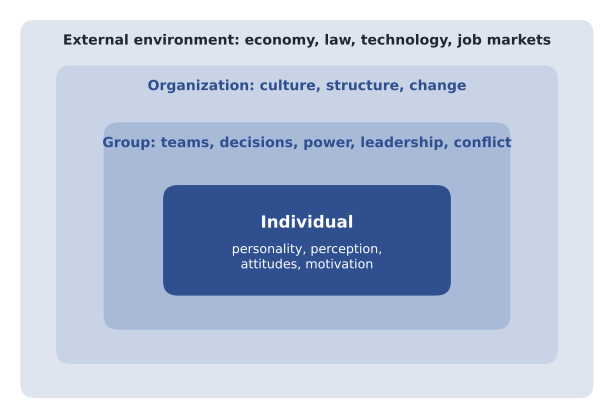
Around all three levels sits the external environment: the economy, labor markets, technology, law, demographics and culture. Remote and hybrid work, artificial intelligence tools, an aging workforce, pay-transparency laws and rising expectations about inclusion are all environmental forces that change behavior inside organizations. A good OB analysis always asks which level a problem really sits at. If every team in a company has high turnover, the cause probably lies at the organizational level, and coaching individual team leads will not fix it.
Worked problem
Locating the level of a problem
A regional bank notices that complaints about rude service have doubled in a year at its 30 branches. Three explanations are proposed: (a) a few employees have abrasive personalities; (b) branch teams are understaffed after a hiring freeze, so queues are long and staff are rushed; (c) the bank introduced a scorecard that pays bonuses for selling credit cards, so tellers push products at every interaction. Classify each explanation by level and suggest how to test it.
Show solution
- (a) is an individual-level explanation. Test it by checking whether complaints are concentrated among a few named employees. If complaints are spread across most staff, personality is unlikely to be the main cause.
- (b) is a group-level explanation about workload and team staffing. Test it by comparing complaint rates with staffing ratios and queue times across branches.
- (c) is an organizational-level explanation about the reward system. Test it by comparing complaint rates before and after the scorecard launched, and by reading complaints for mentions of sales pressure.
- Because complaints doubled across many branches at once, the pattern points first to (b) or (c), which affect everyone, rather than (a).
Answer: The timing and spread of the problem suggest an organizational or group cause. The bank should look at the scorecard and staffing data before sending individual tellers to customer-service training.
Evidence-based management
Medicine changed dramatically when doctors began to ask what the evidence showed rather than what senior physicians had always done. Evidence-based management applies the same idea to organizations. It means making decisions through the careful use of four sources of evidence: scientific research, organizational data, the expertise of experienced practitioners and the values and concerns of the people affected. None of the four is enough by itself. Research may come from a different industry or country, local data may be biased or incomplete, experts can be overconfident, and stakeholders may resist a change that would actually help them.
| Source | Example question | Main risk |
|---|---|---|
| Scientific research | What do meta-analyses say about the link between goal setting and performance? | Results may not transfer to your context |
| Organizational data | What do our exit interviews and turnover records show? | Small samples, missing data, measurement bias |
| Practitioner expertise | What have experienced supervisors seen work on night shifts? | Overconfidence, memorable anecdotes |
| Stakeholder values | How do employees and customers feel about the proposed change? | Vocal minorities, fear of change |
A few research ideas will help you read OB evidence intelligently. A correlation tells you that two variables move together, not that one causes the other. Teams with more social events may have higher morale, but perhaps high-morale teams simply organize more social events. Experiments, in which people are randomly assigned to conditions, are the strongest way to show cause, but they are hard to run in real organizations. A meta-analysis statistically combines many studies of the same question, which gives a more reliable estimate than any single study. Effect sizes tell you how big a relationship is, not just whether it exists: a statistically significant but tiny effect may not be worth the cost of a program.
The correlation coefficient \(r\) runs from −1 to +1. A value near zero means little linear relationship; values around 0.1 are usually described as small, around 0.3 as moderate and 0.5 or above as large in workplace research. Squaring \(r\) gives the share of variation in one variable that the other accounts for, so a correlation of 0.3 between job satisfaction and performance means satisfaction accounts for about 9 % of the variation in performance. That is meaningful at the scale of a large organization, but it leaves most of the variation to other causes.
Worked problem
Interpreting a correlation
An HR analyst at a 2,000-person retailer finds a correlation of \(r = 0.30\) between store managers' coaching scores and their stores' sales growth across 120 stores. A vice-president says, "This proves coaching causes growth. Let's make coaching training mandatory." Evaluate the claim.
Show solution
- Compute variance explained: \(r^2 = 0.30^2 = 0.09\), so coaching scores account for about 9 % of the variation in sales growth.
- Consider reverse causation: managers of growing stores may have more time and resources to coach.
- Consider third variables: better locations could produce both growth and more relaxed, coaching-oriented managers.
- Look for stronger evidence: run a pilot in which some regions receive coaching training first, chosen at random or by a fair rotation, and compare growth with regions that receive it later.
Answer: The correlation is moderate and encouraging, but it does not prove causation. A staged rollout that compares trained and not-yet-trained regions would give much better evidence before spending money on mandatory training for everyone.
Contingency thinking
Few OB principles hold everywhere. Instead, the field relies on contingency thinking: the best approach depends on the situation. Close supervision may help a new employee learn a dangerous task but frustrate an experienced specialist. A highly centralized structure may suit a nuclear power plant, where consistency is vital, but slow down a software start-up that must adapt weekly. When you meet a theory in this course, ask three questions: under what conditions does it work, for whom, and what would make it fail? Answers to those questions are what separate a thoughtful manager from someone who applies the same formula everywhere.
Contingency thinking also applies across cultures. Much of the classic OB research was conducted with North American university students and office workers, a group that cross-cultural psychologists sometimes describe as unusually individualistic. Canada and the United States are both culturally diverse societies, and many organizations operate internationally, so assuming that one style of motivation, feedback or leadership works for everyone is risky. Lesson 2 introduces cultural values frameworks, and lesson 12 returns to culture at the level of the organization.
Organizational behavior in a changing world of work
Several current trends make OB more important, not less. Hybrid and remote work have changed how people build relationships, learn from colleagues and are evaluated. Artificial intelligence tools are changing which tasks people do and raising questions about trust, monitoring and job security. Workforces span four or five generations and many cultures. Pay-transparency laws in British Columbia, Ontario and many US states are making pay ranges public, which affects perceptions of fairness. Employees increasingly expect employers to take positions on social and environmental issues. Each of these trends is, at bottom, a question about behavior: how people perceive change, what motivates them, how teams coordinate and how leaders build trust.
| Trend | OB questions it raises | Lesson |
|---|---|---|
| Hybrid and remote work | How do teams build trust and share knowledge when they rarely meet? | 7, 12 |
| AI at work | How do people perceive algorithmic decisions? Does monitoring reduce motivation? | 3, 8 |
| Pay transparency | How do visible pay ranges change perceived fairness and motivation? | 5, 6 |
| Diverse workforces | How do bias, inclusion and cultural values affect teams? | 2, 3, 10 |
| Continuous change | Why do people resist change, and how can leaders help them adapt? | 12 |
Managers are not the only people who need OB. Everyone who works in an organization manages relationships upward, sideways and downward. Understanding why a colleague reacted defensively, why a team keeps missing deadlines or why a promising initiative stalled is useful at every level. Many of the skills in this course, such as giving fair feedback, framing decisions carefully and reading the politics of a situation, are as useful to a new graduate as to a senior executive.
A simple model for the course
It helps to have a map. Think of the inputs to behavior as the characteristics people bring to work (personality, values, abilities and experience) and the characteristics of the organization (culture, structure, policies and resources). These inputs feed processes: how individuals perceive, decide and feel; how groups communicate, exercise power and lead; and how the organization coordinates and changes. The processes produce outcomes at each level, such as individual performance, satisfaction and well-being; team cohesion and performance; and organizational productivity, survival and reputation. Outcomes then feed back into inputs. A team that succeeds becomes more confident, and an organization with high turnover loses experience.
| Level | Inputs | Processes | Outcomes |
|---|---|---|---|
| Individual | Personality, values, abilities, diversity | Perception, emotion, motivation, decision making | Performance, satisfaction, citizenship, well-being, turnover |
| Group | Group composition, roles, norms, team design | Communication, leadership, power, politics, conflict | Group cohesion, team performance, innovation |
| Organization | Structure, culture, strategy, technology | Change management, coordination, human resource practices | Productivity, survival, reputation |
Throughout the course, you will build a short diagnostic portfolio. Each lesson ends with a task asking you to apply its ideas to an organization you know, whether a current or past employer, a volunteer group or a sports team. Keep your notes; lesson 12 asks you to combine them into a full diagnosis.
Common mistakes
MistakeTreating OB as common sense that needs no evidence.
InsteadTest intuitive beliefs against research and organizational data; many popular beliefs about work are wrong or only true in some conditions.
MistakeBlaming individuals for problems that appear across many people.
InsteadAsk which level the problem sits at; widespread patterns usually have group or organizational causes.
MistakeAssuming a correlation proves causation.
InsteadLook for reverse causation and third variables, and seek stronger evidence such as staged rollouts or experiments.
MistakeApplying one management style everywhere.
InsteadUse contingency thinking: ask under what conditions, for whom and why an approach works.
MistakeAdopting the latest management fad because a famous company uses it.
InsteadCombine research, local data, practitioner expertise and stakeholder views before making a change.
Summary and key terms
- Organizational behavior studies how individuals and groups think, feel and act in organizations, and how organizations shape people.
- OB draws on psychology, sociology, anthropology, economics and political science.
- Its key outcomes include productivity, absenteeism, turnover, citizenship, counterproductive behavior, satisfaction, engagement and well-being.
- Behavior is analyzed at the individual, group and organizational levels, all within an external environment.
- Evidence-based management combines research, organizational data, practitioner expertise and stakeholder values.
- Correlation is not causation; effect sizes and research design matter.
- Contingency thinking asks under what conditions, for whom and why an approach works.
- Current trends such as hybrid work, AI, pay transparency and diverse workforces make OB more important.
- Organizational behavior
- The study of how individuals and groups think, feel and act in organizations, and how organizations shape them.
- Level of analysis
- The level, individual, group or organization, at which a behavior or problem is examined.
- Evidence-based management
- Making decisions through the careful use of research, organizational data, practitioner expertise and stakeholder values.
- Correlation
- A statistical measure of how strongly two variables move together, from −1 to +1.
- Meta-analysis
- A statistical method that combines the results of many studies of the same question.
- Effect size
- A measure of how large a relationship or difference is.
- Contingency thinking
- The view that the best approach depends on the situation.
- Organizational citizenship behavior
- Voluntary behavior that helps colleagues or the organization beyond formal job requirements.
- Counterproductive work behavior
- Voluntary behavior that harms the organization or its members.
- Engagement
- An employee's energy, involvement and enthusiasm for their work and workplace.
Practice problems
Work each problem on paper first, then reveal the answer to check.
Name the three levels of analysis in OB.
Show answer
Individual, group and organizational, all within the external environment.
A correlation between two variables is 0.4. What share of variation does one account for in the other?
Show answer
0.4² = 0.16, or 16 %.
Give the four sources of evidence in evidence-based management.
Show answer
Scientific research, organizational data, practitioner expertise and stakeholder values.
Why might teams that hold more social events report higher morale, other than events causing morale?
Show answer
Reverse causation (high-morale teams organize more events) or a third variable (good leaders cause both).
What is a meta-analysis?
Show answer
A statistical combination of many studies of the same question.
Turnover is high in every department of a firm. Which level of analysis should you examine first?
Show answer
The organizational level, because the problem is widespread.
Give an example of organizational citizenship behavior.
Show answer
Helping a colleague with a backlog, mentoring a new hire or volunteering for an unpopular task.
What does contingency thinking mean?
Show answer
The best approach depends on the situation; ask when, for whom and why it works.
According to Gallup, roughly what share of employees worldwide were engaged in 2025?
Show answer
About 20 %.
Portfolio task: describe one recurring behavior problem in an organization you know and classify it by level.
Show answer
Answers vary; a good answer names the behavior, the level and the evidence for that level.
Lesson quiz · 5 questions
Score 60% or more to complete this lesson.
Create a free account to save your progress, take quizzes and earn a certificate.