
BUS-130 · Lesson 9 of 12 · 30 min
Power, politics and influence
Power is often treated as a dirty word, yet nothing gets done in organizations without it. Getting a budget approved, persuading colleagues to adopt a new process, protecting a team from unreasonable demands and advancing a career all involve power and influence. Power can also be abused, through bullying, harassment, self-serving politics and retaliation against people who speak up. This lesson explains where power comes from, how people use it to influence others, why organizational politics arise and how to act effectively and ethically in political environments.
What power is
Power is the capacity of one person, A, to influence the behavior of another, B, so that B acts in accordance with A's wishes. Power is a capacity, so it can exist without being used. It is also relational: it exists only in relation to someone else and rests on dependence. The more B depends on A for something B values, the more power A has over B. Leadership, covered in lesson 10, uses power to influence people toward goals, but power is broader; a junior IT specialist who is the only person who understands a critical system can have considerable power over senior managers.
Bases of power
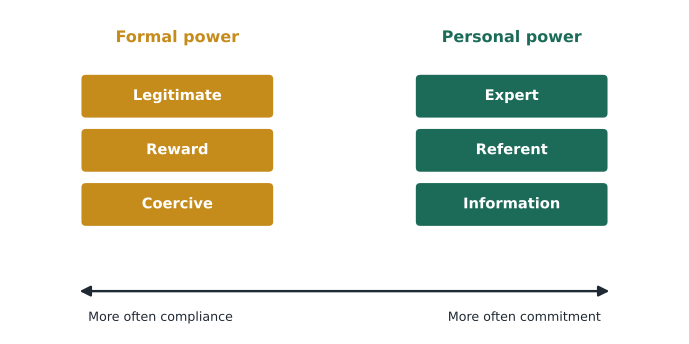
John French and Bertram Raven identified five bases of power, and Raven later added a sixth. The first three are formal, coming from a person's position. Legitimate power is the authority to direct others that comes from one's formal role. Reward power is the ability to give things people value, such as pay increases, promotions, desirable assignments or praise. Coercive power is the ability to punish, through discipline, undesirable assignments or withholding resources. The others are personal, coming from the individual. Expert power is influence based on special skills or knowledge. Referent power is influence based on others' admiration, respect and desire to identify with a person. Information power comes from controlling access to information others need.
| Base | Source | Typical response | Example |
|---|---|---|---|
| Legitimate | Formal position | Compliance | A director assigns a project |
| Reward | Control over valued outcomes | Compliance | A manager approves bonuses |
| Coercive | Ability to punish | Compliance or resistance | A supervisor issues a written warning |
| Expert | Skills and knowledge | Commitment | A senior engineer's view on a design is accepted |
| Referent | Admiration and identification | Commitment | Colleagues follow a respected peer's lead |
| Information | Access to needed information | Compliance or commitment | An analyst controls the data a decision depends on |
Research consistently finds that personal sources of power, expertise and referent power, are more strongly linked to employees' commitment, satisfaction and performance than formal sources. Coercive power is linked to resistance, lower satisfaction and turnover. Formal power produces compliance, which may be enough for routine tasks, but discretionary effort usually requires commitment. Effective managers therefore build expertise and relationships rather than relying on their title.
Dependence: the key to power
Power rests on dependence, and three factors increase dependence. Importance: the resource must be something people value, such as the ability to reduce uncertainty in a critical area. Scarcity: the resource must be in short supply; abundant resources create little dependence. Non-substitutability: there must be few viable alternatives. In a university, the faculty members who bring in large research grants often have influence beyond their rank. In a manufacturing firm, maintenance engineers who alone know how to fix aging equipment can exercise surprising power. This explains why specialists sometimes resist documentation that would make their knowledge available to others.
Worked problem
Analyzing dependence
A mid-sized hospital relies on Dev, a database administrator, to maintain a legacy patient-scheduling system. No one else knows it well, the vendor no longer supports it, replacing it will take two years, and scheduling failures delay surgeries. Dev has recently refused several requests to change his schedule and has asked for a large raise. Analyze the sources of Dev's power and how the hospital could respond.
Show solution
- Importance: scheduling is critical to patient care, so the resource is highly important.
- Scarcity: Dev's knowledge is rare inside the organization.
- Non-substitutability: the vendor no longer supports the system and replacement is two years away, so there are few alternatives.
- All three factors are high, so the hospital depends heavily on Dev and his power is considerable.
- Responses that reduce dependence fairly: document the system, pair Dev with a second administrator, contract external support and accelerate replacement. Responses that recognize his value: a fair retention agreement tied to knowledge transfer.
Answer: Dev's power comes from dependence. The hospital should reduce the risk of a single point of failure while treating Dev fairly; coercing him would increase the chance he leaves with critical knowledge.
Networks and centrality
Power also comes from position in informal networks. People who are central, connected to many others or bridging otherwise separate groups, gain access to information, can broker resources and are seen as influential. Social network analysis maps these relationships, often by surveying employees about whom they go to for advice or information. A simple measure is degree centrality, the number of direct connections a person has. Another is betweenness, how often a person sits on the shortest path between others, which captures brokerage between groups. Organizations use network analysis to identify hidden experts, overloaded connectors and teams that are isolated from the rest of the organization.
# Advice network: who goes to whom for advice (undirected for simplicity)
from itertools import combinations
from collections import deque

edges = [("Ana", "Ben"), ("Ana", "Chen"), ("Ben", "Chen"), ("Chen", "Dina"),
         ("Dina", "Eli"), ("Eli", "Fay"), ("Dina", "Fay"), ("Fay", "Gus")]
people = sorted({p for e in edges for p in e})
nbrs = {p: set() for p in people}
for a, b in edges:
    nbrs[a].add(b); nbrs[b].add(a)

def shortest_paths(s, t):
    # count shortest paths from s to t, and how many pass through each node
    dist = {s: 0}; count = {s: 1}; order = []
    q = deque([s])
    while q:
        u = q.popleft(); order.append(u)
        for v in nbrs[u]:
            if v not in dist:
                dist[v] = dist[u] + 1; count[v] = 0; q.append(v)
            if dist[v] == dist[u] + 1:
                count[v] += count[u]
    return dist, count

betweenness = {p: 0.0 for p in people}
for s, t in combinations(people, 2):
    ds, cs = shortest_paths(s, t)
    dt, ct = shortest_paths(t, s)
    for v in people:
        if v not in (s, t) and ds[v] + dt[v] == ds[t]:
            betweenness[v] += cs[v] * ct[v] / cs[t]

for p in people:
print(f"{p:5s} degree={len(nbrs[p])} betweenness={betweenness[p]:.1f}")Ana degree=2 betweenness=0.0 Ben degree=2 betweenness=0.0 Chen degree=3 betweenness=8.0 Dina degree=3 betweenness=9.0 Eli degree=2 betweenness=0.0 Fay degree=3 betweenness=5.0 Gus degree=1 betweenness=0.0
In the example network, Chen and Dina have only two or three direct connections each, but they have the highest betweenness because they bridge the cluster around Ana and Ben with the cluster around Eli, Fay and Gus. If either left, information would stop flowing between the two groups. Network brokers like Chen and Dina often have more influence than their job titles suggest, and they are also at risk of overload.
Influence tactics
Power is the capacity; influence tactics are how people translate it into action. Research by Gary Yukl and others identifies common tactics. Rational persuasion uses logical arguments and factual evidence. Inspirational appeals arouse enthusiasm by appealing to values and ideals. Consultation increases support by involving the target in planning. Collaboration offers assistance or resources. Ingratiation uses praise or friendliness before a request. Exchange offers a benefit in return. Personal appeals ask for support out of friendship or loyalty. Coalitions enlist others to support the request. Legitimating tactics rely on authority or policy. Pressure uses demands, threats and persistent reminders.
| Tactic | Effectiveness for gaining commitment | Notes |
|---|---|---|
| Rational persuasion | High | Works in most directions, especially upward |
| Inspirational appeals | High | Needs credibility and shared values |
| Consultation | High | Builds ownership; target must have relevant input |
| Collaboration | High | Reduces the cost of compliance for the target |
| Ingratiation | Moderate | Backfires if seen as insincere |
| Exchange | Moderate | Useful with peers; can feel transactional |
| Personal appeals | Moderate | Depends on the relationship |
| Coalitions | Moderate to low | Can create counter-coalitions |
| Legitimating | Low | Produces compliance at best |
| Pressure | Low | Often produces resistance |
Effective influencers combine tactics, starting with softer ones (rational persuasion, consultation, inspirational appeals) and reserving harder tactics. They also adapt to direction: rational persuasion is the most effective tactic for influencing upward, while inspirational appeals and consultation work well downward and exchange and coalitions are common among peers. Culture matters too: personal appeals and coalition-building may be expected in more collectivist settings, while direct rational argument is valued in many North American workplaces.
Worked problem
Choosing influence tactics
Rania, a safety coordinator at a distribution center, wants the operations director to fund $60,000 of racking repairs before peak season. The director is under pressure to cut costs and has rejected two previous requests sent by email. Plan her influence approach.
Show solution
- Rational persuasion: gather inspection data showing damaged uprights, the cost of a collapse (product loss, downtime, injury claims) and the payback of repair.
- Consultation: ask the director which risks worry him most during peak season and adapt the proposal, for example by phasing repairs.
- Coalition: enlist the operations managers and the joint health and safety committee, who share the concern, to support the request.
- Legitimating: reference the relevant regulatory duty to maintain racking only if softer tactics fail.
- Avoid pressure, which would harden resistance from a director already defensive about costs.
Answer: Rania should lead with data and consultation, build a coalition, and keep legitimating appeals in reserve. Meeting in person also gives her more opportunity to respond to concerns than another email.
Organizational politics
Political behavior consists of activities that are not required as part of one's formal role but that influence, or attempt to influence, the distribution of advantages and disadvantages within the organization. Examples include withholding information, forming coalitions, lobbying for or against decisions, leaking information, spreading rumors, exchanging favors and taking credit for others' work. Politics is not all bad; legitimate political behavior such as building coalitions and lobbying for a project is a normal part of organizational life. Illegitimate political behavior, such as sabotage, whistleblower retaliation or deliberate deception, violates the rules of the game.
Politics flourishes under certain conditions. Organizational factors include scarce resources, ambiguous roles and performance criteria, zero-sum reward systems, democratic decision-making without clear rules, high-pressure performance demands, low trust and reorganizations. Individual factors include a high need for power, high self-monitoring, an internal locus of control and Machiavellianism. When employees perceive high levels of politics, they report lower satisfaction, higher anxiety and stress, higher turnover intentions and sometimes lower performance, especially when they do not understand how decisions are made. Transparent decision processes, clear criteria and fair procedures, the procedural justice of lesson 5, reduce perceived politics.
Impression management is the process by which people attempt to control the image others form of them. Techniques include conformity (agreeing with someone's opinion), favors, excuses and apologies for negative events, self-promotion and flattery. Impression management in interviews can raise ratings, which is another argument for structured interviews that focus on job-relevant evidence. At work, self-promotion is often necessary to make contributions visible, especially in hybrid settings, but it backfires when it is excessive or not backed by results.
Political skill and ethics
Political skill is the ability to understand others at work and to use that knowledge to influence them in ways that enhance personal and organizational objectives. It combines social astuteness, interpersonal influence, networking ability and apparent sincerity. Politically skilled people tend to be more effective and suffer less stress in political environments. The ethical question is how political skill is used. Three questions help: Is the political action motivated by self-interest at the expense of the organization's goals? Does it respect the rights of the people affected? Is it fair and equitable? An action that fails these tests should be reconsidered, however effective it might be.
Abuse of power: harassment and retaliation
Power imbalances create the conditions for abuse. Workplace harassment includes unwelcome conduct, comments or actions that a person knows or ought to know would be offensive, humiliating or intimidating, including sexual harassment and bullying. Sexual harassment frequently involves power: a supervisor implying that a promotion depends on a sexual relationship, or a group of co-workers creating a hostile environment. People with less power, such as young workers, temporary workers and those without permanent immigration status, are more vulnerable and less likely to report.
In the United States, harassment based on a protected characteristic, such as sex, race or religion, is a form of discrimination under Title VII when it results in a tangible employment action or creates a hostile work environment that is severe or pervasive. Under the Supreme Court's Faragher and Ellerth decisions, employers can defend against some hostile-environment claims by showing they took reasonable care to prevent and correct harassment and that the employee unreasonably failed to use complaint procedures. The EEOC rescinded its 2024 harassment guidance in January 2026, but Title VII and the case law still apply, and many states, such as California, New York and Illinois, require harassment-prevention training. Retaliation against people who complain is itself unlawful under Title VII, and laws such as the Sarbanes-Oxley Act protect certain whistleblowers.
Whatever the legal framework, organizations reduce abuse of power by setting clear expectations, providing several reporting channels that do not require going through the person accused, investigating promptly and fairly, protecting complainants and witnesses from retaliation and holding powerful people to the same standards as everyone else. Lesson 12 returns to how culture shapes these behaviors.
Common mistakes
MistakeRelying on your job title to get things done.
InsteadBuild expert and referent power through competence, reliability and relationships.
MistakeUsing pressure as the first influence tactic.
InsteadStart with rational persuasion, consultation and inspirational appeals; reserve harder tactics.
MistakeAssuming that all political behavior is unethical.
InsteadDistinguish legitimate coalition-building and advocacy from deception, sabotage and retaliation.
MistakeLetting critical knowledge sit with one person.
InsteadReduce dependence by documenting processes and cross-training, while treating key people fairly.
MistakeHandling harassment complaints informally through the accused person's manager only.
InsteadOffer several reporting channels, investigate promptly and protect complainants from retaliation.
Summary and key terms
- Power is the capacity to influence others and rests on dependence.
- Bases of power are legitimate, reward, coercive, expert, referent and information; personal bases build commitment.
- Dependence increases with importance, scarcity and non-substitutability.
- Network centrality and brokerage are sources of informal power.
- Rational persuasion, consultation, inspirational appeals and collaboration are the most effective influence tactics.
- Politics arises from scarce resources, ambiguity and low trust; transparency and fair procedures reduce it.
- Political skill can be used ethically by testing actions against self-interest, rights and fairness.
- Title VII prohibits harassment and retaliation; Faragher/Ellerth shape employer defenses.
- Power
- The capacity of A to influence the behavior of B so that B acts in accordance with A's wishes.
- Legitimate power
- Power that comes from a formal position in the organization.
- Expert power
- Influence based on special skills or knowledge.
- Referent power
- Influence based on admiration and the desire to identify with someone.
- Dependence
- Reliance on another for a valued resource; the basis of power.
- Betweenness centrality
- How often a person lies on the shortest paths between others in a network.
- Influence tactics
- Ways people translate power into specific actions to change others' behavior.
- Political behavior
- Activities outside formal roles that influence the distribution of advantages and disadvantages.
- Impression management
- Attempts to control the image others form of oneself.
- Political skill
- The ability to understand others and influence them to achieve personal and organizational goals.
Practice problems
Work each problem on paper first, then reveal the answer to check.
Name the six bases of power.
Show answer
Legitimate, reward, coercive, expert, referent and information.
Which bases of power are most strongly linked to commitment?
Show answer
Expert and referent power.
Name the three factors that create dependence.
Show answer
Importance, scarcity and non-substitutability.
A person connects two otherwise separate groups. What network measure captures this?
Show answer
Betweenness centrality.
Which influence tactic is most effective upward?
Show answer
Rational persuasion.
Give two organizational conditions that increase politics.
Show answer
Scarce resources, ambiguous criteria, zero-sum rewards, low trust, reorganizations.
What are the three ethical questions for political behavior?
Show answer
Is it self-serving against organizational goals? Does it respect rights? Is it fair?
Give one legitimate and one illegitimate political behavior.
Show answer
Legitimate: building a coalition for a proposal. Illegitimate: sabotaging a colleague's work.
What is the Faragher/Ellerth defense?
Show answer
An employer defense showing reasonable care to prevent and correct harassment and the employee's unreasonable failure to use complaint procedures.
Portfolio task: map the bases of power held by three people in an organization you know.
Show answer
Answers vary; a good answer distinguishes formal and personal bases and their effects.
Lesson quiz · 5 questions
Score 60% or more to complete this lesson.
Create a free account to save your progress, take quizzes and earn a certificate.