
BUS-130 · Lesson 6 of 12 · 32 min
Motivation in practice: job design, rewards and pay
Theories of motivation become useful when they shape how work is designed and rewarded. This lesson turns the ideas from lesson 5 into practical tools: designing jobs that people find meaningful, offering flexibility and involvement, building pay and reward systems that are fair and motivating, recognizing good work and complying with fast-changing pay-transparency and pay-equity laws. Payroll calculations are covered in BUS-110 and the human resources function in BUS-101; here the question is how these practices affect behavior.
The job characteristics model
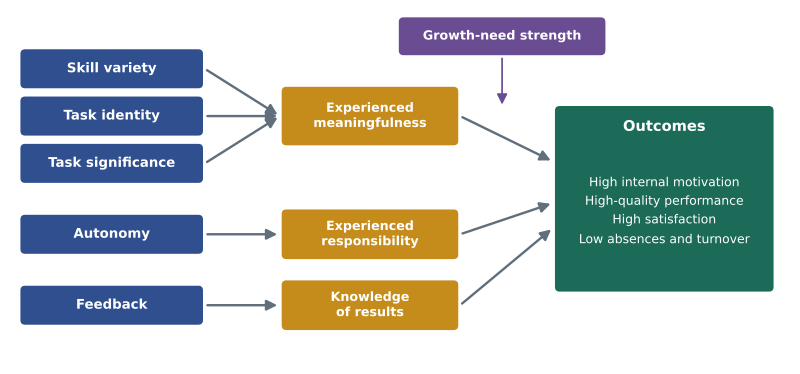
J. Richard Hackman and Greg Oldham's job characteristics model (JCM) is the most influential framework for designing motivating work. It identifies five core job dimensions. Skill variety is the degree to which a job requires different activities and skills. Task identity is the degree to which a job involves completing a whole, identifiable piece of work. Task significance is the degree to which the job affects other people's lives. Autonomy is the freedom and discretion to schedule work and choose methods. Feedback is the degree to which doing the work itself provides clear information about performance.
The first three dimensions create a sense of meaningful work, autonomy creates a sense of responsibility for outcomes, and feedback creates knowledge of results. Together these critical psychological states lead to high internal motivation, quality performance, satisfaction and lower absenteeism and turnover. The effects are strongest for people with a high growth-need strength, those who want challenge and development, although most people respond positively to enriched work. Hackman and Oldham combined the dimensions into a motivating potential score (MPS), in which autonomy and feedback are multiplied because a job with no autonomy or no feedback has little motivating potential regardless of the other dimensions.
Worked problem
Calculating and improving a motivating potential score
Claims processors at an insurer each handle one step of a claim: one person checks forms, another verifies coverage, a third approves payment. A survey on a 1–7 scale gives the checking job these scores: skill variety 2, task identity 2, task significance 5, autonomy 2, feedback 3. A redesign would give each processor complete responsibility for claims from a set of brokers, with authority to approve payments up to $5,000 and a dashboard of their own accuracy and turnaround. Expected scores after redesign: skill variety 5, task identity 6, task significance 6, autonomy 5, feedback 6. Compute the MPS before and after.
Show solution
- Before: average of first three = (2 + 2 + 5) ÷ 3 = 3.0.
- Before MPS = 3.0 × 2 × 3 = 18.
- After: average of first three = (5 + 6 + 6) ÷ 3 ≈ 5.67.
- After MPS = 5.67 × 5 × 6 ≈ 170.
- The maximum possible MPS on a 1–7 scale is 7 × 7 × 7 = 343, so the job moves from about 5 % to about 50 % of the maximum.
Answer: The redesign raises the motivating potential nearly tenfold, mainly through autonomy and feedback. The insurer should pilot it, train processors for the broader role and check that accuracy holds as authority increases.
Ways to redesign jobs
Several practical approaches apply the JCM. Job rotation moves employees periodically between tasks, which reduces boredom and builds flexibility, though it can raise training costs. Job enlargement adds more tasks at the same level, increasing variety horizontally. Job enrichment adds responsibility, planning and control, increasing depth vertically, for example by letting workers schedule their own work, deal directly with customers or check their own quality. Relational job design, a concept developed by Adam Grant, connects employees with the people who benefit from their work. In one study, university fundraising callers who met a scholarship student funded by their calls substantially increased their weekly calls and money raised.
Job crafting reverses the direction of design. Employees reshape their own jobs by changing their tasks (taking on projects that use their strengths), their relationships (building connections with people they find energizing) or their thinking about the job (seeing cleaning a hospital room as part of patient healing). Organizations can encourage job crafting by giving people some discretion and inviting them to suggest changes, within the limits of what the work requires.
| Approach | What changes | Main benefit | Main risk |
|---|---|---|---|
| Job rotation | People move between tasks | Less boredom; broader skills; cover for absences | Training costs; less depth |
| Job enlargement | More tasks at the same level | More variety | Just more work if not well designed |
| Job enrichment | More responsibility and control | Meaning, autonomy, feedback | Needs training; some people prefer routine |
| Relational job design | Contact with beneficiaries | Greater sense of significance | Can feel staged if not genuine |
| Job crafting | Employees reshape tasks, relationships and meaning | Better fit and engagement | Gaps if core tasks are neglected |
Flexible work arrangements
Flexibility is now one of the rewards employees value most. Common arrangements include flextime (choosing start and finish times around core hours), compressed workweeks (for example four 10-hour days), job sharing (two part-time employees sharing one full-time job), telework and hybrid work. Research generally finds that well-designed flexible arrangements increase satisfaction and commitment and reduce turnover, with neutral to positive effects on performance, though fully remote work can make mentoring, informal learning and promotion visibility harder. Lesson 12 returns to hybrid work as a cultural and structural issue.
Four-day week trials have attracted attention. In a widely reported 2022 UK pilot coordinated by the non-profit 4 Day Week Global with researchers, 61 companies reduced hours by about 20 % without cutting pay; at the end of six months, 56 of them continued the policy, and employees reported lower burnout and better work–life balance. Pilots like this rely on volunteer firms, which limits how far the results can be generalized, but they show that redesigning work to remove low-value activity can sometimes preserve output with fewer hours.
US federal law gives employees no general right to flexible work, though the ADA may require schedule changes or telework as a reasonable accommodation and the Family and Medical Leave Act provides unpaid, job-protected leave for eligible workers. Some cities and states, such as San Francisco, New York City and Vermont, give employees a right to request flexible schedules, and several states regulate predictive scheduling for hourly workers in retail and food service.
Employee involvement
Employee involvement programs use the input of employees to increase their commitment to the organization's success. Examples include suggestion systems, quality circles, cross-functional improvement teams, representative participation such as joint health and safety committees and works councils, and, in some firms, employee board representation. Involvement works through several motivational routes: it increases autonomy, it raises expectancy because people help design workable goals and processes, and it improves procedural justice because people have a voice. It fails when it is tokenistic, when suggestions disappear without a response.
Variable pay and rewards
Pay is the most visible reward. Base pay compensates for the job and the person's skills; variable pay links part of pay to individual, team or organizational performance. Common plans include piece rates (pay per unit), merit increases (permanent raises based on appraisal ratings), bonuses (one-time payments for meeting targets), profit sharing (a share of company profits), gainsharing (a share of savings from productivity improvements in a unit) and employee ownership (shares, options or an ownership trust). Skill-based or competency-based pay rewards employees for the skills they acquire, which encourages learning and flexibility.
| Plan | Basis | Advantage | Disadvantage |
|---|---|---|---|
| Piece rate | Units produced | Clear link between effort and pay | Encourages quantity over quality and safety |
| Merit pay | Appraisal rating | Rewards individual performance permanently | Depends on fair appraisals; small differences demotivate |
| Bonus | Meeting specific targets | Flexible; does not raise fixed costs | Can encourage gaming of targets |
| Profit sharing | Company profits | Aligns everyone with profitability | Weak line of sight for individuals |
| Gainsharing | Unit productivity savings | Encourages teamwork and improvement | Requires a credible baseline |
| Employee ownership | Company value | Long-term commitment | Concentrates employee financial risk |
| Skill-based pay | Skills acquired | Encourages learning and flexibility | Paying for skills that are not used |
Line of sight is the key design idea: people are motivated by rewards they believe their own actions can influence. A frontline worker in a 40,000-person company has little sense that their effort changes company-wide profit, so profit sharing alone has weak motivational effects, though it may build identification. Team-based gainsharing in a plant of 200 gives a clearer line of sight.
Worked problem
Calculating a gainsharing payout
A food-processing plant uses a gainsharing plan. Its baseline labor cost is 22 % of the value of production. In a quarter, production is worth $8.0 million and actual labor cost is $1.60 million. Half the savings are shared equally among 160 eligible employees. Compute each employee's payout.
Show solution
- Allowed labor cost = 22 % × $8.0 million = $1.76 million.
- Savings = $1.76 million − $1.60 million = $160,000.
- Employee share = 50 % × $160,000 = $80,000.
- Payout per employee = $80,000 ÷ 160 = $500 for the quarter.
Answer: Each employee receives $500. Because the gain depends on everyone's productivity, the plan encourages cooperation, but the plant must also track quality and safety so savings are not achieved by cutting corners.
Merit increases are often guided by a merit matrix that considers both the appraisal rating and where the person's pay sits within the salary range. The compa-ratio, salary divided by the range midpoint, shows that position.
Worked problem
Using a merit matrix
A company's salary range for an analyst is $64,000 to $96,000, with a midpoint of $80,000. Its merit matrix gives: for an "exceeds" rating, a 5 % increase below a compa-ratio of 0.90, 4 % from 0.90 to 1.10 and 3 % above 1.10. Two analysts are rated "exceeds": Kai earns $70,000 and Rosa earns $90,000. Compute their compa-ratios and increases.
Show solution
- Kai's compa-ratio = $70,000 ÷ $80,000 = 0.875, below 0.90, so 5 %: increase = $3,500, new salary $73,500.
- Rosa's compa-ratio = $90,000 ÷ $80,000 = 1.125, above 1.10, so 3 %: increase = $2,700, new salary $92,700.
- Both performed equally well, but Kai receives a larger percentage because he is lower in the range.
Answer: The matrix moves strong performers toward the midpoint over time and limits pay growth above it. Managers should explain this logic to avoid perceptions of inequity, especially now that pay ranges are increasingly public.
Benefits and recognition
Benefits, such as health and dental coverage, retirement plans, paid time off and wellness programs, are a large share of total compensation. Flexible benefit plans let employees choose from a menu or spend a fixed allowance, which raises the valence of benefits by matching them to individual needs: a young employee might choose more vacation, a parent more dependent coverage. Recognition programs, from informal thanks to formal awards, are among the most cost-effective motivators. Effective recognition is timely, specific about what the person did, sincere and, ideally, connected to the organization's values. Peer-to-peer recognition platforms let colleagues recognize each other, spreading recognition beyond managers.
Pay transparency and pay equity
Laws that make pay information visible are spreading quickly, and they change how employees perceive fairness. When ranges are public, unexplained gaps become visible, which raises equity concerns but also pressures organizations to fix unjustified differences.
In the United States there is no federal pay-range posting law, but many states and cities require pay ranges in job postings, including Colorado, California, Washington, New York, Illinois, Maryland, Minnesota, Hawaii, Vermont, New Jersey, Massachusetts and the District of Columbia, with Delaware's law due to take effect in 2027. Thresholds and details vary; for example, California's 2026 amendments define the pay scale as a good-faith estimate of what the employer reasonably expects to pay. The Equal Pay Act of 1963 requires equal pay for equal work regardless of sex, and Title VII prohibits pay discrimination more broadly. The National Labor Relations Act protects most private-sector employees' right to discuss their pay. Rules change often; check state sources at the time of writing (October 2026).
Worked problem
Checking a job posting for compliance
A Colorado employer posts: "Marketing manager, competitive salary, apply today." Is the posting compliant with Colorado's pay transparency law?
Show solution
- Colorado's Equal Pay for Equal Work Act applies to employers with at least one employee in Colorado.
- Colorado requires postings to include a good-faith pay range and a general description of benefits and other compensation.
- "Competitive salary" does not state a range.
- A compliant version might read "salary $85,000–$105,000, plus health, dental and 401(k) match", with the application deadline required for postings.
Answer: The posting is not compliant: it lacks a pay range and benefits description. Stating a range also forces the employer to decide what the job is really worth.
Common mistakes
MistakeTreating more pay as the answer to every motivation problem.
InsteadDiagnose the job design first; low autonomy and feedback often matter more than pay.
MistakeUsing company-wide profit sharing to motivate individual effort.
InsteadChoose rewards with a clear line of sight to what people can influence, such as team gainsharing.
MistakePaying piece rates without monitoring quality and safety.
InsteadBalance output incentives with quality and safety measures.
MistakePosting vague pay ranges or none at all.
InsteadFollow applicable pay-transparency laws and set defensible ranges based on job evaluation and market data.
MistakeGiving generic, delayed praise.
InsteadRecognize specific actions promptly and sincerely, linking them to values and impact.
Summary and key terms
- The job characteristics model links skill variety, task identity, task significance, autonomy and feedback to motivation and satisfaction.
- MPS multiplies autonomy and feedback, so a job lacking either has little motivating potential.
- Rotation, enlargement, enrichment, relational design and job crafting are ways to redesign work.
- Flexible arrangements raise satisfaction and retention; legal rights to request flexibility are limited and vary.
- Employee involvement works by increasing autonomy, expectancy and voice.
- Variable pay plans differ in line of sight, cost and side effects; compa-ratios guide merit increases.
- Recognition should be timely, specific and sincere.
- Many states require pay ranges in postings; the Equal Pay Act and Title VII prohibit pay discrimination.
- Job characteristics model
- A framework linking five core job dimensions to motivation and satisfaction through three psychological states.
- Motivating potential score
- An index of a job's motivating potential combining the five JCM dimensions.
- Job enrichment
- Adding responsibility, planning and control to a job.
- Job crafting
- Employees reshaping their own tasks, relationships and thinking about their job.
- Relational job design
- Connecting employees with the people who benefit from their work.
- Gainsharing
- A plan that shares productivity savings of a unit with its employees.
- Line of sight
- The degree to which employees see a link between their actions and a reward.
- Compa-ratio
- Salary divided by the midpoint of its salary range.
- Pay transparency
- Laws and practices that make pay ranges and pay information visible.
- Pay equity
- Equal pay for work of equal value between female- and male-dominated jobs.
Practice problems
Work each problem on paper first, then reveal the answer to check.
Name the five core job dimensions in the JCM.
Show answer
Skill variety, task identity, task significance, autonomy and feedback.
A job scores SV 4, TI 4, TS 7, A 3, F 2. What is the MPS?
Show answer
(15 ÷ 3) × 3 × 2 = 30.
Distinguish job enlargement from job enrichment.
Show answer
Enlargement adds more tasks at the same level; enrichment adds responsibility and control.
What did the 2022 UK four-day week pilot report at six months?
Show answer
Most of the 61 companies (56) continued the policy, and employees reported lower burnout.
Why does company-wide profit sharing have weak effects on individual motivation?
Show answer
Individuals see little link between their own effort and company profit (weak line of sight).
A plant's allowed labor cost is $500,000, actual is $440,000, and 40 % of savings is shared among 80 staff. What is each payout?
Show answer
$60,000 × 0.40 ÷ 80 = $300.
An employee earns $55,000 in a range with a midpoint of $50,000. What is the compa-ratio?
Show answer
1.10.
Give four features of effective recognition.
Show answer
Timely, specific, sincere and linked to values or impact.
Name three states that require pay ranges in job postings.
Show answer
For example Colorado, California and New York (also Washington, Illinois, Maryland, Minnesota and others).
Portfolio task: score a job you know on the five JCM dimensions and propose one enrichment.
Show answer
Answers vary; a good answer computes MPS and targets the weakest dimension, often autonomy or feedback.
Lesson quiz · 5 questions
Score 60% or more to complete this lesson.
Create a free account to save your progress, take quizzes and earn a certificate.