
BUS-130 · Lesson 2 of 12 · 30 min
Personality, values and individual differences
No two employees are alike. Two people with the same job title, training and pay can respond to the same manager, deadline or reorganization in completely different ways. Organizational behavior begins with these individual differences: stable characteristics such as personality, abilities and values, and visible and invisible forms of diversity, that shape how people perceive and respond to work. This lesson explains the most useful frameworks, shows how they are measured and used, and warns about common misuses, especially in hiring.
What personality is
Personality is the relatively stable pattern of thoughts, feelings and behaviors that distinguishes one person from another. Relatively stable is the key phrase. Personality is partly heritable, with twin studies suggesting that roughly 40 to 50 % of the variation in major traits is linked to genetic differences, and it is fairly consistent across adulthood. It is not fixed, however. Most people become somewhat more conscientious, agreeable and emotionally stable as they age, a pattern psychologists call the maturity principle, and situations strongly shape how traits are expressed. A naturally talkative person may be quiet at a funeral; a reserved person may become animated when discussing a passion.
Psychologists describe this interaction between person and situation in terms of situation strength. A strong situation, such as a safety-critical procedure, a scripted call center or a formal ceremony, has clear rules and expectations, so personality differences matter less. A weak situation, such as an open-ended project, a new team or a start-up, leaves room for personality to show. This is why personality tends to predict behavior better in jobs with high autonomy.
The Big Five model
The most widely supported framework in personality research is the Big Five, also known as the five-factor model. Decades of research in many languages and cultures have found that people's descriptions of themselves and others cluster into five broad dimensions. Each is a continuum, not a type: people are not simply extraverts or introverts but fall somewhere along a scale, and most people score near the middle.
| Trait | High scorers tend to be | Low scorers tend to be | Typical work links |
|---|---|---|---|
| Conscientiousness | Organized, dependable, persistent, achievement-oriented | Spontaneous, flexible, less careful with details | The most consistent predictor of job performance across jobs; fewer safety incidents |
| Emotional stability (low neuroticism) | Calm, resilient, secure | Anxious, moody, easily stressed | Lower burnout, better coping with pressure, higher job satisfaction |
| Extraversion | Sociable, assertive, energetic | Reserved, quiet, comfortable alone | Sales and management performance; leadership emergence |
| Agreeableness | Cooperative, warm, trusting | Competitive, skeptical, blunt | Team cooperation and customer service; may be paid less and negotiate less assertively |
| Openness to experience | Curious, imaginative, open to new ideas | Conventional, practical, prefers routine | Creativity, learning in training, adapting to change |
Of the five, conscientiousness has the most consistent relationship with job performance across nearly all occupations, from cashiers to engineers to managers. Emotional stability is most strongly linked to satisfaction and stress. Extraversion matters most where social interaction is central, and openness matters most where learning and innovation are central. Agreeableness helps in team and service roles, though very agreeable people may avoid necessary conflict. No profile is best for every job; what matters is the fit between a person's tendencies and the demands of the role.
Worked problem
Interpreting a Big Five profile (illustrative)
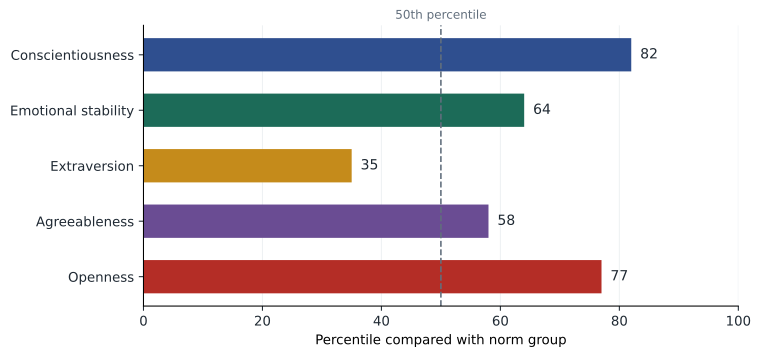
Maya, a fictional applicant for a data analyst role at a logistics company, completes a validated Big Five questionnaire. Her percentile scores compared with a working-adult norm group are: conscientiousness 82, emotional stability 64, extraversion 35, agreeableness 58, openness 77. The hiring manager says, "She is an introvert, so she will not fit our collaborative culture." How should the profile be interpreted?
Show solution
- Percentiles describe position relative to the norm group: 82 means Maya scored higher than about 82 % of the group on conscientiousness.
- High conscientiousness (82) is the most job-relevant result for most roles and suggests careful, dependable work.
- High openness (77) suggests curiosity and comfort with new tools and ideas, useful for analysis.
- Extraversion at 35 is below average but well within the normal range. It describes a preference for quieter settings, not an inability to collaborate.
- Agreeableness (58) and emotional stability (64) are near or slightly above average.
- Personality should be one input among several, combined with structured interviews and work samples, and never used to label a person as a type.
Answer: The profile suggests a dependable, curious analyst who may prefer focused work. The manager's conclusion over-interprets one trait and ignores the strongest job-relevant results.
Other useful traits
Beyond the Big Five, several narrower traits have practical value. Core self-evaluation is a person's basic judgment of their own worth and capability, combining self-esteem, self-efficacy, an internal locus of control and emotional stability. People high in core self-evaluation tend to set higher goals, persist longer and report greater job satisfaction. Locus of control is the degree to which people believe they control what happens to them (internal) or that outcomes depend on luck, fate or powerful others (external). Proactive personality describes people who take initiative to change their circumstances rather than waiting to be told. Self-monitoring is the ability to adjust behavior to fit different situations; high self-monitors adapt easily but may seem inconsistent.
A group of traits sometimes called the Dark Triad, Machiavellianism (manipulativeness), narcissism (grandiosity and need for admiration) and psychopathy (lack of empathy and impulsivity), is linked to counterproductive behavior and unethical decisions. Narcissists often emerge as leaders because they appear confident, but their teams may suffer over time. These traits are measured on continua like any others, and most people show low to moderate levels.
The Myers–Briggs Type Indicator: popular but limited
The Myers–Briggs Type Indicator (MBTI) is one of the most widely used personality tools in organizations. It sorts people into 16 types using four dichotomies, such as extraversion–introversion and thinking–feeling. Many people find it a useful conversation starter about differences in working style. However, research has raised serious concerns. Personality traits are distributed continuously, with most people near the middle, so forcing them into types exaggerates differences between people just either side of a cut-off. Many people receive a different type when retested within weeks, and MBTI types have little demonstrated ability to predict job performance. For selection decisions, the publisher itself advises against using it. Use the MBTI, if at all, for team discussion and self-reflection, not for hiring, promotion or assigning people to roles.
Abilities
Ability is a person's current capacity to perform the tasks of a job. Intellectual or cognitive abilities include verbal comprehension, numerical reasoning, spatial visualization, memory and reasoning; tests of these abilities correlate with one another, which researchers summarize as general mental ability. Physical abilities include strength, stamina, flexibility, coordination and balance. Emotional intelligence, the ability to perceive, understand and manage emotions in oneself and others, is discussed in lesson 4.
How well do different hiring methods predict job performance? A major 2022 re-analysis by Sackett and colleagues revised older, higher estimates downward after correcting statistical errors. Their approximate operational validities were about 0.42 for structured interviews, about 0.40 for job knowledge tests, about 0.33 for work samples, about 0.31 for cognitive ability tests, about 0.19 for conscientiousness measures and only about 0.19 for unstructured interviews. The main lesson for managers is that structured methods, in which every candidate is asked the same job-related questions and scored against the same anchored criteria, outperform informal impressions.
| Selection method | Approximate validity (Sackett et al., 2022) | Notes |
|---|---|---|
| Structured interview | 0.42 | Same job-related questions and scoring rubric for every candidate |
| Job knowledge test | 0.40 | Useful where applicants are expected to know the field already |
| Work sample test | 0.33 | Candidates perform a realistic part of the job |
| Cognitive ability test | 0.31 | Watch for adverse impact on protected groups |
| Conscientiousness measure | 0.19 | Adds modestly to other methods |
| Unstructured interview | 0.19 | Vulnerable to bias and first impressions |
Validity is only part of the picture. Organizations must also consider fairness, cost, applicant reactions and the law. Some cognitive tests produce average score differences between demographic groups, so using them alone can screen out qualified people from some groups. Combining several methods and validating them for the specific job reduces this risk.
Values
Values are basic convictions about what is important or desirable. They are more stable than attitudes and help explain why people make different choices in similar situations. Milton Rokeach distinguished terminal values, desirable end states such as security, freedom or a sense of accomplishment, from instrumental values, preferred ways of behaving such as honesty, ambition or helpfulness. Shalom Schwartz's widely tested theory arranges ten basic values, including achievement, benevolence, security, self-direction and universalism, in a circle, where neighboring values are compatible and opposite values conflict. For example, people who strongly value self-direction (independent thought and action) often clash with policies emphasizing conformity and tradition.
Values matter at work because of fit. Person–job fit is the match between a person's abilities and preferences and the demands of the job. Person–organization fit is the match between a person's values and the organization's culture. Good fit predicts satisfaction, commitment and lower turnover, but organizations that hire only for fit risk sameness, groupthink and bias. A useful distinction is to hire for values fit (for example, honesty and respect for customers) while deliberately seeking diversity of background and thinking style.
| Fit type | Question | Risk if ignored | Risk if overemphasized |
|---|---|---|---|
| Person–job | Can and will this person do this job well? | Poor performance, stress | Narrow hiring that ignores growth potential |
| Person–organization | Do this person's values match ours? | Early turnover, conflict | Cloning, bias against people unlike current staff |
| Person–group | Will this person complement the team? | Team friction | Choosing people the team finds comfortable rather than useful |
National cultural values
Values also differ, on average, between countries. Geert Hofstede's research, based originally on surveys of IBM employees in the 1960s and 1970s and extended since, identified dimensions such as power distance (acceptance of unequal power), individualism versus collectivism, uncertainty avoidance, achievement versus quality-of-life orientation (originally labeled masculinity–femininity), long-term orientation and indulgence. The GLOBE project later studied leadership and culture across more than 60 societies. Canada and the United States both score as relatively individualistic and relatively low in power distance compared with many countries, though Quebec, Indigenous communities and many immigrant communities bring their own distinct values.
Use national culture frameworks with care. They describe average tendencies across millions of people, and variation within a country is usually larger than the difference between countries. Treating an individual as a representative of national averages is stereotyping. The frameworks are best used to prompt questions, such as whether a new colleague from a high power-distance background might be reluctant to challenge a manager in public, and then to learn about the actual person. BUS-120 covers cross-cultural communication in more detail.
Diversity and the law
Workforce diversity includes surface-level characteristics, visible or readily known attributes such as age, sex, race and some disabilities, and deep-level characteristics such as values, personality, beliefs and work preferences. Research suggests that surface-level differences influence first impressions, while deep-level similarity matters more as people work together over time. Well-managed diversity can improve decision quality and innovation by bringing more perspectives, but diversity without inclusion can increase conflict and turnover.
In the United States, Title VII of the Civil Rights Act of 1964 prohibits employment discrimination based on race, color, religion, sex and national origin; the Supreme Court held in Bostock v. Clayton County (2020) that this includes sexual orientation and gender identity. The Age Discrimination in Employment Act protects workers aged 40 and over, and the Americans with Disabilities Act requires reasonable accommodation unless it would cause undue hardship. Executive Order 14173, issued in January 2025, revoked the long-standing affirmative action requirements for federal contractors under Executive Order 11246, and federal agencies have since scrutinized private diversity, equity and inclusion programs. Anti-discrimination law itself still applies, and many states and cities have broader protections. Check current federal guidance before designing diversity programs.
Worked problem
Abilities, accommodation and job requirements
A warehouse requires all applicants to lift 30 kg repeatedly, but most lifting is now done with powered equipment, and only about 5 % of shifts involve manual lifts of that weight. An applicant who uses a mobility aid and cannot lift 30 kg applies for an inventory control job. How should the employer think about this?
Show solution
- Identify the essential duties of the inventory control job, based on what the job actually requires today.
- Check whether the 30 kg requirement is genuinely necessary for this job or a legacy of older, manual work.
- Consider accommodations: assigning occasional heavy lifts to colleagues, providing lift aids or adjusting duties.
- Under the ADA, the employer must provide reasonable accommodation unless it would cause undue hardship, judged by factors such as cost and the employer's resources.
- Document the analysis and decision.
Answer: A blanket physical requirement that is not essential to the job can screen out qualified people unlawfully. The employer should review the requirement and consider accommodations before rejecting the applicant.
Common mistakes
MistakeTreating personality types as fixed boxes that predict everything.
InsteadTreat traits as continua that interact with situations, and use them as one input among several.
MistakeUsing the MBTI to make hiring or promotion decisions.
InsteadUse validated, job-related methods such as structured interviews and work samples for selection.
MistakeAssuming introverts cannot collaborate or lead.
InsteadExtraversion describes a preference for stimulation, not an inability to work with others; many effective leaders are introverted.
MistakeHiring only people who feel like a good fit with the current team.
InsteadHire for shared core values and job-relevant skills while seeking diverse backgrounds and thinking styles.
MistakeApplying national culture averages to individuals.
InsteadUse cultural frameworks to prompt questions, then learn about the actual person.
Summary and key terms
- Personality is a relatively stable pattern of thoughts, feelings and behaviors that interacts with situations.
- The Big Five traits are conscientiousness, emotional stability, extraversion, agreeableness and openness.
- Conscientiousness is the most consistent personality predictor of job performance.
- Core self-evaluation, locus of control, proactive personality and self-monitoring add useful detail; the Dark Triad predicts harmful behavior.
- The MBTI is popular but has weak reliability and predictive validity and should not be used for selection.
- Structured interviews, job knowledge tests and work samples are among the most valid selection methods.
- Values guide choices; person–job and person–organization fit predict satisfaction and retention.
- Title VII, the ADEA and the ADA set US rules on discrimination and accommodation.
- Personality
- A relatively stable pattern of thoughts, feelings and behaviors that distinguishes one person from another.
- Big Five
- A model describing personality in five broad traits: conscientiousness, emotional stability, extraversion, agreeableness and openness.
- Situation strength
- The degree to which norms and rules in a situation constrain behavior.
- Core self-evaluation
- A person's basic judgment of their own worth and capability.
- Locus of control
- The degree to which people believe they control their own outcomes.
- Dark Triad
- Machiavellianism, narcissism and psychopathy, traits linked to harmful behavior.
- General mental ability
- The common factor underlying performance on different cognitive tests.
- Terminal value
- A desirable end state that a person wants to achieve.
- Person–organization fit
- The match between a person's values and an organization's culture.
- Deep-level diversity
- Differences in values, personality, beliefs and preferences that become apparent over time.
Practice problems
Work each problem on paper first, then reveal the answer to check.
Which Big Five trait most consistently predicts job performance?
Show answer
Conscientiousness.
What does a percentile score of 35 on extraversion mean?
Show answer
The person scored higher than about 35 % of the norm group; it is below average but within the normal range.
Why does personality predict behavior less well in strong situations?
Show answer
Clear rules and expectations constrain behavior, so individual differences have less room to show.
Give two research concerns about the MBTI.
Show answer
People often get a different type on retest, and types have little demonstrated ability to predict job performance.
Which selection method had the highest approximate validity in Sackett et al. (2022)?
Show answer
Structured interviews, at about 0.42.
Distinguish terminal and instrumental values.
Show answer
Terminal values are desired end states; instrumental values are preferred ways of behaving.
What is the main risk of hiring heavily for culture fit?
Show answer
Cloning and bias against people unlike current employees, reducing diversity of thought.
What is internal locus of control?
Show answer
The belief that one's own actions largely determine outcomes.
Give one surface-level and one deep-level diversity characteristic.
Show answer
Surface: age or sex. Deep: values or personality.
Portfolio task: describe how one job you know differs in situation strength from another, and what that means for personality.
Show answer
Answers vary; a good answer names a strong and a weak situation and explains why traits matter more in the weak one.
Lesson quiz · 5 questions
Score 60% or more to complete this lesson.
Create a free account to save your progress, take quizzes and earn a certificate.