
CINE-210 · Lesson 2 of 12 · 25 min
Focal length, field of view and perspective
Focal length is the first property anyone mentions about a lens, and for good reason: it determines how much of the scene the camera sees and, combined with camera position, how the space looks. But focal length is often misunderstood. Long lenses do not in themselves compress space, and wide lenses do not in themselves distort faces; those effects come from where the camera stands. This lesson covers how focal length and sensor size determine field of view, calculating horizontal and vertical angles of view, the classifications of wide, normal and long lenses for different formats, perspective and camera distance, the apparent effects of wide and long lenses, lens selection for coverage and storytelling, and building a lens plan for a scene.
Field of view
The field of view, or angle of view, is the angle of the scene captured by the lens and sensor. It depends on the focal length and on the size of the sensor area used: a longer focal length or a smaller sensor gives a narrower view. For a sensor dimension \(d\) (horizontal, vertical or diagonal) and a lens focused at infinity with focal length \(f\), the angle of view is:
Because cinema framing is described horizontally, the horizontal angle of view is the most useful for planning. Focusing closer narrows the field of view slightly, because the effective image distance increases; this contributes to focus breathing (Lesson 8).
Worked problem
Horizontal angle of view
A Super 35 camera uses a sensor area 24.9 mm wide. What is the horizontal angle of view with a 25 mm lens and with a 75 mm lens? What lens gives the same horizontal view on a large-format sensor 36.7 mm wide?
Show solution
- 25 mm: \(\alpha = 2 \arctan(24.9 / 50) = 2 \arctan(0.498) \approx 2 \times 26.5° = 53°\).
- 75 mm: \(\alpha = 2 \arctan(24.9 / 150) \approx 2 \times 9.4° = 18.9°\).
- For the same view on 36.7 mm, scale the focal length by the width ratio: \(25 \times 36.7 / 24.9 \approx 37\) mm.
Answer: About 53° and 19°; a 37 mm lens on the 36.7 mm sensor matches the 25 mm on Super 35.
| Focal length | Horizontal angle, Super 35 (24.9 mm) | Horizontal angle, full frame (36 mm) |
|---|---|---|
| 14 mm | 83° | 104° |
| 18 mm | 69° | 90° |
| 25 mm | 53° | 72° |
| 35 mm | 39° | 54° |
| 50 mm | 28° | 40° |
| 75 mm | 19° | 27° |
| 100 mm | 14° | 20° |
| 135 mm | 10.5° | 15° |
Wide, normal and long
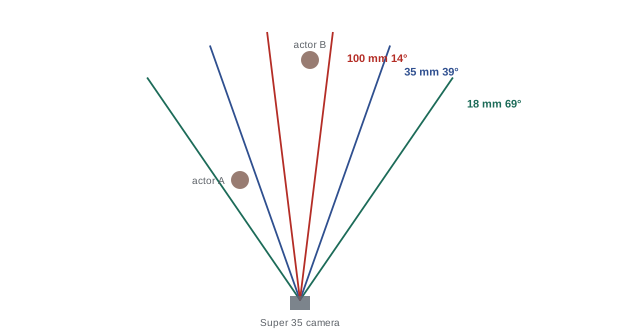
Lenses are classified relative to the format. A "normal" lens has a focal length roughly equal to the diagonal of the image area and gives a view that feels natural, neither expanded nor compressed: about 30 to 35 mm on Super 35, and about 40 to 50 mm on full frame. Wide-angle lenses are shorter than normal and long or telephoto lenses longer. Because the classification depends on the format, the same 35 mm lens is a normal lens on Super 35 and a moderate wide on full frame. Cinematographers working across formats often think in terms of "Super 35 equivalent" focal lengths, or simply in horizontal angles of view, to keep framing intentions clear when formats change. CINE-201 explained crop factors and equivalence across sensor sizes.
Perspective is set by distance
Perspective, the relative size and spacing of objects at different distances, is determined entirely by the camera's position. If an actor is 2 m from the camera and a building behind them is 20 m away, the building appears one tenth as large relative to its real size as the actor, regardless of the lens. Changing the lens without moving the camera changes only how much of the scene is included, as if cropping; perspective is unchanged. What changes perspective is moving the camera. In practice, though, lens choice and camera distance go together: to frame a face in a close-up, a wide lens must be close and a long lens must be far away, and the resulting perspectives differ dramatically.
Here \(H\) is real size and \(d\) distance from the camera. When the camera moves back and a longer lens keeps the subject the same size, the ratio \(d_b / d_s\) moves closer to 1, so the background appears larger relative to the subject.
The look of wide lenses
Wide lenses, used close to subjects, produce characteristic effects. Nearby objects appear much larger than distant ones, so depth seems exaggerated: a corridor looks longer, a room larger, a person's outstretched hand enormous. Movement toward or away from the camera appears faster. Faces filmed close up appear distorted, with noses enlarged and ears receding, effects that can be unflattering or deliberately unsettling. Wide lenses also show more of the environment, placing characters in context, and their deep depth of field keeps foreground and background in focus. Directors such as Orson Welles, Terry Gilliam and the Coen brothers have used wide lenses close to actors to create heightened, expressive or comic effects. Wide lenses also make handheld camera movement look smoother, because small shakes are a smaller fraction of the frame.
The look of long lenses
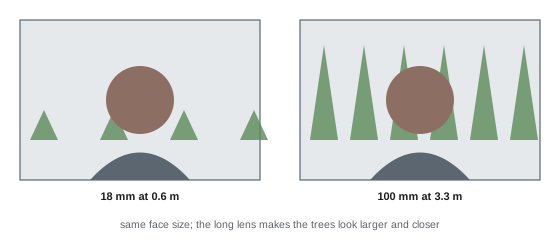
Long lenses, used from far away, produce the opposite effects. Because the camera is distant, the subject and background are at more similar relative distances, so the background appears larger and closer: often called compression. Movement toward or away from the camera appears slow, as in the classic shot of a figure running toward the camera through heat haze and seemingly never arriving. Faces look flattering, with natural proportions. Depth of field is shallow at a given framing and stop, isolating subjects from busy backgrounds. Long lenses also allow observational, documentary-style filming from a distance, letting actors or real people behave naturally, and are used for stunts and vehicle work where the camera must stay away. The flattened, voyeuristic quality of long lenses is used in thrillers and surveillance stories.
Faces and focal length
For close-ups, the camera-to-subject distance largely determines how flattering a face looks. At less than about 1 m, the nose is significantly closer to the camera than the ears, and appears enlarged; at 2 m or more, facial proportions look natural. On Super 35, this corresponds to lenses of about 40 to 75 mm for typical close-ups; on full frame, about 50 to 100 mm. Many cinematographers choose slightly long lenses for close-ups and medium-wide lenses for wider shots, but the choice is creative: some films, such as those shot with wide lenses throughout, deliberately use close camera positions for an intimate, immersive feel. Consistency within a scene, and an awareness of how distance shapes faces, matters more than any rule.
Lens choice and coverage
Within a scene, shots are usually covered with a range of focal lengths: a wide shot to establish geography, medium shots for interaction, close-ups for emotion. Some cinematographers maintain consistent perspective by keeping the camera at similar distances and changing lenses; others keep focal lengths consistent and move the camera. Matching focal lengths between reverse angles in a conversation, for example using the same lens for each actor's close-up at the same distance, keeps the two sides visually balanced; using a longer lens on one character can subtly set them apart. Lens choice also affects production: wide lenses demand more of the set to be dressed and lit, and reveal more of the location; long lenses need more space behind the camera.
Building a lens plan
Many cinematographers plan lenses during pre-production, with the director, using floor plans, storyboards and viewfinder apps that simulate specific cameras and lenses on a phone. A lens plan for a scene might record each shot's focal length, camera position and stop, and the overall philosophy: for example, wider lenses and closer camera positions as a character becomes more isolated, or a progression from long, observational lenses to wide, intimate ones as the story draws the audience in. Directors' viewfinders, both optical devices and phone apps, let cinematographers check framing on location before cameras arrive. On set, the plan adapts to actors' performances and practical realities, but it gives the visual approach coherence.
| Story intention | Lens approach |
|---|---|
| Immersion, subjectivity | Wide lenses close to actors |
| Observation, distance | Long lenses from far away |
| Isolation of a character | Long lens with shallow focus, or wide lens with empty space |
| Relationship to environment | Wide lenses with deep focus |
| Unease, distortion | Very wide lenses close to faces |
Focal length and camera movement
Focal length changes how camera movement looks. With wide lenses, dolly and Steadicam moves feel dynamic, because nearby objects slide past quickly while distant ones barely move, creating strong parallax and a sense of traveling through space. With long lenses, the same move produces little apparent motion, and lateral moves flatten into a gentle slide; small bumps and vibrations, magnified by the long lens, become more visible. Handheld work with long lenses is difficult, as every tremor is amplified, which is why documentary operators often switch to wider lenses for handheld shots and longer lenses on sticks. Lens choice and camera movement are therefore planned together.
Lens height and angle
Focal length interacts with camera height and angle. A wide lens at a low angle exaggerates the height of characters and buildings, making them dominant or threatening; at a high angle, it emphasizes the floor and diminishes characters. Long lenses minimize these effects, producing a more neutral, observational relationship to the subject. Lens and height choices for heroic, vulnerable or menacing characters are part of the film's visual language.
Focal lengths and screen size
The same footage feels different on a cinema screen and a phone. On a large screen, wide shots and deep compositions with small details work well, and viewers can explore the frame; on small screens, closer framings and simpler compositions read more clearly. Productions that will be viewed mostly on televisions and phones may use slightly longer lenses or tighter framings for key moments, while preserving the wide vistas that make cinematic images. Cinematographers consider the main viewing context when building a lens plan.
Keeping track of format and equivalent focal lengths
When a production uses several cameras with different sensor sizes, such as a large-format main camera, a Super 35 second unit camera and a small drone camera, the same focal length gives different views on each. Camera reports should record focal length and sensor mode, and lens plans should specify fields of view or equivalent focal lengths so that matching shots look consistent. Viewfinder apps can calculate equivalent focal lengths across formats quickly.
Testing perspective on location
Before committing to a lens plan, cinematographers often photograph key locations with a stills camera or phone app at the planned focal lengths and positions, sometimes with stand-ins. These reference images show how much of the location each lens reveals, where the camera must stand, and whether there is space for the camera, crew and lighting. They also reveal practical constraints, such as walls that prevent the camera from backing up far enough for a long lens, which may force a wider lens and a different perspective than intended. Adjusting the plan to the space is a normal part of preparation, and shared reference images help the director, production designer and gaffer understand the intended frames.
Some cinematographers also keep a simple lens diary during the shoot, noting which focal lengths and positions worked best in each location, which helps maintain consistency across scenes shot weeks apart.
A clear lens plan, shared with the whole camera team, also speeds up the shooting day, because assistants can prepare the next lens and accessories before each setup is called.
Common mistakes
MistakeBelieving long lenses compress space by themselves.
InsteadCompression comes from camera distance.
MistakeUsing very wide lenses close to faces unintentionally.
InsteadChoose distance deliberately for faces.
MistakeIgnoring the format when classifying lenses.
InsteadNormal depends on the image diagonal.
MistakeMismatched focal lengths on reverse angles without intent.
InsteadMatch lenses and distances unless differentiating characters.
MistakePlanning focal lengths without checking space.
InsteadUse viewfinder apps and floor plans.
Summary and key terms
- Field of view depends on focal length and sensor size: α = 2 arctan(d/2f).
- Normal lenses roughly equal the image diagonal; wide and long are relative to it.
- Perspective depends only on camera position.
- Wide lenses close to subjects exaggerate depth and movement.
- Long lenses from a distance compress space and isolate subjects.
- Camera distance largely determines how flattering faces look.
- Lens plans give a scene a coherent visual approach.
- Field of view
- Angle of the scene captured by lens and sensor.
- Horizontal angle of view
- Field of view across the frame width.
- Normal lens
- Focal length near the image diagonal.
- Wide-angle lens
- Focal length shorter than normal.
- Telephoto lens
- Focal length longer than normal.
- Perspective
- Relative size and spacing of objects at different distances.
- Compression
- Apparent flattening of depth from a distant camera.
- Lens plan
- Planned focal lengths and positions for shots.
- Director's viewfinder
- Tool for previewing framing with specific lenses.
- Super 35 equivalent
- Focal length expressed relative to Super 35.
Practice problems
Work each problem on paper first, then reveal the answer to check.
Horizontal angle of a 50 mm lens on a 24.9 mm wide sensor?
Show answer
About 28°.
What lens on a 36 mm wide sensor matches a 35 mm on Super 35?
Show answer
About 50 mm.
Normal focal length on Super 35?
Show answer
About 30–35 mm.
What determines perspective?
Show answer
Camera position.
What changes if you swap lenses without moving?
Show answer
Only the framing, like cropping.
Name two effects of wide lenses close up.
Show answer
Exaggerated depth, fast movement, facial distortion.
Why do long lenses flatter faces?
Show answer
The camera is farther away.
Minimum distance for natural facial proportions?
Show answer
About 2 m.
Why match lenses on reverse angles?
Show answer
To keep both sides balanced.
Name a tool for planning lenses on location.
Show answer
Director's viewfinder or phone app.
Lesson quiz · 5 questions
Score 60% or more to complete this lesson.
Create a free account to save your progress, take quizzes and earn a certificate.