
CINE-210 · Lesson 8 of 12 · 27 min
Lens character: aberrations, flare and breathing
Two lenses of the same focal length and stop can produce strikingly different images. One may be crisp, contrasty and clinical; another soft, glowing and warm; a third may flare dramatically, render backgrounds with swirling bokeh or bend straight lines. These differences, collectively called lens character or rendering, arise from the way designers balance and correct optical aberrations, the coatings they use, the shape of the iris and the mechanics of focusing. Understanding them lets cinematographers choose lenses for a look and anticipate how they will behave. This lesson covers the main aberrations and their visual effects, contrast and micro-contrast, flare and veiling glare, bokeh character, distortion, focus breathing, field curvature and edge falloff, color rendering, and how to describe and evaluate character.
Aberrations and their effects
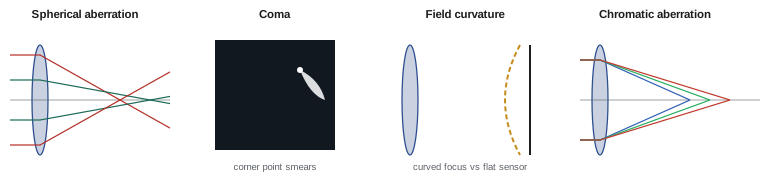
A perfect lens would focus every point of the scene to a perfect point. Real lenses suffer aberrations, departures from this ideal, which designers reduce but never eliminate entirely. The main monochromatic aberrations, described by Ludwig von Seidel in the nineteenth century, are:
- Spherical aberration: rays through the edge of the lens focus at a different distance from rays through the center. It produces a soft glow around highlights and a dreamy softness wide open, and shapes bokeh.
- Coma: off-axis points appear as comet-shaped smears, especially in the corners wide open, visible with point lights at night.
- Astigmatism: lines in different orientations focus at different distances off axis, softening the corners.
- Field curvature: the plane of sharp focus is curved rather than flat, so the corners and center cannot be sharp together on a flat subject.
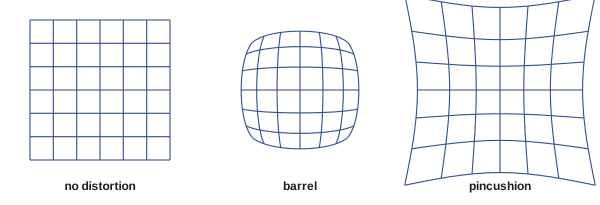
- Distortion: straight lines appear curved, outward (barrel) or inward (pincushion), discussed below.
Chromatic aberrations arise because different wavelengths refract differently: longitudinal chromatic aberration produces colored fringes in front of and behind focus, and lateral chromatic aberration produces color fringes along edges toward the corners. Modern designs correct these with special low-dispersion glass and aspherical elements, while some lenses deliberately retain some aberrations for character.
Contrast and micro-contrast
Contrast describes how strongly a lens separates light and dark areas. Global contrast is reduced by flare and internal reflections, which add light to shadows and lift blacks; modern multi-coated lenses have high global contrast, while older or uncoated lenses look softer and lower in contrast. Micro-contrast, the contrast of fine details, is what makes images look crisp, textured and "three-dimensional"; it is related to the lens's MTF at moderate spatial frequencies (CINE-201). Lenses with high micro-contrast reveal skin texture, fabric and foliage clearly; lenses with lower micro-contrast are gentler on faces. Many cinematographers seek lenses that are sharp but not harsh, with smooth transitions from focus to blur, a quality sometimes described as roundness or dimensionality.
Flare and veiling glare
When bright light enters a lens, some reflects between glass surfaces and the barrel before reaching the sensor. This produces two effects: ghosts, discrete shapes often repeating the iris shape, arranged along a line through the center of the frame from the light source; and veiling glare, a general wash of light that lowers contrast. Coatings reduce reflections, so modern lenses flare less and more cleanly, while vintage and uncoated lenses flare strongly and warmly. Anamorphics add horizontal streaks (Lesson 7). Some modern lenses, such as Zeiss Supreme Prime Radiance and various detuned sets, are designed to flare in controlled, attractive ways, with specific colors. Flare can be beautiful, suggesting warmth, sunlight or memory, or distracting, obscuring faces and revealing that the scene is being filmed. Matte boxes, flags and lens hoods control unwanted flare; deliberately aimed lights create intentional flare.
Bokeh character
The way out-of-focus areas are rendered varies greatly between lenses. Important aspects include:
- Shape of highlights: round, polygonal, cat's-eye toward the edges, or oval in anamorphics.
- Texture of highlights: smooth and evenly lit; bright-edged "soap bubbles" from overcorrected spherical aberration; or onion-ring patterns from aspherical element manufacturing.
- Transition from focus to blur: gradual and smooth, or abrupt.
- Background structure: calm and creamy, or busy and nervous, with doubled lines.
- Swirl: some designs, such as Petzval lenses and certain vintage lenses, render backgrounds with a circular swirl around the center of the frame, caused by field curvature and astigmatism.
Bokeh is subjective, but it strongly affects how a film feels. Lenses with smooth, gentle bokeh are popular for portraits and drama; distinctive bokeh can become a signature of a project.
Distortion
Distortion bends straight lines. Barrel distortion bows lines outward from the center, common in wide-angle lenses; pincushion distortion bows them inward, common in telephotos and some zooms; and mustache or complex distortion combines both. Distortion matters for architecture, horizons and graphic compositions, where curved lines look wrong, and for visual effects, where computer-generated elements must be distorted to match. Many stills lenses for mirrorless cameras rely on software correction of distortion, but cinema lenses are usually optically corrected, because software correction crops and resamples the image and complicates visual effects. Some wide cinema lenses are designed with gentle, natural-looking distortion rather than perfect rectilinearity, which can feel less clinical.
Focus breathing
Focus breathing is a change in field of view as focus changes: when the focus puller racks from a distant background to a close foreground, the image may visibly zoom in or out. Breathing happens because focusing changes the effective focal length of many designs, and it is most noticeable in rack focus shots with static cameras, where the frame appears to pulse. Stills lenses often breathe strongly; cinema lenses are designed to minimize it, using floating element groups and internal focusing designs, though some breathing remains in most lenses, and some cinematographers like a small amount. Anamorphic lenses may also show changes in squeeze or distortion with focus. Breathing can be measured by framing a chart and racking focus from infinity to close focus, observing how much the field of view changes, and some software can compensate digitally using lens data.
Worked problem
Measuring breathing
A camera assistant frames a 1 m wide chart at infinity focus position on a 50 mm lens, then racks to minimum focus at 0.45 m without moving the camera. The chart's width on the monitor shrinks from 1,000 to 940 pixels. How much does the lens breathe, and is this likely to be noticeable?
Show solution
- Change in magnification: 940 / 1,000 = 0.94, a 6 % change in field of view.
- A 6 % change across a full rack from infinity to close focus is moderate.
- In a slow rack between two actors at 2 m and 4 m, the change would be much smaller, perhaps 1 %, and rarely noticeable.
- In a fast rack from a distant background to a close object, a 6 % change may be visible as a slight zoom.
Answer: About 6 % breathing over the full range: noticeable in large racks, minor in typical pulls between actors.
Field curvature and edge falloff
In many lenses, especially wide and vintage designs, the plane of best focus curves, and the corners are softer than the center, sometimes with coma or astigmatism. Combined with vignetting, the darkening of corners, this creates a natural falloff that draws attention to the center of the frame and can make images feel less digital. Large-format sensors use more of the lens's image circle, so edge characteristics become more visible: a lens that is sharp edge to edge on Super 35 may show softness and vignetting on full frame. Cinematographers test lenses on the production format to see how edges behave, and some deliberately choose lenses whose image circle barely covers the sensor, accepting strong falloff for character (Lesson 9).
Color rendering
Lenses also differ in color: some render slightly warm, others cool or neutral, depending on the glass and coatings. Within a matched set, color is consistent; between sets, differences are visible, and between individual vintage lenses they can be significant. Color differences can be corrected in grading, but the interaction of color with flare, contrast and skin tones contributes to each lens family's overall feel. Lens manufacturers publish little about color; tests reveal it.
Describing and evaluating character
Cinematographers use descriptive language for lens character: clinical, sharp, contrasty, warm, creamy, glowing, painterly, organic, gentle, harsh, flat or dimensional. Such terms are subjective, so testing is essential (Lesson 12). A useful character test includes faces of different skin tones at several distances and stops; a backlit scene with practical lights and the sun to show flare; out-of-focus highlights behind and in front of the subject; straight lines for distortion; a rack focus for breathing; and a chart for sharpness and falloff. Comparing lenses side by side, projected or on a large calibrated screen, shows the differences far better than charts or specification sheets.
Detuning and custom character
Some rental houses and lens technicians modify lenses to change their character, a process called detuning. Techniques include removing or altering coatings to increase flare and lower contrast, adjusting element spacing to introduce spherical aberration and softness, and changing iris shapes. Panavision, in particular, offers extensive customization, tailoring lenses to cinematographers' requests, such as reduced contrast for a period film or specific flare colors. Detuned lenses can give a film a unique signature, but they must be tested thoroughly, since modifications may affect sharpness, focus markings and consistency across a set.
Character and resolution
As digital sensors reached 6K, 8K and beyond, many cinematographers found that very sharp modern lenses combined with high-resolution sensors produced images that felt too crisp and clinical, revealing every pore and flaw. This has driven interest in vintage lenses, vintage-style modern designs, diffusion filters and gentler large-format lenses. Character and resolution are not opposites: some modern lenses resolve fine detail while rendering skin gently, through careful control of micro-contrast and aberrations. Choosing lenses that suit both the sensor and the story is one of the key creative decisions in contemporary cinematography.
Character across stops and distances
Lens character is not fixed: it changes with aperture, focus distance and the lighting. A lens may glow wide open and become crisp at T4; render bokeh smoothly at close focus but busily at middle distances; or flare dramatically only when a light source sits at a particular angle. Testing lenses at the stops, distances and lighting conditions the production will actually use is the only reliable way to know how they will look.
Worked problem
Comparing two lenses for a night scene
A cinematographer is choosing between a modern 50 mm T1.5 and a vintage 50 mm T1.4 for a night scene with street lights in the background and the actor's face lit softly. What should the test show, and what might the results be?
Show solution
- Shoot both lenses at the intended stop, perhaps T2, with the actor at the same distance and the background lights out of focus.
- Compare skin texture and contrast on the face: the modern lens may show more detail, the vintage lens more softness.
- Compare bokeh from the street lights: the vintage lens may show cat's-eye shapes toward the edges and some swirl; the modern lens rounder, cleaner highlights.
- Compare flare from any lights near the frame: the vintage lens may flare warmly with lower contrast.
Answer: The test reveals differences in skin, bokeh and flare that decide which lens suits the scene's mood.
Describing character to others
Because terms like "creamy" and "clinical" mean different things to different people, cinematographers often share reference images or test clips with directors and colorists rather than relying on words.
Common mistakes
MistakeJudging lenses only by sharpness.
InsteadEvaluate contrast, flare, bokeh, distortion and breathing.
MistakeAssuming flare is always a defect.
InsteadUse or control flare deliberately.
MistakeIgnoring breathing in rack focus shots.
InsteadTest breathing and choose lenses accordingly.
MistakeTesting lenses on a different format.
InsteadTest edges and falloff on the production sensor.
MistakeRelying on specification sheets for character.
InsteadShoot side-by-side tests with faces and lights.
Summary and key terms
- Lens character arises from how aberrations, coatings and mechanics are balanced.
- Spherical aberration, coma, astigmatism and field curvature shape softness and bokeh.
- Global contrast and micro-contrast affect how crisp and gentle images look.
- Flare produces ghosts and veiling glare; it can be controlled or used.
- Bokeh varies in shape, texture, transition and swirl.
- Distortion bends lines; cinema lenses usually correct it optically.
- Breathing changes field of view during focus pulls.
- Lens character
- Overall rendering style of a lens.
- Spherical aberration
- Edge and central rays focusing at different distances.
- Coma
- Comet-shaped off-axis point images.
- Astigmatism
- Different focus for lines in different orientations.
- Field curvature
- Curved plane of best focus.
- Micro-contrast
- Contrast of fine detail.
- Veiling glare
- Overall wash of stray light lowering contrast.
- Ghost
- Discrete reflection image from bright light.
- Barrel distortion
- Straight lines bowing outward.
- Focus breathing
- Change in field of view when focusing.
Practice problems
Work each problem on paper first, then reveal the answer to check.
Who classified the main monochromatic aberrations?
Show answer
Ludwig von Seidel.
What does spherical aberration look like?
Show answer
A soft glow around highlights wide open.
Where is coma most visible?
Show answer
Corners wide open with point lights.
What lowers global contrast?
Show answer
Flare and internal reflections.
What are ghosts?
Show answer
Reflections forming discrete shapes.
What causes soap-bubble bokeh?
Show answer
Overcorrected spherical aberration.
Which distortion is common in wide lenses?
Show answer
Barrel distortion.
Why correct distortion optically in cinema?
Show answer
Software correction crops and complicates VFX.
How is breathing measured?
Show answer
Rack focus on a chart and compare field of view.
Why test on the production format?
Show answer
Edge behavior depends on how much of the image circle is used.
Lesson quiz · 5 questions
Score 60% or more to complete this lesson.
Create a free account to save your progress, take quizzes and earn a certificate.