
CINE-220 · Lesson 6 of 12 · 25 min
Color temperature, gels and color quality on set
Color is one of the most expressive and most technical aspects of set lighting. Cinematographers must balance sources so that skin looks right, match fixtures of different types, correct existing location light, and use color deliberately for mood and story. Even with LEDs that can produce any color, gels remain essential on most sets, and a working understanding of color temperature, mireds, correction and color quality is part of every gaffer's and cinematographer's toolkit. This lesson covers color temperature and tint, mireds and how to calculate corrections, conversion and correction gels, green and magenta correction, correcting locations, mixed lighting as a creative tool, colored effects gels, matching sources and measuring color on set.
Color temperature and tint
Color temperature describes the color of white light on the scale from warm orange to cool blue, in kelvin, referring to the color of a theoretical black body at that temperature. Tungsten studio lamps are about 3,200 K, daylight is defined at about 5,600 K for film work (5,500 to 6,500 K in different standards), and skylight in shade can be 7,000 to 10,000 K. Color temperature describes only the warm-cool axis; light can also be shifted along the perpendicular green-magenta axis, called tint. Fluorescent, discharge and many LED sources have a green or magenta bias in addition to their color temperature. Cameras and color meters measure both values, and correction may require gels on both axes.
Mireds
Color temperature differences do not correspond to equal perceptual or filter effects: the difference between 2,000 K and 3,000 K looks much larger than between 6,000 K and 7,000 K. The mired scale (micro reciprocal degrees) solves this:
A gel shifts light by a fixed number of mireds, regardless of the source's starting color temperature. Full CTB has a shift of about −131 mireds, converting 3,200 K (312 mireds) to about 5,500 K (181 mireds). Full CTO has a shift of about +159 mireds, converting 5,500 K to about 2,900 K. To find the correction needed between two sources, subtract their mired values.
Worked problem
Matching an HMI to a tungsten-balanced scene
A night interior is balanced for 3,200 K. A 5,600 K HMI is placed outside a window, and the DP wants it to match the interior tungsten exactly. What gel is needed?
Show solution
- Mired value of the HMI: 1,000,000 ÷ 5,600 ≈ 179.
- Mired value of tungsten: 1,000,000 ÷ 3,200 ≈ 313.
- Required shift: 313 − 179 = +134 mireds.
- Full CTO (+159) slightly overcorrects; 3/4 CTO (about +124 to +130) is close. Choose 3/4 CTO and check with a color meter.
Answer: A shift of about +134 mireds; 3/4 CTO is the closest standard gel, confirmed with a meter.
Conversion and correction gels
Color correction gels are thin polyester or polycarbonate filters placed in front of lights or over windows. The main families are:
- CTO (color temperature orange): warms light, converting daylight toward tungsten. Available in full, 3/4, 1/2, 1/4 and 1/8 strengths.
- CTB (color temperature blue): cools light, converting tungsten toward daylight. Also in full and fractional strengths.
- CTS (color temperature straw): a warmer, more yellow alternative to CTO, sometimes preferred for a sunnier look.
- Minus green (magenta) and plus green: correcting the green-magenta axis, in full, 1/2, 1/4 and 1/8 strengths.
- Neutral density (ND): reducing light without changing color, in 0.3 (1 stop), 0.6 (2 stops) and 0.9 (3 stops) grades, often applied to windows.
Manufacturers such as Lee Filters and Rosco publish swatch books with transmission and mired values for each gel. Combination gels, such as CTO plus ND for daylight windows on tungsten-balanced interiors (often called 85N3 or 85N6 after the Wratten 85 filter), correct color and reduce intensity in one sheet.
| Gel | Approx. mired shift | Approx. transmission | Typical use |
|---|---|---|---|
| Full CTB | −131 | About 36 % (−1.5 stops) | Tungsten to daylight |
| 1/2 CTB | −68 | About 52 % | Partial cooling |
| Full CTO | +159 | About 58 % (−2/3 stop) | Daylight to tungsten |
| 1/2 CTO | +81 | About 73 % | Warming, sunset feel |
| 1/4 CTO | +42 | About 81 % | Subtle warmth on skin |
| Full minus green | Removes green | About 55 % | Correcting fluorescents and some LEDs |
| ND 0.6 | 0 | 25 % (−2 stops) | Reducing windows |
Green and magenta
Green casts are a common problem. Older fluorescent tubes, some LEDs, mercury vapor and sodium street lights, and light reflected from foliage or green walls all add green, which makes skin look sickly and is hard to remove completely in grading when it affects only part of the image. Gaffers correct by adding minus green to the green sources, such as covering office fluorescents with minus-green sleeves, or, when the green sources are too numerous to correct, by adding plus green to the film lights so that everything shares the same green bias, then setting the camera's white balance or correcting in grading. LED fixtures with adjustable tint can be set to plus or minus green electronically, which is a great advantage when matching existing location light.
Correcting locations
Real locations often contain a mixture of light sources: daylight through windows, tungsten or LED practicals, fluorescent ceilings, colored signage and street lights. Strategies include:
- Choosing a dominant balance, usually daylight or tungsten, and correcting other sources toward it with gels on windows, sleeves on tubes or replacement bulbs.
- Replacing practical bulbs with film-quality bulbs or LED bulbs of controlled color temperature and high CRI, often on dimmers.
- Turning off problematic sources, such as fluorescent ceilings, and replacing them with controlled film lights.
- Gelling windows with CTO, ND or combinations, using large rolls of gel applied to the glass or hung on frames outside.
- Embracing the mixture deliberately, if it suits the story, while keeping faces clean.
Because correcting large windows is laborious, gaffers often decide early whether to shoot a location daylight-balanced or tungsten-balanced, and plan the lighting package accordingly.
Mixed lighting as a creative tool
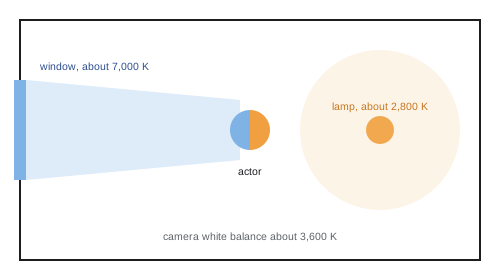
Uncorrected mixtures of color temperatures are a powerful creative device. A warm tungsten interior against the cool blue of dusk through a window creates the classic contrast of warm and cool that signals home, safety or evening. Cool moonlight from outside with warm practicals inside creates night interiors full of depth. Faces lit by warm light against cool backgrounds separate visually from them. The key is control: choose which areas are warm and which cool, keep skin tones attractive, and avoid accidental mixtures that look like mistakes. When balancing the camera, a common choice is to set white balance between the two sources, or for the source lighting the faces.
Colored effect gels
Saturated colored gels create effects: deep blue for night or moonlight stylization, red for danger, emergency or darkroom scenes, amber and orange for firelight, sodium street lights and sunsets, green for unease or for specific sources such as monitors and signs, and lavender or magenta for nightclubs. Gel names and numbers vary by manufacturer; designers often refer to them by number, such as Lee 201 for full CTB. Colored gels absorb a lot of light, often several stops for deep colors, and fade or burn quickly on hot tungsten fixtures, so they must be checked and replaced. With RGB and multi-emitter LEDs, many effects are now produced electronically, often by selecting a gel number from a built-in library, but physical gels remain common on tungsten and HMI units and for fine adjustments.
Matching sources
Every fixture type, and every unit within a type, has its own color. LEDs of different brands set to 5,600 K may look different on camera, because their spectra differ even if their measured color temperature is the same; HMIs drift with age; tungsten lamps vary with voltage. Matching sources is therefore a constant task. Practices include metering each light with a color meter or spectrometer and adjusting tint and color temperature to match; testing fixtures on camera against a reference such as a tungsten Fresnel and a color chart; keeping the same fixture models for faces within a scene; and noting gel corrections in lighting plots so that setups can be reproduced. LED fixtures with SSI and TM-30 data help predict how well they will match each other and traditional sources (Lesson 4).
Measuring color on set
Color meters measure color temperature and green-magenta tint and recommend gels to correct them. Spectrometers, such as the Sekonic C-800 and similar instruments, display the full spectrum of a source and calculate CRI, TLCI, TM-30 and SSI values, revealing problems invisible to the eye. Some light meters and apps now combine incident exposure readings with color readings. Camera tools, such as white balance readings from a gray card and RGB parades on a waveform (CINE-202), show how the camera sees the light. Regular measurement prevents surprises in grading, where uncorrected mixtures can be hard or impossible to separate.
Color temperature in camera
Cameras have their own white balance settings, and the relationship between lighting color and camera white balance determines how colors appear. Setting the camera to 3,200 K makes tungsten light look neutral and daylight look blue; setting it to 5,600 K makes daylight neutral and tungsten orange. Many cinematographers set a fixed white balance for a scene and light to it, rather than adjusting the camera for each shot, which keeps color consistent across coverage. Intermediate settings, such as 4,300 K, balance between daylight and tungsten, giving warm tungsten and cool daylight in the same frame. Raw recording allows white balance to be changed later, but deciding on set keeps monitoring and dailies consistent (CINE-202).
Gel handling and safety
Gels are supplied in rolls and sheets and cut to fit gel frames, clipped to barn doors, or taped to windows. Heat-resistant gels and spacing from hot lamps prevent melting and fire risk; gels on tungsten units fade and should be checked and replaced regularly. Large window gels are applied with care to avoid wrinkles, which can show as streaks on camera, and are often stretched on frames outside windows instead. Gels should be stored flat and labeled, and offcuts kept for small fixtures. Clothespins (called C-47s on set) and wooden pins hold gels on lights, since plastic clips can melt.
Color and storytelling
Color choices carry meaning. Warm light can feel safe, nostalgic or intimate; cool light can feel lonely, clinical or tense; green can feel unwell or uncanny; red can suggest danger or passion. Films often develop color schemes across their length, associating colors with characters, places or emotional states, and lighting is a key part of this scheme along with production design, costume and grading. Contrasting colors, such as warm interiors and cool exteriors, can express the relationship between characters and their world. Thoughtful use of color, motivated by sources and story, is more powerful than arbitrary color for its own sake.
Day-for-night and moonlight color
Night scenes have long been represented with blue light, though real moonlight is reflected sunlight and only slightly bluer than daylight, appearing blue mainly because human vision shifts toward blue in low light. Cinematographers choose how blue to make moonlight: strongly blue for stylized effect, subtly cool for naturalism, or neutral for a modern look. Sodium street lights, orange in reality, are often recreated with amber gels or LED settings, and many cities now use white LED street lighting, which looks different again. Researching the real sources of a location helps make night scenes convincing.
Color on the monitor
Judging color on set requires a calibrated monitor viewed in suitable conditions, since uncalibrated monitors and bright surroundings distort color perception. The DIT's calibrated reference monitor, shaded from ambient light, is the most reliable place to judge color balance, mixed lighting and skin tones. Cinematographers often check both the monitor and the real scene, since the camera may see colors, such as green casts, that the eye adapts to.
Common mistakes
MistakeCalculating corrections in kelvin differences.
InsteadUse mireds to choose gels.
MistakeIgnoring green casts from fluorescents and LEDs.
InsteadCorrect with minus green or match with plus green.
MistakeAccidental mixed light on faces.
InsteadChoose a dominant balance or mix deliberately.
MistakeAssuming fixtures at the same kelvin match.
InsteadMeter and test on camera.
MistakeLeaving faded gels on hot lights.
InsteadCheck and replace gels regularly.
Summary and key terms
- Color temperature runs warm to cool; tint runs green to magenta.
- Mireds make gel corrections consistent: mired = 1,000,000 ÷ K.
- CTO warms, CTB cools, minus green removes green, ND reduces light.
- Locations need a dominant balance, gels, replacement bulbs or deliberate mixtures.
- Warm and cool mixtures create depth and mood when controlled.
- Effect gels and LED color modes create stylized color.
- Meter color and test on camera to match sources.
- Color temperature
- Warm to cool character of white light in kelvin.
- Tint
- Green to magenta bias of light.
- Mired
- One million divided by color temperature in kelvin.
- CTO
- Color temperature orange gel.
- CTB
- Color temperature blue gel.
- Minus green
- Magenta gel removing green.
- ND gel
- Neutral density filter reducing light.
- Mixed lighting
- Sources of different color in one scene.
- Effect gel
- Saturated color filter for stylized light.
- Spectrometer
- Instrument measuring the spectrum and color metrics of light.
Practice problems
Work each problem on paper first, then reveal the answer to check.
Mired value of 4,000 K?
Show answer
250.
Why use mireds rather than kelvin?
Show answer
Gels shift light by a constant mired amount.
Approximate mired shift of full CTB?
Show answer
About −131.
Shift needed from 5,600 K to 3,200 K?
Show answer
About +134 mireds.
What does an 85N6 combine?
Show answer
Daylight-to-tungsten correction and 2 stops of ND.
Two ways to handle green fluorescents?
Show answer
Minus green on tubes or plus green on film lights.
Name two location correction strategies.
Show answer
Gel windows, replace bulbs, turn off sources, choose a balance.
Why do colored gels on tungsten need checking?
Show answer
They fade and burn from heat.
Why might two 5,600 K LEDs look different?
Show answer
Their spectra differ.
What does a spectrometer show?
Show answer
Spectrum and color quality metrics.
Lesson quiz · 5 questions
Score 60% or more to complete this lesson.
Create a free account to save your progress, take quizzes and earn a certificate.